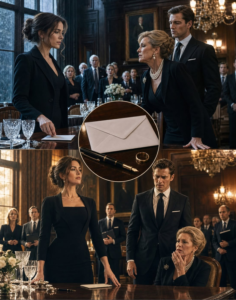
The Funeral Table
At my father-in-law’s funeral reception, my mother-in-law leaned toward me with a smile so controlled it looked painful.
“Please don’t make this about you, Claire,” she said. “You were never really family.”
The sentence landed between us with the quiet precision of a knife placed beside fine china.
Around the dining room of the Whitmore estate, conversations continued beneath the soft clink of crystal and silverware. Men in tailored black suits spoke in murmurs near the library doors. Women wearing pearls and professionally arranged grief gathered beneath portraits of dead Whitmores who had all possessed the same pale eyes and uncompromising mouths.
Outside, January rain tapped against the tall windows.
Inside, Margaret Whitmore watched me as if she expected me to fold.
She had always believed silence was proof of defeat.
I set my untouched champagne flute on the table.
Then I nodded slowly.
“Then your husband had a strange way of choosing his emergency contact.”
The room did not become silent all at once.
It happened in layers.
The cousin nearest us stopped laughing. A board member from Whitmore Industries lowered his glass. Someone near the fireplace whispered, “What did she say?”
Margaret’s face changed.
It was not a dramatic change. Women like Margaret did not gasp or tremble in public. They had spent entire lives learning how to bleed without staining the carpet.
But the muscles around her mouth tightened.
My husband, Daniel, appeared at her shoulder.
His hand settled protectively against his mother’s back, though his eyes were on me.
“Claire,” he said quietly.
That tone had once made me feel guilty before I even knew what I had done.
Now it simply reminded me how much power I had surrendered to keep a marriage peaceful.
I looked at him.
“Yes, Daniel?”
“This isn’t the time.”
“For what?”
His jaw flexed.
“For drama.”
I almost smiled.
His father had died forty-eight hours earlier with my hand wrapped around his. I had signed the hospital documents. I had answered the physician’s questions. I had chosen the navy suit he was buried in because Margaret had not remembered which one he loved and Daniel had not known.
But apparently, I was the danger to the dignity of the afternoon.
Margaret recovered first.
“Charles was ill,” she said. “He became confused toward the end.”
“No,” I replied. “He became honest.”
A few heads turned more fully now.
Margaret’s eyes sharpened.
She had spent years controlling rooms by making everyone else afraid of being impolite. It was her greatest weapon. She could insult a person in a tone so elegant that defending oneself seemed vulgar.
But grief had burned something clean inside me.
I was no longer interested in helping her hide the blade.
Daniel stepped closer.
“You need to leave.”
I looked at him carefully.
At the perfect black suit. The discreet platinum watch. The expression of weary patience he had perfected during the last two years of our marriage, as though living with me had been a long and charitable inconvenience.
He looked exactly like the man I had once loved.
That was the cruelest part.
“Do I?” I asked.
“This is my father’s funeral.”
“I’m aware. I arranged most of it.”
His cheeks flushed.
Margaret’s voice dropped. “You arranged what you were asked to arrange.”
“I chose the church because Charles requested it.”
“He was on medication.”
“I selected the hymns from the list he wrote.”
“He was sentimental.”
“I contacted the Marine honor guard.”
“That was obvious.”
“I called his sister in Vermont.”
Margaret blinked.
Just once.
She had not known Charles still spoke to his sister.
I continued.
“I notified his oldest friend from law school. I found the photograph he wanted displayed near the guest book. I made sure the kitchen served the bourbon bread pudding from the restaurant where he proposed to you in 1978.”
Across the room, someone’s fork struck a plate.
Margaret stared at me.
I had not planned to say that last part.
Some kindnesses should remain private.
But she had mistaken privacy for weakness.
“That was you?” asked a woman beside Margaret.
I recognized her as Diane Mercer, a family friend who treated gossip like a competitive sport.
Margaret gave a brittle laugh.
“The staff handled the details.”
“No,” I said. “The staff followed the document Charles and I prepared three weeks ago.”
Daniel looked at his mother.
A current of uncertainty passed between them.
It was small, but I saw it.
For the first time that afternoon, they realized there had been conversations they did not control.
Margaret drew herself upright.
“Whatever role you played during his final days does not give you the right to turn his death into some performance.”
I felt the words enter the room.
Performance.
That was what she called the nights I slept in the chair beside his hospital bed.
Performance was driving through ice at two in the morning because he had fallen in his bathroom and refused to call Daniel.
Performance was learning how to clean the blood from his mouth after chemotherapy.
Performance was sitting with him while he admitted he was frightened—not of dying, but of leaving behind a family that had confused inheritance with love.
I reached into my handbag.
Daniel’s shoulders tightened.
Margaret’s gaze dropped toward my hand.
I removed a plain white envelope.
No seal. No expensive stationery. Only my name written in Charles Whitmore’s unmistakable slant.
CLAIRE.
I placed it on the table.
Margaret went pale.
Daniel spoke first.
“What is that?”
“A letter.”
“From Dad?”
“Yes.”
“When did he give it to you?”
“He didn’t.”
Margaret’s eyes narrowed. “Then how did you get it?”
“His attorney delivered it this morning.”
The room went still again.
This time, the silence arrived completely.
Daniel stared at the envelope as though it were an explosive device.
“His attorney was here?”
“Mr. Bennett came before the service.”
“Why didn’t he speak to us?”
“He said he would.”
“When?”
I glanced toward the arched doorway behind him.
“Now.”
Every face in the room turned.
Arthur Bennett stood beneath the arch in a dark wool coat, rain shining on the shoulders. He was seventy-two, silver-haired, and known throughout Connecticut for two things: protecting the wealthy and never attending social events without purpose.
Beside him stood a younger woman carrying a leather portfolio.
Arthur removed his gloves.
“I apologize for interrupting,” he said.
Margaret’s fingers closed around the back of a chair.
“This is a private family gathering.”
Arthur’s expression did not change.
“Mrs. Whitmore, I was instructed to come.”
“By whom?”
“Your husband.”
A whisper moved across the room.
Arthur looked at me briefly.
Not warmly. Not coldly.
Professionally.
Then he turned toward the gathered guests.
“Charles left specific instructions regarding the timing and location of a statement he wished to have read.”
Daniel took one step forward.
“This is inappropriate.”
Arthur met his gaze.
“Your father anticipated that opinion.”
The younger woman opened the portfolio.
Margaret’s voice was low.
“Charles would never have turned his own funeral into a legal spectacle.”
“No,” Arthur said. “He believed someone else might.”
Then he looked at the envelope on the table.
“Mrs. Whitmore,” he said to me, using the name I still legally shared with Daniel, “have you opened the letter?”
“No.”
“Please don’t.”
Margaret’s gaze snapped toward me.
Arthur continued.
“Not yet.”
There are moments when a room shifts around a person.
Not because she has raised her voice.
Not because she has demanded attention.
But because everyone suddenly understands that she knows something they do not.
For years, the Whitmores had invited me into rooms only to remind me I had entered through marriage.
That afternoon, for the first time, they looked at me as though I might own the door.
Daniel came close enough that only I could hear him.
“What did you do?”
I turned my head.
His breath smelled faintly of coffee and expensive mint.
I remembered kissing that mouth on our wedding day beneath white roses. I remembered believing his family’s reserve was sophistication and his mother’s cruelty was merely tradition.
I remembered apologizing whenever they made me feel small.
“I answered the phone,” I whispered.
His brow furrowed.
“What?”
“When your father called.”
Then I stepped away from him.
Arthur Bennett removed a sealed document from the portfolio.
“Charles asked that all immediate family members, senior Whitmore Industries board members, and trustees of the Whitmore Foundation remain in the room.”
A man by the fireplace cleared his throat.
“Is this about the estate?”
Arthur’s eyes moved across the gathering.
“No.”
That answer disturbed them more than yes would have.
Because money was the language they understood.
And Charles’s final message was not about money.
It was about character.
That was the one currency almost no one in the room could afford.
Part Two: The Last Six Months
Six months before Charles Whitmore died, he called me at 1:17 in the morning.
Daniel was not home.
By then, that was not unusual.
He claimed he was in Boston meeting investors. Later, I would learn he had spent the night at the Four Seasons with a woman named Vanessa Cole, Whitmore Industries’ newly appointed vice president of strategic communications.
At the time, I still believed the most dangerous lie in my marriage was the one Daniel told me.
It was not.
The most dangerous lie was the one I kept telling myself.
He is under pressure.
His father is difficult.
His mother depends on him.
This is temporary.
I watched his name disappear from my phone screen after my third unanswered call.
Then Charles called.
I almost ignored it.
He and I were not close then. We had been cordial for twelve years, which in the Whitmore family qualified as intimacy.
I answered on the fourth ring.
“Charles?”
For several seconds, all I heard was breathing.
Then he said, “I seem to be on the floor.”
I was already pulling on my shoes.
“Where?”
“Bathroom.”
“Are you bleeding?”
“A little.”
“Did you call an ambulance?”
“I called Daniel.”
My hand stopped on the bedroom door.
“When?”
“Twenty minutes ago.”
“Did he answer?”
“No.”
“Did you call Margaret?”
“She took something to sleep.”
His voice was calm, almost embarrassed.
I grabbed my coat.
“I’m coming.”
The Whitmore estate stood on six acres outside Greenwich, hidden behind iron gates and old trees. By the time I arrived, sleet coated the driveway.
Charles had managed to unlock the side door using the home automation system from his phone.
I found him in the upstairs bathroom, wearing navy pajamas, one side of his face bloodied where he had struck the marble counter.
He looked smaller than I remembered.
That frightened me more than the blood.
Charles Whitmore had built an international logistics company from a regional shipping business inherited from his father. He had survived two recessions, three hostile takeover attempts, a federal antitrust investigation, and a son who believed confidence was a substitute for competence.
I had never seen him helpless.
“Don’t make that face,” he said.
“What face?”
“The one people make when they think an old man has become fragile.”
“You’re on a bathroom floor, Charles.”
“A temporary geographical inconvenience.”
I almost laughed.
Instead, I knelt beside him.
“Can you move your fingers?”
He did.
“Toes?”
He moved them.
“Any neck pain?”
“Only from looking at the quarterly reports Daniel approved.”
That time, I did laugh.
It surprised both of us.
An ambulance arrived eleven minutes later. Margaret slept through the sirens. Daniel returned my call when I was following Charles to the hospital.
“I’m in the middle of something,” he said.
“Your father fell.”
Silence.
“Is he okay?”
“We’re going to St. Vincent’s.”
“Did Mom call you?”
“No. Your father did.”
Another silence.
“I’ll get there when I can.”
He arrived four hours later.
Vanessa’s perfume clung to his scarf.
I knew the scent because she had worn it at our Christmas party.
Daniel kissed my forehead in the emergency room waiting area.
“Thank God you handled it,” he said.
At the time, I heard gratitude.
Months later, I understood the truth.
Thank God you handled it meant thank God I did not have to.
The doctors found a tumor during the scans.
Pancreatic cancer.
Stage four.
Charles received the diagnosis without visible shock. Margaret began crying before the oncologist finished speaking. Daniel asked about treatment options, survival rates, specialists, clinical trials.
All the correct questions.
I sat beside Charles.
His hand rested on the white hospital blanket.
After a moment, I placed mine over it.
He looked down at our hands.
Then at me.
He did not say thank you.
He did not need to.
The family responded to Charles’s illness the way powerful families often respond to mortality: by turning it into logistics.
Margaret created schedules.
Daniel formed a medical advisory group.
His sister, Caroline, flew in from California for three days, posted a black-and-white photograph of herself holding Charles’s hand, and left before his first treatment.
The board sent flowers.
The foundation announced a donation to cancer research.
No one learned how Charles took his tea after chemotherapy.
No one except me.
Lemon. No honey.
Sugar made the metallic taste worse.
At first, I told myself I was helping because Daniel was busy.
Then because Margaret was overwhelmed.
Then because Charles trusted me.
Eventually, I stopped explaining it.
I went because he called.
Sometimes he needed a ride.
Sometimes he needed someone to sit in the kitchen while he pretended to read the newspaper.
Sometimes he wanted to talk about the company.
More often, he wanted to talk about ordinary things.
The first car he ever owned.
The way Margaret looked in a yellow dress when she was twenty-two.
The time Daniel broke his arm climbing a maple tree and blamed the tree.
The daughter Margaret had miscarried before Daniel was born.
“I thought losing a child would make us gentler,” Charles told me one afternoon.
We were sitting in the estate’s glass conservatory while rain slid down the windows.
“Did it?” I asked.
“For a while.”
He studied the weak winter light.
“Then grief became something we competed over.”
That was the first time he spoke to me honestly about his family.
Not all at once.
Charles did nothing all at once.
He disclosed truths the way a careful investor released information: in measured amounts, always watching what the other person did with it.
He told me Margaret had not wanted Daniel to marry me.
I knew that.
He told me Margaret had once hired a private investigator to examine my parents’ finances.
I did not know that.
My father had been a public-school principal in Ohio. My mother ran a small accounting office. They had no scandals, no estates, no buildings named after them.
Margaret considered this suspicious.
“Why are you telling me?” I asked.
“Because you’re still trying to earn a place she decided not to give you.”
The words hurt because they were accurate.
I looked away.
“You think I should stop trying?”
“I think you should stop auditioning.”
A week later, I discovered Daniel’s affair.
Not through lipstick on a collar or a careless text message.
Daniel was too disciplined for clichés.
I found a hotel invoice in a financial report Charles had asked me to review.
After leaving corporate law to support Daniel’s career, I had spent years managing charitable compliance for the Whitmore Foundation. Numbers still spoke to me. They had no interest in protecting anyone’s feelings.
The invoice was coded as executive travel.
Two guests.
One suite.
Champagne.
Spa services.
The dates matched the night Charles fell.
I checked another quarter.
Then another.
Boston. New York. Miami.
Always two guests.
Always Vanessa’s travel schedule aligned.
I sat alone in Charles’s study, surrounded by leather-bound books and the faint smell of cedar, while the shape of my marriage changed.
I did not cry.
Not then.
I printed every record.
I built a timeline.
I saved copies in three locations.
Then I went home and asked Daniel how Boston had been.
“Exhausting,” he said, loosening his tie. “I barely slept.”
“I’m sorry.”
He kissed my cheek.
“You always take such good care of me.”
The cruelty of betrayal is not only that someone lies.
It is that they rely on your love to make the lie comfortable.
I did not confront him.
Silence, when chosen strategically, is not weakness.
It is surveillance.
Over the next four weeks, I watched.
Daniel began pressuring Charles to resign as chairman.
Margaret supported him.
They said it was about health.
It was not.
Daniel had negotiated a merger with Halcyon Freight Partners, a private equity-backed competitor known for buying family companies, stripping assets, cutting staff, and selling what remained.
Charles opposed the deal.
Daniel needed his father’s voting shares.
When persuasion failed, he began building a case that Charles was mentally incompetent.
I learned this because Charles handed me a copy of a letter Daniel had sent to the family physician.
The letter described confusion, paranoia, impaired judgment, and emotional instability.
“Are any of these claims true?” I asked.
Charles smiled without humor.
“I forgot Caroline’s youngest child’s birthday.”
“Most people forget Caroline’s youngest child’s birthday.”
“I also accused Daniel of trying to steal my company.”
“Was he?”
“Yes.”
“Then that is not paranoia.”
His smile disappeared.
“No.”
I read the letter again.
“You need independent counsel.”
“I have Arthur.”
“You need medical documentation.”
“I have that too.”
“You need to stop signing anything without review.”
“I don’t.”
“Good.”
He watched me over the rim of his teacup.
“You did not ask why I showed you.”
“I assumed you wanted my opinion.”
“I wanted to see whether you would defend Daniel.”
I met his gaze.
“I will not defend what I know is wrong.”
“Even if it costs your marriage?”
The question struck deep.
I thought about the hotel invoices.
The perfume on Daniel’s scarf.
The way he still reached for me in sleep, unaware that I had begun grieving him while he was alive.
“My marriage has already cost more than I agreed to pay.”
Charles was silent for a long time.
Then he nodded.
That evening, he changed his emergency contact.
He removed Margaret.
He removed Daniel.
He named me.
I objected.
He ignored me.
“Margaret is your wife,” I said.
“Margaret loves the man I used to be.”
“Daniel is your son.”
“Daniel loves the chair I occupy.”
“That’s cruel.”
“That’s accurate.”
“You have friends.”
“I have acquaintances with excellent tailoring.”
I folded my arms.
“Why me?”
His eyes moved toward the window.
Snow had begun falling across the dark lawn.
“Because when I was bleeding on the floor, you came.”
My throat tightened.
“That isn’t enough.”
“No,” he said. “It should be.”
After that, the war became quieter.
Daniel circulated documents.
Charles obtained evaluations.
Margaret hosted dinners and told guests how bravely the family was facing the crisis.
Caroline called twice, both times to ask about estate planning.
I drove Charles to treatment.
I brought him books he could no longer concentrate on.
I listened when he apologized for not stopping Margaret’s cruelty toward me.
“You saw it?” I asked.
“Of course.”
“You never said anything.”
“No.”
“Why?”
He looked ashamed.
It was the first time I had seen shame on Charles Whitmore’s face.
“I thought surviving her would make you stronger.”
“And did it?”
“No,” he said. “It made her crueler.”
That apology mattered.
But it did not erase anything.
Real forgiveness is not pretending the wound never happened.
It is deciding what the wound will be allowed to become.
Three weeks before his death, Charles called Arthur Bennett to the house.
I was asked to sit in the room.
Daniel and Margaret were not.
Arthur reviewed documents for nearly two hours. Medical directives. Corporate proxies. Trust amendments. A personal statement.
When he reached the final document, he turned to me.
“Mrs. Whitmore, you should understand that accepting this role may expose you to litigation.”
“From whom?”
Arthur glanced toward the closed study door.
“Everyone.”
Charles gave a dry laugh.
I did not.
“What role?”
Arthur looked at Charles.
Charles answered.
“The only one they cannot afford for you to have.”
He slid the document across the desk.
For twelve years, the Whitmore family had treated me as decorative.
Useful at dinners.
Presentable in photographs.
Acceptable as long as I remained grateful.
Now Charles was asking me to become trustee of the controlling voting shares of Whitmore Industries until the company met conditions he had written himself.
I did not inherit the shares personally.
I could not sell them.
I could not profit from them beyond a fixed trustee fee.
But I would control them.
Forty-one percent of the company.
Enough to block the Halcyon merger.
Enough to remove executives for cause.
Enough to determine who sat in the chairman’s seat.
I stared at Charles.
“No.”
He looked amused.
“No?”
“I don’t want your company.”
“That is why you should control it.”
“Give it to an independent trustee.”
“I have.”
He pointed at me.
“I’m not independent. I’m married to Daniel.”
“Temporarily, I suspect.”
Arthur looked down, hiding what might have been a smile.
I felt exposed.
Charles leaned back in his chair, exhausted but alert.
“Claire, my son believes authority is something inherited by standing close to it. My wife believes family is a hierarchy she was born to supervise. The board believes loyalty lasts exactly as long as the quarterly return.”
“And you believe I’m different?”
“I believe you were kind when there was no audience.”
The room grew quiet.
Charles continued.
“You have every reason to hate this family.”
“I don’t hate you.”
“No. That is the point.”
I looked at the papers.
“What are the conditions?”
“The merger is blocked for a minimum of three years. No sale of the company without a supermajority vote. No layoffs exceeding five percent of the workforce without independent review. The employee pension fund must be restored before executive bonuses are issued.”
I looked up sharply.
“The pension fund is underfunded?”
“Daniel redirected contributions.”
My hands went cold.
“To where?”
“An acquisition reserve.”
“That could be illegal.”
“It is certainly immoral.”
“Does the board know?”
“Some of them.”
“And the others?”
“Prefer not to.”
I turned pages.
There were audit provisions.
Whistleblower protections.
Restrictions on related-party transactions.
A requirement that the foundation fund home-care assistance for terminally ill patients whose families could not afford it.
The program was named after a woman I did not recognize.
“Who is Eleanor Price?”
Charles’s face softened.
“My mother’s nurse.”
The answer told me everything.
Arthur placed a pen beside the document.
I did not pick it up.
“What happens to Daniel?”
“That depends on Daniel.”
“You’re making me responsible for judging my husband.”
“No. His conduct has already judged him.”
I stood and walked to the window.
Beyond the glass, the lawn stretched white beneath the snow.
I thought about my father, who had spent thirty-six years in public education and retired with less money than Daniel spent renovating his wine cellar.
I thought about the warehouse employees whose pension contributions had been redirected so executives could present a stronger acquisition position.
I thought about the night Charles fell.
And the husband who did not answer.
“What is in the personal statement?” I asked.
Charles’s gaze rested on me.
“The truth.”
“About what?”
“Who came.”
The simplicity of it made my chest ache.
Who came.
Not who inherited.
Not who performed grief correctly.
Not who carried his name.
Who came when he called.
I returned to the desk.
Then I signed.
Part Three: The Family Version of Truth
Arthur Bennett did not begin by discussing the trust.
He began with a letter.
Not the one addressed to me.
A separate letter, written to the family.
The guests gathered in the formal drawing room, where three generations of Whitmores had celebrated engagements, political victories, charitable awards, and business deals.
Now they stood beneath crystal chandeliers waiting for a dead man to speak.
Margaret sat on a cream-colored sofa, perfectly straight.
Daniel remained beside her.
Caroline had moved closer to Arthur, her expression sharpened by the possibility that the reading might affect her financially.
I stood near the windows.
Not apart from the family.
Not among them.
Exactly where I chose.
Arthur unfolded the pages.
“To my wife, my children, my colleagues, and those who have gathered to say they knew me.”
Margaret’s lips pressed together.
Arthur continued.
“I have spent much of my life rewarding results. I believed character could be inferred from success. I was wrong. Success often reveals only what a person is willing to take. Illness revealed what people were willing to give.”
No one moved.
“During the final six months of my life, I learned the difference between being surrounded and being accompanied.”
Caroline lowered her eyes.
Margaret did not.
“Many people sent flowers. Many asked for updates. Many offered assistance in language broad enough to prevent it from being accepted.”
A quiet, uncomfortable laugh came from someone near the back.
Arthur read on.
“One person came without being summoned twice. She sat through appointments that frightened her. She learned the names of my medications. She argued with physicians when I was too tired to argue. She told me when I was wrong. She protected my dignity without helping me deny reality.”
Daniel looked at me.
I held his gaze.
“She was not the person I expected.”
Margaret’s fingers tightened around her handkerchief.
“She was the person my family taught to believe she did not belong.”
The sentence struck the room harder than any accusation could have.
Arthur paused.
Margaret rose.
“That is enough.”
No one spoke.
Arthur lowered the letter slightly.
“Mrs. Whitmore, these were your husband’s instructions.”
“My husband was dying.”
“Yes.”
“He was vulnerable.”
“Yes.”
“He was being influenced.”
Arthur’s eyes turned cold.
“Do you intend to make a formal allegation?”
The word formal changed everything.
Margaret understood that.
She sat down.
Arthur resumed.
“I will not use this letter to itemize every failure. Death should not be an excuse for cruelty. But neither should grief become a costume worn to conceal neglect.”
Daniel’s face had gone rigid.
I knew that expression.
It meant he was calculating.
Arthur reached the final paragraph.
“My family has often treated blood as proof of love. It is not. Blood is circumstance. Love is conduct.”
He folded the letter.
The room remained silent.
Then Caroline spoke.
“Is that all?”
The question was so nakedly disappointing that even Margaret turned toward her.
Arthur returned the letter to the portfolio.
“That concludes the personal statement.”
Daniel exhaled through his nose.
He had recognized what had not been said.
No mention of the estate.
No public disinheritance.
No dramatic redistribution of money.
He looked relieved.
That was his first mistake.
His second was assuming I needed Charles’s money to defeat him.
Margaret stood again.
“I believe we have imposed on our guests enough.”
Her voice was steady now.
“Arthur, we can address any remaining administrative issues privately.”
Arthur glanced at the board members.
“Some issues concern the company.”
The relief vanished from Daniel’s face.
“What issues?” he asked.
Arthur nodded toward the younger woman, who distributed sealed folders to six members of the board.
The chairman of the audit committee opened his first.
His eyes moved rapidly across the page.
Then he looked at Daniel.
“What is this?”
Daniel did not reach for the folder offered to him.
“What is what?”
“An independent forensic review.”
The atmosphere shifted.
Margaret’s hand moved toward her son.
Daniel ignored it.
He turned to Arthur.
“My father had no authority to commission an audit without board approval.”
“He used personal funds.”
“Of company records?”
“Records provided by a lawful director and shareholder.”
“Which director?”
A man near the fireplace cleared his throat.
Samuel Roth, the company’s longest-serving independent director, removed his glasses.
“I provided access.”
Daniel stared at him.
“You went behind my back?”
Samuel’s expression remained calm.
“I went around your obstruction.”
Daniel’s composure cracked.
Only slightly.
But I saw it.
Arthur continued before he could respond.
“The preliminary review identified misclassification of executive travel, irregular related-party payments, pension contribution delays, and undisclosed communications concerning the proposed Halcyon transaction.”
Vanessa Cole stood near the library doors.
Until that moment, she had remained nearly invisible in a black dress and understated pearls, playing the role of loyal executive paying respect to the family patriarch.
Now several people looked at her.
She did not look at Daniel.
That told me she had prepared for this possibility.
Daniel laughed once.
It was sharp and humorless.
“This is absurd. Preliminary findings are not proof.”
“No,” I said. “The invoices are.”
He turned.
I opened my handbag again.
This time, I removed a slim gray folder.
Margaret’s face darkened.
“Claire.”
I ignored her.
Daniel’s eyes dropped to the folder.
“What invoices?”
“The ones you classified as corporate travel.”
He stared at me.
“Be careful.”
It was not advice.
It was a threat.
I walked toward the center of the room.
For years, Daniel had controlled conflict by moving it behind closed doors. He would wait until guests left, until staff disappeared, until no one could hear the shift in his voice.
He believed privacy belonged to the person with the most to hide.
Not anymore.
“I have been careful,” I said. “For twelve years.”
A pulse moved in his jaw.
“You don’t understand corporate expense reporting.”
“I was a corporate attorney before I left my practice.”
“You worked in regulatory compliance.”
“Yes. Which is why coding hotel suites, champagne, and spa treatments as merger-related travel caught my attention.”
A few people looked toward Vanessa again.
She lifted her chin.
Daniel’s voice became very quiet.
“You went through my records.”
“Your father asked me to review discrepancies.”
“My father was sick.”
“Your father knew exactly where you spent the night he was bleeding on the bathroom floor.”
That sentence broke the room.
Margaret closed her eyes.
Caroline whispered, “Oh my God.”
Daniel did not move.
Vanessa did.
She took one step toward the door.
I looked at her.
“Stay.”
The single word stopped her.
Not because I had authority over her.
Not yet.
Because everyone in the room was watching, and leaving would become a confession.
Vanessa slowly turned back.
Daniel’s face was almost colorless.
“Claire, whatever you think—”
“I don’t think.”
I opened the folder.
“I have hotel records from Boston, New York, and Miami. I have internal calendar entries. I have expense approvals routed through Vanessa’s department. I have security logs from the executive apartment on East Sixty-Third Street.”
Vanessa’s eyes flashed.
“You have no right to possess security logs.”
“Neither did you have the right to delete them.”
She froze.
That had been a test.
I had suspected the deletion.
Now I knew.
Arthur Bennett watched her carefully.
Daniel stepped toward me.
“This has nothing to do with my father’s funeral.”
“It has everything to do with it.”
“How?”
“Because you used his illness to accelerate a merger while sleeping with the executive hired to promote it.”
Vanessa finally spoke.
“The merger was legitimate.”
I turned to her.
“Then why did Halcyon transfer seventy-five thousand dollars to a consulting company registered to your brother?”
Her face changed.
Daniel looked at her.
It was fast.
Barely a second.
But I saw the surprise.
So did the board.
Vanessa’s voice sharpened.
“That payment was unrelated.”
“To what?”
She said nothing.
Daniel turned back to me.
“You’re making reckless accusations based on incomplete documents.”
“Correct.”
His eyes narrowed.
I smiled faintly.
“The complete documents are with the audit committee.”
Samuel Roth closed his folder.
Daniel looked around the room, finally understanding that the floor beneath him was no longer solid.
He reached for anger because charm had failed.
“You vindictive little—”
“Daniel.”
Margaret’s voice cut across the room.
He stopped.
Not because she objected to the insult.
Because she objected to him losing control publicly.
She turned toward me.
Her face had regained its cold elegance.
“You discovered your husband was unfaithful. I’m sorry for your humiliation.”
The precision of her cruelty almost impressed me.
She continued.
“But marital betrayal does not make you a corporate authority.”
“No,” I said. “It doesn’t.”
For one brief second, she looked triumphant.
Then Arthur Bennett opened another document.
“But the voting trust does,” he said.
No one breathed.
Daniel stared at him.
“What voting trust?”
Arthur placed the document on the table.
“The Charles E. Whitmore Stewardship Trust.”
Daniel’s voice dropped.
“My father’s shares pass to me.”
“Some nonvoting economic interests do.”
“His controlling shares pass to the family trust.”
“They did.”
Margaret’s composure finally broke.
“What did he change?”
Arthur looked at me.
Every person in the room followed his gaze.
I did not move.
Arthur spoke clearly.
“Three weeks before his death, Charles transferred his forty-one percent voting interest into an irrevocable stewardship trust.”
Daniel’s face became blank.
Not confused.
Blank.
It was the expression of a man whose mind had encountered a fact it refused to process.
“Who is the trustee?” Samuel asked.
Arthur did not answer.
He did not need to.
Margaret looked at me.
The room understood before Daniel did.
Then his eyes found mine.
“No.”
It was almost a whisper.
Arthur closed the portfolio.
“Claire Whitmore is the trustee.”
The silence that followed was immense.
It seemed to expand beyond the room, beyond the house, into every boardroom and dining room where the Whitmores had ever decided who mattered.
Daniel laughed.
Once.
Then again.
“No. She can’t be.”
“She is,” Arthur said.
“She has a conflict of interest.”
“The trust anticipates that argument.”
“She’s my wife.”
“Not necessarily for long.”
Several people looked away.
Daniel stared at me.
“You planned this.”
“No.”
“You manipulated a dying man.”
“No.”
“You turned him against his own family.”
“No, Daniel.”
My voice remained calm.
“That was your work.”
He took another step toward me.
“You think this makes you powerful?”
“I think it makes me responsible.”
“You have no idea how to run Whitmore Industries.”
“I don’t need to run it.”
“Then what exactly do you think you’re going to do?”
“Stop you from selling it.”
The words landed cleanly.
Across the room, Samuel Roth sat back.
Vanessa’s eyes closed for half a second.
Daniel looked toward the board members.
“The Halcyon merger is already approved in principle.”
“Not by the controlling trust,” Arthur said.
Daniel turned on him.
“My father lacked capacity.”
Arthur’s expression hardened.
“Your father completed three independent neurological evaluations. All confirmed full testamentary and decision-making capacity.”
“We’ll challenge it.”
“You may.”
“We’ll freeze the trust.”
“You may attempt to.”
“I’ll have her removed.”
Arthur’s voice became almost gentle.
“Under the terms of the trust, removal requires proof of fraud, incapacity, or personal financial misconduct. Disagreement is not sufficient.”
Margaret stepped forward.
“This is obscene.”
I looked at her.
“No.”
Her eyes burned.
“You allowed us to bury him without telling us he had done this.”
“I followed his instructions.”
“You stood in church beside us.”
“I stood beside his casket.”
“You accepted condolences.”
“I had lost someone.”
“You had no right.”
That was the moment.
Not the affair.
Not the trust.
Not even the accusation that I had manipulated a dying man.
That sentence opened the deepest wound.
You had no right to grieve.
The room blurred at the edges.
I saw Charles in the hospital, too weak to lift his teacup.
I saw him asleep while monitors flashed green in the dark.
I heard him ask whether dying always made a person feel as though everyone else had begun speaking from another room.
I remembered washing his hair when he was too embarrassed to ask the nurse.
I remembered the final night.
Margaret had gone home because she could not bear the hospital smell.
Daniel had said he was in a meeting.
Caroline’s flight was delayed because she had booked the cheaper ticket despite having access to the family plane.
I had sat beside Charles alone.
At 3:42 in the morning, he opened his eyes.
“Still here?” he whispered.
“Yes.”
“Stubborn woman.”
“Yes.”
He smiled.
Then his fingers tightened weakly around mine.
“Don’t let them make you cruel.”
Those were the last words he spoke.
He died seventeen minutes later.
Now Margaret stood before me in a room full of witnesses and told me I had no right to mourn him.
I could have shouted.
I could have shown her the hospital bracelet still folded in my wallet.
I could have told every person in that room how her husband had called her name once in his sleep and apologized when he woke because he knew she was not there.
Instead, I walked toward the table.
I picked up the envelope addressed to me.
Arthur moved as though to stop me.
Then he paused.
“Is it time?” I asked.
He studied my face.
“Yes.”
The strongest move is not always the one saved for the end.
Sometimes it is the truth you refuse to use until the lie has fully exposed itself.
I opened the envelope.
Part Four: What Charles Left Behind
The letter contained four pages.
The first was personal.
The second was an apology.
The third explained the trust.
The fourth contained a name.
I read silently while the room waited.
Charles’s handwriting weakened near the end, but his words remained precise.
Claire,
By the time you read this, Margaret will have accused you of making my death about yourself. Daniel will have accused you of influencing me. Caroline will ask whether the trust affects her distribution. Someone on the board will use the phrase “fiduciary uncertainty.”
Despite myself, I laughed.
It was a small sound.
But it broke the tension.
Caroline looked offended.
Daniel looked furious.
I continued.
I am sorry that I will not be there to see how accurate I was.
I want you to understand why I chose you.
Not because you cared for me, though you did.
Not because you are more intelligent than my son, though you are.
Not because you discovered what he was doing, though I am grateful.
I chose you because power did not make you kinder to the powerful. It made you more attentive to everyone else.
You knew the nurses’ names.
You noticed when the driver’s hands began shaking.
You asked whether the night custodian’s daughter recovered from surgery.
You thanked people I had spent years overlooking.
This family confuses attention with status. You do not.
I stopped reading.
The letters on the page blurred.
I blinked until they became clear again.
Daniel shifted impatiently.
“What does it say?”
I looked up.
For once, no one answered him.
I returned to the letter.
The trust is not a reward.
It is a burden.
You are permitted to resign.
But before you do, I ask you to remember the people whose lives will be treated as line items if Halcyon acquires the company.
Daniel believes a company exists to prove he deserves it.
I believed a company existed to prove I could build it.
We were both wrong.
A company exists because thousands of people exchange pieces of their lives for the promise that their work will mean security.
Do not let my family break that promise.
Beneath the letter was a second document.
A handwritten list.
Twenty-seven names.
Warehouse supervisors.
Drivers.
Accountants.
A receptionist.
Two nurses.
The estate’s longtime groundskeeper.
Eleanor Price, the nurse who had cared for Charles’s mother, appeared at the top.
Beside every name was a note.
Child in college.
Husband has Parkinson’s.
Thirty-two years of service.
Reported safety violation and was ignored.
Mortgage at risk.
It was not a list of people who owed Charles.
It was a list of people Charles believed he owed.
At the bottom, one final paragraph read:
The authority I have placed in your hands is temporary. The effect of what you do with it will not be.
Please do not use it to punish Daniel.
Make him face consequences, which is different.
And do not confuse Margaret’s fear with strength.
She will.
I folded the letter.
Margaret stared at me.
“Well?”
I slipped the pages back into the envelope.
“It was private.”
Her face tightened.
Daniel gave a disbelieving laugh.
“You opened a private letter in front of everyone and now you’re protecting it?”
“I opened my letter.”
“You’re using Dad’s words to control the narrative.”
“No. I’m declining to use his affection as entertainment.”
The rebuke struck him visibly.
Arthur’s younger associate stepped forward and handed me a document.
I recognized the trust summary.
Arthur addressed the board.
“Under the trust agreement, Claire has exercised her first authority as trustee.”
Daniel turned sharply.
“What authority?”
I answered.
“The Halcyon merger is suspended.”
A board member near the fireplace exhaled.
Another nodded as though he had expected it.
Daniel looked at Samuel Roth.
“You support this?”
“I support reviewing evidence before selling a century-old company to people who have already arranged side payments.”
Vanessa spoke from near the doors.
“There were no side payments.”
I turned to her.
“You should be careful.”
Her lips parted.
I used Daniel’s own words.
He recognized them.
That made it better.
I continued.
“Your employment contract contains a cooperation clause. The audit committee will request your devices and communications tomorrow morning.”
“You cannot seize my personal phone.”
“No. But the board can terminate you for refusing an investigation involving company transactions.”
Her gaze flicked toward Daniel.
He did not look at her.
That was when she understood.
Whatever promises he had made, he would sacrifice her first.
I watched the knowledge settle across her face.
Betrayal had entered the room expecting to expose me.
Instead, it began consuming its own.
Daniel raised both hands.
“This is madness. Claire is emotional. She discovered an affair, and now she’s using corporate governance to retaliate.”
“Then vote to remove me,” I said.
He stared.
“What?”
I turned toward the board members.
“Call an emergency session. Review the trust. Review my qualifications. Review every action I have taken. Place my conduct beside Daniel’s.”
No one spoke.
“Do it publicly,” I added.
Daniel’s expression darkened.
I looked at him.
“You’ve always depended on closed doors. I don’t.”
Samuel Roth stood.
“I move that the board convene tomorrow at nine.”
The audit committee chair spoke next.
“Seconded.”
Daniel looked around the room.
“You cannot hold a board meeting based on a conversation at a funeral.”
Arthur corrected him.
“The trust executed written consent this morning.”
“Before the funeral?”
“Yes.”
Daniel’s gaze snapped toward me.
“You came here knowing.”
“Yes.”
“And you let Mom say that to you.”
I tilted my head.
“Which part?”
His voice lowered.
“That you weren’t family.”
Margaret flinched.
Daniel realized too late what he had admitted.
He had known she would say it.
Perhaps not the exact words.
But the intention.
They had discussed me.
Planned how to place me at the edge of the reception.
How to minimize my presence.
How to make sure the grieving daughter-in-law did not confuse compassion with belonging.
“Yes,” I said. “I let her speak.”
“Why?”
“Because people should be allowed to finish revealing themselves.”
No one moved.
Daniel’s face hardened into hatred.
It was strangely freeing.
Hatred was more honest than contempt.
“You think you’ve won,” he said.
“This is not a marriage argument.”
“No, Claire. This is exactly what it is. You were never comfortable in this family. You hated the expectations. You hated Mom. You resented my work. You resented every room where you weren’t the most important person.”
Margaret watched him with approval.
He was returning to the version of me they understood.
Insecure.
Emotional.
Jealous.
He stepped closer.
“You could never accept that this family had standards.”
I looked at him.
“What standards?”
“Loyalty.”
“You had an affair.”
His nostrils flared.
“Discretion.”
“You billed it to the company.”
A few people coughed to hide their reactions.
“Tradition,” he snapped.
“You tried to sell your father’s company while proving him incompetent.”
“You don’t know what leadership requires.”
“No. But I know what it costs when leadership has no conscience.”
He leaned toward me.
“Without my name, you are nobody.”
That sentence might once have destroyed me.
Years ago, after one of Margaret’s parties, I had stood in our bathroom removing diamond earrings Daniel had given me and asked whether his family would ever accept me.
He had kissed the back of my neck.
“They will when you stop trying so hard.”
I had believed him.
I had spent years shrinking myself into someone impossible to reject.
Now the entire room watched, waiting to see whether he had finally found the wound that would make me bleed.
I removed my wedding ring.
Not dramatically.
Slowly.
Carefully.
Then I placed it on the table beside his father’s letter.
The soft click of platinum against polished wood seemed louder than a shout.
“Your name,” I said, “was the least valuable thing you gave me.”
Daniel’s face went still.
Margaret whispered, “Claire.”
I turned to her.
She looked older than she had an hour earlier.
Not weaker.
Simply less protected by illusion.
“This is still my husband’s home,” she said.
“Of course.”
“You will not take it from me.”
“I have no intention of taking your home.”
Her eyes narrowed, suspicious of mercy.
“The estate transfers to you for life,” Arthur explained. “The trust does not affect your residence.”
Margaret looked at him.
Then at me.
“Then what does she get?”
There it was.
The question beneath every expression of grief.
What does she get?
Arthur answered.
“Nothing from the personal estate beyond items specifically named.”
Caroline frowned.
“What items?”
“A first-edition book, a fountain pen, and Charles’s navy wool coat.”
The room seemed confused.
Daniel looked almost triumphant.
“You did all this for a coat?”
“No,” I said.
I thought of Charles wearing it on the afternoon we walked through the company’s oldest warehouse.
He had stopped to speak with a forklift operator named Luis Mendoza, whose wife was undergoing treatment for breast cancer.
Charles had not remembered Luis’s name.
I had.
The next week, Charles asked me to help create the medical assistance fund.
“I did it because he asked me to protect people you had already decided were expendable.”
The audit committee chair closed his folder.
“Daniel, the preliminary report also suggests you discussed eliminating the domestic pension plan after the merger.”
“That was one scenario.”
“For four thousand employees.”
“A merger requires difficult decisions.”
I stepped toward him.
“No. Cowardice requires euphemisms.”
His eyes flashed.
“You have no idea what it takes to preserve a company.”
“Neither did you.”
The board members were no longer looking at me as Daniel’s wife.
They were looking at Daniel as the executive under investigation.
That was the shift he could not survive.
Not because he had lost authority yet.
Because everyone had seen that authority leave him.
Margaret sensed it too.
She turned toward the guests.
“This reception is over.”
No one moved.
Her voice sharpened.
“I said this reception is over.”
Arthur Bennett closed his portfolio.
“I have one remaining instruction.”
Margaret stared at him.
“What now?”
Arthur glanced at the grandfather clock near the library.
“It is scheduled for three o’clock.”
The clock showed two fifty-eight.
Daniel looked toward the windows.
Outside, headlights appeared through the rain.
One car.
Then another.
Then six more.
They moved up the long drive in a dark procession.
Guests crowded toward the windows.
Margaret’s face tightened.
“Who are those people?”
I knew.
Charles had told me only once, in the final week of his life.
He had asked me whether funerals were for the dead or the living.
“The living,” I said.
“Then mine should be useful.”
The front doors opened.
The house manager entered the drawing room.
Behind him stood men and women in raincoats, work jackets, modest black dresses, and dark uniforms.
Warehouse workers.
Drivers.
Nurses.
Office staff.
Former employees.
People who would never normally be invited into the Whitmore drawing room.
Margaret looked horrified.
Arthur checked his watch.
Three o’clock.
The house manager announced them one by one.
Luis Mendoza, Hartford distribution.
Janice Freeman, retired payroll supervisor.
Tanya Brooks, oncology nurse.
Michael O’Shea, fleet maintenance.
Evelyn Price, daughter of Eleanor Price.
Twenty-seven people entered.
The twenty-seven names from Charles’s list.
And suddenly I understood the final instruction.
The funeral reception had never been intended to end with the family.
It was intended to reveal who Charles had finally learned family could be.
Part Five: The Final Reveal
The newcomers stood uncertainly beneath the chandeliers.
Rain darkened their coats. Several held hats in their hands. A woman wearing blue scrubs beneath a black cardigan looked around the room as if worried she had entered the wrong house.
Margaret approached Arthur.
“You invited employees into my home without permission?”
“Charles invited them.”
“He is dead.”
“Yes,” Arthur said. “Which is why we are here.”
Luis Mendoza saw me and nodded.
I remembered him from the warehouse visit.
His face looked more tired now.
Beside him stood a teenage girl with a violin case.
“Mrs. Whitmore,” he said.
“Claire,” I replied.
He glanced toward Daniel, then away.
The house manager brought additional chairs, but most of the employees remained standing.
The original guests shifted uncomfortably.
The room had been designed to make ordinary people feel impressed.
That afternoon, it made the wealthy feel observed.
Arthur’s associate distributed another set of envelopes.
Each bore a name.
Margaret stared.
“Are those checks?”
Arthur did not answer her.
He addressed the newcomers.
“Charles Whitmore asked each of you to attend because, at some point in his life, you offered him or this company something he failed to acknowledge properly.”
The woman in scrubs covered her mouth.
Arthur continued.
“He also asked me to make clear that these envelopes are not gifts from his estate.”
Daniel frowned.
“Then what are they?”
I looked at him.
“Restitution.”
The word changed the air.
Arthur nodded.
“An independent review conducted at Charles’s request identified unpaid overtime, denied medical reimbursements, suppressed safety reports, pension losses, and employment actions that he believed had caused harm.”
The employees looked at one another.
Daniel stepped forward.
“This is an admission of liability.”
“No,” Arthur said. “It is a series of settlement offers funded by Charles’s personal assets.”
“You cannot distribute settlements without company review.”
“The claims are against decisions made during his chairmanship.”
“Decisions he authorized?”
“Some.”
Daniel looked confused.
He had expected his father’s final statement to condemn everyone else.
He had not expected Charles to condemn himself.
That was the reveal no one had prepared for.
Charles had not spent his final months building a monument to his own goodness.
He had built an accounting of his failures.
Arthur opened the final page of instructions.
“Charles wrote: ‘A man who discovers his conscience at the end of his life should not be praised for timing. He should be judged by what he repairs while he still can.’”
The room was utterly silent.
Luis opened his envelope.
His hands began to shake.
Inside was a settlement concerning the company’s denial of extended health coverage for his wife.
The decision had been approved by a benefits committee Charles chaired.
Janice Freeman received compensation for a pension calculation error she had reported nine years earlier.
Michael O’Shea received damages related to a safety complaint that had been buried by an executive who later became one of Daniel’s closest advisers.
Tanya Brooks did not receive money.
Her envelope contained confirmation of a ten-year grant to the hospital’s overnight caregiver program.
She began to cry.
Not loudly.
She pressed one hand over her mouth and looked at me.
“He remembered?”
“Yes,” I said.
Charles had watched Tanya bring blankets to the spouses who slept beside dying patients.
He had told me that no one thanked the people who cared for the witnesses.
The teenage girl beside Luis opened the violin case.
Inside lay an old violin.
Charles’s sister had played it as a child.
He had given it to Luis’s daughter after hearing she had been accepted into Juilliard’s pre-college program but could not afford an instrument of professional quality.
Margaret sat down.
Not from weakness.
From shock.
For decades, she had believed she knew the full extent of her husband’s life.
Now strangers were entering her home carrying pieces of him she had never seen.
Daniel turned to me.
“You organized this.”
“I helped.”
“He was trying to buy forgiveness.”
“No.”
“Then what do you call it?”
“Responsibility.”
His laugh was bitter.
“You love that word.”
“Because someone in this family should.”
Vanessa moved toward the doors again.
This time, Arthur stopped her.
“Ms. Cole.”
She turned.
He held out one final envelope.
Her name was written across it.
She stared at the paper.
“I don’t want anything.”
“It is not a settlement.”
“What is it?”
“A notice.”
Daniel looked sharply at Arthur.
“What kind of notice?”
Vanessa took the envelope but did not open it.
Arthur answered anyway.
“Notification that evidence related to Halcyon Freight Partners has been referred to federal authorities.”
Chaos did not erupt.
Not immediately.
The most devastating information often produces stillness before panic.
Daniel’s face emptied.
Vanessa tore open the envelope.
Her eyes moved across the first page.
“This is insane.”
Arthur remained calm.
“The forensic review identified communications suggesting the proposed merger valuation may have been manipulated.”
“I had nothing to do with valuation.”
“Then the investigation should confirm that.”
She looked at Daniel.
“You said Charles never saw the communications.”
His eyes sharpened.
“Be quiet.”
It was too late.
Every board member heard her.
Vanessa realized what she had said.
She looked around the room.
“I didn’t mean—”
“What communications?” Samuel Roth asked.
Daniel stepped between them.
“This conversation is over.”
Samuel’s voice hardened.
“No. Your employment may be.”
“You can’t remove me.”
“The board can suspend you pending investigation.”
“I control management.”
I spoke.
“Not anymore.”
Daniel turned toward me.
There it was.
The moment Charles had predicted.
The moment Daniel finally understood the structure.
He was chief executive because the board permitted it.
The board remained because shareholders elected it.
And the largest voting block was controlled by the woman he had told was nobody without his name.
He pointed at me.
“This is revenge.”
“No.”
“You found out about Vanessa, and you destroyed my relationship with my father.”
“Your father knew about Vanessa before I did.”
His face changed.
Vanessa looked at him.
“What?”
Daniel stared at me.
I reached into Charles’s envelope and removed the fourth page.
The one containing a name.
I unfolded it.
“Your father did not discover the affair through the hotel invoices.”
Daniel’s voice was barely audible.
“How?”
“Vanessa told him.”
Every head turned.
Vanessa went white.
“That is not true.”
I looked at her.
“Three months ago, you met Charles at the Mayfair Club.”
Her mouth opened.
“You told him Daniel had promised to marry you after the merger. You asked Charles to persuade me to agree to a quiet divorce.”
Daniel stared at her.
“You went to him?”
Vanessa shook her head.
“No. Daniel, listen—”
“You went to my father?”
“You kept delaying.”
“So you told him?”
“I was trying to protect us.”
“There is no us,” Daniel said.
The words came instantly.
Cruelly.
Reflexively.
Vanessa stopped.
Her expression did not collapse.
It hardened.
Love did not leave her face.
Humiliation replaced it.
And humiliation, in the hands of an intelligent woman, can become dangerous very quickly.
She looked down at the notice in her hands.
Then at Arthur.
“What kind of cooperation would federal investigators consider useful?”
Daniel stepped toward her.
“Vanessa.”
She looked at him with sudden clarity.
“You said your father was incompetent.”
“Don’t do this here.”
“You said Claire was too weak to fight a divorce.”
The room shifted toward me again.
I said nothing.
Vanessa laughed, but her eyes shone.
“You said once the merger closed, the board would make you untouchable.”
Daniel reached for her arm.
She pulled away.
“Do not touch me.”
It was the first strong thing I had ever heard her say in my presence.
She turned to the audit committee.
“I have copies of the Halcyon communications.”
Daniel’s control shattered.
“You lying bitch.”
“Daniel!” Margaret shouted.
But he was no longer listening.
He stepped toward Vanessa.
Two board members moved between them.
Vanessa held the envelope against her chest.
“I also have recordings.”
Daniel froze.
That was another test.
This time, Vanessa was the one holding it.
His reaction confirmed the truth.
She smiled without warmth.
“You should be careful.”
The room had become a hall of mirrors.
Every threat returned to its source.
Every private cruelty acquired an audience.
Every person Daniel underestimated found a voice.
Samuel Roth turned to the other directors.
“I move that Daniel Whitmore be suspended as chief executive effective immediately, pending completion of the forensic audit and any government investigation.”
The audit committee chair spoke.
“Seconded.”
Daniel looked at me.
“You can block this.”
“Yes.”
“Then block it.”
“No.”
His eyes widened slightly.
“Claire.”
It was the first time he said my name without contempt that afternoon.
He lowered his voice.
“We can discuss this privately.”
“No.”
“We are married.”
“Not for much longer.”
His eyes flicked toward the wedding ring on the table.
“You don’t mean that.”
“I filed yesterday.”
Margaret closed her eyes.
Daniel stared at me.
“You filed for divorce before Dad died?”
“After you ignored my call from the hospital.”
His expression changed again.
The final night.
He had told me he was in a board strategy session in Manhattan.
He had not known I already had access to Vanessa’s travel records.
“You knew where I was?”
“Yes.”
“With her?”
“Yes.”
“And you sat beside my father without saying anything?”
“He was dying. Your affair was not the most important thing in the room.”
That wounded him more than rage would have.
Men like Daniel could tolerate being hated.
What they could not tolerate was becoming irrelevant.
He looked around at the board.
At the employees.
At his mother.
At Vanessa.
At the guests who had once admired him.
The public power game was over.
Everyone knew who had lost.
But Arthur had not yet completed Charles’s instructions.
He asked the twenty-seven guests to open the second page inside their envelopes.
Each contained an invitation.
Not to another funeral event.
To a meeting.
Three weeks later, the Whitmore Foundation would convene to establish the Charles Whitmore Accountability Council, composed of employees, caregivers, and community representatives.
The council would review the company’s labor practices and charitable commitments.
It would have no ceremonial role.
It would possess audit access and formal reporting authority.
Margaret read the summary Arthur handed her.
“This gives outsiders influence over the foundation.”
“It gives affected people a voice,” I said.
“This family built the foundation.”
“Employees built the wealth that funded it.”
She looked at me.
Something in her expression had changed.
The hostility remained.
But certainty had weakened.
“And you will chair this council?”
“No.”
That surprised everyone.
Samuel Roth frowned.
“Then who will?”
I looked toward the woman in blue scrubs.
“Tanya Brooks.”
Tanya stared at me.
“I’m a nurse.”
“Yes.”
“I don’t know anything about corporate foundations.”
“You know what it looks like when institutions forget human beings.”
Her eyes filled again.
“I can’t do this.”
“You don’t have to do it alone.”
Arthur handed her a separate folder containing the council charter, legal support provisions, and compensation details.
This was not charity.
Charles had insisted on that.
No unpaid emotional labor disguised as honor.
Tanya looked down at the documents.
Then slowly nodded.
Margaret watched her.
I wondered whether she saw what Charles had finally understood.
The room did not become smaller when power was shared.
It became more honest.
Daniel’s suspension passed.
Five votes in favor.
One abstention.
Daniel was not permitted to vote.
As trustee, I delivered the controlling shares in support.
Arthur recorded the decision at 3:47 in the afternoon.
For twelve years, I had imagined defeating Margaret would feel like triumph.
It did not.
Neither did watching Daniel lose the position he had sacrificed our marriage to obtain.
Satisfaction came, but it was colder and cleaner than joy.
It was the feeling of a locked door opening.
Not so I could enter.
So others could leave.
The guests began departing after four.
Some avoided my eyes.
Some offered quiet congratulations.
Diane Mercer squeezed my hand and told me I had been “extraordinarily brave,” though she had spent years laughing at Margaret’s jokes about my Midwestern clothes.
I thanked her anyway.
Not because she deserved grace.
Because Charles had asked me not to become cruel.
Vanessa left with Arthur’s associate to discuss legal representation.
Before she went, she stopped near me.
For a moment, neither of us spoke.
She had helped my husband betray me.
She had also believed his lies.
One truth did not erase the other.
“I’m not asking you to forgive me,” she said.
“Good.”
Her mouth tightened.
“I did love him.”
“I know.”
“He said your marriage was already over.”
“It was. He just forgot to tell me.”
She looked down.
“I’m sorry.”
I studied her face.
“For the affair?”
“For believing what he said about you.”
That answer was more honest than I expected.
I nodded once.
“Tell the truth during the investigation.”
“I will.”
“That will have to be enough.”
She left.
Caroline departed shortly afterward, but not before asking Arthur whether her inheritance remained intact.
It did.
Charles had not disinherited his children.
He had simply prevented them from confusing wealth with authority.
Daniel stood alone near the fireplace.
Margaret approached me by the windows.
The rain had stopped.
Beyond the glass, the lawn shone beneath a pale break in the clouds.
“Did he hate us?” she asked.
Her voice was quiet.
No audience remained close enough to hear.
“No.”
“He humiliated us.”
“He told the truth.”
“That is not always kind.”
“No.”
She looked toward the doorway where the employees had departed.
“He told you about Eleanor Price?”
“Yes.”
Margaret’s expression softened with old pain.
“She was with his mother at the end.”
“I know.”
“He paid for Eleanor’s daughter to attend nursing school.”
“I didn’t know that.”
“He never told anyone.”
I looked at her.
“Maybe he was kinder than we thought.”
“Or more guilty.”
“Both can be true.”
Margaret’s eyes filled, but the tears did not fall.
“He called your name at the hospital,” I said.
She turned sharply.
I had not planned to tell her.
But not every truth was a weapon.
Some were bridges, even when the river beneath them remained dangerous.
“The final night,” I continued. “He called for you in his sleep.”
Margaret pressed her hand to her mouth.
“Was he frightened?”
“Yes.”
The honesty hurt her.
I could see it.
“Did he ask why I wasn’t there?”
“No.”
That was a lie.
The only one I told that day.
She looked at me for a long moment.
Then she glanced toward the wedding ring still resting on the table.
“What will you do now?”
“Complete the audit.”
“With Daniel?”
“I’ll let the evidence decide.”
“And the house?”
“It is yours.”
“The company?”
“It belongs to the people who keep it alive.”
Her mouth curved bitterly.
“You sound like Charles at the end.”
“I’ll take that as a warning.”
For the first time in twelve years, Margaret almost smiled at me without calculation.
Then the expression disappeared.
“I was cruel to you,” she said.
It was not an apology.
Not quite.
But it was the first time she had named the truth without dressing it in etiquette.
“Yes,” I said.
She flinched.
I did not rescue her.
“I thought you wanted something from us.”
“I did.”
“What?”
“A family.”
The answer broke something in her face.
I picked up Charles’s letter and his fountain pen from the table.
I left the wedding ring where it was.
Then I walked toward the front doors.
Daniel called my name.
I stopped.
But I did not turn around.
“You can’t just leave,” he said.
I looked back then.
The room seemed enormous around him.
The portraits.
The chandeliers.
The polished floors.
All the symbols of permanence that had convinced him consequences were for other people.
“I came when your father called,” I said. “You didn’t.”
His face tightened.
“That doesn’t make you better than me.”
“No.”
I opened the door.
Cold air entered the house.
“It made me family.”
Then I left him standing beneath the weight of his own name.
Conclusion: Who Came When It Mattered
Three months later, the first meeting of the Charles Whitmore Accountability Council took place in a warehouse conference room in Hartford.
Not at the estate.
Not at the foundation’s marble headquarters.
Charles had specified the location.
The room smelled faintly of coffee, cardboard, and machine oil.
Tanya Brooks sat at the head of the table, still visibly nervous but prepared.
Luis Mendoza represented distribution employees. Janice Freeman represented retirees. Two drivers, a hospital social worker, a community college dean, and three company officers filled the remaining seats.
I sat along the side wall.
Not at the head.
The forensic audit had uncovered enough misconduct to end the Halcyon merger permanently.
Daniel resigned before the board could remove him.
Federal investigators continued reviewing the related-party payments. Vanessa cooperated. Several executives were terminated. The pension fund was restored using canceled executive bonuses and proceeds from the sale of the company aircraft.
No one lost a warehouse job.
That mattered more to me than the headlines.
The newspapers called me the reluctant queen of Whitmore Industries.
I hated the phrase.
Queens inherited power.
I was safeguarding it until the company could adopt a permanent employee-inclusive governance structure.
My divorce became final in June.
Daniel did not contest it.
He kept the Manhattan apartment.
I kept my original last name.
Claire Bennett.
No relation to Arthur.
Margaret remained at the estate.
We did not become friends.
Life is not always improved by pretending every wound should become affection.
But she sent a handwritten note after the first council meeting.
It contained six words.
He would have been proud today.
I read it twice.
Then I placed it inside Charles’s first-edition copy of The Great Gatsby—the book he had left me.
His navy coat hung beside my front door.
The fountain pen rested on my desk.
I used it only for decisions that mattered.
One autumn evening, nearly a year after the funeral, I returned to the hospital where Charles had died.
The caregiver program funded in his name had opened a quiet overnight room for families of terminal patients.
There were reclining chairs, warm blankets, private showers, lockers, fresh coffee, and windows facing east.
Nothing luxurious.
Everything necessary.
Tanya walked me through the space.
Near the entrance, a small brass plaque carried a sentence Charles had written in his final instructions:
Care is what remains when status leaves the room.
A woman sat beside one of the windows, asleep with her head against the glass. Her husband was upstairs in intensive care.
A volunteer lowered a blanket over her shoulders.
No cameras.
No speeches.
No audience.
Just kindness, given quietly.
I stood there holding Charles’s letter inside my coat pocket.
For so long, I had believed family was a door someone else had to open for me.
Margaret’s approval.
Daniel’s protection.
The Whitmore name.
I understood now that belonging was not permission granted by the loudest person in the room.
It was built in smaller moments.
Who answered.
Who stayed.
Who told the truth.
Who used power to protect someone who could offer nothing in return.
Charles had been imperfect.
Proud.
Often absent.
Silent when he should have defended me.
Generous in ways no one saw and careless in ways other people paid for.
Near the end, he did not ask to be remembered as a good man.
He asked for the harm to be repaired.
That was not redemption.
But it was responsibility.
And sometimes responsibility is where redemption begins.
Before leaving the hospital, I sat alone in the quiet room.
Outside, evening light turned the windows gold.
I opened Charles’s letter one final time.
At the bottom of the last page, beneath his signature, he had added a sentence in smaller handwriting.
You will be tempted to believe they gave you power. Remember that they only failed to recognize the power you already had.
I smiled.
Then I folded the letter and returned it to my pocket.
At the funeral, they had tried to remove me from the family portrait.
Instead, they revealed who had been holding the frame.
They tried to humiliate me in public.
They gave me witnesses.
They tried to call me a stranger.
Charles left behind the record of who had answered when he called.
They tried to exclude me from grief I had carried alone.
But family is not always the loudest person at the funeral.
Sometimes, family is simply the one who came when it mattered.