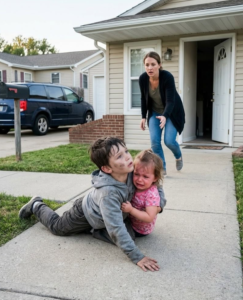
The nurse set a folded index card beside me and explained that it had been tucked into Drew’s clothing when he arrived. Three short sentences were written across it in heavy block letters, simple enough for a six-year-old to memorize.
“Drew fell in the yard. Lily was sleeping. We stay inside because we get sick.”
I read it twice.
Image
Then I looked through the glass toward the room where Drew was lying with his injured leg supported and Lily was curled beneath a hospital blanket nearby.
The note did not sound like a child’s explanation.
It sounded rehearsed.
The nurse did not tell me what to think. She simply asked whether I recognized the handwriting.
I didn’t.
But when Drew was awake enough to answer a few questions, I held the card where he could see it and asked him something much simpler.
“Do you know what this is?”
His whole body tightened.
He nodded.
“What is it for?”
Drew stared at the blanket over his legs.
“What we’re supposed to say.”
I felt something cold move through me.
“Who told you to say it?”
He did not answer immediately. His eyes moved toward Lily first, the same way they had in my living room when he was hurt and still checking whether she was okay.
Finally he whispered, “Mom.”
That one word changed the shape of everything.
For three years, I had treated Reena’s explanations like boundaries I was supposed to respect.
The kids were tired.
The kids were sick.
The kids were having a difficult week.
They needed routine.
They needed quiet.
They needed stability.
Now a six-year-old boy was lying in a hospital bed with a fracture that had gone untreated, and he had carried a written version of the story he was expected to tell if anybody noticed.
The doctor returned later and explained the X-rays more carefully. Drew’s leg had not been injured during the seven-block trip to my house. The damage was older. His body had already started trying to heal around an injury that should have received medical care much earlier.
I asked the question I was afraid to hear answered.
“Could he have walked on it?”
The doctor paused before answering.
“A child can sometimes force himself to move through remarkable pain when he believes he has no other choice.”
I looked at Drew.
Seven blocks.
Both hands pulling him forward whenever his leg would not cooperate.
Lily crying against him.
And no adult beside them.
The hospital staff kept their questions short. Nobody crowded him. Nobody demanded a complete story while he was exhausted.
That mattered.
Because Drew had spent so long watching adults for danger that even kindness seemed to make him suspicious.
When someone brought him juice, he asked whether Lily could have one too.
When someone adjusted his blanket, he wanted to know where Lily was.
When Lily finally fell asleep, he watched her for another minute before closing his own eyes.
He was six years old, and somewhere along the way he had learned that his job was to keep a three-year-old safe.
I kept remembering Aaron.
My brother had been the kind of father who carried extra crackers in his coat pocket because Drew got hungry in the car. He used to send me pictures of ridiculous little things: Drew asleep sideways across the couch, baby Lily gripping Aaron’s finger, a pile of children’s shoes by the front door.
After Aaron died, those pictures stopped.
At first, of course they stopped.
Everything stopped for a while.
Then Reena began shutting people out.
Not dramatically.
That was what fooled me.
She never screamed at me to stay away. She never announced that I could not see the children again. She simply made every visit impossible one excuse at a time.
I would text about Saturday.
They were busy.
I would ask about Sunday.
Lily had a cold.
I would leave groceries on the porch.
Reena would thank me afterward instead of opening the door.
I mistook politeness for proof that everything inside the house was normal.
The next morning, Drew finally told more of the story.
Not all at once.
Children rarely tell frightening things in neat chronological order. He talked about cereal first. Then a toy truck. Then how Lily hated the dark. Then he asked whether he was going home.
I told him the only thing I knew for certain.
“You’re staying somewhere safe while the adults figure this out.”
He studied my face.
“With Lily?”
“Yes.”
His shoulders loosened slightly.
Only then did he start talking about the room.
Reena called it the quiet room.
Drew called it the punishment room.
When either child cried too much, spilled something, argued, woke Reena, or refused to stay where she wanted them, she would put them inside and close the door.
Sometimes it was only for a short while.
Sometimes, Drew said, it felt much longer.
The detail he remembered most was not the darkness.
It was listening.
He had learned to listen for Reena’s footsteps so he would know when she was approaching. He had learned how to tell whether Lily was about to panic from the way her breathing changed. He had learned to distract her with stories about Aaron because she barely remembered their father anymore.
“I tell her Daddy would’ve opened it,” he said.
I had to look away for a moment.
The phrase that had been haunting me was the last word Drew said in my yard.
Again.
She locked us in there again.
I had understood immediately that it meant the confinement had happened before.
I had not understood how much of Drew’s childhood had been organized around preparing for the next time.
When I asked about his leg, he stopped talking.
So I did not push.
Later, with someone trained to speak with children present, Drew explained only what he could manage.
He had hurt the leg before the day he escaped. He had cried about it. Reena told him he was being dramatic and needed to stop making Lily upset.
Afterward, he learned to drag himself instead of asking her again.
The day he came to my house, Reena had put both children in the room and closed the door.
Something about the latch did not hold the way it usually did.
Drew realized the door could move.
He pushed until it opened far enough for Lily to squeeze through.
Then he followed.
He knew my house was several blocks away because Aaron had walked the route with him before he died.
Drew remembered the mailbox.
He remembered my porch.
He remembered that I had once told him he could come to me if he ever needed anything.
Apparently, a six-year-old had remembered a sentence that I had forgotten saying.
He could not carry Lily the entire distance. She walked when she could. When she became frightened or tired, he pulled her against his chest and kept moving.
At some point his leg hurt badly enough that he stopped trying to stand.
He continued anyway.
By the time he reached my sidewalk, he was dragging himself with his hands.
There was no dramatic explanation for how he did it.
He was afraid that if he stopped, Reena would find them.
Fear carried him farther than his injured body should have been able to go.
The written card mattered because it showed something beyond one bad day.
Drew said Reena had made him practice the sentences.
If someone asked why he limped, he had fallen outside.
If someone asked about Lily, she was sleeping.
If someone asked why relatives rarely saw them, the children got sick easily and needed to stay home.
One prepared explanation covered three different problems.
The injury.
The isolation.
The absence of witnesses.
I kept thinking about every time Reena had told me I was making things harder by asking to visit.
She had understood something about me that I had not understood about myself.
I was terrified of becoming the intrusive brother-in-law who made a grieving widow’s life worse.
So every time she pushed me back politely, I retreated.
My guilt did the rest of her work for her.
When Reena finally contacted me, her message was almost shockingly normal.
She asked whether the children were with me.
Not whether Drew was alive.
Not why an ambulance had been called.
Not whether Lily was safe.
Just whether they were with me.
I did not answer immediately.
I showed the message to the appropriate people at the hospital and let them handle the next steps.
Reena sent another.
Then another.
Her tone changed from worried to irritated.
She said Drew had a habit of exaggerating when he wanted attention. She said his leg had been fine earlier. She said Lily copied everything her brother did.
Then she wrote something that made the index card on the chair beside me feel even heavier.
She said Drew must have injured himself after leaving the house.
But the X-rays had already taken that possibility away.
For the first time in three years, Reena’s version of events had run into something she could not talk around.
A medical image did not care whether she sounded calm.
Drew’s body had kept its own timeline.
The following days moved in small pieces.
Drew received the care his leg had been missing. Lily stayed close to him whenever she was allowed. I answered questions, provided old messages, and went through the records of every attempted visit I still had on my phone.
I had not saved them as evidence.
I had saved them because I kept hoping one of those conversations would eventually end with, “Come over. The kids would love to see you.”
Instead they formed a pattern.
My offers became more specific over time.
I could take Drew for an afternoon.
No.
I could bring dinner and leave immediately.
Not tonight.
Could I drop off Lily’s birthday present myself?
She was already asleep.
Could I speak to Drew on the phone?
He did not feel like talking.
One message meant nothing.
Dozens meant something different.
Reena had not simply been overwhelmed and forgetting to return calls.
She had been controlling contact.
The hardest part was realizing there had been moments when my instincts had warned me.
Once, months earlier, I had heard a child’s voice when Reena answered the phone. I asked if it was Drew.
There was a pause.
Then Reena said he was watching television and did not want to talk.
I accepted that.
Another time I left groceries and noticed the curtains move upstairs.
I waved.
Nobody waved back.
I told myself not to be strange about it.
Grief makes families complicated, I thought.
That sentence became my excuse for not asking harder questions.
But guilt was useless if I turned it into another reason to freeze.
So I focused on what Drew and Lily needed next.
Food that did not disappear after one serving.
A predictable bedtime.
Clean clothes.
Medical appointments.
People who knocked before entering.
Doors that opened.
At first Drew asked permission for everything.
Could Lily have another banana?
Could he leave a cup beside his bed?
Could they watch television after dinner?
Could he take a cracker for later?
That last one nearly broke me.
“You don’t have to hide food here,” I told him.
He looked embarrassed.
“I wasn’t hiding it.”
I nodded.
“Okay. You can still keep it.”
He slipped the cracker into his pocket.
I did not mention it again.
A few days later, I found three unopened crackers lined up neatly beside his bed.
Not eaten.
Just available.
He seemed to sleep better knowing they were there.
Lily adjusted faster in some ways and slower in others.
For the first week, I left most interior doors open.
No speeches.
No promises I could not guarantee.
I just stopped doors from becoming surprises.
The adults handling the case eventually needed Drew to answer more questions about the room and about what had happened before the escape.
I worried he would think he was being punished for telling the truth.
Instead, the moment that frightened him most came afterward.
“Is Mom going to know I told?”
I said yes because lying to him would only teach him the same lesson again.
“Probably.”
His eyes filled immediately.
“She’s going to be mad.”
I pulled my chair closer but did not touch him until he reached for my hand first.
“She can be angry,” I said. “You still get to tell what happened.”
Drew stared at our hands for a long time.
Then he asked, “Even if she’s my mom?”
“Even then.”
That was the point when I understood the real damage Reena had done.
It was not only the room.
It was not only the untreated leg.
She had taught Drew that being loved meant protecting the adult who frightened him.
Undoing that would take longer than any cast or hospital stay.
Reena continued offering explanations.
Stress.
Grief.
Two difficult children.
No support.
Some of those things may even have been true.
Losing Aaron had changed all of us. Raising two small children alone would have exhausted anyone. There may have been days when Reena genuinely felt trapped by a life she had never expected to have.
But difficulty did not turn a locked room into safety.
Exhaustion did not treat Drew’s fracture.
Grief did not write the sentences he was supposed to repeat.
Whatever explanation existed for how Reena reached that point, the children could not be required to absorb the consequences while the adults debated her intentions.
That became the boundary I stopped apologizing for.
Drew and Lily remained together while longer-term decisions were worked out. I rearranged my home around them slowly rather than pretending we had become an instant happy family.
There were bad nights.
There were accidents.
There were moments when Drew became furious over something tiny because the tiny thing was safer to be angry about than the enormous things.
Once I told him it was time to put away a toy before dinner, and he shouted, “You’re not my dad.”
He looked terrified the second the words left his mouth.
I could see him waiting for punishment.
I picked up another toy from the floor and dropped it into the bin.
“Correct,” I said. “I’m still asking you to clean up.”
He stared at me.
Then he put the truck away.
Ten minutes later he ate two helpings of dinner.
Nothing terrible happened.
That became important too.
Safety was not built by one heroic rescue.
It was built by boring repetitions.
Dinner appeared again tomorrow.
Nobody took food away because someone cried.
A mistake did not lead to confinement.
An angry sentence did not make love disappear.
A closed door could open.
Weeks later, Drew’s recovery had progressed enough that he could move around more comfortably with the support he had been given. One afternoon I heard Lily laughing from the hallway and found the two of them building a crooked tower from couch cushions.
Drew noticed me and immediately looked toward the cushions, waiting to see whether I was angry.
I told them not to block the walkway.
He moved the tower six inches.
That was it.
Lily went back to laughing.
Drew went back to building.
The ordinary moment hit me harder than the dramatic ones sometimes did.
Aaron should have been there for it.
I could not replace him.
I stopped trying to imagine that I could.
What I could do was keep the promise Drew had somehow remembered from years earlier.
If you need me, come to me.
He had.
Against every reasonable expectation, he had crossed seven sidewalk blocks with an injured leg because he believed my house meant something different from the house behind him.
Months later, the folded card from his pocket was no longer something I needed to look at.
I could remember every line.
Drew fell in the yard.
Lily was sleeping.
We stay inside because we get sick.
A whole false life reduced to three easy sentences.
The children were learning different ones now, although nobody made them memorize anything.
Can I have more?
Yes.
Can Lily come too?
Yes.
Can I tell you something even if you’ll be mad?
Yes.
One evening, I walked past Drew’s room and realized his door was closed.
For months he had insisted on keeping it open.
My hand stopped near the knob out of instinct.
Then I heard him inside explaining something very seriously to Lily about toy cars.
They were fine.
The door was closed because Drew had chosen to close it.
So I knocked.
“Yeah?” he called.
I opened it only after he answered.
Drew was sitting on the floor with Lily beside him, crackers on a plate between them and toys spread everywhere.
He looked up, completely unconcerned.
I told them dinner would be ready soon.
“Okay,” he said.
Then he turned back to Lily.
I left the room and pulled the door almost shut again, exactly the way he had left it.