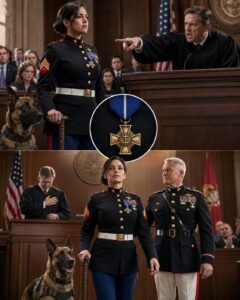
THIS IS A COURT, NOT A PARADE
The courtroom was loud until one sentence cut through everything like a blade.
“Remove that decoration.”
For a second, I thought I had misunderstood him.
The judge sat high above me beneath the state seal, one hand resting beside a stack of papers, the other pointing directly at my chest.
Not at my uniform.
Not at the ribbons.
At the medal.
My medal.
“This is a court,” he said, his mouth tightening with irritation, “not a parade.”
The air changed.
I heard it happen.
A cough died somewhere behind me.
Paper stopped rustling.
Even the bailiff near the wall shifted his weight as if he suddenly wished he were standing somewhere else.
My fingers tightened around the carved handle of my cane.
Atlas, sitting against my left leg, raised his head.
He felt the change in me before anyone else could see it.
He always did.
I didn’t look down at him.
I kept my eyes on the judge.
“Your Honor,” I said carefully, “this is an authorized Marine Corps dress uniform.”
“I can see what it is.”
His voice became sharper.
That tone.
I knew that tone.
I had heard versions of it in hospitals.
In rehabilitation offices.
In waiting rooms where people saw the cane before they saw me.
It was the tone people used when they had already decided what you were before you were allowed to speak.
The judge leaned back.
“The medal is unnecessary. Remove it.”
A whisper moved through the gallery.
I could feel eyes on me from every direction.
Some curious.
Some uncomfortable.
Some angry.
A few people recognized me.
I could tell by the way their expressions changed.
Recognition never felt the way strangers imagined it did.
They saw newspaper photographs.
Ceremonies.
Flags.
A citation printed beneath my name.
They saw the clean version.
They never smelled burned fabric.
They never heard a man screaming for his mother while blood filled his mouth.
They never heard the sound a knee made when something inside it tore apart.
They never knew that sometimes the brightest medal in a room carried the darkest memory.
The judge tapped one finger against the bench.
“Well?”
I swallowed.
My right knee had begun to throb.
That happened when I stood too long.
Or when rain was coming.
Or when I remembered too much.
Doctors had put screws into what remained after the mountain took the rest.
They had rebuilt enough of me to let me walk again.
Not normally.
Not without pain.
But enough.
I looked down at the medal.
The Navy Cross rested against my uniform exactly where regulations required.
I had almost refused to wear it that morning.
Atlas had watched me from beside the bed while I stood in front of the mirror, dress uniform hanging over one arm.
I had stared at the medal case for nearly five minutes.
There were days when I could look at it.
There were days when I couldn’t.
That morning, I opened the case.
Not because I wanted anyone to notice it.
Because fourteen men had once depended on me to go back for them.
Some of them had later told me that the medal belonged to all of us.
So I wore it.
For them.
Not for me.
Now a judge was pointing at it as if I had pinned on a piece of costume jewelry.
“Captain Donovan,” he said.
The title sounded almost mocking in his mouth.
“Are you refusing a direct instruction from this court?”
My jaw tightened.
I had come into that courtroom determined not to become a spectacle.
Whatever else happened that day, I would not give anyone the satisfaction of turning me into the angry disabled veteran they could dismiss afterward.
I had spent too many years learning the difference between surrender and restraint.
So I did the only thing I could do without betraying myself.
I lifted my hand.
Slowly.
My fingertips touched the medal once.
Just once.
The metal was cold.
And for the smallest fraction of a second, the courtroom disappeared.
I was back on the mountain.
Smoke.
Dust.
A dead radio.
Someone yelling my name.
Then I pulled my hand away.
“I won’t dishonor it,” I said.
The judge’s face hardened.
“Excuse me?”
I didn’t answer.
I turned.
Pain shot through my knee so violently that my vision flickered white.
I steadied myself on the cane.
Tap.
Atlas rose instantly.
Tap.
His shoulder stayed beside my leg.
Tap.
The sound of the cane carried across the marble floor.
No one spoke.
I could feel the gallery watching me leave.
Maybe some of them thought I was defeated.
Maybe the judge did too.
I heard his chair creak behind me.
Then came the faint sound of a satisfied exhale.
He thought he had won.
That was the strangest part.
I wasn’t angry enough to hate him yet.
Mostly, I was tired.
Tired of explaining scars to people who had never asked how I got them.
Tired of watching respect disappear the second someone decided my limp made me weak.
Tired of being praised in ceremonies and treated like an inconvenience in ordinary rooms.
I reached the aisle.
Atlas glanced up at me.
“I’m okay,” I whispered.
It was a lie.
He knew it.
I knew it.
But we kept moving.
Three more steps.
Then the heavy wooden doors behind me opened.
The hinges gave a low groan.
At first, I didn’t turn.
People came and went from courtrooms all day.
Then I heard footsteps.
Measured.
Steady.
Not hurried.
Not uncertain.
The kind of footsteps that didn’t need permission to command attention.
The whispers behind me stopped.
Atlas stopped.
So did I.
Something in my chest tightened before my mind understood why.
I knew that cadence.
I turned slowly.
A Marine Corps general stood beneath the doorway.
Four stars.
Immaculate uniform.
Broad shoulders.
Silver hair.
A face I had not seen in person for years but could never have mistaken.
General Thomas Readington.
The officer who had pinned the Navy Cross to my uniform.
The officer who had looked me in the eye afterward and quietly said, I wish we could give you back what it cost.
The judge’s smirk disappeared.
I watched the color leave his face.
General Readington’s gaze moved from the judge…
to me…
to the medal.
Then back to me.
My spine straightened on instinct.
My damaged leg protested immediately.
I didn’t care.
I transferred the cane into my left hand.
Atlas remained perfectly still.
My right hand rose.
The salute trembled slightly.
It wasn’t textbook anymore.
My shoulder had never recovered completely.
My fingers shook.
But I held it.
General Readington returned it instantly.
Sharp.
Precise.
No hesitation.
For one suspended second, there was no judge.
No gallery.
No marble courtroom.
There was only one Marine acknowledging another.
Then Readington lowered his hand.
His expression changed.
He looked toward the bench.
And I saw something in his eyes that I had seen only once before.
The night they brought in the casualty list.
Cold anger.
Controlled completely.
Which somehow made it worse.
He walked past me.
“General Thomas Readington,” he said.
His voice was not loud.
It didn’t need to be.
“United States Marine Corps.”
He stopped before the bench.
Then he turned slightly and gestured toward me.
“And this is Captain Mara Donovan.”
The judge opened his mouth.
Readington continued.
“The most decorated officer I have personally commissioned in thirty years.”
Silence didn’t simply fill the courtroom.
It crushed it.
The judge stared at him.
Then at me.
Then at the medal he had ordered me to remove.
For the first time since I had walked into that room, the man behind the bench looked uncertain.
Readington reached inside the folder under his arm.
And I realized he had not come to make a speech.
He had come prepared.
He placed a sealed packet in front of the clerk.
“Please enter that into the record.”
The clerk looked at the judge.
Then at the general.
Then took it.
My pulse began to beat harder.
I didn’t yet know what was inside.
But when the judge saw the first page, his hand stopped moving.
And that was when I understood.
This wasn’t over.
It had barely begun.
PART 2: WHAT THE MEDAL MEANT
The judge cleared his throat.
“General, I don’t know what you believe is happening here, but this court—”
“I know exactly what happened.”
General Readington’s answer was calm.
Almost gentle.
That made every person in the room lean closer.
The clerk unfolded the documents.
Readington nodded toward them.
“The relevant federal statute and military protections governing authorized uniforms and decorations in court proceedings are cited there.”
The judge’s eyes moved rapidly across the page.
I watched his expression change line by line.
Defiance.
Confusion.
Recognition.
Then something very close to fear.
Readington continued.
“Captain Donovan appeared in an authorized dress uniform. The decoration you ordered her to remove is not an accessory. It is an officially awarded military decoration.”
The judge’s face stiffened.
“I was maintaining decorum.”
“No.”
One word.
Nothing more.
It landed harder than shouting.
Readington stepped forward.
“You attempted to force a permanently disabled Marine to remove the Navy Cross from her authorized uniform because you considered it decorative.”
The judge’s fingers tightened around the paper.
“I did not know what medal it was.”
For the first time since Readington arrived, I felt something inside me snap.
Not loudly.
Not dramatically.
Just a clean break.
I had heard those words before.
Different places.
Different people.
I didn’t know.
As if ignorance erased impact.
As if refusing to ask made cruelty accidental.
I turned back toward the bench.
My cane struck the marble once.
The sound made the judge look at me.
I walked back toward the front.
Atlas moved with me.
The judge’s eyes dropped briefly toward him.
Then toward my leg.
This time, he noticed both.
Funny how quickly people learned to see when consequences entered the room.
“I told you it was authorized,” I said.
My voice didn’t shake.
That surprised me.
“You did know that.”
The judge’s jaw moved, but no answer came.
Readington looked at me.
I could see the question in his expression.
Did I want to continue?
For years after the ambush, people had made decisions for me because they believed they were protecting me.
Doctors.
Commanders.
Family.
Friends.
Sometimes they were right.
Sometimes protection felt dangerously close to having your choices taken away.
Readington had never done that.
So he waited.
I gave him a small nod.
He turned back toward the judge.
“You say you didn’t know what the Navy Cross looks like.”
His voice remained level.
“Then perhaps the court should understand what it represents.”
Something cold moved through my stomach.
“General—”
He looked at me.
I knew what was coming.
The citation.
The official words.
The polished language used to describe the worst day of my life.
I hated hearing it.
Every ceremony turned chaos into paragraphs.
Every citation made terror sound orderly.
Readington saw the resistance in my face.
He didn’t open the citation.
Instead, he closed the folder.
“I won’t read the official version,” he said.
His voice softened by half a degree.
“I’ll tell you what happened.”
My throat closed.
The courtroom blurred around the edges.
Atlas leaned his weight against my leg.
Not enough to knock me off balance.
Just enough to remind me where I was.
Readington looked toward the gallery.
“Captain Donovan’s unit was moving through mountain terrain when they were hit from elevated positions.”
And suddenly I could smell the dust.
There are memories you visit.
And memories that visit you.
This one never knocked.
It just walked in.
The first shot had sounded almost small.
A crack against the vastness of the mountains.
Then another.
Then twenty.
The world exploded.
I remembered throwing myself behind a section of rock as rounds struck stone hard enough to spray fragments across my face.
Someone screamed.
“CONTACT LEFT!”
Another voice.
“MEDIC!”
Then the radio went wild.
Overlapping calls.
Coordinates.
Panic hidden beneath training.
I tried to stand.
My platoon sergeant shoved me back down as rounds ripped across the ridge.
“Donovan, stay low!”
Then an explosion lifted dirt into the sky.
For three seconds, I heard nothing.
Not quiet.
Nothing.
A high ringing tone swallowed the world.
When sound returned, it came back all at once.
Men shouting.
Weapons firing.
Someone crying.
And one voice repeating the same word.
“Help.”
Readington’s voice pulled the courtroom around me again.
“The initial attack separated members of the unit and disabled their primary communications.”
I stared at the floor.
The marble became rock.
My cane became a rifle under my palm.
Atlas became a shape at the edge of memory.
I could hear Corporal Ellis.
I never forgot his voice.
“Mara!”
Not Captain.
Not ma’am.
Mara.
Because rank disappears when someone thinks they’re dying.
I saw him fourteen yards away.
Maybe fifteen.
Pinned behind a shallow ridge.
Blood soaking through his sleeve.
Rounds striking the dirt between us.
Everyone knew crossing that open ground was insane.
I knew it too.
I went anyway.
Readington said, “Captain Donovan left cover.”
Someone in the gallery inhaled sharply.
I remembered crawling.
Elbows.
Knees.
Stone cutting through my gloves.
A round struck close enough to slap dirt across my cheek.
Another hit my pack.
I kept moving.
When I reached Ellis, he was pale.
“You’re stupid,” he gasped.
“Yeah.”
I grabbed his vest.
“Save your breath.”
I dragged him backward.
Every inch felt like a mile.
He outweighed me.
Gear made it worse.
My shoulders screamed.
My lungs burned.
Then we reached cover.
Someone grabbed him.
I fell beside him.
I should have stayed.
That is what people never understood.
No one ordered me to go back.
No one would have blamed me if I hadn’t.
I had already done more than I should have.
Then I heard another voice.
And another.
Fourteen wounded.
Scattered across a kill zone.
Readington paced slowly before the bench.
“She went back.”
The judge stared at him.
Readington paused.
“Then she went back again.”
A woman in the gallery covered her mouth.
“Again.”
I shut my eyes.
“Again.”
Dust.
Blood.
Weight.
Fear.
“Again.”
A face going gray in my hands.
“Again.”
My own voice screaming at someone not to close his eyes.
“Again.”
Until I stopped counting.
Until survival became rhythm.
Find them.
Reach them.
Pull them.
Return.
Breathe.
Go back.
Readington’s voice grew quieter.
“During one of those recoveries, Captain Donovan was struck and sustained catastrophic damage to her knee.”
My right hand tightened around the cane.
The injury had happened almost stupidly.
There had been no heroic music.
No slow motion.
I had planted my boot between two rocks.
A blast hit somewhere below us.
My body turned.
My foot didn’t.
The pain was immediate.
Bright.
Blinding.
My knee folded.
I hit the ground hard enough to bite my tongue.
For a moment, I couldn’t breathe.
Someone shouted for me.
I tried to stand.
My leg collapsed.
So I crawled.
That was the part I remembered best.
Not the pain.
The anger.
I was furious at my own body.
How dare it stop?
How dare bone and ligament and blood decide we were finished when people still needed me?
So I kept moving on my hands and one knee.
Readington looked directly at the judge.
“Her leg had effectively failed.”
He waited.
“She continued the rescue.”
The judge’s face had gone completely still.
Readington’s gaze moved toward me.
“She used her own body as cover when there was no cover left.”
I remembered that too.
A young Marine beneath me.
Barely twenty.
Eyes huge.
“Ma’am, you’re hit.”
“I know.”
“You’re bleeding.”
“I know.”
“You need to—”
“Shut up and breathe.”
I had thrown myself over him while fire struck around us.
I remember thinking something absurd.
That my mother was going to kill me if the bullets didn’t.
Then the firing shifted.
I dragged him out.
Fourteen.
Every one alive when we reached the extraction point.
Readington turned toward the courtroom.
“She collapsed only after the last wounded Marine was clear.”
No one made a sound.
Not one.
I opened my eyes.
The room had changed.
People who had been staring at my medal were now looking at me.
I hated that almost as much.
I didn’t want pity.
I didn’t want worship.
I wanted them to understand one thing.
The medal had never been decoration.
Readington returned his attention to the judge.
“That medal represents what happened after her body had already given her every possible reason to stop.”
He glanced at the Navy Cross.
Then back at the man behind the bench.
“You ordered her to remove it because you thought it offended the dignity of your courtroom.”
His voice dropped.
“Judge, that medal does not diminish the dignity of this room.”
A pause.
“It exposes whether this room deserves it.”
The judge lowered his eyes.
And for the first time, I saw his hands trembling.
But Readington still wasn’t finished.
Neither was I.
PART 3: THE PART THEY NEVER PUT IN THE CITATION
The courtroom had heard how I earned the medal.
They had not heard what came after.
That part never appeared in citations.
No one mentioned the first time I woke in a military hospital and tried to swing both legs off the bed.
No one printed the sound I made when my right foot touched the floor.
No one wrote about the surgeon standing beside me, expression carefully neutral, explaining that the damage was worse than they had hoped.
There were words like reconstruction.
Permanent impairment.
Mobility limitations.
Further procedures.
Possibility.
Adaptation.
People used large words when the truth was too ugly to say plainly.
My old life was gone.
That was the plain version.
Readington knew some of it.
Atlas knew almost all of it.
The judge knew none of it.
Until that morning, he hadn’t cared.
I stood near the counsel table while the clerk kept the documents Readington had submitted.
The judge seemed to be searching for a way to regain control.
He straightened a stack of papers that were already straight.
Then he looked at Readington.
“This is highly irregular.”
Readington gave him a level stare.
“So was ordering an officer to strip an authorized military decoration in open court.”
“I did not order her to strip.”
“You ordered her to remove it from her uniform.”
“That is not the same thing.”
My stomach turned.
There it was.
Not remorse.
Not yet.
Technical escape.
A smaller definition.
A safer word.
I had seen wounded men do the same thing with pain.
It’s not bad.
It’s only a scratch.
I can walk.
Human beings bargain with truth when truth threatens them.
The judge was bargaining now.
I stepped forward.
“Your Honor.”
He looked at me.
I could have let Readington continue.
Part of me wanted to.
He had rank.
Authority.
Documents.
A voice powerful enough to shake the bench without ever rising.
But this had happened to me.
And I had spent enough years having other people speak about what happened to me while I sat silently beside them.
So I spoke.
“When you told me to remove the medal, I told you the uniform was authorized.”
The judge said nothing.
“You heard me.”
Still nothing.
“You did not ask what the decoration was.”
His lips tightened.
“You did not ask why I was wearing it.”
I took another step.
Pain climbed from my knee into my hip.
Atlas moved with me.
“You saw something you didn’t understand and decided your authority mattered more than understanding it.”
A murmur moved through the gallery.
The judge glanced toward the room.
I understood that look.
He had finally become aware of witnesses.
I almost laughed.
Not because anything was funny.
Because fifteen minutes earlier he had enjoyed those same witnesses.
My humiliation had strengthened him.
Now they terrified him.
“I meant no disrespect to your service,” he said.
There are apologies that accept responsibility.
And apologies designed to escape it.
I knew the difference.
“So you respected my service,” I said, “while ordering me to remove the symbol of it?”
The judge’s mouth opened.
Closed.
I heard someone behind me whisper, “Jesus.”
The bailiff looked at the floor.
Readington didn’t interrupt.
That mattered to me.
He let the silence belong to me.
I touched the handle of my cane.
There was a tiny notch near the top.
I had carved it accidentally during rehabilitation.
On one of my worst days.
I had been learning to walk with support.
Ten feet.
That had been the goal.
Ten feet across a room.
I had once crossed open ground under enemy fire.
Then suddenly ten feet of hospital tile defeated me.
I remembered gripping the cane so hard that my thumbnail dug into the wood.
I took three steps.
My leg buckled.
I fell.
A therapist moved toward me.
I yelled at her not to touch me.
Not my finest moment.
I stayed on the floor afterward, ashamed and furious.
The therapist waited.
Finally she said, “Are you finished?”
I looked up at her.
“With what?”
“Deciding whether falling means you stay down.”
I hated her for saying it.
Then I stood.
The notch in the cane came from that day.
I had kept it instead of replacing the handle.
A reminder.
Falling and staying down were different decisions.
The judge had made me feel, for one brief moment, as if I were back on that hospital floor.
Small.
Observed.
Reduced.
I refused to stay there.
“You called it a decoration,” I said.
His face tightened.
“Yes.”
“Do you know what I remember when I touch it?”
No answer.
“I don’t remember the ceremony.”
My voice grew quieter.
“I don’t remember cameras.”
The whole room seemed to lean toward me.
“I remember a Marine asking me whether he was going to die.”
The judge’s eyes lifted.
“I remember lying to him.”
My throat tightened.
“I told him no.”
The memory came sharp enough to hurt.
His blood on my hands.
His fingers wrapped around my sleeve.
“Was he one of the fourteen?” someone whispered from the gallery.
I didn’t look back.
“Yes.”
The answer came out almost soundless.
I looked at the judge.
“I remember another man apologizing because he thought he was too heavy for me to drag.”
The judge swallowed.
“I remember telling him if he survived, he could apologize later.”
A few people laughed softly through tears.
I nearly smiled.
Nearly.
“He did.”
The smile disappeared.
“I remember one of them asking me to leave him because he thought going back for him would get me killed.”
My voice cracked then.
Only once.
Atlas pressed closer.
“I remember being afraid he was right.”
That was the part people never wanted from heroes.
Fear.
They wanted bravery to mean you were never terrified.
It didn’t.
I had been terrified.
I had wanted to live.
I had wanted to go home.
I had wanted someone else to make the decision.
Someone else to be stronger.
There was no one else.
So I went.
“You see metal,” I told the judge.
“I see fourteen men I almost couldn’t reach.”
The judge stared at me.
“And every time someone calls it a decoration, I hear the ones who were screaming.”
No one moved.
I glanced toward Readington.
His expression had softened.
Not pity.
Never pity.
Understanding.
The judge lowered his gaze again.
His voice, when it came, was smaller.
“I did not know.”
I felt anger rise.
This time I let some of it reach my face.
“That is exactly the problem.”
He looked at me.
“You didn’t know.”
I nodded toward the bench.
“And you decided you didn’t need to.”
That landed.
I saw it.
Not only in him.
In the gallery.
In the clerk.
In the bailiff.
Maybe even in myself.
Because somewhere beneath my anger was a truth I had avoided for years.
I had spent so much time wishing people would stop asking questions about my injuries that I had forgotten what it felt like when someone refused to ask anything at all.
There was a difference between privacy and invisibility.
I had wanted dignity.
The judge had offered erasure.
Readington finally stepped forward.
“The documents have been entered?”
The clerk nodded.
“Yes, General.”
“Good.”
He looked toward the judge.
“Then this is no longer simply about disrespect.”
The judge stiffened.
Readington’s expression returned to ice.
“This court has a formal record of what occurred.”
I saw the judge’s fingers curl around the edge of the bench.
Readington continued.
“And conduct of this nature warrants immediate disciplinary review.”
The words dropped one at a time.
The judge’s breathing changed.
“General—”
“Potentially including removal.”
The room went dead silent.
My pulse hammered.
I had expected anger.
Maybe a warning.
I hadn’t expected that.
Neither had the judge.
He stared at Readington as if the floor beneath his chair had disappeared.
For the first time, he was the one who looked cornered.
But what surprised me most was what I felt.
Not triumph.
Not satisfaction.
Something heavier.
Because I knew what it was to have one moment change how everyone saw you.
And I was about to decide what mine meant.
PART 4: I DIDN’T WANT REVENGE
People assume that when someone humiliates you publicly, the most satisfying thing in the world is watching them humiliated in return.
Maybe for some people it is.
Standing there, watching the judge’s hands tremble, I discovered it wasn’t for me.
I wanted accountability.
There was a difference.
I had learned that difference in uniform.
Revenge asks, How much can I make you hurt?
Accountability asks, What must happen so you cannot do this again?
I looked around the courtroom.
Some people were glaring at the judge.
Others were staring at me.
One woman had tears running openly down her face.
The bailiff’s jaw was tight.
The clerk still had the federal documents in her hands.
And the judge…
He finally looked human.
Not powerful.
Not untouchable.
Just human.
That did not excuse him.
It made what came next matter more.
He cleared his throat.
“Captain Donovan.”
I waited.
He struggled with the words.
“I believe this situation has escalated beyond what I intended.”
I almost closed my eyes.
There it was again.
Intent.
The shield people reached for when impact became impossible to deny.
Readington’s expression darkened.
I raised one hand slightly.
He stopped.
I wanted this answer to be mine.
“Sir,” I said, looking at the judge, “that still isn’t an apology.”
The judge stared at me.
Somewhere behind me, someone shifted.
I continued.
“You keep telling this room what you intended.”
My voice was steady.
“I’m telling you what you did.”
The judge’s lips pressed together.
For several seconds, pride fought something else across his face.
Maybe fear.
Maybe shame.
Maybe both.
Then he stood.
That surprised everyone.
I could hear it in the sudden movement behind me.
Judges did not normally stand for people in front of their benches.
He looked at the medal.
Then at my cane.
Then at Atlas.
Finally, he looked me in the eyes.
“Captain Donovan.”
His voice had changed.
“I was wrong.”
No excuse followed.
I said nothing.
He swallowed.
“I treated your lawful uniform as though it were a personal display. I dismissed you when you attempted to explain that to me.”
The room remained silent.
“I spoke to you with disrespect.”
He paused.
“And I used the authority of this court carelessly.”
That was closer.
Much closer.
“I apologize.”
I studied him.
There was no smirk now.
No irritation.
No impatient tapping of his fingers.
Just a man standing in the place where certainty had been.
Part of me wanted to say nothing.
Let him stand there.
Let discomfort teach him.
But silence had already done enough that day.
So I answered.
“I hear your apology.”
Not I forgive you.
Not yet.
Maybe someday.
Forgiveness was not something another person got to demand because they had finally found the correct words.
The judge nodded once.
Readington turned toward me.
I knew that look too.
He was asking without asking.
What do you want?
That question should have been easy.
Instead, it terrified me.
I had not planned for this.
I had planned to come to court.
Stand where instructed.
Answer what was asked.
Leave.
I had not planned to become the center of the room.
I looked at the medal again.
Then at the gallery.
Then at the judge.
“Put it on the record.”
The clerk glanced up.
The judge frowned slightly.
“What?”
“Everything.”
My voice grew stronger.
“The order to remove the medal.”
I pointed toward the federal documents.
“The correction.”
I looked at the judge.
“Your apology.”
Something changed in Readington’s face.
Approval.
Not because I was asking for punishment.
Because I was asking for memory.
Institutions forgot what people remembered.
Records did not.
The judge hesitated.
Then looked toward the court reporter.
“Enter it.”
Keys clicked immediately.
I felt my shoulders loosen by half an inch.
“And the disciplinary review?” the judge asked Readington.
Readington’s answer came without emotion.
“That decision is not Captain Donovan’s burden.”
He was right.
That mattered too.
Victims should not have to decide the professional fate of the people who mistreated them.
The appropriate authorities could review what happened.
The record would exist.
The facts would exist.
I didn’t need to turn justice into revenge to prove I was strong.
The judge sat slowly.
Readington stepped aside.
For a moment, nobody knew what came next.
Then the judge looked at me.
“Captain Donovan.”
“Yes, Your Honor?”
His gaze moved to the Navy Cross.
“You will, of course, retain your decoration.”
I almost smiled.
“Wasn’t planning on taking it off.”
A few people laughed.
The tension cracked.
Even Readington’s mouth moved at one corner.
The judge looked embarrassed.
Good.
Maybe embarrassment was useful when it taught a person something.
Then he looked at Atlas.
“And your service animal may remain.”
This time I did smile.
Atlas had not moved.
“He was planning on that too.”
The gallery laughed again.
Softly.
Humanly.
The room could breathe.
I moved toward the table where I had originally been standing.
My knee screamed with every step.
Now that the adrenaline was fading, the pain came harder.
Readington noticed.
Of course he did.
He moved toward me.
I gave him a look.
He stopped immediately.
Another thing I respected about him.
He knew when help became interference.
I reached the chair on my own.
Then I sat.
Atlas lowered himself against my boots.
I rested one hand on his head.
Readington took the seat behind me.
The judge shuffled the papers in front of him.
For the first time that morning, I thought the original proceedings might actually continue.
Then a voice from the gallery said quietly:
“Captain?”
The bailiff immediately turned.
I looked back.
An older man stood near the rear.
He had tears in his eyes.
He didn’t approach.
He didn’t say anything dramatic.
He simply raised two fingers to his brow.
A salute.
Then another person stood.
Another.
I froze.
Not everyone saluted.
Some only stood.
But one by one, people rose from the benches.
The rustling was soft.
Wood creaked.
Shoes scraped against the floor.
Within seconds, almost the entire gallery was standing.
My throat tightened.
I hated public attention.
I had told myself that for years.
But this was different.
They weren’t applauding.
They weren’t cheering.
They were simply standing.
Acknowledging.
My eyes burned.
Atlas looked up.
I placed my palm against his neck.
“Don’t,” I whispered to myself.
Too late.
One tear slipped down my cheek.
I wiped it away angrily.
Readington leaned forward behind me.
“You always were terrible at accepting gratitude.”
I stared straight ahead.
“Permission to tell a four-star general to shut up?”
“Denied.”
That almost broke me.
I laughed.
One short sound through tears.
The judge watched us.
Then something happened I never expected.
He stood again.
Not because procedure required it.
Not because anyone told him to.
He stood with the gallery.
His hands remained at his sides.
His eyes lowered.
I looked at him for a long moment.
Then I gave one nod.
Nothing more.
It was enough.
The courtroom settled again.
But before anyone sat, General Readington spoke.
“Captain.”
I turned.
His expression had become distant.
Serious.
“There’s something about that day I never told you.”
My stomach tightened.
The room seemed to disappear again.
“What?”
He looked at the medal.
Then at me.
And suddenly I was afraid of whatever came next.
PART 5: THE FOURTEENTH MAN
For years, I had remembered the ambush in fragments.
Not as a complete story.
Trauma rarely gives you a clean beginning, middle, and end.
It gives you flashes.
A glove covered in blood.
A broken radio.
Dust hanging in sunlight.
Someone screaming a name.
A rifle too hot to touch.
My knee folding.
The metallic taste of fear.
Fourteen wounded Marines.
I knew their names.
I had visited some of them after rehabilitation.
Others had visited me.
We joked about that day because sometimes joking is the only way soldiers can touch something terrible without letting it burn them again.
But there were pieces I had never fully remembered.
Especially near the end.
By then I had lost too much blood.
Pain had narrowed the world.
My memories became scattered.
I remembered dragging the thirteenth man.
I remembered someone shouting that extraction was almost there.
I remembered being told to stop.
Then there was the fourteenth.
After that—
Nothing.
Until the helicopter.
I woke with someone cutting my trousers away from my leg.
I had assumed the blank space was simply my brain protecting itself.
Readington looked at me now.
“The official report said you collapsed after the final Marine was recovered.”
“Yes.”
“That’s true.”
His voice changed.
“But incomplete.”
My hand tightened around Atlas’s harness.
I didn’t like surprises about that day.
“General.”
“I’m not adding anything to your citation.”
He must have seen the alarm in my face.
“This isn’t about another award.”
“Good.”
A tiny smile.
Then it vanished.
“You remember going back for the last Marine?”
“Parts.”
“You were ordered not to.”
I blinked.
“I know.”
“No.”
Readington shook his head.
“You were ordered not to because everyone believed he was already dead.”
The courtroom became very quiet again.
My heart beat once.
Hard.
I remembered shouting.
Someone grabbing my shoulder.
A voice saying, He’s gone.
I had always thought they meant there was no way to reach him.
Readington continued.
“The unit was preparing to move.”
A pressure built behind my ribs.
“You refused.”
A flash.
My own voice.
I’m not leaving him.
I closed my eyes.
The memory came closer.
Not cleanly.
Like something surfacing through dark water.
I saw a body lying near a shattered section of rock.
No movement.
No response.
Gunfire farther up the ridge.
Someone saying the position would be hit again.
I had crawled anyway.
Readington said, “When you reached him, he wasn’t breathing.”
My stomach turned.
I remembered.
Oh God.
I remembered.
My hands on his vest.
Turning him.
Blood.
So much blood.
I had pressed my fingers against his neck.
Nothing.
Then—
Something.
A flutter.
Tiny.
Almost imagined.
“He had a pulse,” I whispered.
Readington nodded.
“Barely.”
The whole courtroom vanished.
I was there.
I could feel my palms against the ground.
I could hear myself screaming for help.
No one came.
Not because they didn’t want to.
Because coming would have put more bodies in the open.
So I grabbed him.
My knee was already destroyed.
I could not stand.
I wrapped one hand in the back of his vest.
I pulled.
And pulled.
And pulled.
The pain was so severe I vomited once against the dirt.
Then kept going.
Readington’s voice came from very far away.
“He was the Marine beneath you when the final burst crossed your position.”
My breath stopped.
The young face.
Wide eyes.
Ma’am, you’re hit.
“You shielded him.”
I stared at Readington.
“I remember.”
“He survived.”
“I know.”
Readington nodded slowly.
“What you don’t know is what he told investigators afterward.”
I couldn’t speak.
“He said you kept talking to him.”
A memory struck me.
My voice.
Hoarse.
Angry.
Stay with me.
Look at me.
Do not close your eyes.
I felt tears rise.
Readington continued.
“He said every time he started to lose consciousness, you called him back.”
I looked away.
“He said he could hear you crying.”
My face burned.
“I wasn’t crying.”
Readington almost smiled.
“That is exactly what you told the investigator.”
A few quiet laughs moved through the gallery.
I wiped my cheek.
“Then why are you telling me this now?”
Readington looked toward the judge.
Then back at me.
“Because people tell the story of what you did as if courage made you untouchable.”
His eyes narrowed slightly.
“It didn’t.”
No one breathed.
“You were injured.”
He pointed gently toward my cane.
“You were terrified.”
My throat tightened.
“You were exhausted.”
A pause.
“You wanted to stop.”
I looked at the floor.
“Yes.”
“And you kept going.”
He nodded toward the medal.
“That is what it means.”
The judge stared at him.
Readington continued.
“Not invincibility.”
His voice dropped.
“Choice.”
The word hit me harder than anything else he had said.
Choice.
For years I had looked at the Navy Cross and seen the worst day of my life.
The men I nearly failed to reach.
The body that never healed.
The nightmares.
The surgeries.
The cane.
I had never thought of the medal as proof that I had been fearless.
I knew better.
But maybe somewhere deep inside me, I had resented it because other people treated it that way.
They saw heroism.
I remembered terror.
They saw strength.
I remembered crawling because I could no longer stand.
They saw courage.
I remembered wanting desperately to stop.
Readington had just given me the word I had been missing.
Choice.
Courage did not erase fear.
It happened inside it.
The judge slowly looked toward me.
Now when his eyes reached the medal, there was no contempt in them.
No irritation.
Something else lived there.
Shame.
Understanding, maybe.
Not enough to erase what happened.
Enough to change what happened next.
“Captain Donovan,” he said.
His voice was quiet.
“Yes?”
“I owe you more than an apology.”
I tensed.
I didn’t want another speech.
Then he surprised me.
“I owe every person who enters this courtroom the humility to understand that I may not know the story standing in front of me.”
My grip on the cane loosened.
He looked around the room.
“Authority without that humility becomes arrogance.”
Readington said nothing.
Neither did I.
The judge looked at me again.
“I demonstrated that today.”
It was the first thing he had said that sounded like he understood the real failure.
Not ignorance.
Arrogance.
The assumption that his ignorance didn’t matter.
I nodded once.
“That’s what I needed you to understand.”
He lowered his head.
“I do.”
Maybe he did.
Maybe true understanding would take longer.
Mine had.
But the record had been made.
The apology had been made.
The review would happen.
And something inside me that had been locked tight since the moment he pointed at my chest finally opened.
Not healed.
Opened.
There was a difference.
The rest of the proceeding passed almost quietly.
No one stared at my medal anymore.
At least, not in the same way.
Whenever I caught someone looking toward it, their eyes moved to my face afterward.
That mattered more than they could have known.
When the judge finally announced the end of the session, people began collecting coats and papers.
I remained seated.
My leg needed a moment before I could stand.
Readington approached.
“You all right?”
“No.”
He nodded.
“Good answer.”
I looked up at him.
“I’m getting better at those.”
Atlas stretched.
Readington glanced down.
“He outrank me?”
“Emotionally?”
“Yes.”
“Absolutely.”
Readington almost smiled.
Then his expression became serious.
“You were walking out.”
I looked toward the doors.
“Yes.”
“Would you have come back?”
That question stayed between us.
I thought about it.
About the judge.
About the medal.
About my hand touching it.
About the three steps I had taken toward the exit.
“I don’t know.”
Readington nodded.
He didn’t judge me.
“I wasn’t leaving because he was right,” I added.
“I know.”
“I was leaving because if I stayed, I might have said something I couldn’t take back.”
“Also know that.”
I narrowed my eyes.
“You know too much.”
“Four stars.”
“Is that how it works?”
“That’s how I tell people it works.”
I laughed again.
Then the smile faded.
“Thank you.”
Readington looked uncomfortable.
Good.
Now we were even.
“For coming,” I said.
He shook his head.
“I came because the situation required correction.”
“That sounds like general-speak for ‘you’re welcome.’”
“It is.”
I stood slowly.
Pain shot through the joint.
Atlas moved into position.
Readington watched me get balanced.
No hand reached out.
No unnecessary help.
Just presence.
That was dignity too.
We started toward the doors.
Then the judge called my name.
“Captain Donovan.”
I turned.
He remained behind the bench.
For a second, I expected another apology.
Instead, he raised his hand.
Not a salute.
He knew better than to imitate something that wasn’t his.
He simply placed his hand over his heart.
Nothing theatrical.
Nothing loud.
I looked at him.
Then at the courtroom where he had tried to make me smaller.
I touched the medal once.
And walked out wearing it.
PART 6: WHAT I CARRIED OUT WITH ME
The hallway outside the courtroom was almost empty.
Sunlight spilled through tall windows and stretched pale rectangles across the polished floor.
My cane struck the marble.
Tap.
Tap.
Tap.
Atlas walked beside me.
Readington followed half a step back.
For several minutes, neither of us spoke.
I was grateful.
People often rush to fill silence after something emotional.
Soldiers usually know better.
Sometimes silence is where the body catches up with what the mind has survived.
We reached a bench near the end of the hall.
I sat.
Not gracefully.
My leg had had enough.
Atlas settled at my feet and rested his head across my boot.
Readington remained standing beside the window.
“You planned that entrance?” I asked.
He turned.
“What entrance?”
“The dramatic doors. The footsteps. Four stars glowing under courtroom lighting.”
“Completely accidental.”
“Sure.”
“I’m a Marine, Captain. Not an actor.”
“Debatable.”
His expression almost broke.
I looked down at my hands.
They were still shaking.
Readington noticed.
He said nothing.
That was another gift.
After a moment, I touched the medal.
This time I didn’t see the judge pointing at it.
I saw Ellis calling my name.
I saw the fourteenth Marine opening his eyes.
I saw the helicopter.
I saw a hospital ceiling.
I saw myself on a rehabilitation floor, furious because ten feet seemed impossible.
I saw the first day I walked without someone holding my arm.
I saw Atlas arriving years later and looking at me with the patient expression of a creature who had apparently been informed that I was difficult and accepted the assignment anyway.
I saw all of it.
Not one moment.
A chain.
That was what the medal was.
Not proof that I had never broken.
Proof that breaking had not been the end.
“You know what bothered me most?” I asked.
Readington waited.
“Not that he didn’t recognize it.”
I ran one finger along the medal’s edge.
“It was the way he said ‘decoration.’”
Readington nodded.
“Like I had put it on because I wanted attention.”
“You hate attention.”
“I hate stupid attention.”
“There is another kind?”
“Apparently.”
He looked toward the courtroom doors.
“People saw something today.”
“What?”
“You.”
I frowned.
“They saw a medal.”
“At first.”
He faced me.
“Then you made them see the person wearing it.”
I let that settle.
General Readington had defended the law.
He had told them about the ambush.
He had placed the documents into the record.
But he was right about one thing.
The moment that mattered most to me had not been his entrance.
It had been when I turned back around.
When I walked toward the bench again.
When I spoke.
For years, I believed strength meant continuing forward.
That day taught me something else.
Sometimes strength meant turning back.
Not to fight every battle.
Not to answer every insult.
But to refuse to let someone else write the meaning of what happened to you.
The courtroom doors opened behind us.
People began filing into the hall.
Some noticed me and hesitated.
I braced myself.
An older woman approached first.
She stopped several feet away.
“Captain?”
“Yes, ma’am?”
“My father served.”
I nodded.
She looked at the medal.
Then at me.
“Thank you.”
Two words.
Nothing more.
She walked away.
A younger man approached next.
Then the older man who had saluted from the gallery.
He didn’t salute this time.
He held out his hand.
I shook it.
His grip trembled.
“My son’s a Marine,” he said.
“Tell him not to do anything stupid.”
He laughed through wet eyes.
“I believe that ship sailed when he enlisted.”
“Fair point.”
He squeezed my hand once.
Then left.
People passed.
Some spoke.
Some simply nodded.
No one asked for the story again.
I was grateful for that.
The story had already been told.
Finally, the hallway emptied.
Readington checked his watch.
“Car’s downstairs.”
“I can manage.”
“I didn’t offer to carry you.”
I looked at him.
“I meant I can get home.”
“I know.”
He paused.
Then, almost casually, he said, “There are eleven Marines who would be irritated with me if I let you leave without making sure you were all right.”
“Eleven?”
“Three are overseas.”
I stared at him.
The fourteen.
“You told them?”
“I informed some people there had been an incident.”
My eyes narrowed.
“How many phone calls happened before you walked through those doors?”
“Classified.”
“General.”
“Captain.”
I laughed despite myself.
Then I felt the emotion rise again.
All fourteen.
Somewhere in the world, the men from that mountain were older now.
Some had families.
Some still carried scars.
Some probably still woke at night.
So did I.
We had survived the same day differently.
The medal on my chest had always felt heavier because I thought it belonged to the version of the story where I saved them.
But that wasn’t the whole truth.
They had carried me too.
After the ambush.
After the surgeries.
Through phone calls.
Visits.
Bad jokes.
Anniversaries we pretended not to remember.
The medal was mine.
The story wasn’t mine alone.
I stood.
This time the pain was manageable.
Atlas rose.
Readington and I started down the hallway.
At the elevator, I caught my reflection in the metal doors.
For years, mirrors had been complicated.
I always noticed the differences first.
The slight drop of one shoulder.
The way I shifted weight away from my right leg.
The cane.
The scars hidden beneath cloth.
That afternoon, I saw the uniform first.
Then the medal.
Then my own face.
Not the Marine from the photographs.
Not the patient from rehabilitation.
Not the disabled veteran strangers sometimes pitied.
Me.
All of it.
The elevator doors opened.
Readington stepped inside.
I didn’t.
Not immediately.
He raised an eyebrow.
“You coming?”
I looked once more toward the courtroom.
The doors were closed now.
The building had returned to normal.
People would walk through it tomorrow.
Cases would be heard.
Papers filed.
Arguments made.
Maybe the judge would return to his bench after the review.
Maybe he wouldn’t.
That wasn’t mine to decide.
What mattered was that the record would remember.
What mattered was that the next person who entered that courtroom wearing a story the judge didn’t understand might be treated differently.
Maybe that was too hopeful.
I had spent enough time around institutions to know they did not transform because of one dramatic morning.
But people could.
Sometimes.
If the truth reached them hard enough.
I stepped into the elevator.
The doors closed.
As we descended, Readington glanced at the medal.
“You know,” he said, “there is one detail I left out.”
I groaned.
“Please tell me there isn’t another courtroom speech.”
“No.”
“What detail?”
He looked straight ahead.
“The fourteenth Marine.”
My stomach tightened again.
“What about him?”
“He heard what happened today.”
I stared at him.
“How?”
Readington said nothing.
“General.”
A tiny smile appeared.
Then my phone vibrated inside my pocket.
Once.
Twice.
Three times.
I pulled it out.
A message waited.
No dramatic paragraph.
No speech.
Just one line.
You came back for me. I’m glad you went back for yourself today.
I stopped breathing.
The elevator blurred.
I knew who had sent it before I saw the name.
For several seconds, I couldn’t answer.
I didn’t try.
I pressed the phone against my chest just beneath the medal.
Atlas leaned against my leg.
Readington looked away toward the elevator numbers, granting me privacy.
And there, inside a quiet courthouse elevator, after the anger and humiliation and memories and applause I had never asked for, I finally understood why the morning had hurt so much.
The judge had not simply insulted a medal.
For one terrible moment, he had reduced everything behind it to an object he believed he had the power to remove.
But he had been wrong.
He could order metal taken from cloth.
He could not remove the mountain.
He could not remove the fourteen men.
He could not remove the fear.
He could not remove the choice I made while crawling through fire.
He could not remove the years it took me to walk again.
He could not remove the woman I became afterward.
And most of all—
he could not remove the meaning.
The elevator doors opened onto the ground floor.
I slipped the phone back into my pocket.
Readington stepped out.
Atlas followed.
I tightened my grip around the wooden cane and moved after them.
Tap.
Tap.
Tap.
Each step hurt.
Some always would.
But pain and defeat were not the same thing.
I had learned that on a mountain.
I had learned it again on a rehabilitation floor.
And that morning, in a courtroom where one man had mistaken authority for understanding, I learned it one more time.
I walked through the courthouse doors into the sunlight.
My cane in one hand.
Atlas beside me.
The Navy Cross still on my chest.
Not because a general had arrived.
Not because a courtroom had finally stood.
Not even because the judge had apologized.
I wore it because fourteen men had once needed me to keep moving when my body was begging me to stop.
And years later, when another kind of pain told me to leave quietly and disappear—
I turned around.
I went back.
And this time, I rescued my own voice.