“I’m not walking you down the aisle.”
My father said it three days before my wedding.
I was standing in my workshop with damp hands, trimming the last batch of roses for the centerpieces while an old country station played quietly from a radio near the potting sink. There was soil beneath one thumbnail, leaves scattered over the concrete floor, and fourteen half-finished arrangements lined up along the workbench.
Dad’s name had appeared on my phone.
I answered with my elbow because both hands were wet.
Then he said the one thing I had spent thirty-two years pretending he would never say.
For several seconds, I didn’t respond.
Outside, an October wind moved through the ornamental grasses along the fence. The shop door rattled once in its frame.
Finally I asked, “Why?”
He inhaled.
“Your sister says it would be hard for her.”
I looked at the rose stem in my hand.
“My wedding would be hard for Vanessa?”
“That isn’t what I said.”
“It’s exactly what you said.”
“Her marriage is going through a difficult time, Daniela. You know that.”
I did know.
Vanessa was thirty-five, three years older than me, married to Esteban Salas, and the mother of five-year-old Lucía and three-year-old Oscar.
She was also, in ways nobody in our family ever admitted out loud, the center of gravity around which my parents had organized most of their adult lives.
If Vanessa was unhappy, everyone adjusted.
If Vanessa was tired, everyone lowered their voices.
If Vanessa needed something, plans changed.
My wedding, apparently, was no exception.
“So because Vanessa is having problems with Esteban,” I said carefully, “you can’t walk your other daughter down the aisle?”
Dad was quiet.
Behind him, I could hear a television.
Then he said, “She thinks seeing me give you away would be too much right now.”
The phrase was so strange I almost laughed.
“Give me away?”
“You know what I mean.”
“No, Dad. I actually don’t.”
Another silence.
I set the pruning shears on the counter.
Then I asked the question I already knew the answer to.
“Did she threaten to keep Lucía and Oscar away again?”
His breathing changed.
That was enough.
“Dad.”
“She’s upset.”
“That wasn’t my question.”
“She said if I walk you down the aisle, she may not bring the kids for Christmas.”
There it was.
The lever.
Vanessa had discovered it years earlier.
Our father could tolerate almost any inconvenience, any insult, any awkward family situation, but not the possibility of losing access to his grandchildren.
She knew it.
He knew she knew it.
And still, every time she pulled that lever, he acted surprised that the machine moved.
I closed my eyes.
“All right.”
“Daniela—”
“No. It’s okay.”
“I don’t want you thinking I don’t care.”
I looked at the fourteen centerpieces waiting on my workbench.
Three days before my wedding, I was standing alone in a flower shop I had built from nothing while my father explained that he cared about me very much but not enough to disappoint my sister.
“I don’t think that,” I said.
It was the kindest lie I could manage.
Then I ended the call.
I finished centerpiece number fourteen.
My hands never shook.
I almost wished they had.
Shaking would have meant I was surprised.
The truth was, some part of me had been preparing for that call my entire life.
I grew up in Villaverde, a small Texas town where the houses along our street were mostly white stucco with carefully edged lawns, where people knew which truck belonged in which driveway and whose children had come home from college before they knew those children’s majors.
Vanessa was the impressive daughter.
Everyone agreed.
She was captain of the debate team in high school. She played piano well enough that my parents attended every recital with a camera and a bouquet. She spoke clearly, dressed carefully, and learned early how to make adults feel as though their approval had been her idea.
Dad introduced her at neighborhood cookouts with the same sentence.
“This is Vanessa. She’s going to be an attorney one day.”
She never became one.
That didn’t matter.
The sentence had already done its work.
I was the daughter who came home with dirt on my knees.
At fourteen, I built a greenhouse in the backyard out of scrap lumber, plastic sheeting, mismatched screws, and a hinge I removed from an old cabinet Dad had put at the curb.
It was barely eight feet long.
It leaned slightly to the left.
Mom called it an eyesore.
By August, I had tomatoes nearly the size of my fist.
That year, my school science fair happened on the same Saturday as Vanessa’s regional spelling competition.
I had spent five months on my project.
Heirloom seed varieties.
Soil composition.
Water retention.
Temperature logs.
Growth measurements.
A spiral notebook filled with photographs and handwritten observations.
I won first place.
Dad arrived forty minutes after the awards ended.
Teachers were folding chairs.
Parents were carrying poster boards toward the parking lot.
I stood beside my table holding a blue ribbon.
Dad hurried into the gym wearing the same khakis he had worn to Vanessa’s competition.
“Your sister’s event ran long,” he said.
He looked at the ribbon.
“Good job.”
Then he checked his phone.
That was it.
Good job.
The greenhouse stayed in our backyard for nine years.
I replaced the plastic once and the old cabinet hinge twice.
Every summer, I grew tomatoes.
Nobody in my family ever asked why.
Maybe that was the first thing I built without waiting for permission.
I just didn’t know it yet.
My high school graduation fell on a Thursday in June.
That same week, Vanessa received an acceptance letter for a graduate business program in the state capital.
Mom combined the celebrations.
We went to an Italian restaurant downtown with red leather booths and framed photographs of Tuscany on the walls.
Three toasts were given during dinner.
All three were for Vanessa.
Dad lifted his wineglass.
“To our brilliant girl.”
Mom dabbed at her eyes.
“I always knew you were meant for big things.”
Vanessa thanked them for believing in her.
I ate my pasta and clapped at the appropriate moments.
Nobody mentioned my diploma.
Nobody mentioned that I had been accepted into the horticulture program at State.
I had paid my application fee myself using money from landscaping jobs I had done since sophomore year.
Six neighborhood lawns.
Flower beds.
Patio planters.
A vegetable garden for Mrs. Camacho two doors down.
When I told Mom what I planned to study, she set her coffee cup on the kitchen counter and looked at me as if I had announced I was majoring in clouds.
“That isn’t a real career, Daniela.”
She said it once to my face.
She said it many more times when I wasn’t there.
I learned that years later from Rosa Camacho, our neighbor and my grandmother Elena’s closest friend.
Rosa had overheard Mom talking to my aunt on the phone.
“I don’t even know what to tell people,” Mom had said.
Apparently having a daughter who understood plant biology was more embarrassing than having a daughter without a daughter-shaped story she could repeat at dinner parties.
My parents paid Vanessa’s graduate tuition.
All of it.
Mom announced the amount at a holiday dinner as if she were reading a financial statement.
My tuition was paid with landscaping work, scholarships, and student loans.
Nobody announced my debt.
I graduated.
Then I worked.
Nurseries first.
Landscape crews.
A municipal parks department.
Eventually, I became a horticultural designer specializing in drought-tolerant gardens, drainage landscapes, native plant restoration, and residential installations.
By twenty-eight, I had my own business.
By thirty, I had four employees, a work truck, a waiting list, and a workshop behind the small bungalow I bought on the edge of town.
My mother still referred to it as “Daniela’s gardening thing.”
At family dinners, if someone asked what I did, Vanessa occasionally explained it for me.
“She helps people with their yards.”
I stopped correcting her.
Not because she was right.
Because I eventually understood that some people need your life to remain smaller than theirs.
Vanessa married Esteban three years after graduate school.
He worked in banking and owned suits that seemed to come with their own confidence.
My parents adored him.
The wedding was held at a country club outside Montevello.
Dad gave a speech.
Mom cried through most of it.
Vanessa danced with our father while a photographer circled them.
I stood near the edge of the dance floor holding my champagne and smiling.
I remember thinking Dad looked so proud.
I had never seen that exact expression directed toward me.
Then Lucía was born.
Three years later came Oscar.
Dad retired from insurance the same year Oscar arrived, and those two children became the center of his calendar.
He drove to Vanessa’s house three times a week.
He built Lucía a backyard swing.
Oscar became obsessed with a children’s book about trains, and Dad read it so often he could eventually recite most of it without looking at the pages.
There was something beautiful about watching him become a grandfather.
There was also something dangerous in how completely he needed that role.
Vanessa noticed.
The first time I saw her use it deliberately was at Christmas dinner.
She wanted the chair at the head of the table.
Dad was already sitting there.
Vanessa said, “Lucía wants me next to her.”
Dad moved.
Small thing.
Nobody cared.
The second time was during a family photograph.
Vanessa looked at the picture Mom had taken and said, “Daniela looks strange in the background. Can we do one more without her standing there?”
Dad turned to me.
“Sweetheart, move over for a second.”
I did.
Another small thing.
Then one afternoon, I heard the larger version.
Dad was in my parents’ kitchen with his phone on speaker while he looked for a warranty document.
He didn’t realize I had walked in.
Vanessa’s voice came through the phone.
“If you go with Daniela to that event, don’t expect me to bring the kids over this weekend.”
Dad stopped opening drawers.
“Nessa.”
“I mean it.”
“What am I supposed to do?”
“Choose.”
There was a long silence.
Then Dad sighed.
“All right, Nessa. All right.”
I backed out of the kitchen before he saw me.
Mom came through the hallway thirty seconds later.
She saw my face.
She knew I had heard.
Her reaction wasn’t shame.
It wasn’t apology.
She simply lowered her voice and said, “She’s their mother. Don’t pressure your father.”
That was the hierarchy in our family.
The grandchildren first.
Then whatever kept Vanessa calm.
Then whatever kept my parents comfortable.
Somewhere below the property tax bill, there was me.
Then I met Marcos Delgado.
It was a Tuesday in April.
I was installing a rain garden beside a county road outside Villaverde, and he was the civil engineer overseeing drainage improvements for a small bridge project farther uphill.
We both arrived early.
I had black coffee in a dented stainless thermos.
He had black coffee in a newer thermos that he would later deny was expensive.
I was unloading root-bound native grasses from the back of my truck when he walked over.
He picked up two containers.
“I can carry those,” I told him.
“I know.”
He kept walking.
“Then why are you carrying them?”
“My coffee is finished and I’m bored.”
That was the first thing Marcos ever said to me that wasn’t about stormwater runoff.
Our first date was a nursery walk followed by tacos from a food truck parked beside a gas station.
We both had dirt on our boots.
He asked questions about plants because he actually wanted the answers.
Not because he was waiting for a pause to talk about himself.
At one point I explained for ten minutes why people overwater rosemary.
When I stopped, embarrassed, he said, “Keep going. I like knowing why I kill things.”
It was the easiest first date of my life.
Two weeks later, he introduced me to his father.
Franco Delgado was sixty-three, a retired carpenter with sun-darkened hands and gray eyes almost identical to Marcos’s.
He lived alone in a house he had built with Marcos’s mother, who had died eight years earlier.
His garage smelled like cedar, motor oil, and coffee.
A radio played constantly from a shelf above his workbench.
Franco called me “kid” by the third week.
By the second month, he had built me shelving for my workshop.
I never asked.
He simply showed up one Saturday morning with lumber in the bed of his pickup.
“What are you doing?”
“Your shelves are terrible.”
“They work.”
“So does duct tape. That doesn’t make it cabinetry.”
He spent six hours building them.
Oak.
Perfect joints.
Smooth finish.
Inside the lower shelf, where almost nobody would see, he carved my initials.
D.R.
Tiny letters.
I still run my fingers over them most mornings.
The first time Franco visited my childhood home and saw the old greenhouse still leaning in the backyard, he stood in the doorway for several seconds.
“You built this?”
“When I was fourteen.”
He rubbed one thumb over the replacement hinge.
“You still use it?”
“Sometimes.”
He looked at the dirt under my fingernails.
“That means you built something today.”
Nobody in my family had ever said anything like that to me.
Not good job.
Not interesting hobby.
Not even I’m proud of you.
Something simpler.
You built something.
He saw the work.
That was all I had ever wanted.
Marcos proposed three years after we met.
He chose the botanical garden I had designed for the municipal library, a public project I had fought for over two summers when funding kept getting reduced.
It was October.
The maple trees were turning red around the stone walkway.
He stopped beside a bench I had selected from a catalog two years earlier.
Then he lowered himself onto one knee.
I said yes before he finished asking.
We laughed.
Then I cried.
Then he laughed because I was crying.
We sat on the bench afterward with my hand in his and the ring catching autumn light.
That evening I called my parents.
Dad answered on the fourth ring.
“I’m engaged.”
Silence.
Then:
“Congratulations.”
One word.
The same word he might have used if I told him a coworker had been promoted.
Mom took the phone.
Her first question was:
“Is Marcos from a good family?”
Not are you happy.
Not when did he ask.
Not let me see the ring.
She wanted a family résumé.
“His father is a retired carpenter.”
Silence.
One of those silences in which someone chooses not to say what they are thinking and expects you to be grateful for the restraint.
I asked Dad to walk me down the aisle about a month later.
He answered quickly.
“Of course.”
Almost automatically.
Like agreeing to hold a door.
When I told Marcos, he rested his hand on my knee.
“You know how they are,” he said.
“I know.”
“Then why ask?”
“Because I want to give them one more chance.”
Marcos never told me what to do with my family.
That was one of the reasons I trusted him.
He didn’t fix my relationships for me.
He simply made sure there was somewhere soft to land after I confronted them myself.
For nearly a year, Dad’s agreement stayed on the wedding plan.
Father of the bride.
First row.
Processional.
Father-daughter dance.
Then three days before the ceremony, my phone rang while I was trimming roses.
And once again, Vanessa became the reason a promise to me could be revised without consulting me.
Mom called ten minutes after Dad.
“You talked to your father.”
“Yes.”
“Don’t make this bigger than it is.”
I leaned against the workbench.
“How large am I allowed to make it?”
“Daniela.”
“I’m asking.”
“You can walk by yourself.”
“That isn’t the point.”
“Plenty of modern brides do.”
“I asked my father a year ago.”
“Things change.”
“Because Vanessa says so?”
“Your sister is hurting.”
“And I’m not?”
“You have Marcos.”
I almost laughed.
There it was.
The family accounting system in its cleanest form.
I had someone.
Therefore, my pain counted less.
“Vanessa has children, friends, a husband—”
“Her marriage is difficult right now.”
“So my wedding needs to become smaller to make her feel better?”
“That’s not what anyone is asking.”
“She asked Dad not to walk me down the aisle.”
“She’s emotional.”
“And Dad agreed.”
“He doesn’t want to lose the grandchildren.”
“So I’m easier to lose.”
Mom went silent.
I had not planned to say it.
Once it existed between us, I realized it was the truest sentence of the conversation.
Mom’s voice hardened.
“Stop creating drama.”
Then she ended the call.
I walked outside.
The late October air was cold enough to smell clean.
I sat on the top porch step behind my workshop and held my phone in both hands.
The garden I had planted when I bought the house stretched along the fence.
Hydrangeas.
Lavender.
Native grasses.
A young redbud tree already taller than I was.
Everything there had begun as something small enough to carry in one hand.
Marcos found me twenty minutes later.
He didn’t ask what happened.
He sat beside me.
Put one arm around my shoulders.
Waited.
Eventually I said, “Dad backed out.”
“I heard part of the call.”
“Vanessa threatened Christmas.”
Marcos exhaled through his nose.
“Of course she did.”
“I don’t want to walk alone.”
He turned toward me.
“Then you won’t.”
I looked at him.
He didn’t offer himself.
He didn’t immediately tell me what to do.
He simply said it again.
“You won’t.”
The next morning, Marcos made scrambled eggs with chives from the planter he somehow kept alive despite forgetting to water nearly everything else.
We sat across from each other at the kitchen table.
He finally asked, “What do you want?”
“I told you. I don’t want to walk alone.”
“Okay.”
I waited.
He drank coffee.
Then he said, “Dad has been practicing his tie knot since we got engaged.”
I stared at him.
“What?”
“I caught him watching a video Sunday.”
“Why?”
Marcos looked at me as though I had missed something obvious.
“Because he hoped somebody might need him.”
Something warm opened in my chest.
“I can’t ask Franco.”
“You absolutely can.”
“That’s too much.”
“This is the man who drove forty minutes to your shop because one cabinet hinge squeaked.”
“I did not ask him to fix that.”
“Exactly.”
“He built me shelves.”
“Exactly.”
“He cooks us Sunday dinner.”
“Exactly.”
I looked down at my plate.
Marcos’s voice softened.
“He’s been waiting, Dani. He just didn’t want to step where he wasn’t invited.”
That sentence stayed with me.
Waiting.
Not demanding.
Not assuming.
Waiting to be asked.
An hour later, Jimena called.
Jimena had been my best friend since college and was serving as my maid of honor. She could reorganize a wedding schedule with the calm efficiency of a flight controller.
That morning, she had run into Vanessa at a salon in Montevello.
Small towns have long arms.
“Your sister was there,” Jimena said.
“I’m sorry.”
“That should not be your automatic reaction.”
“It saves time.”
“She was talking.”
“She usually does.”
“About you.”
I closed my eyes.
“What now?”
Jimena hesitated.
“She said the wedding has become all about you.”
I opened my eyes again.
“My wedding?”
“I know.”
“That sounds like satire.”
“I’m not finished.”
“Wonderful.”
“She said ever since your landscaping company got attention, you act like nobody else exists.”
I stared toward the workshop window.
“What attention?”
“Apparently having a successful business counts.”
Jimena’s voice softened.
“Then she said it isn’t even a real job.”
There it was.
My mother’s sentence.
Passed down like a family recipe nobody had requested.
That isn’t a real career.
My mother had said it at the kitchen counter fourteen years earlier.
Now Vanessa was repeating it while getting her hair done three days before my wedding.
Jimena continued.
“She isn’t upset because your wedding hurts her.”
I was quiet.
“She’s jealous, Dani.”
“I know.”
“No. I mean really jealous. You have Marcos. You built a business. You have your own place. You don’t need her approval.”
“That sounds very healthy when you say it.”
“I’m serious.”
“So am I.”
“She can’t control any of those things.”
Jimena paused.
“But she could control whether your dad walked you down the aisle.”
That was the sentence that made everything line up.
Vanessa wasn’t trying to protect herself from pain.
She was trying to move one piece on the board because my happiness had placed too many other pieces beyond her reach.
I thought about the previous Christmas.
We had eaten at Vanessa’s house because Mom insisted she had the larger dining room.
Technically true.
Spiritually irrelevant.
Esteban sat at the head of the table wearing a crisp white shirt and checking his phone.
I counted eleven times because he was directly across from me and Mom was describing Vanessa’s kitchen remodel in exhausting detail.
Vanessa was louder than usual that evening.
Not happy loud.
Performance loud.
She laughed too long.
Touched Esteban’s arm twice.
He didn’t respond either time.
Then Lucía asked a question.
Five-year-olds don’t understand which truths adults have agreed not to notice.
“Why does Daddy sleep in the office now?”
The room went silent.
Esteban looked up from his phone.
Vanessa’s face changed.
Not anger.
Not embarrassment.
Something underneath both.
Dad immediately asked Oscar whether he wanted more bread.
Mom started talking about dessert.
Vanessa poured wine.
Her hand shook for perhaps two seconds.
Then she smiled and passed the gravy.
I understood something that evening but didn’t name it until Jimena’s salon call.
Vanessa’s marriage wasn’t going through a rough patch.
The floor beneath it was coming apart.
And rather than look down, she was rearranging furniture over the cracks.
My wedding had simply become the newest piece she could move.
That afternoon, I drove to Franco’s house in Robledo.
He lived forty minutes away in a small brick place with a porch he had rebuilt himself and a garage that smelled permanently of sawdust.
I found him sanding an old rocking chair.
He looked up.
“Hey, kid.”
“Hi.”
“Coffee’s inside.”
“I need to ask you something.”
He switched off the sander.
I had rehearsed the sentence during the entire drive.
I lost it immediately.
“My dad backed out.”
Franco’s expression didn’t change much.
He set the sanding block down.
“He isn’t walking me down the aisle.”
Franco did not ask why.
He did not insult my father.
He did not say I told you so.
He asked only, “When do you need me?”
My throat closed.
“Saturday. One o’clock.”
He nodded.
“I’ll be there at noon.”
I laughed because I was about to cry.
“That wasn’t exactly my question.”
“It was close enough.”
“Franco—”
He looked directly at me.
“Kid.”
I stopped.
“I’ve been waiting a long time for somebody to ask.”
I cried in the truck on the way home.
It was the first time I had cried all week.
Not because Dad wasn’t walking me.
Because someone else wanted to.
Jimena rearranged the seating chart that evening.
Father-of-the-bride seat at the head table.
First row.
Center aisle.
Franco Delgado.
She sent me a screenshot.
There.
Fixed.
Marcos took Franco shopping for a suit on Thursday.
Apparently Franco insisted the brown jacket he had worn to three funerals and a retirement dinner was “perfectly good.”
Marcos disagreed.
He sent me a photograph from the fitting room.
Franco stood in a charcoal suit, shoulders stiff, looking simultaneously proud and deeply suspicious of formalwear.
His rough hands extended from white cuffs as if they belonged to another outfit.
Dad asked three times if the tie is straight, Marcos wrote.
I saved the picture.
That night, I wrote my vows in the workshop.
The oak shelving Franco built stood beside me.
I crossed out half the first draft.
Then most of the second.
Eventually I kept only what sounded like us.
My parents did not call Wednesday.
They did not call Thursday.
Neither did I.
I checked my phone more than I wanted to admit.
Then I put it in a drawer.
I had not told them about Franco.
As far as they knew, I would walk alone.
Let them assume.
Saturday would answer the question for them.
Late Thursday afternoon, someone knocked on my front door.
Rosa Camacho stood outside.
She had lived two houses from my parents for most of my childhood and had been my grandmother Elena’s closest friend for forty years.
She was carrying a small velvet pouch and an old digital recorder.
“Can I come in?”
“Of course.”
She sat at my kitchen table.
For once, Rosa looked nervous.
“Your grandmother gave me something the week before she died.”
I stared at her.
“Grandma Elena?”
“She made me promise not to give it to you until you got married.”
“That was eleven years ago.”
“I know.”
“You kept something for eleven years?”
“I’m very trustworthy.”
“You’re also eighty.”
“Which is why I was getting concerned about your schedule.”
I laughed.
Then she pushed the recorder toward me.
“She wanted you to hear this before your wedding.”
My fingers rested on the little plastic device.
Rosa nodded.
I pressed play.
Static.
Then my grandmother’s voice filled the kitchen.
Older than I remembered.
Tired.
Still unmistakably hers.
“Daniela, if you’re hearing this, you’re probably about to walk into one of the biggest rooms of your life.”
I covered my mouth.
“I wish I were there. I wish I could tell your mother to sit down and let you shine for once.”
Rosa smiled faintly.
“I wish I could tell your father to look up from whatever has distracted him and see you properly.”
My vision blurred.
“But I know this family, so I’m going to tell you what they may forget.”
The recording crackled.
“You have always been the builder.”
I stopped breathing.
“From that crooked greenhouse to whatever you’re building now, you make things grow where nothing existed before.”
I looked toward the workshop.
“You don’t need people to notice before the thing becomes real.”
My eyes filled completely.
Then Grandma said the line I would carry into my wedding.
“Family is who shows up.”
A breath.
“I love you. Build something beautiful.”
The recording ended.
Rosa reached across the table and held my hand.
Neither of us spoke for a while.
Then she opened the velvet pouch.
Inside were Grandma Elena’s pearl earrings.
“For Saturday,” Rosa said.
I touched one carefully.
“I don’t know what to say.”
“Then don’t.”
I saved the recording to my phone.
Friday was the rehearsal dinner.
Franco arrived forty minutes early.
Of course he did.
The catering staff was struggling with a folding table.
Franco took off his jacket and helped without being asked.
Later, during dinner, he stood to make a toast.
He held his glass the same way he held a chisel.
Firmly.
Seriously.
“I’m not a man of many words.”
Marcos laughed.
“That is not true.”
Franco pointed at him.
“My son has been waiting thirty years to interrupt me publicly.”
Everyone laughed.
Then Franco looked at me.
“Three years ago, a woman showed up at Marcos’s job and pulled a pizza out of her truck like he owed her money.”
More laughter.
“I liked her immediately.”
He paused.
“I never had a daughter.”
The room became quiet.
Franco swallowed.
“Turns out I just had to wait longer than expected.”
Jimena lifted her napkin to her eyes.
I looked down because I couldn’t look at anyone.
That same evening, my father sat in his garage staring at the wall.
I learned this weeks later from Jimena, who had heard it from Mom during one of those post-wedding conversations people have after they finally become honest.
Mom found him there.
“Are we going tomorrow?” she asked.
“Yes.”
“Vanessa says she may not.”
Dad stared ahead.
“She’ll go.”
“Where are we sitting?”
“In the back.”
Mom apparently frowned.
“Why?”
Dad answered, “I’m not giving Daniela the satisfaction of turning this into some statement.”
Even then.
Even after choosing not to walk with me, he was still worried I might make his absence look meaningful.
That night Vanessa texted me.
Heard you’re not walking alone. Who is it?
I turned the phone face down.
Jimena sent me another screenshot later.
Dad had messaged Marcos.
Vanessa is upset. Maybe we shouldn’t come. I think Daniela is trying to embarrass us.
Marcos’s reply was short.
Daniela hasn’t asked anyone to stay away.
Then Vanessa sent Dad one final message.
If you go, I’m going too.
That was the final arrangement.
Two hundred wedding guests.
One retired carpenter in a new charcoal suit.
And three people in the last row who still believed the day somehow revolved around them.
I woke at five Saturday morning.
I made coffee.
Then I sat on my front porch and watched fog move through the garden.
The lavender along the path had survived the first cold nights.
My grandmother used to say lavender was tougher than people gave it credit for.
I had two messages waiting.
From Franco:
Ready when you are, kid. Tie is straight.
From Marcos:
See you at the end of the aisle. I’ll be the guy who can’t stop smiling.
I looked at my hands.
Calluses from pruning shears.
A thin scratch across one knuckle.
A little soil still beneath one nail despite the shower.
These hands had built a greenhouse at fourteen.
They had paid tuition.
Installed gardens.
Signed business documents.
Held exhausted employees together through impossible summers.
Built fourteen wedding centerpieces after my father called to say he wouldn’t walk beside me.
For most of my life, my family had treated what I built as background scenery.
That morning I finally understood that their recognition had never been structural support.
The building stood without it.
Jimena arrived at seven.
Rosa came at nine carrying Grandma’s pearl earrings.
My hair was pinned with a small pearl comb Rosa had also brought.
The wedding took place in a restored barn on a hill outside Villaverde.
Old timber beams.
Open sides.
Long views over fields turning gold.
I had done the flowers myself.
Lavender.
Late-season dahlias.
Rosemary.
My grandmother always said rosemary was for remembering.
At eleven-thirty, someone knocked on the bridal room door.
Franco stepped inside.
Charcoal suit.
White shirt.
Tie perfectly straight.
His eyes filled immediately.
“Don’t cry,” I said. “I already put on mascara.”
“I’m not crying.”
“You are.”
“Allergies.”
“In October?”
“Very aggressive season.”
Jimena laughed from across the room.
Franco looked at me again.
“You look beautiful.”
Then he shook his head.
“No.”
I raised an eyebrow.
“You look strong.”
That was exactly the right word.
A little before noon, I looked through the curtain.
Marcos’s side was full.
Mine was smaller.
But not empty.
Clients.
Employees.
Neighbors.
College friends.
Rosa.
People whose gardens I had installed.
People whose lives had intersected with mine because of work, friendship, kindness, or time.
Then I found the last row.
Dad sat staring at his shoes.
Mom held her purse across her lap like a shield.
Vanessa scanned the room as though she were checking exits.
They had come.
For one ridiculous second, something hopeful moved inside me.
Maybe they came to fix it.
Then Mom leaned toward Dad and whispered something.
He looked irritated.
Vanessa crossed her arms.
And I understood.
They had come so they could later say they had been there.
That was enough.
The music began at one.
Jimena went first.
Before stepping through the doorway, she looked back and winked.
I stood alone for a moment.
Then I put in one earbud and played Grandma Elena’s recording.
Her voice filled one ear while the ceremony music filled the other.
You have always been the builder.
My throat tightened.
You make things grow where nothing existed before.
I closed my eyes.
Family is who shows up.
I stopped the recording.
Franco stepped beside me.
He offered his arm.
Warm.
Solid.
The skin along his hand was rough from decades of work.
“You okay?” he asked.
I looked at him.
“I’m okay.”
He smiled.
“Good.”
Then he lowered his voice.
“Let’s show them what showing up looks like.”
The barn doors opened.
Two hundred heads turned.
I saw faces.
Flowers.
Sunlight.
Old beams.
Then everything blurred except the man waiting at the other end.
Marcos stood beneath an arch of rosemary and late roses.
His eyes were already wet.
He smiled exactly the way his message promised.
I did not look toward the last row.
Not once.
Franco and I walked together.
A carpenter and a gardener.
No shared blood.
No shared last name.
Exactly where we were supposed to be.
When we reached the front, the officiant smiled.
“Who supports this woman as she enters this marriage?”
It was not the old wording.
I had changed it months earlier because I did not belong to anyone who could give me away.
Franco cleared his throat.
Then answered:
“Her family. All of us who showed up.”
A breath seemed to move through the entire room.
I looked at Franco.
His jaw tightened as he tried not to cry.
Then he placed my hand in Marcos’s.
Not like handing me over.
Like connecting two things he respected.
The ceremony became quiet after that.
My vows were simple.
I told Marcos I chose him.
I chose the life we had built.
I chose the family we would continue building not because somebody assigned it to us, but because we showed up for it every day.
Marcos squeezed my hands.
We were married shortly after one.
During the reception, Dad approached me near the dessert table.
He carried water instead of champagne.
His face looked older than it had three days earlier.
“Daniela.”
“Hi, Dad.”
He shifted his weight.
“I wanted to say I’m sorry.”
I waited.
“I should have…”
He stopped.
I could have rescued him.
I had done that my entire life.
Finished sentences.
Softened moments.
Made everyone more comfortable.
I didn’t.
Dad looked toward the dance floor.
“I should have been there.”
“You were there.”
“You know what I mean.”
I did.
I looked at him.
“Are you sorry you missed walking me down the aisle?”
He met my eyes.
“Of course.”
“Or are you sorry everybody saw you weren’t the one walking me?”
His mouth opened.
Then closed.
There are questions people can answer quickly when they already know the truth.
Dad did not answer quickly.
Mom appeared beside him.
“Daniela, don’t make a scene.”
I almost smiled.
The band was playing softly.
Guests were eating cake.
Nobody near us had raised a voice.
“I’m not making a scene.”
Mom took Dad by the arm.
“It’s your wedding day. Let it go.”
For once, I did.
But not in the way she meant.
I let them walk away.
The father-daughter dance happened twenty minutes later.
With Franco.
He approached the dance floor cautiously.
“I should warn you.”
“What?”
“I learned to dance in 1978.”
“That sounds dangerous.”
“It was.”
He placed one hand carefully at my back.
The music started.
He never tried to perform.
Never spun me dramatically.
Never acted like the moment belonged to him.
He just stayed in rhythm and let me have the space.
Halfway through, he whispered, “Your dad’s watching.”
I looked at Franco.
“I’m not.”
He nodded.
“Good.”
Vanessa sat alone at a table near the edge of the reception.
Esteban had not come.
Work trip, she told Mom.
Nobody believed that explanation completely.
Rosa eventually sat beside Vanessa.
I didn’t hear their conversation, but Rosa told me later that she said one thing.
“Your grandmother would have been proud of you too, if you ever allowed somebody else’s happiness to exist beside your own.”
Vanessa left for the restroom with wet eyes.
My parents slipped out around five.
Not dramatically.
They simply disappeared.
The way people leave a party they attended physically but never really entered.
That night, according to Rosa, Dad asked Mom a question while they drove home.
“When was the last time we built something for Daniela?”
Mom did not answer.
Two weeks later, Vanessa called me.
I nearly let it go to voicemail.
Then I answered.
Her voice sounded different.
Smaller.
“Esteban left.”
I closed my eyes.
“I’m sorry.”
“He says he needs space.”
I sat on the edge of my workshop desk.
Vanessa cried.
Not loudly.
Not theatrically.
For once, there was no audience.
“I knew it was happening,” she said.
“I think we all knew something was wrong.”
“I thought if Mom and Dad stayed focused on me…”
She stopped.
“Focused on you how?”
“I don’t know.”
“Yes, you do.”
Silence.
Then she said, “I thought it would make me feel less alone.”
There it was.
Not an excuse.
An explanation.
“I kept thinking if they were with me, if Dad had the kids all the time, if Mom was helping me, maybe it wouldn’t feel like everything was coming apart.”
I listened.
“And then your wedding came.”
“My wedding existed before your marriage problems.”
“I know.”
“You used Dad.”
“I know.”
“You used your children to control him.”
Her breathing broke slightly.
“I know.”
“And you knew exactly what walking me down that aisle meant to me.”
“Yes.”
I looked through the workshop doorway toward the oak shelves Franco had built.
“What do you want from me, Vanessa?”
“I don’t know.”
“That’s honest.”
“I’m sorry.”
I believed she was sorry.
That did not mean I could return to the old arrangement.
“I hope you find what you need,” I told her.
She cried harder.
“But I can’t keep being your cushion while you push me down.”
She went quiet.
I expected anger.
Defensiveness.
Instead she whispered, “I understand.”
Maybe she did.
Maybe she only understood for that minute.
Either way, it was enough for the call.
That same week, an email arrived from Dad.
Sent at 2:14 in the morning.
The subject line was simply:
Daniela.
I opened it at my kitchen table.
It was short.
He wrote that he should have walked me down the aisle.
He admitted Vanessa had used the grandchildren as a wall between us and that he had allowed it because keeping access to them felt easier than confronting her.
Then he wrote something I had never heard from him before.
Keeping the peace was not the same thing as being a good father.
I read that line twice.
Then came another.
I still have the picture of you holding that giant tomato from your science fair. It has been taped inside my garage cabinet for years.
I stopped.
I remembered the gym.
The blue ribbon.
Dad arriving after the chairs were already being folded.
Good job.
Then his email continued.
I was proud of you then.
I have always been proud of you.
I was just too weak about the wrong things and too quiet about the right ones.
I sat there for a long time.
A younger version of me would have treated that email like overdue payment.
Proof.
Finally.
The approval I had been waiting for since fourteen.
But thirty-two-year-old me understood something the girl with the greenhouse had not.
Dad’s pride did not create my accomplishments.
His failure to express it did not erase them.
Still, I saved the email.
Not because I needed it.
Because he had finally told the truth.
I placed a printed copy in the same small wooden box where I kept Grandma Elena’s recording and the pearl earrings Rosa had carried for eleven years.
Different kinds of evidence.
One from a woman who saw me clearly before she left.
One from a man who finally looked up.
Married life did not become a fairy tale afterward.
Marcos still left cabinet doors open.
I still overwatered basil even though I professionally advised people not to.
We argued about where to spend Thanksgiving.
Franco continued arriving at our house with tools whenever he suspected anything might be loose.
Once I caught him measuring the porch railing.
“What are you doing?”
“Nothing.”
“You have a tape measure.”
“Lots of people carry tape measures.”
“You drove forty minutes.”
“Roads are public.”
He replaced the railing two weeks later.
Vanessa’s life became quieter.
Esteban moved into an apartment.
Their marriage did not recover quickly.
I stopped asking for details unless she volunteered them.
For the first time, Vanessa had to live inside a problem she could not move onto someone else’s calendar.
It changed her.
Slowly.
Not perfectly.
At Thanksgiving, she arrived at my parents’ house with Lucía and Oscar.
Dad opened the door.
For a fraction of a second, I watched his face tighten as though he still expected access to those children to vanish whenever Vanessa became unhappy.
Then Lucía ran toward him.
“Grandpa!”
He hugged her.
Vanessa stood behind them.
Dad looked at her.
She looked back.
No threat.
No bargain.
Just a doorway.
Later, Vanessa found me on the back porch.
“You hate me?”
“No.”
“You should.”
“That sounds convenient for you.”
She gave me a tired smile.
“What does that mean?”
“If I hate you, you get to make this about whether I’m forgiving enough.”
She looked down.
“And if you don’t?”
“Then it stays about what you did.”
She absorbed that.
“You sound like a therapist.”
“I grow plants.”
“Mom still tells people that.”
“I know.”
Vanessa laughed quietly.
Then she said, “Your business is real.”
I looked at her.
“That may be the worst apology I’ve ever received.”
“It’s not the whole apology.”
“Good.”
“I was jealous.”
The word sat between us.
“I know.”
“I hated watching you become happy while I was pretending everything at my house was fine.”
“That doesn’t make sense.”
“I know.”
“I would have helped you.”
“I know that too.”
She looked through the window toward our parents.
“That may have been part of why I didn’t ask.”
I waited.
“You helping me would have meant admitting you had something I needed.”
There was the old competition.
The invisible scoreboard our parents had created before either of us knew we were playing.
Vanessa had been the bright daughter.
I had been the practical one.
She had been celebrated.
I had been dependable.
Her success needed witnesses.
Mine learned to survive without them.
Somewhere along the way, she began to believe my independence was an accusation against her.
“It was never a competition for me,” I said.
“I know.”
“Was it for you?”
She looked toward the yard.
“Yes.”
That was painful.
Also freeing.
We stood together in the cold.
Finally she said, “I’m trying to stop.”
“Good.”
“Do you think we can be sisters again?”
I considered it.
“We never stopped being sisters.”
Her eyes filled.
“That wasn’t what I meant.”
“I know.”
I touched her arm.
“We can build something different.”
That word again.
Build.
Grandma Elena had known me.
Winter passed.
In spring, Marcos and I planted rosemary along the walkway beside our house.
Franco complained I spaced it too far apart.
I reminded him I had a degree.
He said degrees did not make rosemary grow faster.
I told him retirement had made him arrogant.
He said he had always been arrogant.
The old greenhouse at my parents’ house finally came down that summer.
A storm damaged the plastic and part of the frame.
Dad called.
“I think it’s time.”
I drove over.
For twenty minutes, we stood in the backyard looking at the crooked little structure.
The wood was gray.
One corner leaned worse than ever.
The replacement hinge I installed in college was rusted.
Dad touched it.
“You really built this yourself?”
“I told you I did.”
“I know.”
“No. I mean I told you when I was fourteen.”
He looked ashamed.
“I know.”
We dismantled it together.
No ceremony.
Just screws.
Boards.
Old plastic.
At one point Dad found a small wooden plant marker beneath the bench.
DANIELA – TOMATO A
My handwriting at fourteen.
He cleaned the dirt off with his thumb.
“Keep it,” I said.
“You sure?”
“Yes.”
He slipped it into his shirt pocket.
A few weeks later, I visited my parents and saw it attached to the wall in Dad’s garage beside the old science-fair photograph.
He did not point it out.
Neither did I.
Sometimes repair happens quietly.
Not everything needs a speech.
On our first wedding anniversary, Marcos took me back to the botanical garden where he proposed.
The trees were red again.
We sat on the same bench.
“You regret anything?” he asked.
“About marrying you?”
“Obviously not. That would be absurd.”
I laughed.
“You?”
“I regret Dad’s tie.”
“What was wrong with his tie?”
“Nothing. He asked me twelve times.”
I leaned against him.
After a while, I pulled out my phone.
Grandma Elena’s recording was still saved there.
I played it.
Her voice came through the tiny speaker.
I wish I could tell your mother to sit down and let you shine.
Marcos smiled.
You have always been the builder.
His hand closed over mine.
Family is who shows up.
The recording ended.
Neither of us spoke.
Leaves moved across the path.
A couple walked past holding hands.
Somewhere near the library entrance, a little girl was trying to balance along the edge of the flower bed while her father followed behind.
I thought about family.
For most of my childhood, I had believed the word meant obligation.
People you accepted because they were assigned to you.
People whose disappointments you carried because blood gave them priority.
People you waited for.
People whose approval could arrive forty minutes late and still expect you to be grateful.
I don’t believe that anymore.
Blood matters.
History matters.
But neither excuses absence.
Family is also the person who drives forty minutes to repair a hinge you never asked him to notice.
It is the friend who rearranges a seating chart without turning your pain into gossip.
It is the neighbor who protects a twelve-sentence recording for eleven years because your grandmother made her promise.
It is the man waiting at the end of the aisle with tears in his eyes.
It is sometimes even the father who fails you, then finally has the courage to admit that keeping the peace was easier than showing up.
Showing up does not always mean standing in a wedding aisle.
Sometimes it means telling the truth after years of hiding behind excuses.
Sometimes it means respecting a boundary.
Sometimes it means letting someone else’s happiness exist without measuring it against your own.
Sometimes it means returning.
A year after the wedding, Franco came to my workshop carrying a narrow wooden box.
“What’s that?”
“Wedding gift.”
“You gave us a wedding gift.”
“That one was from me and Marcos.”
“You and Marcos gave us a smoker.”
“Exactly.”
“So what’s this?”
He placed the box on my workbench.
“Open it.”
Inside was a small hand-carved wooden sign.
No decorative vines.
No elaborate border.
Just four words.
BUILD SOMETHING BEAUTIFUL.
I stared at it.
“How did you know?”
“Know what?”
“That’s what Grandma said.”
He frowned.
“Marcos told me months ago.”
I looked toward the doorway.
My husband was standing outside pretending he had not been listening.
“Traitor.”
He smiled.
Franco picked up the sign.
“Where do you want it?”
I pointed toward the oak shelves.
“Above those.”
He measured carefully.
Leveled it twice.
Then mounted it to the wall.
I stood beneath it afterward.
The shelves Franco had built.
My initials hidden inside.
Grandma’s words above them.
Fourteen centerpieces had once lined that same bench while my father explained why my sister’s pain mattered more than my wedding.
Now the room held something else.
Not revenge.
Not victory.
Something steadier.
Perspective.
Dad had believed refusing to walk beside me would leave an empty space.
Vanessa had believed she could create that empty space and make me feel it.
Mom had believed walking alone would teach me not to make a fuss.
They were all wrong.
The space did not remain empty.
Someone stepped into it.
That was the part none of them had expected.
For years, my family had treated my independence like proof that I needed less.
Less attention.
Less help.
Less celebration.
Less protection.
They saw that I could build things alone and assumed I should.
But being capable of standing alone is not the same as wanting everyone you love to stay seated.
That wedding taught me the difference.
And it taught my father something too.
The following spring, I received an invitation to speak at a small business luncheon organized by the county.
Nothing enormous.
Maybe eighty people.
Local contractors.
Shop owners.
Designers.
A few city employees.
I almost didn’t tell my parents.
Then I did.
The morning of the event, Dad arrived twenty minutes early.
He sat in the second row.
Mom sat beside him.
No Vanessa.
No grandchildren.
No competing ceremony.
No reason he had to be there except that I had asked.
When my name was announced, I walked onto the small stage.
Dad looked up.
Really looked.
I talked about sustainable landscaping, local hiring, growing a company slowly, and why clients should stop planting certain thirsty shrubs in Texas heat.
Nothing inspirational.
Nothing designed to heal childhood wounds.
Afterward, Dad met me near the exit.
“You were good.”
I smiled.
“Thanks.”
Then he corrected himself.
“No.”
He looked embarrassed.
“You were excellent.”
That was better.
Not because I needed it.
Because he finally understood the difference.
A few months later, Vanessa came to the workshop with Lucía.
Her daughter needed help with a school science project.
Of all things, she wanted to grow tomatoes.
I laughed so hard Vanessa became defensive.
“What?”
“Nothing.”
“What?”
“Absolutely nothing.”
Lucía planted three heirloom varieties in small pots.
I showed her how to label each one.
How to measure growth.
How to photograph the leaves.
How to track water.
Vanessa stood nearby watching.
“This looks familiar,” she said eventually.
“It should.”
“Your science fair.”
I looked at her.
“You remember?”
“Of course I remember.”
“You were at your spelling competition.”
“I saw your ribbon afterward.”
I had forgotten that.
Vanessa touched one of the seed packets.
“Dad should have stayed.”
I said nothing.
“He should have been there when they gave it to you.”
“Probably.”
She looked at me.
“I’m sorry for that too.”
“You didn’t schedule the events.”
“No.”
“But I liked that mine won.”
There was the honesty again.
Not pretty.
Useful.
“Thank you for saying it.”
Lucía looked up from her pot.
“Mom, Aunt Dani says tomatoes like warm soil.”
Vanessa smiled at her daughter.
“Then listen to Aunt Dani. She knows what she’s doing.”
I looked away before Vanessa could see how much that small sentence affected me.
Lucía entered the project at her elementary school fair.
She won second place.
Dad arrived thirty minutes early.
He brought flowers.
Vanessa laughed when she saw them.
“She grew tomatoes, Dad. She didn’t perform Swan Lake.”
“I know.”
“You brought flowers.”
“People like flowers.”
I stood beside him.
He looked at me.
Neither of us mentioned the blue ribbon from eighteen years earlier.
We did not need to.
Some things heal through repetition performed correctly the second time.
That evening, Marcos and I drove home with the windows down.
The air smelled like cut grass and warm pavement.
“You’re quiet,” he said.
“I’m thinking.”
“Dangerous.”
“Very.”
“About?”
I looked at my hands.
Still dirt beneath one nail.
Still calluses.
Still mine.
“I think Grandma was right.”
“That narrows it down very little. Your grandmother had opinions.”
“She said I build things.”
“You do.”
“I always thought she meant gardens.”
Marcos glanced at me.
“What do you think she meant?”
I watched the road ahead.
“Everything.”
The greenhouse.
The business.
The workshop.
My marriage.
My relationship with Franco.
The boundaries with Vanessa.
The changed relationship with Dad.
None had simply appeared.
Nothing worth keeping ever had.
You build it.
Board by board.
Conversation by conversation.
Boundary by boundary.
Sometimes you have to remove what no longer holds.
Sometimes you replace the hinge.
Sometimes the entire structure has to come down.
And sometimes, three days before your wedding, someone you expected beside you chooses not to show up.
It hurts.
You let it hurt.
Then you look around.
You notice the people already standing there.
You offer your arm.
You open the doors.
And you walk.
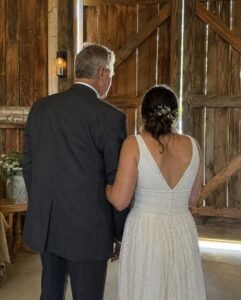
On the second anniversary of our wedding, the photograph I loved most still wasn’t the formal portrait.
It wasn’t the kiss.
It wasn’t even the photograph of Marcos and me beneath the rosemary arch.
It was a picture Jimena took from behind just before the barn doors opened.
Franco stands on the left in his charcoal suit.
I stand beside him in white.
His arm is offered.
My hand rests lightly on it.
Neither of us is looking at the camera.
Ahead of us, the doors are still closed.
You can see light around their edges.
That is all.
Two people waiting for a door to open.
On the back of the printed copy, I eventually wrote one sentence.
Family is who shows up.
The picture hangs in my workshop beneath Franco’s wooden sign.
Every morning, I unlock the door.
I turn on the lights.
I walk past the shelves with my initials hidden inside.
Sometimes my hands are clean.
Usually they aren’t.
And before the first employee arrives, before the trucks start, before phones ring and clients need decisions, there is a minute when the workshop is completely quiet.
In that minute, I sometimes think about the phone call three days before my wedding.
Dad telling me he wouldn’t walk with me.
Mom telling me to go alone.
Vanessa believing my happiness had to be reduced because hers had become difficult.
For a long time, I imagined that memory would always feel like rejection.
It doesn’t.
Not anymore.
Now I remember what came after.
The drive to Robledo.
Franco setting down his sanding block.
When do you need me?
The new charcoal suit.
Grandma Elena’s voice after eleven years of silence.
You have always been the builder.
The barn doors opening.
Two hundred people turning.
Marcos smiling at the far end.
And a man who had no obligation to me offering his arm because he had been waiting for the chance to show up.
My father thought his absence would define that walk.
It didn’t.
Vanessa thought she could make the moment smaller.
She couldn’t.
My mother thought I should quietly accept whatever was left.
I stopped doing that.
What defined that day was not who failed me.
It was who stood beside me after they did.
And once I understood that, I stopped measuring my life by empty chairs.
I started counting the people who arrived.
“`
If you came here from Facebook because of this story, return to the Facebook post, tap Like, and comment exactly “Amazing” to support the storyteller. That small action means more than it seems and gives the writer genuine encouragement to keep sharing more stories about family pressure, firm boundaries, and finally protecting what you worked so hard to build.