
We actually laughed out loud when we discovered the frantic message carved deep into the wood of our new home’s upstairs closet.
NEVER GIVE THE HARRISES A KEY.
At the time, the warning felt utterly ridiculous. Our neighbors, Tom and Linda Harris, were the epitome of suburban perfection. They had greeted us on move-in day with warm smiles, a fresh tray of lasagna, and helpful advice about the neighborhood’s trash collection schedule. The idea that these sweet, middle-aged people were a threat seemed like a joke.
The Breach of Sanctuary
I stared at my phone, barely remembering to breathe. Tom and Linda Harris were standing on our front porch. Tom was holding something metallic in his hand. At first, my brain tried to rationalize it—I assumed it was his smartphone or a garage door opener. But then he lifted it directly toward our front door lock.
It was a key.
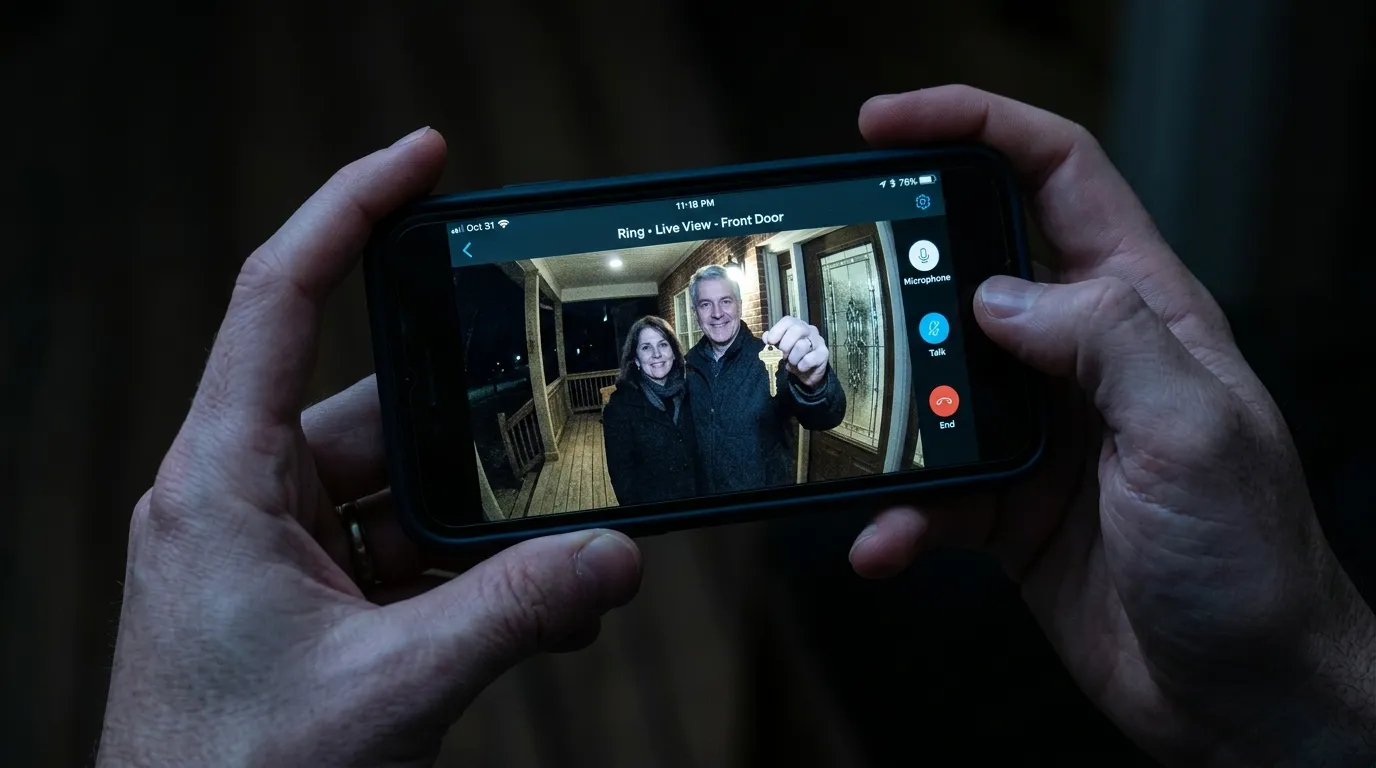
The moment our “perfect” neighbors unlocked our front door while we were hours away.
I shot upright so quickly I nearly spilled my iced tea across the rug. My husband, Jason, looked over at me in alarm.
Without saying a single word, I handed him my glowing phone. Together, in stunned silence, we watched Tom smoothly slide the key into our deadbolt. It turned with ease. The heavy wooden door clicked open. Linda cast a nervous glance over her shoulder before scurrying inside after him. Then, the heavy door swung shut behind them.
Jason stared at the dark screen. “What the hell?”
My fingers were already trembling as I dialed the police. “We never gave them a key, Jason. Never.”
“I know that,” he replied, his voice hardening.
“Maybe Margaret gave them one before she moved out?” I suggested, grasping at straws.
Instantly, the ominous words carved into the upstairs closet flashed like a neon sign through my mind.
DON’T EVER GIVE THE HARRISES A KEY.
“No,” I said quietly, a cold dread washing over me. “I really don’t think she did.”
Even though we were a two-hour drive away, Jason immediately grabbed his car keys. We practically flew down the highway. The police called us while we were still en route. Two officers had already reached the property and done a perimeter check.
Tom and Linda were gone. The house was locked. There were zero signs of forced entry, and nothing obviously seemed to be missing or out of place.
“Ma’am, did these neighbors have permission to enter your house?” the officer asked over the car speakerphone.
“Could they have gotten a key from the former owner?”
“I don’t know.” I hated myself for giving that answer. For six entire months, Margaret’s desperate warning had been sitting in the dark, only a few feet from where we slept peacefully every single night. And we had laughed about it. We had thought she was just a paranoid old woman.
Secrets Hidden in the Concrete
When we finally pulled into our driveway, two police cruisers were parked outside with their lights flashing, casting eerie red and blue shadows across the lawn. Next door, the Harris house was completely dark and entirely silent.
Officer Ramirez met us at the front steps. “Is there anything especially valuable, sensitive, or private hidden in the house?”
Jason shook his head, looking bewildered. “Just laptops. Some everyday jewelry. Normal things.”
Then, a sudden thought struck me like lightning. “The basement office.”
Jason frowned, clearly confused. “What about it?”
I was already pushing past them, walking briskly down the stairs to the basement. The tiny, windowless office tucked behind the laundry room appeared completely untouched. The heavy oak desk was exactly where we left it. The bookshelf looked perfectly normal. The metal filing cabinet was securely closed.
But then I looked down and noticed the rug.
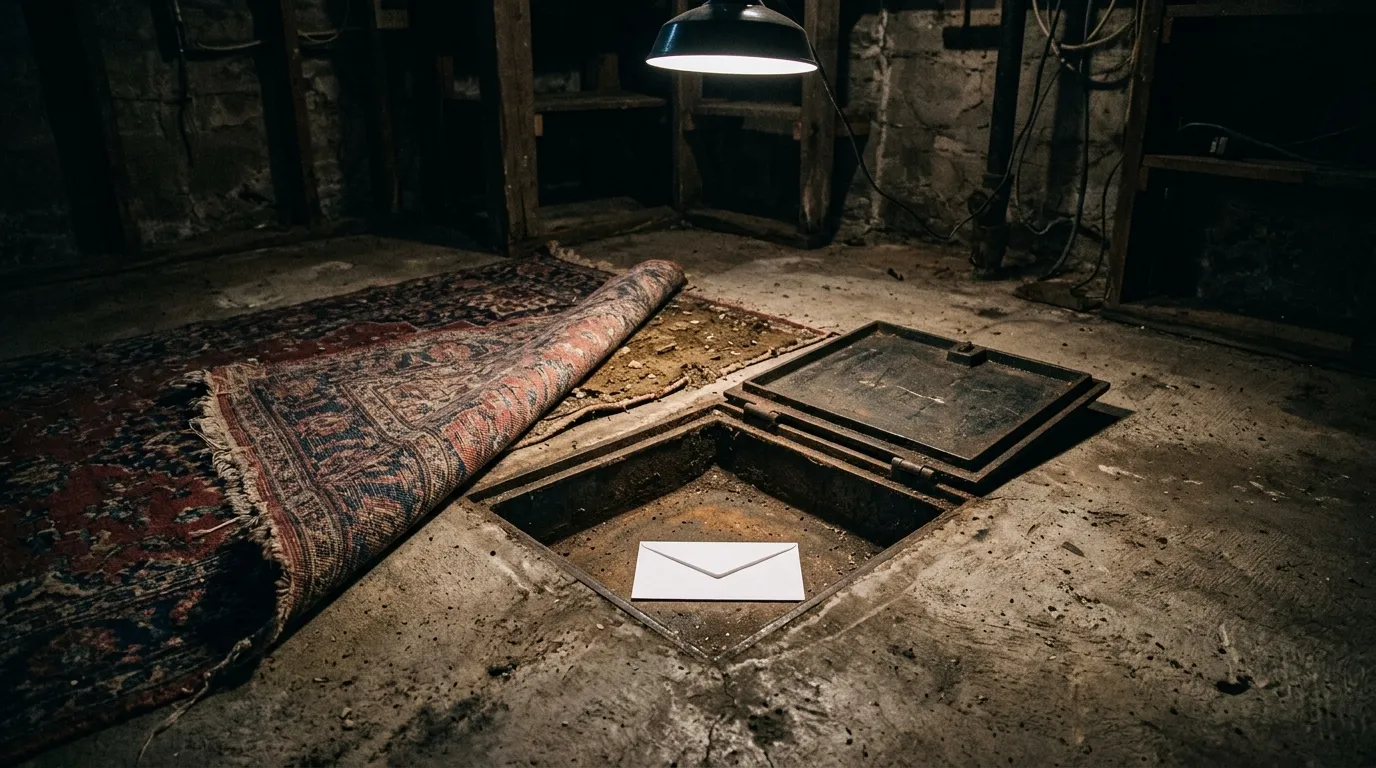
The hidden floor safe we had lived above for six months without ever knowing.
Jason stared at it, his jaw dropping. “I’ve never seen that before in my life.”
Neither had I. Officer Ramirez put on a pair of blue latex gloves and carefully lifted the heavy metal panel. Beneath it was a shallow, heavy-duty floor safe. And it was already popped open.
Inside, there was nothing but years of accumulated dust and a single, crisp white envelope. Written across the front, in neat cursive, was my name: Emily.
Officer Ramirez carefully opened the envelope and handed me the note. The very first sentence made my stomach drop into my shoes.
If you’re reading this, they came back.
The message was from Margaret, the sweet, elderly woman who had owned the house before us. My knees suddenly felt weak, and I had to lean against the wall. The letter continued:
A ten-digit phone number was scribbled beneath the message. My hands shook as I dialed it right there in the basement.
The True Cost of Trust
“Margaret?” I asked when the line connected.
There was a long, heavy silence. Finally, an older woman answered cautiously. “Who is this?”
“My name is Emily. My husband Jason and I bought your house six months ago.”
Another tense pause followed. Then she said something that chilled me to my core. “They got inside, didn’t they?”
It wasn’t a question. It was a statement of fact.
“Yes,” I breathed.
I heard her exhale sharply through the phone. “Oh, God.”
I sank down onto the bottom basement step, feeling entirely overwhelmed. “Margaret, please, tell me what’s happening. Who are these people?”
Margaret stayed quiet for several seconds, gathering her thoughts. When she began, her story shattered every illusion I had about our idyllic neighborhood.
“Tom and Linda were my best friends for twenty-five years,” she started.
Linda naturally had a key to Margaret’s house, and Margaret had a key to theirs. “For emergencies,” Margaret explained sadly.
Then, tragedy struck. George developed aggressive pancreatic cancer. He passed away eight years before Jason and I bought the property. Afterward, Tom and Linda became even more fiercely involved in Margaret’s daily life. Linda brought over fresh groceries every week. Tom came over to fix leaky faucets and mow the lawn.
“At first, I deeply appreciated it,” Margaret said, her voice cracking slightly.
“At first?” I prompted.
She sighed heavily. “Then I started noticing things. Small things. Drawers that I distinctly remembered closing were left open. My private mail had been shifted on the counter. Small amounts of cash disappeared from my purse. A bottle of expensive wine would be opened, even though I couldn’t remember drinking any.”
None of it was serious enough to prove to the police. And because she was an older widow deep in the throes of grief, Tom and Linda easily blamed every strange incident on Margaret’s “forgetfulness.”
“They gaslit me,” Margaret said. “I honestly thought I was losing my mind.”
The Motive Behind the Madness
One specific envelope vanished.
“What was in the envelope?” I asked, gripping the phone tighter.
“Financial records involving Tom.”
Margaret explained that years earlier, her husband George and Tom had invested together in several small, local construction projects. Eventually, George made a sickening discovery: Tom had been embezzling company money to quietly pay off his own massive personal debts. It wasn’t enough to completely bankrupt the business, but it was enough to permanently destroy their partnership and friendship.
George forced Tom into a buyout. But George, being a smart man, kept copies of all the damning financial records locked in his safe, just in case Tom ever tried to sue him or claim George owed him money.
“And those exact records disappeared from the safe?” I asked.
“Yes. But I couldn’t prove Tom took them.”
So, Margaret devised a clever test. She placed an old family photograph inside the floor safe in a highly specific, measured position. Then, she packed her bags and left town for two nights without breathing a word to Tom or Linda.
When she returned home, the photograph had been moved.
The very next morning, a terrified Margaret hired a locksmith to change every single lock on the house. Not long afterward, Linda casually approached her and asked why her “emergency key” no longer worked.
Margaret gave a dry, humorless laugh over the phone. “She claimed she thought she heard a strange noise and just wanted to ‘check the house’ to make sure I was safe.”
“While you weren’t even home?”
“Exactly.”
Margaret laid down the law, explicitly telling them never to set foot in her house again. Linda wept crocodile tears. Tom became incredibly furious and defensive.
That’s when the psychological warfare truly began. Margaret would return from the store and find her fresh groceries already sitting on her kitchen counter. Laundry she hadn’t gotten around to folding would suddenly be neatly stacked on her bed. A window she strictly remembered leaving open for a breeze would be locked tight.
All of this happened after the locks had been changed.
“How were they getting inside?” I asked, terrified.
“I didn’t know,” Margaret admitted. She eventually installed hidden cameras, but for months, nothing happened. Then, one of her cameras simply disappeared. Completely vanished. Meanwhile, Tom began spreading vicious rumors around the neighborhood, telling everyone that Margaret had become horribly paranoid and unstable after George died. Some neighbors believed the lies. Others just wanted to stay out of the drama.
“That’s when I finally broke down and decided to sell the house,” Margaret said softly.
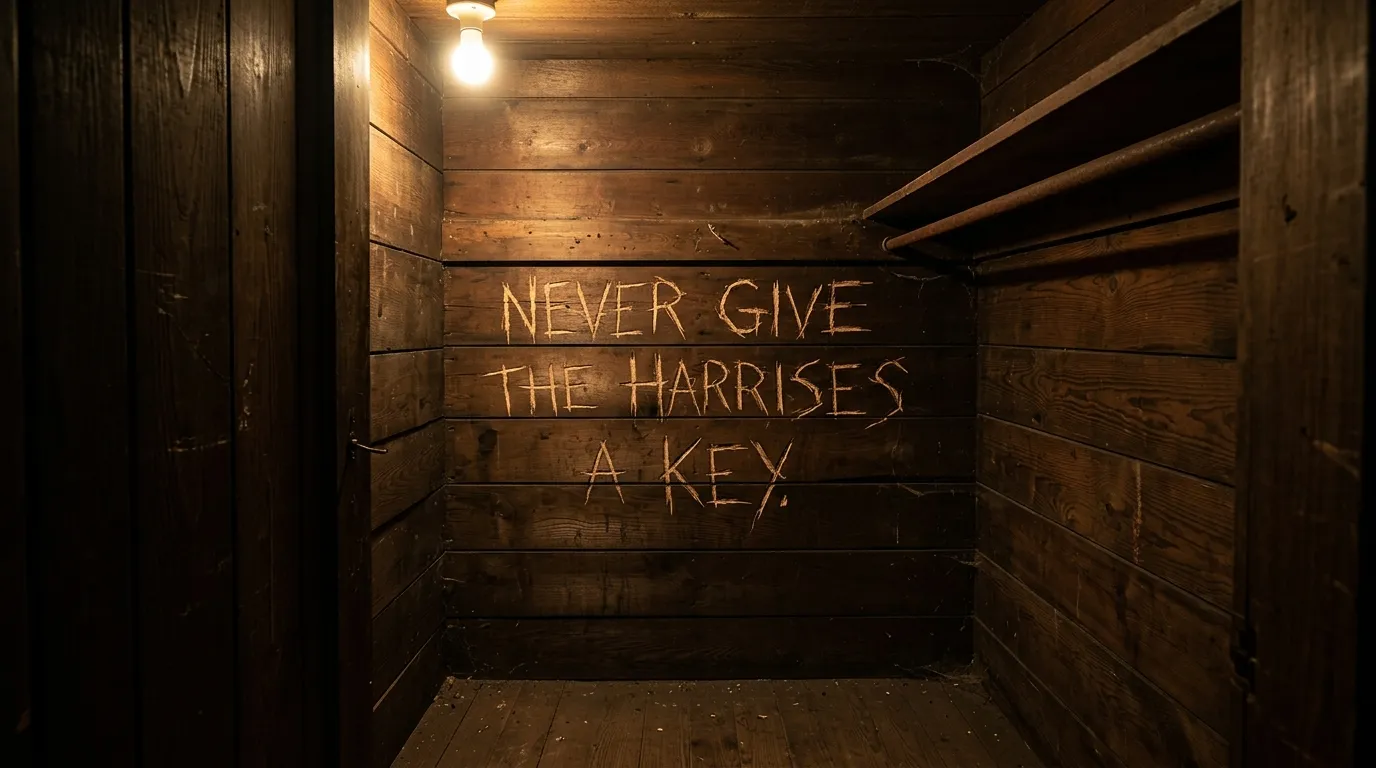
The desperate warning left by Margaret to protect the next owners.
I looked at the handwritten note still trembling in my hand. “Margaret… why didn’t you just warn us when we bought it?”
She hesitated. “My real estate attorney strongly advised me not to make wild accusations in writing that I couldn’t legally prove. He said Tom could sue me for slander and ruin the house sale.”
“So you scratched a permanent warning into the closet wood instead.”
“Yes. Because Linda always hated that closet. I knew she wouldn’t look in there if they managed to sneak in during the real estate showings.”
Jason leaned in closer to the phone. “Margaret, if George’s documents disappeared years ago, why on earth would Tom still be breaking in and searching now?”
Margaret didn’t have a good answer. But suddenly, my blood ran cold as a memory surfaced.
The night before our weekend trip, Tom had been chatting with Jason over the fence. He casually asked if we kept a “spare house key” hidden under a rock or in a fake planter, just in case we ever got locked out. He didn’t ask about our alarm system. He didn’t ask if family was checking on the place.
He was fishing to see if we had a key he could grab.
Eyes in the Dark
I looked around the basement office. Linda clearly knew where this room was. Tom knew exactly what model garage door opener we had. They knew far, far too much about our daily routines.
Acting on pure adrenaline, I began aggressively yanking open the desk drawers. The heavy bottom drawer jammed violently. Jason stepped in and pulled much harder until the wood shrieked and it finally slid completely out of its tracks and crashed to the floor.
Behind where the drawer usually sat, tucked into a narrow, hidden void in the desk’s framing, sat a small, matte-black object.
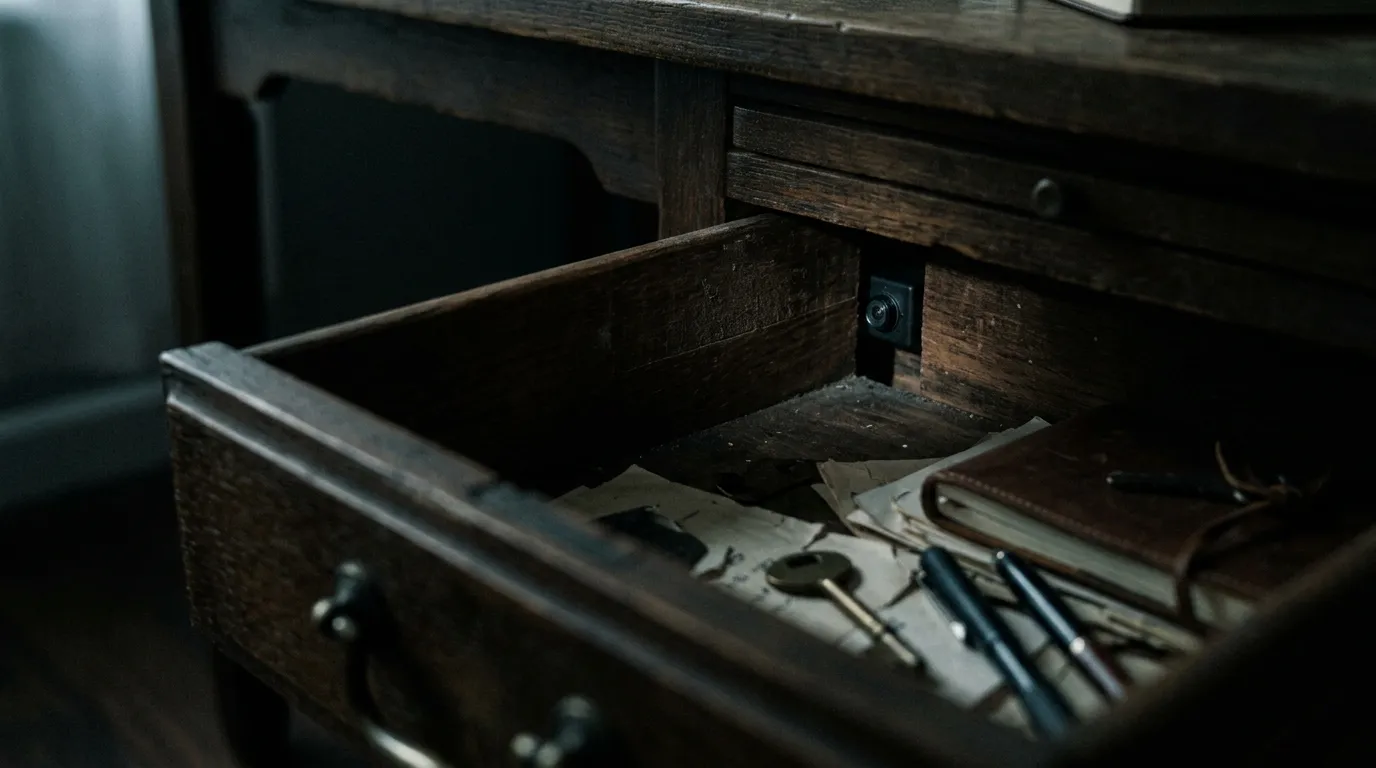
The horrifying discovery behind our basement desk.
Officer Ramirez immediately shouted, stopping us from touching it. He knelt down, wearing his gloves, and carefully extracted it.
It was a tiny, high-tech, battery-powered spy camera.
My entire body went completely numb. “What the hell?” I whispered, feeling deeply, physically violated.
The police immediately initiated a full sweep of the house. They found two more hidden cameras. One was meticulously tucked behind a thick row of books on our living room bookshelf. Another had been expertly wired inside a smoke detector in the upstairs hallway.
Thankfully, they found none inside the bedroom or the bathrooms. But that barely provided any comfort. We had been watched. Monitored. Hunted in our own sanctuary.
The Confrontation
More police officers were dispatched to the scene. I sat outside on the cold concrete front steps, wrapping a blanket around my shoulders, while Jason paced the lawn like an angry tiger.
Suddenly, the front door of the Harris house creaked open. Linda walked slowly across the grass toward us, her face pale.
“Emily?” she called out timidly.
I stood up, my fists clenched. Officer Ramirez immediately stepped between us to keep the peace.
“Where’s Tom?” I demanded, my voice shaking with rage.
“He’s… he’s inside,” she stammered.
“You entered my house today, Linda.”
Her expression shifted instantly into a mask of neighborly concern. “Emily, we were just checking on something. We thought we heard a noise—”
“With a key we never gave you!” I shouted.
“I can explain!”
Officer Ramirez nodded sternly. “Good. You can explain it to me.”
Just then, Tom marched outside. Unlike Linda, who looked terrified, Tom looked deeply irritated, as if we were wasting his valuable time. “This is completely ridiculous,” he scoffed.
I almost laughed at the audacity. Margaret had told me this was exactly how he operated. He always made his victims feel like they were the unreasonable ones.
Jason stepped forward, getting into Tom’s personal space. “You broke into our house, you piece of garbage.”
Tom pointed a thick finger at me. “Your wife is hysterical and overreacting.”
Jason’s expression turned lethal. “Do not ever talk about my wife.”
“We were trying to help!” Tom insisted smoothly.
“With what?” Jason growled.
Tom’s eyes darted nervously toward our house for a fraction of a second. It was incredibly brief, but I caught it. And so did the veteran police officer standing next to us.
“We found the cameras, Tom,” I said clearly.
Linda’s face completely collapsed in terror. Tom’s expression, however, remained totally blank. That sociopathic lack of reaction told me everything I ever needed to know about him.
Linda whimpered his name. “Tom…”
He spun on her, his eyes flashing with sudden menace. “Don’t say a word.”
When Officer Ramirez calmly informed them that detectives were currently drafting a search warrant for their property, Linda finally broke. She began sobbing uncontrollably on our lawn.
“Please,” she begged.
Tom glared at her. “Go home, Linda. Now.”
“No,” she whispered.
“Linda!”
She shook her head defiantly, tears streaming down her face. “I’m done, Tom. I’m so done.”
She turned to the police. “We had a key made.”
Jason froze. Officer Ramirez pulled out a notepad. “When?”
“Two months ago.”
“How did you get their key to copy it?”
Linda wiped her tear-stained face. “Tom copied Jason’s key.”
Suddenly, a memory from moving week hit me like a physical blow. Tom had generously loaned us a heavy extension ladder. He had spent an hour helping Jason carry heavy boxes through the garage. Jason had absentmindedly left his keychain sitting on the garage workbench. Apparently, in those few minutes alone, Tom had pressed our front-door key into a mold to take an impression, and later forged a perfect duplicate.
Jason looked physically sick, betrayed by his own neighborly trust. “Why? Just tell me why.”
Linda pointed a trembling finger at her husband. “Because he desperately wanted access to your basement.”
Under questioning, Linda finally confessed to everything Margaret had suspected for years. Tom had indeed stolen George’s financial records from the safe years ago. But Tom’s paranoia ran deep. Once Margaret became suspicious and changed the locks, Tom convinced himself that George—being a meticulous businessman—must have hidden a second set of backup documents somewhere in the house.
Because George used the basement room as his primary office, Tom was obsessed with tearing it apart to find the phantom copies.
“So you searched our house?” I asked, disgusted.
“Twice,” Linda admitted softly.
“And the cameras?”
Linda stared at the grass. “We put them there so we could monitor you… so we would know if you discovered the safe or found any documents before we did.”
I felt profoundly violated. For six months, we had walked around our home in our pajamas, argued, cooked dinner, and watched movies, entirely believing our lives were private. Meanwhile, the monsters next door felt entitled to watch our every move and walk into our home whenever they pleased.
The Aftermath and Reclaiming Our Home
Tom was arrested that night. When police executed the search warrant on the Harris home, the discoveries were horrifying. They found Margaret’s missing envelope containing the original embezzlement proof. They found blank keys and a professional key-forging kit. Worst of all, they found a thick manila folder boldly labeled: COLLINS HOUSE.
It was a dossier on us. Inside were meticulously hand-drawn maps of our basement, lists of our vehicles, and creepy notes detailing our daily routines:
- Monday — both cars gone by 8:15 AM.
- Thursday — Jason home early from the gym.
- Weekend — unpredictable, check cameras first.
They hadn’t just been our neighbors; they had been studying us like prey.
The criminal investigation dragged on for months. Not every accusation from Margaret’s past could be easily prosecuted due to the statute of limitations. But investigators had rock-solid, current evidence involving illegal entry, unauthorized surveillance, possession of stolen property, and the forged key. Linda cut a deal and fully cooperated with the police, which gave them the nail in Tom’s coffin.
Two weeks later, Linda packed up her life and moved away to another state. Before she left, she actually came to our door to apologize. I listened, but I didn’t forgive her. Helping a monster for years makes you a monster, too.
About a month later, Margaret came back to visit us. She walked upstairs, stood in the closet, and smiled softly at the frantic sentence she had carved into the wood all those years ago.
Jason chuckled grimly. “Margaret, why didn’t you just write, ‘They break into houses and plant cameras’?”
Margaret laughed, a sound of genuine relief. “Jason, would you honestly have believed me?”
He paused, then sighed. “Probably not.”
That was the most terrifying part of this entire ordeal. Tom and Linda had seemed like wonderful, ideal neighbors. They brought us baked goods. They loaned us tools. We are conditioned to imagine dangerous people as sketchy strangers glaring through fences or lurking in dark alleys. We never suspect the smiling people who kindly drag our empty trash cans back from the curb on Tuesday mornings.
We changed every single lock in the house, including the electronic garage codes. We ripped out the old alarm system and installed top-of-the-line, encrypted security cameras of our own. We even hauled the heavy basement desk to the town dump because I couldn’t bear to look at it without remembering the black lens watching me.
Today, the basement office belongs entirely to me. I work from there twice a week. At first, I was paranoid, inspecting every shadowy corner. But eventually, the trauma faded. It feels like we finally reclaimed the soul of our home.
The Harris house eventually sold. A sweet young couple moved in, and a few days later, they walked over holding a warm plate of homemade chocolate chip cookies.
Jason stared at them through the screen door with extreme suspicion. “Absolutely not,” he muttered under his breath.
I laughed so hard I nearly dropped my coffee mug. We accepted the cookies (which were delicious), but no—our new neighbors absolutely do not have a spare key. Nobody does.
Not because I’m completely paranoid or believe everyone is evil, but because I finally learned that setting firm boundaries isn’t rude. I refused to let Jason paint over Margaret’s carved warning in the closet. We repainted the walls, replaced the trim, and put in new shelving, but those jagged wooden letters remain untouched.
DON’T EVER GIVE THE HARRISES A KEY.
I keep it there to remind myself of a very hard lesson: Once entitled people convince themselves they have the right to your life, a locked door stops looking like a boundary to them. It just becomes an obstacle.
Have you ever had an experience with a neighbor who crossed a major boundary, and how did you handle it?