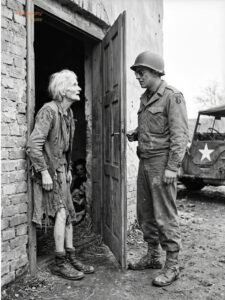
On May 7, 1945, as World War II was finally coming to an end, a young American soldier walked into a small factory building in Volary, Czechoslovakia, and witnessed a scene he would never forget. Inside were dozens of women who had survived one of the darkest chapters in human history. They were exhausted, starving, and barely recognizable as the people they had once been. Among them was a young woman named Gerda Weissmann, a Holocaust survivor who weighed only about thirty kilograms after enduring years of persecution, forced labor, and a brutal death march across Europe.
She had lost nearly everything.
Her parents were gone. Her brother was gone. Her childhood was gone. The future she once imagined had disappeared beneath the cruelty of Nazi Germany.
But on that spring day, when a soldier wearing an American uniform entered the building, Gerda experienced something she had not felt in years.
Hope.
She looked at him and spoke three words that carried the weight of her entire identity and suffering:
“We are Jewish, you know.”
The soldier stood silently for a moment.
Then he answered with two words that would change both of their lives forever.
“So am I.”
His name was Kurt Klein.
Their meeting was not only the beginning of a remarkable love story. It was a moment when two survivors of unimaginable loss found each other and proved that compassion, dignity, and love could still exist after humanity had witnessed its darkest days.
A Happy Childhood Before the Storm
Gerda Weissmann was born on May 8, 1924, in Bielsko, Poland, into a loving Jewish family.
Before the war, her life was filled with the ordinary joys that many young people experience. She lived with her parents, Julius and Helene Weissmann, and her older brother Arthur. Her father was a successful fur manufacturer, and her mother created a warm and stable home where family was the center of everything.
Arthur was not simply her brother. He was her closest companion. Like many teenagers of her generation, Gerda attended school, spent time with friends, enjoyed books and music, and dreamed about the future.
She believed life would continue exactly as she knew it.
But history was about to change her world forever.
On September 1, 1939, German forces invaded Poland. The sound of aircraft overhead marked the beginning of World War II and the destruction of millions of lives.
At first, many people hoped the conflict would be temporary. But for Jewish families across Europe, the Nazi occupation brought a systematic campaign of discrimination, persecution, and terror.
Laws were introduced that stripped Jewish people of their rights. They were removed from schools and professions. Their movements were restricted. Their property was taken. Their communities were slowly destroyed.
For Gerda, the changes were devastating because they happened step by step.
The life she knew did not disappear in a single moment.
It was taken away piece by piece.
By 1942, Gerda and her family were forced into the Bielsko ghetto. Soon afterward came the deportations that separated countless families throughout Europe.
Her parents were sent to Auschwitz.
Her brother Arthur had already been taken away.
Gerda never saw any of them again.
Like millions of other victims of the Holocaust, her family was murdered by the Nazi regime.
At only eighteen years old, Gerda was alone in the world.
But before she was separated from her family, her father gave her one piece of advice that would later save her life.
He told her to wear her ski boots.
It was summer, and the instruction seemed unusual.
But Julius Weissmann understood that difficult times might come. Strong footwear could become essential for survival.
Gerda listened.
Those boots would later carry her through one of the most dangerous journeys of her life.
Surviving the Camps
After losing her family, Gerda was sent into the Nazi forced labor camp system connected to Gross-Rosen concentration camp.
Between 1942 and 1945, she endured years of hunger, exhaustion, fear, and uncertainty.
She worked in textile factories under brutal conditions alongside thousands of other prisoners.
Every day became a struggle.
Food was scarce.
Medical care was almost nonexistent.
The prisoners were treated as if their lives had no value.
Yet even in those terrible conditions, Gerda discovered that survival depended on more than physical strength.
It depended on maintaining a reason to continue.
She held onto memories of her family.
She remembered her father’s voice.
She remembered the home she had lost.
She remembered that she was still a human being, even when the Nazis tried to take away every sign of individuality and dignity.
Small acts of kindness became important.
A shared piece of food.
A comforting word.
A moment of friendship.
These simple gestures reminded prisoners that cruelty had not completely destroyed compassion.
Gerda survived one day at a time.
Then, in early 1945, as Allied forces moved closer and Germany faced defeat, the Nazis began evacuating concentration camps.
They did not want prisoners to be liberated and reveal what had happened.
Thousands of prisoners were forced to leave the camps on brutal marches through freezing winter conditions.
For Gerda, another unimaginable test was about to begin.
The 106-Day Death March
On January 29, 1945, Gerda and approximately two thousand other Jewish women were forced to leave the Grünberg camp.
They began a journey that would last 106 days.
They walked through winter landscapes, across hundreds of kilometers, wearing inadequate clothing and receiving almost no food.
Many prisoners were too weak to continue.
Some collapsed from exhaustion.
Others became sick and could not walk any farther.
The women were surrounded by guards and forced forward despite their suffering.
For Gerda, the march became a battle between life and death.
The women who walked beside her became her new family.
They shared the same suffering.
They encouraged one another.
They tried to protect each other.
But one by one, those companions disappeared.
Gerda later remembered many of the women who did not survive.
Their names remained with her because she believed that remembering them was a responsibility.
The world needed to know they had existed.
They had families.
They had dreams.
They had lives before the war.
The march continued for weeks.
Then months.
Through snow, cold, hunger, and exhaustion, Gerda kept walking.
And beneath her feet were the ski boots her father had insisted she wear years earlier.
A small act of love from a father had become a lifeline.

The Day Liberation Arrived
By May 1945, Germany was collapsing.
The war in Europe was ending.
But for the surviving women of the death march, freedom still seemed impossible.
When they finally reached Volary, Czechoslovakia, fewer than 150 of the original 2,000 women were still alive.
They were abandoned inside an old factory building.
Gerda was among them.
She was extremely weak.
Her body had been destroyed by years of suffering.
She had not lived a normal life for years.
She had only survived.
Then, suddenly, she heard something outside.
Vehicles.
Voices.
Footsteps.
But this time, they were not German soldiers.
An American military jeep approached the building.
The soldiers wore uniforms marked with the symbol of liberation.
Among them was Lieutenant Kurt Klein.
Kurt was twenty-four years old and serving in the United States Army.
He had also experienced the pain of losing family during the Holocaust.
Born in Germany, Kurt had been sent to America as a teenager because his parents wanted to save him from growing persecution.
He escaped.
His parents did not.
They were later murdered at Auschwitz.
Standing inside that factory, Kurt was facing someone whose story reflected his own.
Two strangers.
Two survivors.
Two people connected by a tragedy they never should have experienced.
When Kurt approached Gerda, he asked whether she spoke English or German.
She answered.
Then she told him:
“We are Jewish, you know.”
Kurt replied:
“So am I.”
Those words represented more than shared religion.
They represented recognition.
For years, Gerda had been treated as less than human.
Suddenly, someone saw her.
Not as a prisoner.
Not as a victim.
But as a person.
Kurt later opened the factory door and allowed Gerda to walk ahead of him.
To many people, it was a simple gesture.
But to Gerda, it meant everything.
She later described that moment as the restoration of humanity, dignity, and freedom.
After years of being forced behind walls and fences, someone had finally opened a door for her.
A Love Story Born From Survival
After liberation, Kurt and Gerda continued to see each other.
Kurt helped care for survivors, while Gerda recovered from her illness.
Their friendship slowly became something deeper.
They understood each other in a way few people could.
Both had lost parents.
Both had lost their homes.
Both had survived a world that had tried to destroy them.
In September 1945, Kurt proposed.
But their journey was not simple.
Military obligations and immigration restrictions kept them apart for nearly a year.
Finally, on June 18, 1946, they were married in Paris.
They later moved to Buffalo, New York.
There, they built a new life together.
They raised three children.
They created the family that the Holocaust had taken away from them.
But Gerda never forgot those who did not survive.
She understood that survival carried responsibility.
She believed those who lived had a duty to tell the truth.
Sharing Her Story With the World
In 1957, Gerda published her memoir, “All But My Life.”
The book became one of the most widely read personal accounts of the Holocaust.
Through her writing and speaking, Gerda gave a voice to millions who could no longer speak for themselves.
She visited schools, universities, and communities around the world.
She spoke about hatred, prejudice, courage, and the importance of protecting human dignity.
Her message was never about revenge.
It was about remembrance.
She wanted future generations to understand that ordinary people have the power to choose kindness or cruelty.
She often reminded audiences that freedom should never be taken for granted.
In 1995, her story became the HBO documentary “One Survivor Remembers.”
The film won the Academy Award for Best Documentary Short Subject.
When Gerda accepted the award, she reflected on how her understanding of victory had changed.
During the Holocaust, winning meant simply receiving a piece of bread or surviving another day.
Later in life, victory meant something much greater.
It meant being alive to tell the story.
A Life Dedicated to Hope
In 2011, President Barack Obama awarded Gerda Weissmann Klein the Presidential Medal of Freedom, one of the highest civilian honors in the United States.
But Gerda never viewed herself as someone special.
She saw herself as someone responsible.
She continued speaking because she believed memory was essential.
She co-founded Citizenship Counts, an organization focused on teaching young people about citizenship and civic responsibility.
She understood the value of belonging to a country where freedom and opportunity were possible.
The nation that welcomed her had given her a second chance at life.
The Legacy of Gerda Weissmann Klein
Kurt Klein passed away in 2002.
Together, he and Gerda had shared fifty-six years of marriage.
Their relationship began in the ruins of war but became a symbol of love, resilience, and hope.
Gerda continued telling her story until her final years.
She died on April 3, 2022, in Phoenix, Arizona, at the age of ninety-seven.
Her life represented one of the most powerful lessons of the twentieth century.
The Nazis tried to erase her identity.
They tried to destroy her family.
They tried to take away her future.
But they failed.
Gerda survived.
And she transformed survival into a mission.
She carried the memories of those who never returned.
She spoke for those whose voices were silenced.
She reminded the world that even after unimaginable suffering, human beings still have the ability to choose compassion.
A young American soldier opened a door for a woman who had spent six years surrounded by walls, fences, and fear.
That simple act restored something the Nazis had tried to destroy.
Dignity.
Humanity.
Hope.
Gerda Weissmann Klein’s story is not only about surviving the Holocaust.
It is about what happens afterward.
It is about rebuilding.
It is about forgiveness without forgetting.
It is about choosing to bring light into the world after experiencing darkness.
The door that opened in Volary in 1945 was more than an entrance to a building.
It was the doorway to a new life.
And because Gerda chose to tell her story, that door remains open for generations to come.