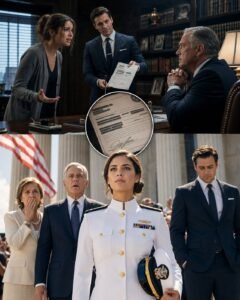
My Family Called Me a Navy Disgrace for Ten Years—Until I Walked Into Federal Court
THE WITNESS THEY ERASED
My parents walked into federal court that morning believing they were there to save their son.
They left knowing they had helped him bury their daughter.
The rear doors opened just after nine-thirty.
Light from the courthouse windows caught the white shoulder boards of my ceremonial uniform first, then the medals over my chest, then my face.
For one strange second, nobody in the courtroom seemed to breathe.
My shoes struck the polished floor.
Once.
Twice.
Three times.
Each step carried me closer to the witness stand and farther from the nineteen-year-old girl who had once stood in my father’s study begging him to believe her.
My mother saw me first.
Judith Moore’s fingers opened.
Her purse fell from her lap and struck the floor with a crack loud enough to make people turn.
She didn’t reach for it.
She only stared.
My father rose halfway from the wooden bench behind the defense table, one hand gripping its back.
Warren Moore had always been a large man, broad through the shoulders, silver-haired even before I left home, the kind of man who believed posture could substitute for certainty.
That morning, he looked suddenly old.
Then Grant turned around.
My brother had spent most of the trial sitting straight-backed beside his attorney, composed enough to make fraud look like an administrative misunderstanding. His suit was dark navy. His tie was conservative. His hair had been cut three days earlier, because Grant understood the theater of respectability better than anyone I had ever known.
Harbor Shield Recovery had been built on that theater.
Grant Moore, hometown businessman.
Grant Moore, generous donor.
Grant Moore, reliable son.
Grant Moore, the man who supposedly carried our family after his unstable younger sister washed out of the Navy and disappeared.
He had rehearsed that version of himself for a decade.
Then he looked at me in dress whites.
And the performance cracked.
Not completely.
Grant had always been too disciplined for that.
But I saw it.
His mouth opened slightly.
His face lost color.
His right hand tightened around the pen lying in front of him.
For the first time in ten years, my brother was looking at something he could not rewrite before anyone else saw it.
Me.
The prosecutor waited until I reached the front of the courtroom.
« Please raise your right hand. »
I did.
I swore to tell the truth.
There had been a time when those words would have felt ironic.
The truth had never protected me inside the Moore family.
The truth had been something Grant bent, my parents negotiated with, and I exhausted myself trying to prove.
But a federal courtroom was different.
Here, lies had to survive documents.
Dates.
Signatures.
Records.
Questions.
Here, Grant could not close the study door, lower his voice, and tell our parents I was confused.
Here, my father could not say, « Your brother has the paperwork, Leah. »
Here, my mother could not touch my arm and whisper, « Please don’t make this uglier than it already is. »
Here, the truth did not need permission from my family.
The prosecutor stepped toward the witness stand.
« Please state your full name and title for the record. »
I looked straight ahead.
Not at Grant.
Not yet.
« Lieutenant Commander Leah Moore, United States Navy. »
Behind the prosecutor, somebody shifted.
My mother made a sound so small I almost didn’t hear it.
My father’s knees seemed to give beneath him. He lowered himself slowly onto the bench.
Grant did not move.
The prosecutor let the silence settle.
« Lieutenant Commander Moore, are you related to the defendant? »
« Yes. »
« How? »
« He’s my older brother. »
For the first time, I looked at him.
Grant met my eyes.
Ten years vanished.
I saw him at twenty-four, leaning against our mother’s kitchen counter, telling me not to embarrass Dad by joining the Navy if I wasn’t sure I could handle it.
I saw him at twenty-seven, smiling beside our grandfather at Thanksgiving while asking casual questions about the marsh property.
I saw him across my father’s study desk, one hand resting on forged discharge papers, wearing concern like a costume.
And now I saw him at forty, charged with building a federal contracting business from my identity.
« Lieutenant Commander Moore, » the prosecutor continued, « did you ever give the defendant permission to use your military service record in connection with Harbor Shield Recovery? »
« No. »
« Did you ever authorize him to represent that you had an ownership interest in the company? »
« No. »
« Did you ever sign documents transferring your veteran status, service history, or personal eligibility to Harbor Shield Recovery? »
« No. »
The prosecutor picked up a folder.
Grant’s attorney stood.
« Objection. Characterization— »
« Overruled. »
The judge didn’t look impressed.
The attorney sat.
The prosecutor opened the folder.
« Did you sign this? »
A document appeared on the courtroom screen.
Even before I turned toward it, I knew what it was.
I had spent months looking at copies.
My name appeared near the bottom.
LEAH M. MOORE.
The signature beneath it looked almost right.
Grant had practiced.
The first L rose at the same angle mine did. The M in Moore leaned forward. Even the pressure break between my first and last name had been imitated.
But I knew my own hand.
« No. »
« Is that your signature? »
« It’s a copy of my signature. »
« How can you tell? »
« Because I know what I signed. »
« And did you sign this? »
« No. »
The prosecutor advanced to the next page.
Veteran preference certification.
My service information.
My date of entry.
My branch.
Pieces of my history reduced to typed fields.
Except one section described me as honorably separated.
I felt my jaw tighten.
That lie had traveled farther than I ever imagined.
In my family, I had supposedly been discharged in disgrace.
In Grant’s federal paperwork, I had become honorably separated whenever honorable service made him money.
Even his lies had different uniforms depending on the audience.
The prosecutor asked, « Were you separated from the Navy on the date shown in this document? »
« No. »
« Where were you? »
« Serving. »
A pause.
« Still in the Navy? »
« Yes. »
The prosecutor turned slightly toward the jury.
« For how long after the date your brother represented you as separated? »
I looked at Grant.
« Years. »
His attorney shifted again.
The prosecutor changed the screen.
A photograph appeared.
I had forgotten investigators had included it.
I was standing on a pier in service uniform, younger, thinner, my hair pulled back tight. The date stamped beneath the image fell six months after Grant’s fake discharge paperwork.
My mother covered her mouth.
That hurt more than I expected.
Not because she was seeing proof.
Because I had given her proof years ago.
I had stood in front of her alive.
Apparently, a courtroom exhibit carried more weight than her daughter.
« Lieutenant Commander Moore, » the prosecutor said gently, « I want to go back. Before Harbor Shield Recovery. Before these certifications. Before any federal investigation. »
I knew what was coming.
« Tell the jury what your family believed had happened to your Navy career. »
The question opened a door I had spent years keeping shut.
My hands remained folded.
My posture remained straight.
But somewhere inside me, I was nineteen again.
« My family believed I failed. »
« Why? »
I looked at Grant.
« Because my brother told them I had. »
The courtroom seemed to narrow around us.
Grant’s attorney leaned toward him and whispered something.
Grant didn’t answer.
The prosecutor waited.
« What exactly did he tell them? »
I drew in one slow breath.
« That I’d washed out. That I couldn’t handle the pressure. That the Navy had discharged me. That I was ashamed, unstable, and too embarrassed to come home. »
« And was any of that true? »
« No. »
« What was true? »
I looked down for a moment at the white sleeve covering my wrist.
Then I lifted my eyes.
« The truth was that I stayed. »
I could feel my father’s stare from behind the defense table.
« I stayed through training. I stayed through the nights when I thought exhaustion had become a physical place. I stayed when people around me quit. I stayed when I was afraid. I stayed when I was lonely. I stayed when I stopped receiving letters from home because my brother had convinced my parents I didn’t want them. »
My mother’s hand fell from her mouth.
I kept going.
« I stayed while my family told people I had failed. »
The prosecutor did not interrupt.
« I stayed while Grant built an entire version of me that didn’t exist. »
For ten years, my family had called my silence an admission.
Now they were finally hearing what it had cost me to stop defending myself.
The prosecutor asked, « Why didn’t you correct them? »
A bitter laugh almost escaped me.
« I tried. »
And that was the part Grant had always left out.
I tried until trying became another way to bleed.
I tried before I learned that some people do not reject the truth because the evidence is weak.
They reject it because the lie is more useful.
And nobody had found me less useful than my own family once Grant decided he needed me gone.
The prosecutor closed the folder.
« Let’s talk about that. »
I glanced once toward my parents.
My mother’s face was wet.
My father looked at the floor.
Grant stared straight ahead.
And I began telling the jury how my brother had murdered my reputation without ever laying a hand on me.
—
## PART 2: THE STORY GRANT BUILT
I was nineteen when I told my parents I wanted to enlist.
My father stopped cutting his steak.
That was how I remembered it.
Not the date.
Not what I was wearing.
Not what my mother had cooked.
Just Dad’s knife suspended over the plate.
« What did you say? »
« I want to join the Navy. »
Grant laughed.
Not loudly.
One short sound.
Enough.
He was twenty-four then, already working beside Dad, already being introduced as the future of Moore Coastal Holdings even though there wasn’t much of a company to inherit. My grandfather owned some land. My father had made good investments. Grant had ambition.
In our family, ambition counted for more when it wore a tie.
Dad put down his knife.
« You want to enlist. »
« Yes. »
« Why? »
I had answers.
I wanted structure.
Purpose.
A life that belonged to me.
I wanted to prove to myself that discipline could be learned, that fear could be trained through, that my world did not have to end at county lines and family expectations.
What I said was, « Because I think I can do something meaningful. »
Grant took a drink of water.
Dad stared at me.
« Then don’t start something you can’t finish. »
That sentence stayed with me through every hard day that came after.
Not because it encouraged me.
Because I knew he expected to be right.
My mother worried in softer ways.
She asked whether I would be safe.
Whether I had really thought about it.
Whether I wouldn’t rather go to college nearby.
She told me I didn’t have to prove anything.
Grant was the only one who smiled.
« If she wants to find out, » he said, « let her. »
At nineteen, I mistook that for support.
I would learn better.
Training stripped the romance out of everything.
There were no dramatic speeches when I was exhausted.
Nobody cared whether I had been underestimated at home.
The work did not adjust itself to my feelings.
That was one reason I loved it.
For the first time in my life, expectations were clear.
Meet the standard or don’t.
Improve or don’t.
Show up or don’t.
Nobody cared that Grant had been the golden child.
Nobody knew my father.
Nobody gave me points for being a Moore.
I was terrible at some things at first.
I learned.
I failed small.
I learned faster.
I became steadier.
The first letter I wrote home was four pages.
My mother answered with six.
My father wrote one paragraph at the bottom.
Proud of you. Keep your head down. Finish what you started.
Grant added a separate note.
Don’t get too comfortable. Hard part’s probably coming.
I smiled when I read it.
I thought that was just Grant.
Grant always needed the last word.
Months became years.
My calls home became harder to schedule.
My parents’ lives continued without me.
Grant moved deeper into Dad’s business affairs.
My grandfather’s health started failing.
Every time I came home, I felt the distance growing in ways I couldn’t name.
It wasn’t hostility.
Not yet.
It was something quieter.
My mother would mention a conversation I didn’t remember having.
Dad would refer to an email I hadn’t sent.
Grant would say, « Leah, we already talked about this. »
Sometimes I assumed exhaustion had scrambled my memory.
Sometimes I wondered whether my family had.
The first obvious fracture came when my mother asked why I needed money.
We were on the phone.
I was standing outside a building with the wind cutting across the parking lot.
« What money? »
There was a pause.
« The money you asked Grant for. »
« I didn’t ask Grant for money. »
Another pause.
Then that careful voice my mother used whenever she believed emotion was about to become embarrassing.
« Leah. »
« Mom, I didn’t ask him for anything. »
« He said you were having trouble. »
« What kind of trouble? »
« I don’t know. He didn’t want to betray your confidence. »
I almost laughed.
Grant had betrayed my confidence our entire childhood. If I had ever truly confessed a weakness to him, he’d have put it on a billboard.
« Can I talk to him? »
« He said you asked him not to tell us. »
« I didn’t ask him anything. »
My mother sighed.
« Maybe you’re overtired. »
That was the first time I heard it.
The doubt.
Not concern.
Doubt.
I called Grant.
He didn’t answer.
Two days later he texted.
Mom misunderstood. Handled it.
I called him again.
« What did she misunderstand? »
« Nothing. Forget it. »
« You told her I asked you for money. »
« I said you might need help. »
« Why? »
« Because you sounded stressed. »
« I didn’t talk to you. »
He laughed.
« Jesus, Leah. Do you want me to apologize for caring? »
That was Grant’s gift.
He could take the knife out of your back and ask why you were bleeding on his shirt.
I should have pushed harder.
Instead I was busy.
I told myself it was one strange conversation.
Then the emails began.
At least, the emails began for my family.
I didn’t know they existed until much later.
Messages from an old account I barely used.
Messages apologizing for not calling.
Messages saying training was becoming too much.
Messages saying I had made mistakes.
Messages asking Grant to keep things from Mom and Dad.
Messages that sounded almost like me because Grant knew exactly which words I used when I was tired.
He had known me my whole life.
He knew my rhythm.
He knew I shortened certain sentences.
He knew I hated sounding helpless.
So his fake version of me resisted help just enough to feel real.
That was the genius of Grant’s lie.
He didn’t make me pathetic.
He made me proud and failing.
Exactly what our father had warned me not to become.
My parents believed it because the story fit a fear they already had.
Then came the forged discharge papers.
Official-looking.
Stamped.
Numbered.
Dense with the kind of administrative language civilians rarely question.
Grant later claimed I had sent them to him because I could not face Dad.
He said I begged him to keep my humiliation quiet.
By then my grandfather had died.
The marshland became part of everything.
It wasn’t glamorous property.
People heard « inheritance » and imagined mansions.
My grandfather’s land was wetlands, scrub grass, tidal creeks, and old boundary markers that leaned in storms.
I loved it.
He used to take me there when I was little.
He taught me how to watch the birds move before weather changed.
He said land didn’t care which child talked louder.
When his affairs were settled, I had an interest in that property.
Grant had always wanted control of it.
At the time, I didn’t understand why.
Development potential.
Collateral.
Prestige.
Maybe simply because it was something I had.
Grant had never needed a reason more sophisticated than that.
Documents moved while I was away.
Family discussions happened without me.
Grant positioned himself as the stable sibling managing the consequences of my supposed collapse.
My father began referring people to him.
My mother signed what Dad told her to sign.
Grant handled details.
My savings account changed.
Then shrank.
Then disappeared into explanations I would not fully understand until years later.
Every loss was tied to the same story.
Leah was gone.
Leah was unstable.
Leah could not be reached.
Leah had asked Grant to take care of things.
Leah didn’t want the family embarrassed.
The first time I came home determined to end it, I wore my uniform on purpose.
I thought physical proof would matter.
That still embarrasses me.
Not the uniform.
The hope.
My father’s study smelled exactly as it always had—wood polish, paper, coffee that had gone cold.
Grant stood near the window.
Dad sat behind his desk.
Mom was in the chair beside it.
On the desk lay the forged papers.
I stared at them.
« Where did you get those? »
Dad’s expression hardened.
« Don’t. »
« Don’t what? »
« Come in here pretending you don’t know what we’re talking about. »
« I don’t know what you’re talking about. »
Grant folded his arms.
« Leah. »
I looked at him.
He gave me a wounded expression.
He had practiced that too.
« You sent them to me. »
« No, I didn’t. »
Dad tapped the pages.
« This has your information. »
« It isn’t mine. »
« Your name is on it. »
« I can see my name. »
My voice rose despite my effort to control it.
« I am standing here in uniform. »
Grant sighed.
« Anybody can keep a uniform. »
I turned toward him so quickly my mother flinched.
« What did you say? »
He looked at Dad instead of me.
« She’s been doing this for months. »
« Doing what? »
« Trying to keep the story going. »
I laughed then because sometimes the truth is so grotesque your body mistakes it for humor.
« What story? »
Dad stood.
« Enough. »
I stared at him.
« I am serving. »
His face tightened.
« Then explain these. »
« I can’t explain forged documents I didn’t create. »
Grant spoke quietly.
« Leah, you asked me to help you. »
« No. »
« You said Dad would never understand. »
« No. »
« You were ashamed. »
« No. »
« You were afraid he’d tell everyone you’d quit. »
« I DIDN’T QUIT. »
My voice struck the walls.
Silence followed.
My mother whispered, « Please. »
That word hurt more than Dad shouting.
Please.
Not please believe her.
Please stop.
Please don’t force us to choose again.
I stepped toward Dad.
I had brought my identification.
Records.
Recent orders.
Things with dates.
Things with numbers.
Things that should have ended the argument.
I placed them on his desk.
« Call. »
Dad frowned.
« Call who? »
« The number. Verify it. Call. Don’t ask Grant. Don’t ask me. Call. »
Grant’s face changed.
Barely.
But I saw it.
So I pushed.
« Do it. »
Dad didn’t reach for the phone.
« Why are you making this into a spectacle? »
I stared at him.
« A spectacle? »
« You disappear for months. »
« I’m stationed away from home. »
« You barely call. »
« I call Mom. »
My mother looked down.
That was when I knew something else was wrong.
« Mom? »
She rubbed her thumb over the strap of her purse.
« Grant said your calls were… confused. »
I felt cold.
« What? »
« He said sometimes you didn’t remember conversations. »
I turned slowly.
Grant’s expression remained calm.
« You told her I’m confused? »
« You are confused. »
I crossed the distance between us before I knew I had moved.
Not to hit him.
I never touched him.
I got close enough that he had to look directly at me.
« What have you been telling them? »
His voice dropped.
« Go back to wherever you’ve been pretending to be. »
The sentence was quiet enough that my parents couldn’t hear it.
I did.
And suddenly I understood.
This wasn’t misunderstanding.
This wasn’t a family communication problem.
My brother knew exactly what he was doing.
I stepped away.
« Give me my savings records. »
Dad’s face closed.
« Leah— »
« My account. The marsh property. Everything with my name on it. »
Grant shook his head.
« Here we go. »
« What did you do? »
My mother stood.
« Leah, if you came home because you need money— »
I turned toward her.
I will remember her face until I die.
She wasn’t cruel.
That would have been easier.
She looked concerned.
Concerned for the daughter she believed had failed and come home demanding money.
« You think I need money. »
She reached toward me.
« Sweetheart— »
I stepped back.
That was the moment.
Not the forged documents.
Not Grant’s whisper.
Not Dad refusing to make a phone call.
My mother reaching for me with pity ended something inside me.
I looked at the three of them.
My brother, who knew the truth.
My father, who could have verified it.
My mother, who preferred a tragic explanation to an uncomfortable question.
And I realized I could spend the rest of my life dragging proof into that room.
Grant would simply manufacture another reason not to believe it.
So I picked up the documents I had brought.
Dad said, « Where are you going? »
I stopped at the door.
« You said not to start something I couldn’t finish. »
His face changed.
I almost smiled.
« I finished it. »
« Leah— »
« I kept finishing it. »
My voice shook then.
I hated that.
« But you needed me to fail more than you needed to know me. »
My mother’s eyes filled.
Grant rolled his.
That little movement erased whatever doubt remained.
I looked at him.
« You won. »
For the first time that evening, he seemed surprised.
I opened the door.
« You get to be the good son. »
Then I looked at my parents.
« And I get to stop begging. »
I left.
For years afterward, Grant told people that was the night I admitted everything.
In his version, I had broken down.
Confessed.
Fled in shame.
He became the son who protected the Moore name.
I became the daughter nobody mentioned unless someone asked too directly.
Grant thought silence meant he had erased me.
What he never understood was that while he was busy inventing the end of my life, I was still living it.
Still working.
Still advancing.
Still becoming someone he could not fake forever.
And one morning, years after I stopped going home, his company name landed on my desk.
Harbor Shield Recovery.
At first, I almost didn’t recognize it.
Then I saw the veteran certification.
And my brother’s lie finally made the mistake that destroyed him.
It became federal paperwork.
—
## PART 3: THE LIE THAT LEARNED TO MAKE MONEY
I remember staring at the screen longer than I should have.
Harbor Shield Recovery.
The file had been routed as part of a broader review involving storm-recovery contracting.
Nothing about the company name alone should have affected me.
Harbor.
Shield.
Recovery.
The kind of words businesses chose when they wanted to sound dependable after hurricanes had torn neighborhoods apart.
Then I saw the ownership section.
Veteran-linked ownership: fifty-one percent.
I stopped breathing.
I scrolled.
Service verification.
Honorable separation.
Hardship history.
Initial: L.
Last name: Moore.
For a few seconds, I told myself coincidence was still possible.
Moore was common.
The initial meant nothing.
Then I opened the supporting material.
My date of birth was wrong by one digit.
My service entry date was correct.
My old home address was there.
My branch.
Training information.
A version of my biography.
And beside one certification—
my signature.
Copied.
Not approximated this time.
Copied.
I knew where it came from.
An old bank document.
Grant had taken something I actually signed and transferred the image.
I sat very still.
Around me, the office continued.
Phones.
Keyboards.
Someone laughed down the hall.
A printer started.
I could hear everything with unnatural clarity.
There are moments when anger arrives like fire.
This wasn’t one.
This anger was ice.
It spread slowly through my chest.
For years, I had made peace with being dead to my family.
I told myself Grant could keep his story.
Let him tell neighbors I failed.
Let my father shake his head when my name came up.
Let my mother keep old photographs in a drawer because displaying them created questions.
I had stopped trying to win a trial that existed only inside our house.
But this wasn’t inside our house anymore.
Grant had taken the lie outside.
He had monetized it.
He had used my service—the exact service he had taught my parents to despise—as an asset.
At home, I was a disgraced failure.
On federal forms, I was valuable.
I read every page.
Then I read them again.
I did not call Grant.
I did not call my parents.
I did not drive home.
That was the old Leah’s instinct: confront, demand, prove.
I had learned better.
I followed procedure.
The conflict was disclosed immediately.
The file moved away from me.
Investigators took over.
I became a source.
Then a witness.
The first investigator who interviewed me asked a simple question.
« Did your brother have access to your personal records? »
« Yes. »
« How? »
« Family. »
That answer sounded pathetic.
He waited.
I explained the old account.
The family documents.
My grandfather’s estate.
The savings.
The forged discharge papers.
His pen stopped moving.
« Forged discharge papers? »
« That’s what he used to convince my parents I’d failed out. »
He looked at me.
« And then he represented you to the government as honorably separated? »
« Yes. »
The investigator leaned back.
He didn’t laugh.
But the absurdity was visible in his face.
« Those two stories can’t both be true. »
« No. »
« Which did he believe? »
« Whichever one paid him. »
That became the center of everything.
Grant’s lies were not random.
They were functional.
When he needed my parents to distrust me, I was unstable and disgraced.
When he needed access to assets, I was absent and had supposedly authorized him to manage things.
When he needed veteran-linked eligibility, I became honorably separated.
He edited my identity according to the room.
Investigators began pulling records.
Not only Harbor Shield’s federal certifications.
Guarantees.
Loan documents.
Property records.
Business applications.
Financial transfers.
My name appeared like a ghost.
Sometimes directly.
Sometimes through references.
Sometimes through narratives about the family sacrifice behind Harbor Shield Recovery.
Grant had even used the story of his troubled veteran sister at charity events.
Not often enough to become famous.
Just enough to become sympathetic.
He had created a version of me who failed and then became useful to him anyway.
That part made me sick.
Then investigators showed me my parents’ signatures.
Dad’s first.
Warren Moore.
Then Mom’s.
Judith Moore.
Guarantees.
Pledged assets.
Retirement funds tied into obligations supporting Harbor Shield.
I stared at the pages.
« Did they know? »
The investigator chose his answer carefully.
« We’re determining what everyone knew and when. »
« But they signed. »
« Yes. »
My father always read before signing.
That had been one of his rules.
Never sign what you haven’t read.
I almost laughed when I remembered him saying it.
« What did Grant tell them? »
« We’ll ask. »
I looked at my mother’s signature again.
Perfectly familiar.
She had signed birthday cards that way.
School forms.
Christmas checks.
Notes sent with packages during my first years away.
Before the packages stopped.
Before the notes stopped.
Before I became easier to mourn than understand.
For the first time since the investigation began, anger gave way to something heavier.
If my parents had knowingly participated, I wasn’t sure what that would do to me.
Believing Grant had been one betrayal.
Helping him steal from the government using my identity would be another.
I wanted the truth.
I was also afraid of it.
That was the part I never told anyone.
People imagine truth as clean.
It isn’t.
Sometimes you pull back a lie and find people you still love standing underneath it.
The investigation continued.
Harbor Shield’s records were broader than my piece of the case, but my identity sat at a critical point.
The veteran-linked representations were not decorative.
They mattered.
My service had given Grant credibility.
Eligibility.
Access.
He had used me as a foundation while telling our parents I was something to be ashamed of.
Weeks later, I was told my parents had been interviewed.
I asked no questions.
I waited.
That took discipline.
More discipline than anything Grant ever imagined I possessed.
My father called three days afterward.
I stared at his name on my phone.
I hadn’t seen it in years.
WARREN MOORE.
My thumb hovered over the screen.
I almost let it ring out.
Then I answered.
« Hello. »
Silence.
« Leah? »
His voice sounded older than I remembered.
« Yes. »
Another silence.
« We need to talk. »
I closed my eyes.
« About what? »
« Grant. »
Of course.
Not me.
Grant.
« What about him? »
« He says there’s been some misunderstanding. »
I nearly ended the call.
Instead I asked, « Do you believe him? »
Dad breathed into the phone.
« I don’t know what to believe. »
That sentence would have destroyed me ten years earlier.
Now it only made me tired.
« You were shown records. »
« Yes. »
« You were asked about your signatures. »
« Yes. »
« You were shown my service history. »
Silence.
« Dad? »
« Yes. »
« Was it real enough this time? »
He exhaled sharply.
« Don’t do that. »
I opened my eyes.
« Do what? »
« Punish us. »
I stared across my apartment.
For one second I could see his study again.
Forged papers.
My uniform.
His hand refusing to touch the phone.
« You think this is punishment? »
« We made mistakes. »
« You made choices. »
« Grant said— »
I interrupted him.
« No. »
He went quiet.
I had almost never interrupted my father growing up.
Not because he hit us.
He never did.
Because the Moore house had rules about respect, and somehow respect always traveled one direction.
« Do not tell me what Grant said. »
« Leah— »
« For ten years, every conversation about me began with Grant said. You had my phone number. You had my identification in your hand. I asked you to verify it. You refused. »
« We thought you were in trouble. »
« You thought I was lying. »
« We thought we were protecting you. »
« From what? »
He had no answer.
« From embarrassment? » I asked. « From people knowing I supposedly failed? From having to admit Grant might be lying? »
« Your brother was trying to help. »
I laughed once.
There it was.
Even now.
« Then he can explain that to the federal prosecutor. »
Dad’s voice hardened.
« He’s your brother. »
That hurt.
I wish it hadn’t.
After all those years, some part of me still remembered carrying Grant’s backpack when I was seven because he’d hurt his ankle.
Some part remembered him teaching me how to drive Dad’s truck.
Some part remembered believing he would always be there if anyone outside the family hurt me.
Blood is inconvenient that way.
It remembers before it judges.
« Yes, » I said. « He is. »
« Then don’t destroy him. »
I stood.
I don’t know why.
There was nobody in the room with me.
Still, I stood.
« Dad, I am not doing this to Grant. »
« You’re cooperating. »
« He used my identity. »
« He made bad decisions. »
« He forged my name. »
« He was under pressure. »
« He stole my service history. »
« He built a company on it. »
« He tied your retirement to it. »
Silence.
That landed.
I continued.
« You want to know what I’m doing? I’m telling the truth when someone asks me a question. That’s all. »
« You could refuse. »
« No. »
« You could say you don’t remember. »
I closed my eyes.
There it was.
Not just belief.
Protection.
The same protection that had swallowed twelve years of my life.
« Is that what you’re going to do? »
Dad’s breath caught.
I waited.
« Are you going to lie for him? »
« No. »
The answer was quiet.
I believed him.
For some reason, that almost made it worse.
« Then don’t ask me to. »
My father’s voice cracked.
« We’re going to lose everything. »
I looked down.
I had spent years thinking I wanted him to feel what losing everything meant.
I didn’t.
Not like this.
« I know. »
« Your mother isn’t sleeping. »
« I know. »
« Grant says if we all stay calm— »
« Grant has been telling people to stay calm while he moves the ground under their feet his whole life. »
Dad said nothing.
I sat again.
My anger was fading.
Not into forgiveness.
Into clarity.
« Dad, listen to me. »
« I’m listening. »
« You are not losing everything because I came back. »
He breathed unevenly.
« You’re losing things because Grant built them on a lie. »
The silence after that lasted so long I checked the screen to see whether the call had ended.
Then Dad said, « I should’ve made the call. »
I knew exactly what he meant.
The phone on his desk.
The verification number.
Ten years late.
« Yes. »
He started to say something else.
I hung up.
My mother called the next day.
I didn’t answer.
She left no voicemail.
Months later, after charges were filed, the government asked whether I would testify.
I didn’t need time.
« Yes. »
The prosecutor studied me.
« You understand the defense may try to characterize this as a family dispute. »
« I know. »
« They may say you’re bitter. »
« I am bitter. »
That surprised her.
I continued.
« But bitterness didn’t create those forms. »
« No. »
« It didn’t copy my signature. »
« No. »
« It didn’t falsify my status. »
« No. »
« It didn’t sign contracts. »
She watched me.
« Why testify? »
There were answers that would have sounded better.
Duty.
Justice.
Integrity.
All true.
None complete.
So I told her the truth.
« Because lies should not be allowed to outlive the people they bury. »
And that was how I ended up walking through the rear doors of a federal courtroom in dress whites while my mother dropped her purse and my brother realized the sister he had spent ten years calling a failure had become the witness he could not explain away.
—
## PART 4: UNDER OATH
Grant’s attorney tried to turn me into exactly the woman Grant had spent years describing.
Angry.
Estranged.
Vindictive.
Emotional.
He began politely.
They always do.
« Lieutenant Commander Moore, you have not had a normal sibling relationship with your brother for many years, correct? »
« Correct. »
« In fact, you’ve been estranged. »
« Yes. »
« You were also estranged from your parents. »
« Yes. »
« Because of a family dispute. »
« Because my brother forged documents and convinced them I had failed out of the Navy. »
« That’s your interpretation. »
« No. That’s what happened. »
He paused.
The jury looked at me.
Grant stared at his legal pad.
His attorney walked a few steps.
« You resent your brother. »
« I resent what he did. »
« That’s a yes. »
« Yes. »
« Deeply? »
« Yes. »
« Enough that you stopped speaking to your family. »
« Yes. »
« Enough that you didn’t come home for holidays. »
« Yes. »
« Enough that you allowed your parents to believe for years that you wanted nothing to do with them. »
That one was clever.
I felt it.
My mother’s face lifted.
The question turned Grant’s deception into my abandonment.
For a second, I was back in the study.
Please don’t make this uglier.
I looked at the attorney.
« I allowed my parents to make their choice. »
He tilted his head.
« Which was? »
« To believe Grant instead of verifying the truth. »
« Isn’t it fair to say you were hurt by that? »
« Yes. »
« Humiliated? »
« Yes. »
« Angry? »
« Yes. »
« And now your brother is on trial. »
« Yes. »
« You understand he could go to prison. »
« Yes. »
« You understand your parents may lose much of what they’ve built. »
« Yes. »
He stepped closer.
« And you still chose to testify. »
« Yes. »
« Despite all that anger. »
« Because of what he did. »
« Or because you’re finally getting revenge. »
The courtroom became very quiet.
There it was.
The word Grant needed.
Revenge.
Turn fraud into sibling resentment.
Turn documents into feelings.
Turn me into the unstable sister again.
I looked at Grant.
This time he looked back.
He was waiting.
Maybe he expected me to explode.
Maybe he expected the old Leah to start proving herself.
I didn’t.
« No. »
His attorney smiled faintly.
« No? »
« No. Revenge would have been me inventing something about Grant the way he invented things about me. »
The smile disappeared.
« I’m testifying about documents that exist. »
He opened his mouth.
I kept going until he interrupted me.
« I’m testifying about my service record, which exists. My signature, which was copied. My personal information, which was used. Harbor Shield’s certifications, which exist. My family’s signatures, which exist. »
« Lieutenant Commander— »
« The truth isn’t revenge because the person hearing it doesn’t like what it does to him. »
« Objection. »
The judge looked at me.
« Answer only the questions asked. »
« Yes, Your Honor. »
Grant’s attorney turned away for a moment.
I could feel my heartbeat in my throat.
But my hands were steady.
He tried another direction.
« Your brother had access to your personal information because you trusted him once. »
« Yes. »
« You provided family members documents over the years. »
« Yes. »
« Your signature appeared on legitimate family and banking records. »
« Yes. »
« So it is possible that materials bearing your signature were in his possession lawfully. »
« Materials, yes. »
« Thank you. »
« Using them was not. »
« Please answer only the question. »
« I did. »
A few jurors glanced down.
Grant’s attorney continued.
« Harbor Shield Recovery performed actual work, correct? »
« I wasn’t responsible for evaluating every aspect of the company’s performance. »
« So you don’t know. »
« I know what I was asked to testify about. »
« Which is limited. »
« Yes. »
He wanted me to overreach.
I didn’t.
That was something Grant had never understood about discipline.
Restraint can be more dangerous than rage.
« You cannot testify that every contract Harbor Shield received depended solely on your status. »
« Correct. »
« You cannot testify that every dollar earned was fraudulent. »
« Correct. »
« You cannot testify about my client’s state of mind. »
« Correct. »
He relaxed slightly.
Then he asked, « So your testimony is really about a handful of documents bearing information connected to you. »
I looked toward the screen.
My copied signature remained visible.
« No. »
His expression tightened.
« No? »
« My testimony is that I did not authorize my brother to use my identity or military service to obtain anything. »
« Asked and answered. »
« Then we’ll move on. »
He walked back toward the defense table.
I thought he was finished.
He wasn’t.
He picked up a sheet.
« Lieutenant Commander Moore, didn’t you once tell your brother, quote, ‘You won’? »
My stomach tightened.
The study.
The door.
My parents behind me.
I looked at Grant.
Now he watched carefully.
« Yes. »
His attorney nodded as if he had caught me.
« And didn’t you also say, ‘You get to be the good son’? »
« Yes. »
« So even before any federal investigation, you viewed your relationship with your brother as a competition. »
« No. »
« You used the word won. »
« I did. »
« What did he win? »
I nearly smiled.
That question was a mistake.
I turned toward the jury.
« My parents. »
Grant’s attorney froze.
I continued.
« He had spent years telling them I was lying. I came home with proof I was still serving. I asked my father to verify it. He refused. My mother thought I’d come back for money. »
The attorney lifted a hand.
« That’s not— »
« You asked what he won. »
The judge looked at him.
« He did. »
The attorney lowered his hand.
I faced him again.
« When I said Grant won, I meant I was done competing with a lie. »
No one moved.
« He got to be the reliable child. He got to manage the family assets. He got to explain my absence however he wanted. I left. »
The attorney’s jaw tightened.
« And you’re telling this jury that you simply walked away from your own inheritance? »
« I walked away from my family. »
« Convenient. »
« It wasn’t. »
He set the page down.
« No further questions. »
The prosecutor rose for redirect.
She did not begin with emotion.
She approached the evidence screen.
« Lieutenant Commander Moore, defense counsel asked whether you resented your brother. »
« Yes. »
« Does your resentment change your date of enlistment? »
« No. »
« Does it change your service record? »
« No. »
« Does it turn this copied signature into an authorized signature? »
« No. »
« Does it make these veteran representations accurate? »
« No. »
« Did your anger create the forged discharge documents your parents were shown years before Harbor Shield came under federal review? »
« No. »
« Did your anger cause your brother to tell your parents you’d failed? »
« No. »
She changed the screen.
The fake discharge paperwork appeared beside a Harbor Shield veteran certification.
Two documents.
Two versions of me.
One said I had failed.
The other needed me honorable.
The prosecutor pointed to the first.
« According to what your brother told your family, what were you? »
« Disgraced. »
She pointed to the second.
« According to what Harbor Shield told the government? »
« Honorably separated. »
« Could both have been true? »
« No. »
« What was actually true? »
« I was still serving. »
She faced the jury.
« The whole time? »
« Yes. »
That was the truth Grant could not survive.
Not because it was dramatic.
Because it was simple.
I had been serving while he said I failed.
Serving while he took control.
Serving while he used my absence.
Serving while he transferred my reputation from family shame to business asset whenever it benefited him.
The prosecutor returned to the podium.
« Why didn’t you go public years earlier? »
I thought about that.
« Because I didn’t know there was anything public to expose. »
« What did you think this was? »
« A family lie. »
« And when did that change? »
« When I saw Harbor Shield’s file. »
« What did you do? »
« I reported the conflict and followed procedure. »
« Did you contact your brother first? »
« No. »
« Threaten him? »
« No. »
« Demand money? »
« No. »
« Demand your property back in exchange for silence? »
« No. »
« Contact the press? »
« No. »
« What did you do? »
« I told investigators the truth. »
The prosecutor nodded.
« No further questions. »
I should have felt relief.
Instead, I heard a voice behind her.
« Leah. »
Grant.
His attorney grabbed his arm.
The judge looked up sharply.
Grant ignored him.
« Leah. »
My entire body went cold.
The courtroom turned toward him.
The judge’s voice cut across the room.
« Mr. Moore, do not address the witness. »
Grant stared at me.
For one second, the polished businessman disappeared.
He looked like my brother.
Not the brother I wanted.
The real one.
Afraid.
Cornered.
Furious that the world had stopped accepting his version.
His mouth moved.
I read the words even though he barely made a sound.
You know why.
The judge warned him again.
His attorney pulled him down.
But something shifted inside me.
You know why.
I did know.
Or at least I had spent years wondering.
Why had Grant chosen me?
Why not simply build his own life?
Why destroy mine inside the family before using it outside?
I had once assumed there had to be some grand secret.
There wasn’t.
The truth was smaller.
And uglier.
Grant had always needed to be the child standing closest to my father’s approval.
When I left home, he had the field.
When I started succeeding at something Dad respected—discipline, service, endurance—my existence became inconvenient.
My father had begun bragging about me.
Only a little.
Enough.
My grandfather had been proud of me.
Enough.
The marshland belonged partly to me.
Enough.
My savings were beyond Grant’s control.
Enough.
Grant didn’t need to hate me.
He only needed me diminished.
Once the first lie worked, every later lie became easier.
That was his motive.
Pressure, access, opportunity.
Then habit.
By the time federal money entered the picture, Grant had spent years learning that my identity was something he could rearrange without consequence.
Until he couldn’t.
I was dismissed from the stand.
As I stepped down, I avoided looking toward my parents.
I had almost reached the aisle when my mother whispered my name.
« Leah. »
My feet stopped.
I hated that they did.
I turned.
Her eyes went to the ribbons on my chest.
Then my rank.
Then my face.
« I didn’t know. »
The words came out broken.
I stood there in front of everyone.
Reporters were outside.
Attorneys were moving papers.
The jury had already left.
Grant sat ten feet away.
And my mother whispered again.
« I didn’t know. »
For years, I had imagined what I would say if she ever admitted it.
I had speeches.
Accusations.
Perfect sentences sharpened in sleepless rooms.
None came.
I only said, « You didn’t ask. »
Her face folded.
My father closed his eyes.
Grant looked away.
I walked out.
The trial continued.
Other witnesses testified.
Financial records were explained.
Contracting procedures were laid out.
My parents’ involvement was examined carefully.
They had signed documents.
They had pledged assets.
They had repeated parts of Grant’s story.
But the deeper the record went, the clearer another distinction became.
Grant had built the architecture.
My parents had helped hold it up.
Sometimes because they trusted him.
Sometimes because they wanted his business to succeed.
Sometimes because admitting they had been wrong about me would have forced them to question everything else he told them.
That did not make them innocent.
It made the betrayal more human.
And, somehow, harder to forgive.
The hardest day came when Dad testified.
Grant’s attorney asked whether my father loved his son.
« Yes. »
« Did you believe he intended to defraud anyone? »
Dad looked at Grant.
Grant’s face changed.
Hope.
Even then, some part of him believed Dad would save him.
My father swallowed.
« I believed my son. »
« That wasn’t my question. »
« I know. »
« Did you believe he intended to defraud anyone? »
Dad stared at the microphone.
« When? »
The attorney hesitated.
« At the time you signed the guarantees. »
« No. »
« Why not? »
« Because he told me the paperwork was proper. »
Grant breathed out.
His attorney continued.
« And you trusted him. »
« Yes. »
« Completely. »
Dad looked across the courtroom.
His eyes found mine.
« No. »
Grant turned toward him.
Dad’s voice shook.
« I wanted to. »
The attorney frowned.
« What does that mean? »
My father kept looking at me.
« It means there was a time someone else told me he was lying. »
I stopped breathing.
Grant’s attorney stepped forward.
« Mr. Moore— »
« My daughter. »
The prosecutor remained still.
Dad’s eyes filled.
« She put proof in front of me. »
Grant’s attorney objected.
The judge allowed limited explanation.
Dad gripped the edge of the witness stand.
« I could’ve checked. »
My mother started crying behind him.
« I didn’t. »
« Mr. Moore, we’re discussing the business certifications. »
« I know. »
« Then please answer the question asked. »
Dad nodded.
But the damage was done.
Not to Grant’s case.
To the story our family had told itself.
For the first time, my father had said it in public.
I could have checked.
I didn’t.
Grant stopped looking at him after that.
The jury got the case on a Friday.
I went back to work.
People found that strange.
« What else am I supposed to do? » I asked.
Wait in a courthouse hallway while strangers decided whether records meant what they clearly meant?
I had spent enough of my life waiting for other people to acknowledge reality.
Monday afternoon, the call came.
The jury had reached a verdict.
I returned to court in a dark service uniform this time.
No dramatic entrance.
No gasps.
No dropped purse.
My parents sat apart from Grant.
That told me more than anything.
Grant stood as the jury entered.
I watched his shoulders.
For years, those shoulders had seemed impossibly strong.
The dependable son.
The businessman.
The man who handled things.
Now I could see what had always been beneath it.
Tension.
Constant, exhausting tension.
The fear of losing control.
The first guilty verdict was read.
Grant did not move.
The second.
His jaw tightened.
Then another.
I did not smile.
I had imagined I would.
I had imagined satisfaction rushing through me.
Instead I felt something open.
Not joy.
Space.
For twelve years, Grant’s lie had lived beside me like a second shadow.
That afternoon, for the first time, it belonged entirely to him.
When the court adjourned, deputies moved toward Grant.
He turned before they reached him.
Not toward our parents.
Toward me.
« Was it worth it? »
His attorney hissed his name.
Grant didn’t stop.
« Was it? »
My parents watched.
I looked at my brother.
I could have given him the cruelty he expected.
I could have told him yes.
I could have listed everything he’d taken.
Instead I said, « You still think I did this to you. »
His face twisted.
« You testified. »
« You forged it. »
« I built that company. »
« With my name. »
« I saved this family. »
« You used it. »
« You abandoned us. »
I took a step closer.
The deputy watched but did not interfere.
« No, Grant. »
His eyes burned.
« You made sure there wasn’t a place for me, then called it abandonment when I stopped knocking. »
For the first time, he had no answer ready.
« You think you won now? »
The question sounded almost childish.
That hurt more than his anger.
Because suddenly I remembered the older brother he had once been.
The boy who taught me to ride a bicycle.
The teenager who punched a kid for making me cry.
The young man who became so afraid of being second that he turned his sister into evidence of his superiority.
I shook my head.
« This was never something to win. »
The deputy touched his arm.
Grant looked toward Dad.
« Dad? »
My father stared at him.
Grant’s voice broke.
« Dad. »
For ten years, that word had been enough.
Dad had defended.
Explained.
Paid.
Signed.
Believed.
This time, my father only said, « Why didn’t you make the call? »
Grant’s face went blank.
He knew.
The phone in the study.
The verification number.
The moment everything could have stopped.
« I was protecting you, » Grant whispered.
Dad’s face crumpled.
« No. »
Grant was led away.
My mother leaned against the bench.
And for the first time in my life, nobody in my family asked me to fix what my brother had broken.
—
## PART 5: WHAT THE TRUTH LEFT BEHIND
People think justice ends with a verdict.
It doesn’t.
A verdict is a door closing.
Then everyone still alive has to decide where to stand.
Grant’s sentencing came months later.
By then, Harbor Shield Recovery was no longer the proud company people mentioned at fundraisers.
Its contracts had been dissected.
Its finances had become evidence.
The clean blue logo that had once appeared on trucks and donation banners now looked ridiculous to me.
A shield.
Grant had always loved symbols that promised protection.
At sentencing, I gave a statement.
I almost declined.
The prosecutor told me I didn’t owe anyone another word.
She was right.
But there was something I needed Grant to hear without being able to interrupt.
I stood before the court.
My parents sat behind him again, but differently now.
Not behind him as defenders.
Behind him because he was still their son and love does not become simple just because the person you love has done something terrible.
I understood that better than I wanted to.
I looked at Grant.
« I spent years thinking the worst thing you stole from me was my family’s belief. »
His eyes stayed on the table.
« It wasn’t. »
He looked up.
« The worst thing you stole was my right to exist in their lives as myself. »
The courtroom was silent.
« You replaced me with somebody easier to control. A failure. A liar. A burden. Then when that version became useful financially, you changed her again. »
Grant blinked rapidly.
« You took the thing you taught them to be ashamed of—my service—and used it when it had value. »
My voice tightened, but I continued.
« You used my name when I wasn’t in the room. You used my signature where I never signed. You used my absence as permission. »
My father lowered his head.
« I used to think I needed my parents to admit I was telling the truth. Then I thought I needed you to admit what you did. »
I shook my head.
« I don’t anymore. »
Grant finally looked directly at me.
« That’s what you never understood. My life did not stop because you edited me out of yours. »
I touched the edge of the lectern.
« I kept serving. I kept working. I made friends who knew me without your explanation. I became someone your lie could not reach. »
My mother’s shoulders shook.
I looked toward the judge.
« I don’t ask the court to punish my brother because he hurt my feelings. I ask only that what he did be treated for what it was. »
Then I sat.
Grant received his sentence.
I won’t pretend the number healed me.
No number could restore twelve Christmases.
No prison term could return the years my mother thought I was ashamed to call.
No judgment could recreate the afternoon my grandfather once walked with me through the marsh and told me some things should stay in a family because family meant trust.
The property issues would take time.
So would the financial damage my parents faced.
Truth did not magically refill accounts or untangle titles.
It did something less cinematic and more important.
It stopped the lie from making decisions for us.
Outside the courthouse after sentencing, my mother asked me to wait.
I almost kept walking.
Then I stopped under the stone columns.
She approached slowly.
Dad stayed several feet behind her.
There were cameras near the sidewalk, so we moved around the side of the building where the afternoon shadows cut across the wall.
Mom looked at my uniform.
« You look beautiful. »
I felt myself close.
She saw it.
« I’m sorry. That was stupid. »
« No. »
« No, it was. »
She rubbed her hands together.
« I don’t know how to talk to you. »
« That makes two of us. »
She nodded.
For a few seconds, neither of us said anything.
Then she reached into her purse.
My body tensed automatically.
She noticed.
Her hand stopped.
« I’m not asking you for anything. »
She pulled out a photograph.
Old.
Faded at the edges.
I recognized it before she turned it around.
My grandfather and me in the marsh.
I was maybe fourteen.
Mud to my knees.
Hair everywhere.
Grandpa holding a fishing rod.
Me laughing at something outside the frame.
« I kept this, » Mom said.
I looked at her.
« Okay. »
« I kept all of them. »
The old me would have softened.
The old me would have made her confession easier.
I didn’t.
« Keeping pictures isn’t the same as keeping a daughter. »
She shut her eyes.
« I know. »
That mattered.
Not enough.
But it mattered.
« I should have called, » she said.
I looked toward Dad.
He stood with his hands in his coat pockets.
« Both of you should have. »
« Yes. »
« You should have asked me. »
« Yes. »
« You should have wondered why Grant always had an explanation ready before I had a chance to speak. »
« Yes. »
Her voice broke.
« I was afraid. »
« Of me? »
« No. »
She looked toward my father.
« Of being wrong. »
That was the first answer from either of my parents that felt complete.
I understood it immediately.
If Mom had believed me that night, she would have had to face what Grant had done.
If Dad had made one phone call, he would have had to question every document Grant handled.
Every financial decision.
Every conversation.
Every judgment made in Grant’s favor.
Believing I failed had hurt them.
Admitting their son had manufactured my failure would have destroyed the story they told themselves about their family.
So they chose the pain they could manage.
Me.
I nodded slowly.
« That cost you twelve years. »
« I know. »
« It cost me twelve years too. »
She started crying again.
« I know. »
I wished she would stop saying that.
I also knew I had spent half my life wanting to hear it.
Dad finally approached.
He looked thinner.
The confidence I remembered had not returned after the trial.
« Your grandfather would be proud of you. »
I almost laughed.
« You don’t get to use Grandpa for this. »
Dad flinched.
« You’re right. »
Another surprise.
There had been a time Warren Moore would have fought that sentence for an hour.
Now he only took it.
« I don’t know what happens now, » he said.
« Neither do I. »
« Your mother wants you to come home. »
Mom looked embarrassed.
I shook my head.
« No. »
She nodded quickly, as if she had expected it.
Dad asked, « Ever? »
I looked at them.
There was no satisfying answer.
Forgiveness is often described as a bridge.
For me, it felt more like deciding whether land mines were still buried under the road.
« I don’t know. »
Dad stared at the ground.
« Fair. »
« No more Grant’s version. »
He looked up.
« What? »
« If we’re going to speak, you ask me. »
He nodded.
« If you hear something about me, you ask me. »
« Okay. »
« You don’t decide what I’m feeling because somebody else explained it. »
« Okay. »
« You don’t ask me to forgive Grant. »
Dad closed his eyes briefly.
« I won’t. »
« You don’t tell me he’s my brother as if I’ve forgotten. »
His mouth tightened.
« I won’t. »
I looked at Mom.
She nodded.
« And you don’t call me only when something is wrong. »
Tears appeared again.
« I can do that. »
« I don’t know whether I can be your daughter the way I was. »
My mother’s face broke.
I continued before guilt could stop me.
« That version of me is gone. »
« I understand. »
« No. I don’t think you do. »
She looked at me.
« I don’t mean I’m gone. I mean the girl who needed you to believe her more than she believed herself is gone. »
The words surprised me.
Maybe because they were true.
Mom pressed the photograph to her chest.
« Can I still call? »
I looked toward the courthouse entrance.
People moved through the revolving doors.
Cases beginning.
Cases ending.
Truths entering as paperwork and leaving as consequences.
« Yes. »
My mother nodded.
Just once.
That was all I could give.
It was enough for that day.
I started walking.
Dad called my name.
I turned.
He looked as though he wanted to say something profound.
Maybe apologize again.
Maybe ask whether I could help recover the marshland.
Maybe tell me he loved me.
Instead he said, « Lieutenant Commander? »
I raised an eyebrow.
A strange expression crossed his face.
Pride.
Not the loud kind.
Not the kind he displayed at dinners.
Something smaller.
Ashamed of arriving late.
« Yes. »
He nodded.
Then he said the words he had written to me years ago when he still believed I was serving.
« Finish what you started. »
For a moment, I couldn’t speak.
Then I looked at the federal courthouse behind him.
At my mother holding a photograph of the daughter she had allowed someone else to define.
At the father who had finally admitted his refusal to verify the truth had been a choice.
At the place where my brother’s version of me had collapsed under its own documents.
« I already did. »
I walked away.
Months passed.
Mom called every Sunday.
At first, our conversations lasted five minutes.
Weather.
Work.
Nothing dangerous.
Then ten.
Then twenty.
Dad sometimes joined.
He never mentioned Grant unless I asked.
I rarely asked.
Grant wrote me one letter from prison.
I recognized his handwriting immediately.
Leah,
I don’t know what you want from me.
That first sentence told me nothing had changed.
I folded the letter without finishing it.
Months later, I read the rest.
He explained pressure.
Dad’s expectations.
The company.
Grandpa’s property.
His fear that I would come home and take everything he had worked for.
His belief that I didn’t care about the inheritance because I had « chosen the Navy. »
His belief that I would eventually forgive him because families forgive things.
Near the end, one sentence stopped me.
I only needed them to believe it for a little while.
A little while.
That was how entire lives were stolen.
Not always by people who plan decades of cruelty.
Sometimes by people who tell themselves the first lie only needs to survive until Friday.
Then next month.
Then Christmas.
Then the next contract.
Then the audit.
Then the trial.
Grant had needed my parents to believe him for a little while.
He had needed the bank to believe him for a little while.
He had needed federal reviewers to believe him for a little while.
Eventually, all those little whiles became twelve years.
I put the letter away.
I never wrote back.
Not because I hated him.
That would have been simpler.
I didn’t know what I felt.
Maybe someday I would.
I no longer believed every wound needed an immediate name.
The marshland dispute took longer than the criminal case.
Lawyers handled most of it.
Records were corrected.
Claims were reviewed.
Financial knots were slowly pulled apart.
I visited the property before everything was settled.
Just once.
I went alone.
The marsh looked smaller than it had when I was fourteen.
Maybe everything does when you return as an adult.
The grass moved in the wind.
Water pushed through the tidal channels.
A white bird lifted from the reeds and crossed the sky.
I stood near the place where Grandpa used to park his truck.
For years, I had thought losing that land meant Grant had taken the last piece of my childhood.
Standing there, I realized something.
Grant could manipulate ownership records.
He could move money.
He could copy signatures.
He could poison memories by attaching lies to them.
But he had never been there when Grandpa taught me to read approaching weather.
He had never been inside my head when I decided at nineteen that fear was not a reason to stay small.
He had never endured the nights I endured.
He had never stood my watches.
He had never done my work.
He had never earned my rank.
My brother had stolen the paperwork around my life.
He had never stolen the life itself.
That distinction saved me.
The following year, I was invited to a family gathering for the first time in more than a decade.
Mom asked.
She did not pressure.
Dad did not call afterward to persuade me.
I said no.
Then changed my mind.
I arrived late.
Deliberately.
I wanted the option to leave.
Some relatives stared when I entered.
A cousin I hadn’t seen in years hugged me and whispered, « I always wondered. »
I almost asked why she had never called.
I decided not to spend the evening collecting old failures.
On the fireplace mantel stood photographs.
My parents.
Grandpa.
Grant.
Me.
Not the fourteen-year-old marsh photograph.
A recent photograph.
My official portrait.
Uniform.
Rank visible.
I stopped.
Mom approached behind me.
« I can take it down. »
I studied it.
« No. »
She waited.
« Leave it. »
Across the room, Dad was talking to an uncle.
He saw me looking.
He didn’t smile.
He only nodded.
It wasn’t restoration.
Restoration would imply we could go back.
We couldn’t.
It was something else.
Recognition.
Late.
Imperfect.
Earned through consequences instead of trust.
But real.
That night, as I drove away, I thought about the morning I walked into federal court.
People later told me how dramatic it looked.
The white uniform.
My mother’s purse falling.
My father standing.
Grant turning around.
They talked about it as if that were the moment everything changed.
It wasn’t.
The real change had happened years earlier in my father’s study.
The night I finally stopped asking people committed to misunderstanding me for permission to know who I was.
The courtroom only made the rest of them catch up.
Grant had spent ten years telling everyone I failed out of the Navy.
He forged the documents.
He stole the story.
He turned my absence into shame.
He used my name to build a company.
He believed that if he controlled the record, he controlled the truth.
He was wrong.
Records can be forged.
Signatures can be copied.
Families can choose the easier child to believe.
Money can reward a lie for years.
But there is one thing a lie can never do forever.
It cannot make the person it buried stop existing.
I existed through every year they erased me.
I existed when my mother stopped displaying my photographs.
I existed when my father referred to my service as « that Navy situation. »
I existed when Grant signed my name.
I existed when Harbor Shield took money under a version of my history I never authorized.
I existed before the investigation.
Before the indictment.
Before the white uniform.
Before the courtroom doors opened.
The difference was that on that Tuesday morning, I finally walked into a room where my existence did not require my family’s approval.
The prosecutor had asked me to state my name and title for the record.
At the time, I thought I was answering a legal question.
Years later, I understood why the moment had felt so powerful.
For most of my adult life, other people had stated my identity for me.
Grant said I was a failure.
Dad said I was confused.
Mom said I was ashamed.
Neighbors said I disappeared.
Business records said I was an owner.
Federal forms said I was honorably separated.
Everyone had a Leah Moore.
Only one of them was real.
So I still remember exactly how it felt to sit beneath that courtroom light, raise my head, and finally answer for myself.
My name is Leah Moore.
I did not fail.
I did not disappear.
I did not authorize the lie.
And after twelve years of being buried beneath my brother’s version of me, I came back to tell the truth under oath.
This time, my family had no choice but to hear it.