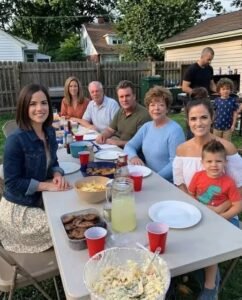
I still remember exactly what my son, Noah, wore to my father’s seventy-first birthday picnic. The air was thick with the scent of barbecue and freshly cut grass, but Noah was solely focused on his wardrobe. He had deliberately chosen his absolute favorite navy-blue dinosaur shirt—the one with a striking green Triceratops printed boldly across the chest. To Noah, clothes were never just clothes; they were armor. He believed what you wore mattered immensely for important occasions.
Noah was eight years old at the time, and he approached family gatherings with the intense seriousness of a graduate student preparing for a final exam. On the winding drive to my parents’ house, he reminded me three distinct times to park in the driveway rather than along the street. Why? Because one neighbor’s dog occasionally slipped through a loose section of wooden fencing.
“I’m not scared of dogs,” Noah explained, his small hands resting flat on his knees. “I just like knowing exactly where they are before they come near me.”
That was Noah in a nutshell. He liked plans. He thrived on predictability. He needed to know what might happen long before it actually happened. His therapist, Dr. Anita Ramos, beautifully described it as a “strong situational awareness combined with a deep need for predictable environments.” But at loud, chaotic family gatherings, that diagnosis meant Noah was always working ten times harder than anyone else realized just to exist in the same space.
The Lemonade Incident
When we finally arrived, Noah surveyed the yard like a general inspecting a battlefield. He carefully chose a specific wooden bench to sit on because his sharp eyes had already noticed a trail of ants marching through the grass near the folding chairs. From the very moment his sneakers touched the lawn, he seemed fiercely determined to do everything correctly.
Then, the lemonade accident happened.
My brother David’s golden retriever, Murphy, came barreling around the corner of the patio, a furry torpedo of pure joy, and bumped squarely into Noah from behind. The impact was sudden. Noah’s plastic cup flew from his hand, sending a bright yellow wave of lemonade splashing across the picnic table and directly onto my Aunt Carol’s floral sleeve.
Noah immediately sprang into action, breath hitching. He apologized profusely—first to Aunt Carol, and then, somehow, earnestly to Murphy the dog. Without missing a beat, he sprinted to the outdoor kitchen, found a roll of paper towels, and began furiously scrubbing the table himself.
Everyone around the table chuckled gently.
“It was just the dog, sweetie.”
“Noah, relax, it’s fine.”
“You didn’t do anything wrong.”
But Noah wouldn’t stop. He kept wiping, his knuckles white, until the plastic table cover was completely bone-dry. Nobody had asked him to clean it. The mess wasn’t even his fault. But Noah desperately wanted everyone to see that he could handle himself. That he could be helpful. That he wasn’t a problem.
Watching him try so incredibly hard to earn basic acceptance from people who should have given it freely and unconditionally broke something deep inside me. My family wasn’t openly cruel; honestly, outright cruelty would almost have been easier to fight against. What they had—especially my mother, Margaret—was a deeply ingrained habit of deciding which people were “easy” to love and which people required “too much adjustment.”
The Breaking Point
My mother had lived her entire life that way, and the rest of us had learned long ago not to challenge the status quo. But then, she said it.
She was sitting directly across from Noah at the picnic table. Her paper plate held half a hamburger and a scoop of her famous potato salad. She watched him for several long, agonizing minutes as he folded his used paper towels into perfect, tiny squares.
Then, without even bothering to lower her voice, she said:
“Next time, don’t bring the kid.”
Noah had his plastic fork halfway to his mouth. Slowly, painfully slowly, he lowered it back to his plate. He looked down, staring blankly at the green Triceratops printed on his shirt. I felt the blood drain from my face, my entire body going ice-cold in the late afternoon sun.
“What did you just say?” I demanded, my voice trembling.
Mom casually wiped her mouth with a floral napkin. “I said what everyone else is already thinking, Marissa. He ruins the mood.”
The entire yard froze. Nobody moved a muscle. My brother David suddenly became intensely fascinated with flipping burgers on the grill. My sister glued her eyes to her smartphone screen. My father, Robert, cleared his throat uncomfortably. Noah’s cousins stared a hole through their paper plates.
Not one single person stepped up to defend him.
I opened my mouth, ready to unleash years of pent-up frustration. But before I could speak, the sharp, grating sound of a heavy chair scraping against the concrete patio pierced the silence.
My seventeen-year-old daughter, Lily, stood up.
Lily was normally a quiet force. She was thoughtful and deeply observant—someone who always preferred listening intently before speaking her mind. She rarely created conflict. But she had spent the last eight years watching her little brother work twice as hard as everyone else just to feel a sliver of inclusion.
She placed both hands flat on the picnic table, leaning forward. She looked directly, fiercely, into her grandmother’s eyes.
“Say that again.”
Mom blinked, clearly taken aback. “Excuse me?”
Lily didn’t flinch. “Say it again. Look right at Noah and tell him he doesn’t belong at family gatherings because he makes you uncomfortable.”
Aunt Carol reached out, whispering pleadingly, “Lily…”
“No,” Lily shot back. Her voice trembled with adrenaline, but her gaze never wavered. “Everyone keeps playing this game, pretending Grandma doesn’t mean these things. But Noah knows she means them. He always knows.”
Mom leaned back in her chair, crossing her arms defensively. “You’re seventeen years old, Lily. Stay out of adult conversations.”
“This stopped being an adult conversation the exact second you humiliated an eight-year-old in front of his entire family,” Lily fired back immediately.
The Recording
The entire yard went dead quiet. Even the breeze seemed to stop. Then, with deliberate slowness, Lily reached into her canvas backpack. She pulled out her smartphone, unlocked the screen, and placed it directly in the center of the picnic table.
On the bright screen was an audio recording app. The timer read four minutes and twenty-three seconds. It had been recorded just three nights earlier.
Mom stared at the device as if it were a live grenade. Lily hovered her index finger right beside the digital play button.
“You told me I was old enough to understand why Noah shouldn’t come to family events anymore, Grandma,” Lily said softly, dangerously.
Mom’s napkin slipped completely from her hand, falling onto the patio.
I already knew exactly what was on that recording. Lily had called me in tears the night after that phone conversation. I had sat at my own kitchen table, my heart shattering, as I listened to my mother coldly explain why my son was an inconvenience. On the tape, she told Lily that Noah’s presence was disruptive. That he was far too sensitive. That he required too much specialized attention. That it would just be so much “easier” if I found a babysitter for him during family events.
“A meltdown?” Lily had asked.
“Whatever they call it now.”
Now, her phone sat like a judge’s gavel in the middle of the table.
“Where did you get that?” Mom demanded, her voice losing its previous confidence.
“From our phone call three nights ago,” Lily answered flatly.
My father, Robert, finally found his voice. “Margaret.”
Mom remained stubbornly silent.
Dad pointed a stern finger toward the phone. “What exactly is on that recording?”
“A conversation where Grandma explains in detail why Noah shouldn’t come to family events because he makes them too difficult for her,” Lily answered.
Dad turned his entire body toward his wife of forty-seven years. “Is that true?”
“I was speaking privately to my granddaughter!”
“That didn’t answer my question, Margaret. Did you say those things?”
Finally, Mom lifted her chin defiantly. “Yes. I said what I believe. Noah is difficult. These gatherings are incredibly stressful when he’s here. Lily is old enough to understand how the real world works.”
Dad stared at her in utter disbelief. “He’s eight.”
“He is eight years old, Margaret, and he is sitting right there.”
“Children need to understand the world isn’t always going to—”
“Stop.”
Dad didn’t shout. He didn’t need to. The low, rumbling authority in his voice was something I had never heard in my entire life. Mom snapped her mouth shut instantly.
Dad turned his warm eyes toward my son. “Noah.”
Noah looked up, his eyes wide and shiny. “Yes, sir?”
“You belong here. Do you understand me?”
Noah’s voice was barely a whisper. “Yes, sir.”
“I’m so deeply sorry you had to hear that from anyone, let alone family.”
“It’s okay,” Noah mumbled reflexively.
“No.” Dad shook his head firmly. “It isn’t okay. It is the opposite of okay. I need you to understand that, Noah.”
Noah nodded slowly, processing the validation. “Okay. Thank you, Grandpa.”
With that, Dad stood up and walked purposefully inside the house. The picnic, as you can imagine, never recovered. People started awkwardly gathering plates and Tupperware. Aunt Carol began obsessively refilling the lemonade pitcher just to have something to do with her hands.
“Yes, sweetheart?”
“Can I go sit somewhere else now?”
“Of course you can.”
When the world gets overwhelming, finding something visually grounding makes all the difference.
He walked carefully across the yard, stepping over the garden hose, and sat beneath the sprawling branches of a large, ancient oak tree. When Noah needed to process complex, difficult emotions, he liked to focus his energy on something visual and structural. That afternoon, he spent his time tracing the thick, twisted roots emerging from the earth.
Back at the table, Lily picked up her phone. She looked at her grandmother.
“I’m not going to play the recording,” Lily said softly. “I thought about it. I really did. But Noah is twenty feet away, and he doesn’t need to hear every single cruel thing you said about him.” She slipped the phone back into her bag. “But I needed you to know I had it. And I needed everyone sitting at this table to know that these conversations have been happening behind closed doors.”
Then, she picked up her plate and walked over to the oak tree, lowering herself onto the grass beside her little brother. Neither of them spoke. They just existed, together, in the shade.
I turned to my mother one last time.
“For three years,” I said, my voice eerily calm, “I’ve been managing your feelings about Noah. Before every single gathering, I prepare him for you. I tell him Grandma can be ‘difficult.’ I tell him to be patient with you. I actually apologize for the things he does differently, as though his neurological differences are some kind of personal insult to you.”
I took a deep, shaky breath. “I’m done.”
“Marissa—” she started.
“No. He tries harder at these gatherings than any child I’ve ever known. He comes home absolutely exhausted because he spends hours masking and monitoring every single thing around him just so he can fit into this family’s rigid little box.”
“I know he tries,” Mom whispered, finally looking ashamed.
“Then behave like you know it,” I said. “We aren’t attending another family event until I know, for a fact, that he will be treated like someone you actually want there.”
The Triceratops Theory
Beneath the oak tree, Noah finally broke the silence.
“Mom? Is Grandma right? Do I ruin the mood?”
I looked at my brilliant, beautiful son. At the dinosaur shirt he had chosen with such pride. At the boy who had scrubbed a table he didn’t dirty. “No, baby. Grandma is wrong about a lot of things. Especially about you.”
He was quiet for a long moment, tracing a finger over the green Triceratops on his chest.
“Triceratops were misunderstood too, you know,” he said matter-of-factly.
“I know,” I smiled gently.
“People used to think their huge horns were just weapons for fighting. But scientists know now they probably used the horns and their big neck frill to communicate with each other.” He glanced over at his sister. “They were communicating the whole time. People just didn’t know how to read it.”
I swallowed hard, fighting back tears. “Yes.”
“It’s really hard when you’re communicating and nobody notices.”
Without looking at him, Lily gently bumped her shoulder against his. Noah smiled, and bumped her right back.
Learning to Read the Frill
Change didn’t happen overnight. For two whole months, we stayed away from family gatherings. But during that time, Grandpa Robert held his ground. He and Mom argued, but eventually, she agreed to see a family counselor.
When the counselor had her listen to the entirety of Lily’s recording, Mom had broken down, admitting, “I sound mean.”
But the real breakthrough came weeks later. The counselor had helped Mom realize that her frustration wasn’t actually anger—it was fear. She didn’t understand sensory processing. She didn’t understand autism. And instead of trying to learn, she let her discomfort curdle into criticism. The counselor gave her books and videos on neurodiversity. And slowly, the defensive walls started to crumble.
Dad called me in late September. “She said to me yesterday, ‘Robert, I’ve been reading the frill all wrong.’”
She wanted to see Noah. Not at a big, chaotic party. Just a quiet visit. Noah agreed, but on his own terms: he wanted a short visit, a quiet retreat room just in case, and he wanted his sister there.
Healing begins with the willingness to finally listen—and a perfectly tart glass of lemonade.
We arrived on a crisp Saturday afternoon in October. Mom had made fresh lemonade—having called ahead to ask exactly how Noah preferred it (slightly tart, less sugar). When Noah tasted it, he nodded approvingly. “It’s exactly right.”
Mom sat across from him at the kitchen table, looking more vulnerable than I had ever seen her.
“Noah,” she began, her voice steady but thick with emotion. “What I said at Grandpa’s birthday was wrong. It was terribly unkind. You were trying very hard that day, and instead of making things easier for you, I made them harder. That was the exact opposite of what a grandmother should do.”
Noah held his glass with both hands. “Grandpa told me you went to a counselor. She helped you understand that you were afraid of things you didn’t understand?”
“Yes,” Mom admitted.
“That makes sense,” Noah replied analytically. “Fear causes avoidance. And when you can’t avoid something, sometimes you become defensive.”
Mom blinked, astounded. “That’s almost exactly what the professional counselor said.”
Noah leaned forward, excited to share his wisdom. “I want to explain Triceratops to you, Grandma.”
And so he did. He explained the horns and the frill, and how focusing only on the obvious meant missing the actual conversation. “I communicate all the time, Grandma. At the picnic, I was communicating that I was trying hard to belong. I was handling a lot of noise and people. But because I don’t always communicate the way other people do, sometimes people don’t notice. If you don’t understand the frill, you miss the whole conversation.”
Mom’s eyes filled with genuine tears. “I understand that now.”
He studied her face with an intense gaze. “Do you?”
Mom didn’t lie. “I’m learning.”
Noah considered this carefully. “That’s honest. I can work with honest.”
The Best Kind of Brave
Before we left, Noah formally requested to come to Thanksgiving, laying out his accommodations—the quiet reading room, managing Murphy the dog during dinner—with the precision of a seasoned negotiator. Mom agreed to every single one with a real, warm smile.
While Noah was showing Grandpa a school project, Mom pulled Lily aside. She thanked her teenage granddaughter for doing what the adults were too cowardly to do: making it completely impossible to look away.
On the drive home, bathed in the golden October light, Noah stared happily out the window. “She’s learning the frill,” he announced to the car.
“She is,” I agreed.
“That’s enough to start.”
Looking in the rearview mirror, I caught Lily smiling quietly. She had stood up at that picnic when every single adult had chosen comfortable silence. She had been terrified, but she had done the right thing anyway.
As Noah had once told me, being afraid and doing the right thing anyway is the best kind of bravery.
Sometimes, families don’t change because everyone magically becomes wiser overnight. Sometimes, they change because just one person finally becomes brave enough to make silence impossible. We simply needed to learn how to read the signals. And finally, mercifully, we were trying. For now, that was a pretty great place to start.
Have you ever had a moment where you had to be the brave one to shift a tough family dynamic?