I never thought a phone call could shatter everything I believed about family until that Tuesday morning when I found Harold collapsed on our bathroom floor.
The sound still haunts me, that awful thud that woke me from sleep. I rushed to find my husband of 42 years sprawled beside the bathtub, his face gray and his breathing shallow. Harold had always been strong, stubborn as an ox, the kind of man who insisted on mowing the lawn at 78, even when his knees protested.
Seeing him so helpless made my hands shake as I knelt beside him. “Harold, honey, can you hear me?” I whispered, checking for a pulse the way they taught us in that CPR class we’d taken years ago. His heartbeat was erratic, weak.
Panic shot through my chest like lightning. I grabbed my phone with trembling fingers and dialed 911 first. The operator was professional, asking questions I could barely focus on, while Harold’s breathing grew more labored.
They said an ambulance was coming, but in our small town, that could mean 20 minutes or more. That’s when I made the call that would change everything. I dialed Everett’s number, my thumb hovering over his contact photo. A picture from last Christmas where he stood stiffly beside Oilia, both of them looking like they’d rather be anywhere else.
My son lived only 15 minutes away. Surely, he would drop everything to help his father. The phone rang once, twice.
On the third ring, a voice answered, but it wasn’t Everett’s warm baritone. It was Oilia’s clipped, irritated tone.
“What is it now, Dorene?”
Not, “Hi, Mom,” or, “How are you?” Just that cold, impatient question that made my stomach clench. I tried to keep my voice steady, but I could hear it cracking.
“Oh, thank God. I need you and Everett to come right away. Harold collapsed, and he’s really bad. The ambulance is coming, but I’m scared. And oh my god.”
She cut me off with an exaggerated sigh.
“Seriously? We’re in Tuscany, Dorene. We’re on vacation. Our first real vacation in 2 years.”
My breath caught.
“What do you mean you’re in Tuscanyany? When did you—”
“We left Sunday night. I posted about it on Facebook. Maybe if you actually paid attention to our lives instead of always making everything about you and Harold, you’d know these things.”
The words hit me like a slap. I looked down at Harold, whose lips were starting to turn blue around the edges.
“Oilia, please. I’m not making this up. He’s really sick. He might be having a heart attack. I need Everett to—”
“Look, Dorene.” Her voice carried that patronizing tone she usually reserved for explaining technology to me. “You’re 66 years old. You’re not a child. Learn to handle things yourself. Call 911, drive him to the hospital, whatever. But don’t expect us to drop everything and fly home because Harold has another one of his episodes.”
Episodes. She called his health scares episodes like they were dramatic performances instead of genuine medical emergencies. I felt something cold settle in my chest, but I pressed on because this was my husband’s life.
“This isn’t an episode, Oilia. He’s unconscious. He’s barely breathing. Please just put Everett on the phone.”
“Everett is getting a massage. We paid good money for this spa package, and I’m not ruining it because you can’t handle a medical situation like any other adult would. Figure it out.”
The line went dead.
I stared at my phone, certain I’d misheard, certain my daughter-in-law hadn’t just hung up on me while my husband was dying. But the silence on the other end confirmed what my heart already knew.
When I needed them most, they weren’t coming.
The ambulance arrived 18 minutes later. By then, Harold had stopped responding entirely. I rode in the back, holding his cold hand while the paramedic worked over him with equipment I didn’t understand.
All I could think about was Oilia’s voice saying, “Learn to handle things yourself.” Like caring for my dying husband was some inconvenience I should manage alone.
At the hospital, they rushed Harold into the cardiac unit while I sat in a plastic chair in the waiting room, still in my night gown with a coat thrown over it. The fluorescent lights buzzed overhead, and the smell of disinfectant made me nauseous.
I called Everett’s number again, hoping maybe the reception had been bad. Maybe Oilia had misunderstood the severity.
This time, Everett answered.
“Mom, Oilia told me you called. Look, I know you’re worried, but dad’s been to the emergency room four times this year. Remember that chest pain in March that turned out to be acid reflux and the dizzy spell in June that was just his blood pressure medication?”
His voice was calm, reasonable, like he was explaining something obvious to a child. In the background, I could hear laughter and music, the sounds of people enjoying themselves while my world fell apart.
“Everett, this is different. He collapsed. He’s in intensive care. They’re talking about emergency surgery.”
“Mom, you tend to catastrophize. Remember when you thought I was dying of pneumonia when I just had a cold? The doctors will take good care of him. They always do. We’ll be home in 10 days. And I’m sure he’ll be fine by then.”
10 days.
My son thought his father could wait 10 days.
“What if he’s not fine?”
The question came out as a whisper.
“Then we’ll deal with it when we get back. But honestly, Mom, Dad’s too stubborn to die. He’ll probably outlive us all just to spite everyone.”
He laughed at his own joke. Actually laughed while his father fought for his life 20 ft away from where I sat.
“I have to go, Mom. We have dinner reservations at this amazing place overlooking the Mediterranean. Give dad my love when he wakes up.”
The line went dead again.
I sat there for hours watching nurses and doctors hurry past, listening to the beep of machines and the murmur of medical conversations I couldn’t quite follow. Other families came and went, worried spouses, anxious children, grandparents holding each other up during crisis.
I watched them support each other and felt more alone than I’d ever felt in my life.
At 2:47 a.m., Dr. Martinez found me still sitting in that same plastic chair. His expression told me everything before he said a word.
Harold was gone.
The massive heart attack had been too severe. The damage too extensive. If he’d received treatment sooner, if he’d had family there to advocate for him, if the emergency response had been faster, but those were all may now.
I signed papers I couldn’t focus on and listened to explanations about what happens next. But all I could hear was Oilia’s voice saying, “Figure it out.”
And my son’s laughter echoing in my ears.
Harold died alone except for me while our son enjoyed Mediterranean cuisine and our daughter-in-law got her spa treatments.
They’d chosen a vacation over a family emergency. And now it was too late for them to choose anything else.
But as I sat there in the hospital parking lot at dawn, watching the sun rise over the town Harold and I had called home for four decades, I realized something had died in me, too.
The part that believed family always comes through for each other. The part that made excuses for my son’s priorities and his wife’s coldness.
I drove home to an empty house and began planning a funeral, knowing that when Everett and Oilia finally returned from their perfect vacation, they’d find a very different version of me waiting.
They came back 2 days early from Tuscanyany, but not because they’d had a change of heart.
I was sitting at my kitchen table surrounded by sympathy cards and funeral arrangements when I heard Oilia’s voice carrying through my front door before she even knocked. She was on her phone complaining to someone about having to cut the trip short because of Harold’s dramatic timing.
When I opened the door, Everett stood there looking uncomfortable in a wrinkled black suit he’d clearly packed in a hurry. Oilia wore designer sunglasses despite the overcast sky and a black dress that probably cost more than my monthly grocery budget.
She was still talking on her phone.
“I know, right? Like who has a heart attack on a Tuesday? Couldn’t he have waited until we got back?”
She noticed me watching and rolled her eyes.
“I have to go. The grieving widow is giving me looks.”
Everett cleared his throat.
“Mom, we’re so sorry we weren’t here. If we’d known it was this serious—”
“You did know.”
The words came out flat, emotionless. I’d cried all my tears in that hospital chair.
“I told you exactly how serious it was.”
Oilia finally looked at me directly, lowering her sunglasses.
“Dorene, honey, you have to understand. We had no way of knowing this time was different. Harold had so many false alarms.”
False alarms.
She was calling my husband’s previous health scares false alarms, as if his suffering hadn’t been real because he’d survived those other times.
“Come on, Mom.” Everett stepped forward like he was going to hug me. But something in my posture stopped him. “You know we would have come if we’d realized. We feel terrible about this.”
I studied my son’s face, looking for genuine remorse for the boy who used to cry when he accidentally stepped on ants. But all I saw was social obligation, the performance of grief he thought was expected.
“The funeral is tomorrow at 2,” I said simply. “St. Matthews.”
“Tomorrow?” Oilia’s voice pitched higher. “That’s so soon. We haven’t even had time to process this, and we’re exhausted from the flight. Can’t we push it back a few days?”
I looked at her perfectly applied makeup, her manicured nails, her hair that had obviously been styled that morning.
“Harold’s been dead for 5 days. He can’t wait any longer for his family to be ready.”
The funeral was exactly what Harold would have wanted. Simple, dignified, filled with the neighbors and friends who had actually been part of our lives.
The church was packed with people who remembered Harold’s kindness, his terrible jokes, his willingness to help anyone who needed it. Mr. Peterson from Next Door spoke about how Harold had snowb blown his driveway every winter for 15 years. Mrs. Chen shared a story about Harold fixing her fence after a storm, refusing payment.
I sat in the front pew, listening to these stories of the man I’d loved, surrounded by the community that had known us both.
Everett and Oilia sat beside me, but they felt like strangers.
During the service, Oilia checked her phone three times. When the pastor asked if anyone wanted to share memories, Everett stood up and gave a generic speech about Harold being a good father and grandfather that could have applied to anyone.
He mentioned no specific memories, no personal stories. It was like listening to someone read from a template.
After the service, people filed past me with genuine condolences. Harold’s old work colleagues, our neighbors, friends from the community center where we’d volunteered.
Each person had a story, a memory, a piece of Herald they wanted to share with me.
I was talking to Agnes Morrison, Harold’s former secretary who’d driven 3 hours to be there, when I overheard Oilia talking to her sister on her phone just behind a pillar.
“Well, at least now we can finally do something with that beach house. It’s been sitting there wasted while they barely used it. Did you see the property values in that area? We could renovate it into something really spectacular.”
My blood turned to ice.
Agnes was still talking, but I couldn’t hear her anymore. All I could focus on was Oilia’s voice, casual and businesslike, discussing my husband’s property like she was planning a shopping trip.
“The old house will probably need to be sold, too. I mean, what does Dorene need with all that space? She should really be thinking about downsizing anyway. A nice little condo somewhere would be much more appropriate for a woman her age.”
Agnes noticed my expression and stopped mid-sentence.
“Dorene, dear, are you all right?”
I excused myself and walked toward the lady’s room, but Oilia’s voice followed me.
“The life insurance should help, too. Harold was old-fashioned about these things, so I’m sure he left Dorene well provided for, which means she won’t need to hold on to assets she can’t maintain. It’s really the practical thing to do.”
I pushed through the bathroom door and locked myself in a stall, my hands shaking.
She was already dividing up Harold’s life, planning what to do with our home, our memories. Our 42 years together, and she was doing it at his funeral while his body was still warm in the casket.
When I came out, the receiving line was ending. Most people had moved to the fellowship hall for the meal the church ladies had prepared.
I stood alone in the sanctuary, looking at Harold’s casket, surrounded by flowers, trying to process what I’d heard.
That’s when Oilia approached me.
She’d put her sunglasses back on and carried herself with the confidence of someone who thought she was about to have a very reasonable conversation.
“Dorene, I hope you don’t mind, but Everett and I were talking, and we think it might be good for you to have some help going through Harold’s things. You know, making decisions about what to keep and what to move along.”
I turned to look at her.
“Move along?”
“Well, you know how men accumulate things. Tools, books, clothes that don’t fit anymore, and the house has so much stuff that’s probably just overwhelming for you to deal with alone.”
She was standing close enough that I could smell her expensive perfume, see my own reflection in her oversized sunglasses.
In those lenses, I looked small, defeated, exactly how she wanted me to feel.
“We could help you sort through everything,” she continued. “Maybe start with the beach house since that’s the most complicated. It needs so much work anyway. And honestly, when would you ever use it now?”
The beach house.
The little cottage Harold and I had bought 30 years ago with the first big bonus from his promotion. Where we’d spent every anniversary, where Everett had learned to swim, where Harold and I had dreamed about retirement.
She was talking about it like it was already hers.
“That’s very thoughtful of you, Oilia.”
My voice was so calm, it surprised even me.
She smiled, thinking she’d won something.
“I’m glad you’re being practical about this. I know Harold would want you to make smart decisions.”
She paused, then leaned closer. Her voice dropped to what she probably thought was a compassionate whisper, but I could hear the calculation underneath.
“Between you and me, Dorene, it’s probably better this way. You and Harold were getting to an age where maintaining multiple properties was becoming a burden. Now you can focus on what really matters. Taking care of yourself.”
Taking care of myself.
As if Harold had been a burden instead of my partner. As if our life together had been something I needed to be freed from.
I watched her walk away to find Everett. Her heels clicking confidently across the church floor.
She moved like someone who had just solved a problem. Made a smart business decision.
At my husband’s funeral, while I was saying goodbye to the love of my life, she was already moving into our future.
But as I stood there watching her go, I felt something shift inside me.
The grief was still there, raw and overwhelming. But underneath it, something else was growing. Something that felt like the foundation Harold had taught me to build, solid, unshakable, and absolutely certain of what needed to be done.
I walked to the fellowship hall where people were sharing stories and comfort food. Oilia was at a corner table showing photos from Tuscanyany to anyone who would listen. Everett sat beside her, nodding along like this was perfectly normal behavior at his father’s funeral.
But I smiled and accepted condolences and let everyone think I was just a grieving widow who needed their protection and support.
Because sometimes the most dangerous woman in the room is the one no one sees coming.
3 days after we buried Harold, I was sitting in my kitchen drinking coffee that had gone cold hours ago when the doorbell rang.
Through the window, I could see a silver sedan in my driveway and a man in a navy suit standing on my porch with a leather briefcase.
I almost didn’t answer. The past week had been a parade of well-meaning neighbors bringing casserles and insurance representatives with forms to sign.
I wasn’t ready for another conversation about Harold’s death. Another reminder that I was now a widow instead of a wife.
But something about the man’s posture, the way he stood patiently without ringing again, made me open the door.
“Mrs. Holloway, I’m James Crawford from Crawford and Associates. I was your husband’s attorney.”
I blinked at him.
“Harold’s attorney? But we used Peterson and Smith for our wills. Have for 20 years.”
Mr. Crawford nodded, his expression gentle but serious.
“Yes, ma’am. Mr. Peterson handled your family’s general legal needs, but 6 months ago, your husband came to me specifically to handle some private matters.”
Private matters.
Harold had never mentioned visiting another lawyer.
In 42 years of marriage, we’d made every major decision together. We’d written our wills sitting at this same kitchen table with Mr. Peterson making sure everything was straightforward and fair.
“I’m sorry, but there must be some mistake. Harold would have told me if he was changing lawyers or updating our wills.”
Mr. Crawford shifted his briefcase to his other hand.
“Mrs. Holloway, may I come in? There are some things about your husband’s final wishes that you need to know before the will is read next week.”
Something cold settled in my stomach.
“What kind of things?”
“The kind that might be difficult to hear in front of your family.”
I let him in and led him to the living room where Harold used to read his evening paper.
Mr. Crawford sat across from me, setting his briefcase on the coffee table Harold had built with his own hands 30 years ago.
“Mrs. Holloway, your husband came to me in distress last October. He said he’d discovered some things about your family that had changed his perspective on how his estate should be handled.”
October.
I tried to remember what had happened last October that might have upset Harold. It had been around Everett’s birthday. I remembered. We’d hosted a dinner party and Oilia had.
“He was particularly concerned about conversations he’d overheard between your son and daughter-in-law.”
My hands clenched in my lap.
“What kind of conversations?”
Mr. Crawford opened his briefcase and pulled out a manila folder.
“Mrs. Holloway, what I’m about to share with you was recorded inadvertently. Your husband had purchased a new baby monitor system to use when his mother visited. She had dementia, and he wanted to ensure her safety when she napped in the guest room downstairs.”
Harold’s mother had passed away in November, just 5 months after moving in with us. The monitor system had been Harold’s idea. He’d installed receivers throughout the house so we could hear if she needed help during the night.
“The monitor in the guest room has remarkable range and sensitivity. It picks up conversations throughout most of the first floor, including the living room and kitchen.”
I felt my breathing become shallow.
“What did Harold hear?”
Mr. Crawford pulled out a typed transcript.
“This conversation took place on October 15th during your son’s birthday dinner. Your husband was upstairs helping his mother get ready for bed. Your son and daughter-in-law were in your kitchen cleaning up after dinner.”
He handed me the transcript.
My hands shook as I read the header.
Audio recording. Everett and Oilia Holloway. October 15th, 10:47 p.m.
The words on the page blurred as I read.
Oilia: “God, these family dinners are torture. How much longer do you think we have to keep doing this?”
Everett: “What do you mean?”
Oilia: “I mean, your parents aren’t getting any younger. Your dad’s had what, three trips to the ER this year? And your grandmother is completely gone mentally. It’s just a matter of time.”
Everett: “Oilia, that’s pretty dark, even for you.”
Oilia: “I’m being practical. They’re sitting on prime real estate and a decent life insurance policy. And for what? So your mother can hoard knickknacks and your father can putter around fixing things that don’t need fixing? It’s waste.”
Everett: “Keep your voice down.”
Oilia: “They can’t hear us. Besides, I’m not saying anything terrible. I’m just pointing out that when this generation finally moves on, we’ll be in a position to really build something. The beach house alone is worth what? 400,000 now. And this place has to be worth 600. Easy.”
I stopped reading.
My vision had started to tunnel and I felt like I might be sick. But Mister Crawford gestured for me to continue.
Everett: “I don’t really want to think about this right now.”
Oilia: “Well, you should think about it because your mother is going to live forever out of pure stubbornness. And meanwhile, we’re stuck in that tiny condo making nice at family dinners while our real life is on hold.”
Everett: “What are you suggesting?”
Oilia: “I’m suggesting that maybe it wouldn’t be the worst thing if your father’s next health scare was actually serious. And maybe your mother would be happier in one of those nice senior communities where she could socialize with people her own age instead of rattling around this big empty house.”
Everett: “Jesus. Oilia.”
Oilia: “What? I’m talking about their quality of life. Wouldn’t they be happier somewhere they could get proper care when they need it?”
Everett: “And we’d be happier with their money.”
Oilia: “Well, yes. Obviously, that’s how inheritance works. The old generation dies and leaves their assets to the young generation who can actually use them productively.”
The transcript went on for three more pages. Oilia detailing her plans for renovating the beach house. Everett calculating the value of Harold’s life insurance. Both of them discussing us like we were obstacles to their financial future rather than people they claimed to love.
I set the papers down with trembling hands.
“Harold heard all of this?”
“Yes, ma’am. He brought the recording to me the next week. He was devastated would be an understatement.”
I could picture Harold upstairs helping his frail mother into bed, listening to his own son and daughter-in-law discuss his death like a business opportunity.
The betrayal must have cut him deeper than any physical pain.
“He wanted to change his will immediately,” Mr. Crawford continued, “but I advised him to wait to think it through, so we scheduled another appointment for December.”
“What did he decide?”
Mr. Crawford pulled out another document.
“He created an entirely new will separate from the one Mr. Peterson had drafted for both of you. His portion of your joint assets, his life insurance, and his individual properties have been placed in a trust.”
I stared at the official looking papers.
“What kind of trust?”
“The Harold Holloway Memorial Trust for Cardiac Care. It will fund emergency cardiac treatment for uninsured patients at Regional Medical Center. The trust is managed by the hospital’s board of directors with you as the sole beneficiary during your lifetime.”
My breath caught.
“What does that mean?”
“It means you have full use of the trust’s assets during your lifetime. You can live in any of the properties, use the income from investments, access the funds for your personal needs, but when you pass away, everything goes to the hospital to continue funding cardiac care.”
I felt dizzy.
“So Everett and Oilia get nothing?”
“Not the beach house, not the life insurance money, not any portion of your husband’s estate.”
The room spun around me.
Harold had heard his son planning his death and responded by cutting him out entirely. But he’d protected me, ensured I’d never be at the mercy of Everett and Oilia’s greed.
“There’s more,” Mr. Crawford said gently. “Your husband recorded several other conversations over the following months. Would you like to hear them?”
I nodded, though I wasn’t sure I could handle any more revelations.
He pulled out a small digital recorder.
“This one was from December while you were at your book club meeting.”
Oilia’s voice filled my living room, clear and cold.
“I give Harold 6 months, maybe less. These old men never last long after their mothers die, and honestly, it would solve so many problems. Dorene’s manageable. She’ll do whatever Everett tells her to do. But Harold’s stubborn. He’d probably try to hold on to this house until he’s 90.”
Everett’s voice.
“Mom’s pretty attached to him.”
Oilia.
“She’ll grieve for a while, then she’ll realize she’s better off. Think about it. No more worrying about his health. No more adjusting her schedule around his doctor appointments. Freedom.”
I reached over and turned off the recorder.
I couldn’t listen to anymore. But I’d heard enough to understand why Harold had spent his final months quietly, methodically protecting me from the people I’d thought were our family.
“Mrs. Holloway,” Mr. Crawford said softly. “There’s one more thing. Your husband left specific instructions about when this information should be revealed.”
“When?”
“After the family has had time to show their true intentions regarding the estate. He suspected they would pressure you about the properties, try to convince you to sell or sign things over.”
As if summoned by his words, my phone rang.
Everett’s name appeared on the screen.
I looked at Mr. Crawford, who nodded encouragingly.
I answered.
“Hi, Mom. Ailia and I were wondering if you’d had a chance to think about what we discussed at the funeral, about getting some help organizing Dad’s things.”
His voice sounded so normal, so caring.
If I hadn’t just read those transcripts, I might have believed he genuinely wanted to help.
“Actually, Everett, I think we should all sit down together soon. There are some things about your father’s final wishes that we need to discuss.”
“Oh, good. How about tomorrow? We could start with the beach house papers, you know, just to get the ball rolling on some of the more complicated stuff.”
I closed my eyes, hearing Oilia’s voice in my head.
The beach house alone is worth 400,000 now.
“Tomorrow sounds perfect,” I said. “Let’s meet here at 2:00.”
“Great, Mom. We’ll take care of everything. Dad would want you to have help with all this legal stuff.”
After I hung up, Mr. Crawford packed his papers back into his briefcase.
“Are you ready for tomorrow, Mrs. Holloway?”
I thought about Harold installing those baby monitors to protect his mother, accidentally uncovering the truth about our son’s priorities.
I thought about Oilia calculating the value of our life at Harold’s funeral.
I thought about the emergency room where Harold died alone while they enjoyed Mediterranean cuisine.
“Mr. Crawford,” I said, “I want copies of everything. Every recording, every transcript, every document Harold signed.”
“Of course. And Mrs. Holloway, your husband asked me to tell you something if this day ever came.”
“What?”
“He said to remember that the family you build is more important than the family you’re born into. And sometimes protecting the people you love means protecting them from the people they love.”
After he left, I sat in Harold’s chair and looked around our living room.
Tomorrow, Everett and Oilia would walk in here expecting to begin dividing up our life together. They’d bring papers to sign and reasonable arguments about my future. They’d speak kindly and express concern for my well-being while calculating the value of everything Harold and I had built.
But they had no idea that Harold had heard every word of their plans.
They had no idea that their greed had cost them everything they’d hoped to gain.
And they had no idea that the quiet, grieving widow they thought they could manipulate had just learned exactly who they really were.
They arrived exactly at 2:00, and I could hear Oilia’s voice through the door before they even knocked.
“Remember, we need to be gentle but firm. She’s probably overwhelmed by all the paperwork and decisions. We’re doing her a favor by taking charge.”
I opened the door to find them both dressed like they were attending a business meeting.
Everett wore a suit I’d never seen before. And Oilia carried a leather portfolio that looked expensive and official. She’d pulled her hair back in a severe bun and wore glasses she didn’t need.
What I used to call her serious professional costume.
“Mom, you look tired,” Everett said, kissing my cheek. “Have you been sleeping okay?”
“As well as can be expected.”
I led them to the living room where Mr. Crawford and I had sat the day before.
“Can I get you coffee?”
“That would be lovely,” Oilia said, settling into Harold’s chair like she belonged there. “But first, let’s talk about why we’re here.”
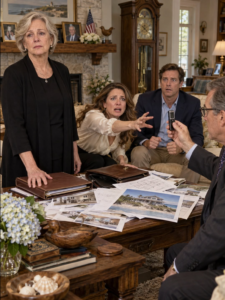
She opened her portfolio and spread papers across the coffee table with the efficiency of someone who’d done this before. Property assessments, real estate market analyses, contact information for estate sale companies.
She’d clearly spent considerable time preparing for this conversation.
“Now, Dorine, I know this is hard to think about, but we need to be practical. Harold left you with significant assets, but also significant responsibilities. This house, the beach cottage, the maintenance, the property taxes. It’s a lot for one person to manage.”
I sat down across from them, noting how Oilia had positioned herself in Harold’s chair while relegating me to the couch like a guest in my own home.
“I see you’ve done some research.”
“Of course. We want to make sure you have all the information you need to make good decisions.”
She picked up one of the papers.
“For instance, did you know this house is now valued at $640,000? That’s a significant asset that’s just sitting here.”
Everett leaned forward.
“And the property taxes alone are over 8,000 a year. That’s a lot of money going out every month for a house that’s really too big for one person.”
I nodded thoughtfully.
“It is a large house.”
“Exactly,” Oilia said, warming to her theme. “And think about the utilities, the upkeep, the yard work Harold used to do. You’ll have to hire people for all of that now. It adds up quickly.”
She pulled out another document.
“I’ve been looking at some lovely senior communities in the area. Thornfield Estates is particularly nice. They have activities, medical support on site, and you’d have your own apartment, but with none of the worries of maintaining a whole house.”
I studied the glossy brochure she handed me.
Smiling elderly people playing cards, participating in craft activities, eating meals in a communal dining room.
It looked pleasant enough if you wanted to live like you were already dead.
“This looks very organized,” I said.
“It is. And think of the peace of mind. If you had a medical emergency, help would be right there. You wouldn’t have to rely on neighbors or worry about being alone.”
The irony of Oilia expressing concern about me having a medical emergency with no family support wasn’t lost on me.
I kept my expression neutral as she continued her presentation.
“Now, as for the beach house,” she said, pulling out more papers. “That property really does need immediate attention. The roof is at least 15 years old. The plumbing is original to the house, and the electrical system isn’t up to current codes. We’re talking about major renovations just to keep it habitable.”
Everett nodded along.
“Dad was always patching things instead of really fixing them. The foundation has some settling issues, too.”
I remembered Harold spending weekends at the beach house, carefully maintaining every detail because he loved that place. He’d redone the electrical himself just 3 years ago and had been proud of how well he’d preserved the cottage’s character while updating its systems.
“Have you had contractors look at it?” I asked.
Oilia and Everett exchanged a quick glance.
“Well, not exactly,” she admitted. “But these old beach properties all have the same problems. Salt air, moisture, settling foundations. It’s just the reality of coastal real estate.”
She spread out what looked like renovation plans across the table.
“But look at the potential. With the right updates, this could be a showpiece. Open concept living, modern kitchen, spa-style bathrooms. The lot is large enough to add a pool and maybe even a guest cottage.”
I looked at the plans more closely.
They weren’t rough sketches or ideas.
These were detailed architectural drawings with measurements and specifications. Someone had spent considerable time and money having these created.
“These are very detailed plans,” I said. “When did you have them drawn up?”
Oilia’s cheeks flushed slightly.
“Oh, these are just some ideas we’ve been playing around with. You know how I love design projects. I thought it might be helpful to visualize the possibilities.”
But the dates on the drawings told a different story.
They were dated November 15th, 2 weeks after Harold’s mother had died, months before Harold’s heart attack.
Oilia had been planning renovations to our beach house while Harold was still alive, while we were still using it for our weekend getaways.
“The thing is,” Everick continued, apparently unaware that I’d noticed the dates, “these kinds of renovations are expensive, probably 200,000 or more, but the property value after improvements would easily hit 700,000.”
“Of course,” Oilia added quickly. “That’s only if you wanted to sell it eventually. But honestly, Dorene, when would you use a beach house now? It seems like a lot of expense and worry for something that would just sit empty most of the time.”
I set the plans down carefully.
“It sounds like you’ve put a lot of thought into this.”
“We just want what’s best for you,” Everett said. “Dad always worried about leaving you with too much to handle. He used to say he wished he could simplify things for you.”
That was a lie.
Harold had never said anything like that. If anything, he’d worried about me being alone, about having enough resources and security.
He’d talked about the beach house being a place where I could go to feel close to him after he was gone.
“Actually,” Oilia said, leaning forward with sudden enthusiasm. “I have an idea that might solve everything.”
She pulled out a different set of papers.
“What if Everett and I took over the beach house renovation project? We could handle all the contractors, manage the timeline, deal with all the headaches. You could focus on settling into your new place without the stress of a construction project.”
I looked at the papers she’d handed me.
They were contracts, agreements that would give Everett and Oilia full authority to make decisions about the beach house renovation, including the right to choose contractors, approve expenses, and oversee the project.
“This seems very generous of you,” I said, “but also like a lot of work.”
“Well,” Oilia said with a smile that didn’t reach her eyes, “we’d be investing our own time and energy. So naturally, when the property is eventually sold, we’d need to recoup our investment plus a reasonable return.”
There it was.
The real plan.
They wanted me to sign over control of the beach house so they could renovate it with my money, then claim a significant portion of the profits when it sold.
They’d structured it as helping me while actually positioning themselves to benefit from Harold’s death.
“What percentage would be reasonable?” I asked.
Everett shifted uncomfortably.
“We haven’t really worked out all the details yet.”
“I was thinking 60/40,” Oilia said smoothly, “since we’d be doing all the work and taking all the risk.”
60%.
They wanted 60% of a property Harold and I had owned for 30 years, that we’d paid for with money Harold earned working double shifts, that held decades of our happiest memories.
“And what about this house?” I asked.
“Well, obviously you’d need to sell it to fund your move to Thornfield Estates,” Oilia said. “But there should be plenty left over after you buy into the senior community. In fact, you might even come out ahead financially. No more property taxes, utilities, or maintenance costs.”
I looked around my living room at the built-in bookcases Harold had constructed, the mantle where our family photos sat, the window seat where I’d read thousands of books over the decades.
They were talking about dismantling my entire life as if it were a simple accounting problem.
“This is a lot to think about,” I said.
“Of course it is,” Everett said. “But mom, the sooner we get started, the sooner you can stop worrying about all these responsibilities.”
Oilia nodded.
“And really, these decisions are just going to get harder as time goes on. Grief makes everything feel overwhelming. It’s better to handle the practical things now while you have support.”
Support.
They were calling their attempt to manipulate me into signing away my home and Harold’s legacy support.
“I do have one question,” I said, “about the beach house renovations. How exactly would you fund a $200,000 project?”
Another quick glance between them.
“Well,” Everett said slowly, “we were thinking you could take out a home equity loan against this house. The interest rates are good right now, and with the property values, you’d easily qualify.”
I felt something cold settle in my chest.
They wanted me to mortgage my home to pay for renovations to another property that they would then control and profit from.
They were asking me to risk the roof over my head so they could build their dream vacation house.
“Or,” Oilia said, “if you decided to sell this place right away, you could use part of those proceeds. Either way, the numbers work out beautifully.”
She pulled out a calculator and started running figures with the practiced ease of someone who’d done this calculation many times before.
“640,000 from the house sale minus maybe 60,000 for Thornfield Estates buyin leaves you with almost 600,000. Use 200 for the beach house renovation and you still have 400,000 earning interest while the beach property appreciates.”
It was a convincing presentation.
They’d thought of everything. Anticipated every question, prepared answers that made their plan sound logical and beneficial for me.
If I hadn’t known about Harold’s recordings, if I hadn’t heard them discussing his death as a business opportunity, I might have believed they genuinely cared about my welfare.
“You’ve really thought this through,” I said.
“We have,” Oilia said proudly. “I know it seems complicated, but once we get everything organized, your life will be so much simpler.”
“And we’ll handle everything,” Everett added. “All the paperwork, all the decisions. You won’t have to worry about any of it.”
I looked at my son, trying to find some trace of the boy who used to bring me dandelions and call them flowers.
But all I saw was a man who’d calculated the value of his father’s life and found it wanting compared to real estate profits.
“Well,” I said, gathering up their papers, “this certainly gives me a lot to consider.”
“Actually,” Oilia said, “if you’re comfortable with the general direction, we could go ahead and get some of the paperwork started. You know how these things can drag on if we don’t stay on top of them.”
She pulled out a pen with the kind of flourish that suggested she’d been waiting all afternoon for this moment.
“The beach house management agreement is pretty straightforward. And I have the contact information for the real estate agent who specializes in Thornfield Estates.”
I looked at the pen she was offering me, then at the contracts spread across my coffee table, then at their expectant faces.
They thought they had won.
They thought the grieving widow was about to sign away her independence and her husband’s legacy because they’d presented their greed as concern for my well-being.
“You know what?” I said, standing up suddenly. “I think I should probably discuss all of this with Harold’s lawyer first, just to make sure I understand all the legal implications.”
The temperature in the room seemed to drop 10°.
Oilia’s smile became fixed and artificial.
“Oh, I don’t think that’s necessary,” she said quickly. “Mister Peterson knows your family situation. These are pretty standard arrangements.”
“Actually, I meant Harold’s other lawyer, Mr. Crawford. Did you know Harold had been working with another attorney lately?”
The look that passed between Everett and Oilia told me they most definitely had not known about Mr. Crawford.
Oilia’s hand tightened around her pen.
“Other lawyer?”
Everett’s voice was carefully controlled.
“What for?”
“Apparently, Harold had some concerns about his estate planning. Mr. Crawford is coming by tomorrow to discuss Harold’s final wishes with all of us.”
I watched Oilia’s face carefully as I said this.
For just a moment, her mask slipped and I saw something that looked like panic flash across her features before she regained control.
“Well,” she said, forcing a laugh. “I’m sure it’s nothing that changes the basics. Harold always said he wanted things to be simple for you.”
But her hands were shaking slightly as she packed up her papers, and Everett had gone very quiet.
They left with promises to call soon and reminders that I shouldn’t wait too long to make these important decisions.
After they drove away, I stood at my front window watching their taillights disappear down the street.
They had no idea that tomorrow’s meeting with Mr. Crawford wouldn’t be about Harold’s final wishes.
It would be about their own recorded confessions of greed and manipulation.
But as I thought about the architectural plans they’d shown me, dated from when Harold was still alive, I realized something that made my blood run cold.
They hadn’t just been waiting for Harold to die.
They’d been actively planning for it, preparing to profit from our loss before it even happened.
And tomorrow, they were going to learn that Harold had been listening all along.
The next morning, I woke up with a strange sense of calm.
For the first time since Harold’s death, I felt like I had a purpose beyond just surviving each day.
I made coffee in his favorite mug and sat at our kitchen table, watching the sunrise through the window where he used to read his morning paper.
At exactly 10:00, Mr. Crawford arrived.
I’d asked him to come an hour before Everett and Oilia were expected, wanting to make sure we had everything prepared.
He carried a larger briefcase today and moved with the focused efficiency of a man about to execute a carefully planned strategy.
“Are you ready for this, Mrs. Holloway?” he asked as we settled in the living room.
“I’ve been ready since I heard those recordings,” I said. “Harold protected me even after death. The least I can do is honor that.”
Mr. Crawford opened his briefcase and began arranging documents on the coffee table with precise organization.
“I want you to understand exactly how this will unfold. First, I’ll review the existing will that Mr. Peterson drafted, the one your family believes is still valid. Then, I’ll present Harold’s amended will and the trust documents. Finally, we’ll play selected portions of the recordings.”
I nodded, feeling my heart rate increase despite my resolve.
“How do you think they’ll react?”
“Based on my experience? Denial first, then anger, then desperate attempts at negotiation. Mrs. Holloway, I need you to be prepared for them to say hurtful things. When people realize they’ve lost something they counted on, they often lash out at whoever they perceive as responsible. Even though they’re responsible for their own situation. Especially then.”
At 11:00 sharp, I heard car doors slam in my driveway.
Through the window, I could see Everett and Oilia walking toward the house.
Oilia carried her leather portfolio again, but today she also had a large handbag and what looked like a folder of real estate listings.
She’d clearly planned to leave here with signed contracts.
I opened the door before they could knock.
“Everett, Oilia, please come in. Mr. Crawford is here to discuss your father’s estate.”
Oilia’s smile faltered slightly when she saw the lawyer’s briefcase and the formal arrangement of papers, but she recovered quickly.
“Wonderful. It’s always good to have professional guidance during these transitions.”
She settled into Harold’s chair again, spreading her own papers on the side table with proprietary confidence.
Everett sat on the couch, but I noticed he kept glancing at Mr. Crawford with poorly concealed nervousness.
“Now then,” Mister Crawford began, his voice professionally neutral. “I understand you’ve been discussing Mrs. Holloway’s future housing arrangements and the disposition of certain properties.”
“That’s right,” Oilia said smoothly. “We want to make sure Dorene has the support she needs to make good decisions during this difficult time.”
“How thoughtful. And I assume you’re both familiar with the existing will that was drafted by Peterson and Smith.”
“Generally speaking,” Everett said, “Dad always said he wanted to keep things simple, equal distribution between mom and me, with mom getting the house and dad’s life insurance.”
Mr. Crawford nodded.
“Yes, that’s what the original will specified. However, there have been some changes that affect those arrangements.”
I watched Oilia’s face carefully. She was trying to maintain her composed expression, but I could see tension building around her eyes.
“What kind of changes?” she asked.
“6 months ago, your father-in-law came to me with concerns about his estate planning. He discovered some information that made him reconsider how his assets should be distributed.”
“What information?”
Everett’s voice was sharper now.
Mr. Crawford reached into his briefcase and pulled out the digital recorder.
“Mr. Holloway had installed a baby monitor system to care for his mother during her final illness. The system inadvertently recorded several conversations that took place in this house.”
The color drained from Oilia’s face.
Everett shifted forward on the couch, his hands clenched into fists.
“I don’t understand,” Oilia said, but her voice had lost its confident tone. “What does that have to do with Harold’s will?”
“Everything,” Mr. Crawford said simply.
He pressed play on the recorder.
Oilia’s voice filled the room, clear and unmistakable.
“God, these family dinners are torture. How much longer do you think we have to keep doing this?”
I watched my son’s face as he heard his own voice responding.
Watched him realize that every cruel word, every calculated comment about Harold’s death being convenient, every discussion of our property values had been preserved.
When the recording reached the part where Oilia discussed Harold’s next health scare being actually serious, she lunged for the recorder.
“Turn that off. That’s illegal. You can’t record people without their consent.”
Mr. Crawford calmly moved the device out of her reach.
“Actually, in this state, recording conversations that take place in your own home is perfectly legal. And since Mr. Holloway installed the system for legitimate safety reasons, these recordings are admissible evidence of your intentions regarding his estate.”
“Those conversations were taken out of context,” Everett said desperately. “We were just talking hypothetically about the future.”
“Were you?”
Mr. Crawford pulled out the architectural plans Oilia had shown me the day before.
“Because these renovation plans for the beach house are dated November 15th, when your father was still alive and actively using the property. It appears you were making very concrete plans for assets you didn’t yet own.”
Oilia’s hands shook as she stared at the plans.
“Those were just ideas, design concepts. There’s nothing wrong with thinking about possibilities.”
“Perhaps not. But combined with the recorded conversations expressing hope for your father-in-law’s death and detailed financial calculations based on his life insurance policy, these plans paint a rather clear picture of your motivations.”
Mr. Crawford opened another folder.
“Which brings us to your father’s response to these discoveries.”
He placed a thick legal document on the coffee table.
“The Harold Holloway Memorial Trust for Cardiac Care, established December 20th of last year.”
I watched Everett scan the first page, his face growing paler with each line he read.
“What is this?”
“Your father’s amended will. His portion of all joint assets, his life insurance policy, and his individual properties, including the beach house, have been placed in an irrevocable trust.”
“A trust for what?”
Oilia’s voice was barely a whisper.
“Cardiac emergency care for uninsured patients. Your father was quite specific about his reasoning. He felt that since his own family couldn’t be relied upon during his medical emergency, he wanted to ensure other families wouldn’t face the same abandonment.”
The silence in the room was deafening.
I could hear the grandfather clock Harold had inherited from his father ticking in the hallway, marking the seconds as my son and daughter-in-law processed the complete collapse of their financial expectations.
“This can’t be legal,” Oilia finally said. “You can’t just cut out your own family. There are laws about that.”
“Actually, there aren’t. In this state, you have no legal right to inherit from your spouse’s parents. Mr. Holloway was free to dispose of his assets as he saw fit.”
“But the beach house,” Everett said weekly. “We’ve been taking care of it, maintaining it.”
“Have you?”
Mr. Crawford pulled out maintenance records.
“According to these receipts, your father personally handled all upkeep and repairs. There’s no record of any financial contribution from either of you.”
“We contributed time,” Oilia protested. “We helped with cleaning, with organization.”
I almost laughed at that.
Oilia had visited the beach house exactly three times in the past 2 years, and each time she’d spent the entire visit complaining about the outdated kitchen and bathrooms.
“Mrs. Holloway,” Mr. Crawford continued, turning to me. “As the surviving spouse, you maintain full use of all trust assets during your lifetime. You can live in either property, access investment income, and make decisions about maintenance and improvements. But upon your death, everything transfers to the hospital foundation.”
“What does that mean for us?” Everett asked.
“It means,” I said quietly, “that you get exactly what you planned for me to have after I moved to that senior community. Nothing.”
Oilia shot to her feet.
“This is your doing. You turned Harold against his own son.”
“Actually,” Mr. Crawford interrupted, “Mrs. Holloway had no knowledge of these changes until after her husband’s death. The recordings make it clear that Mr. Holloway acted solely based on what he heard you say.”
He played another segment.
Oilia’s voice discussing how manageable I would be after Harold’s death, how I’d do whatever Everett tells me to do.
Harold realized, I said, standing to face them, that you weren’t waiting to inherit from us.
“You were waiting for us to die.”
“That’s not true,” Everett protested. But his voice lacked conviction.
“Isn’t it? You went to Tuscanyany while your father was dying. Oilia told me to figure it out myself while Harold fought for his life alone in a hospital room.”
“We didn’t know how serious it was,” Oilia said.
But even she seemed to realize how hollow that sounded now.
“You didn’t want to know because Harold’s death was inconvenient timing for your vacation, not a family tragedy.”
Mr. Crawford packed his papers efficiently.
“I think that covers everything. Mrs. Holloway, you have my contact information if you need anything. Mr. and Mrs. Holloway, I’d recommend you consult with your own attorney if you have questions about the trust documents. Though, I should mention that Mr. Herald included very specific language preventing any challenges to his decisions.”
After he left, the three of us sat in horrible silence.
Oilia stared at the trust documents like she could will them to say something different. Everett kept opening and closing his mouth as if searching for words that wouldn’t come.
Finally, Oilia spoke.
“You could contest this. We’re family. We could work together to challenge the trust.”
I looked at her with something approaching pity.
Even now, even after learning that Harold had heard every cruel word she’d spoken about us, she thought she could manipulate me into helping her.
“Oilia,” I said gently, “I was married to Harold for 42 years. I loved him more than my own life. Why would I contest a will designed to honor his memory and help people who face the same medical emergencies he did?”
“Because Everett is your son,” she exploded. “Blood is supposed to mean something.”
“It does mean something. It means I raised Everett to be better than this. It means Harold loved him enough to give him chance after chance to prove he cared about more than money.”
I walked to the window and looked out at the garden Harold had planted for me, now dormant in the late winter cold, but ready to bloom again in spring.
“You want to know what blood means to me? It means remembering the boy who used to help his father build birdhouses in the garage. It means loving someone enough to be heartbroken when they choose greed over family.”
When I turned around, they were both crying, but I felt nothing except a profound sense of peace.
Harold had protected me from them, and now I finally understood why.
6 months after that terrible confrontation in my living room, I stood in the cardiac unit at Regional Medical Center watching Dr. Martinez explain treatment options to a young woman whose husband had just suffered a massive heart attack.
She was about 30, maybe younger, with two small children clinging to her legs and terror in her eyes.
“The surgery is expensive,” Dr. Martinez was saying gently. “But the Harold Hol Memorial Trust can cover the costs if you qualify.”
“What do I need to do?” she asked, her voice shaking.
“Nothing. Just focus on your family. The trust handles everything else.”
I stood quietly in the hallway, watching this woman received the help that might have saved Harold if it had existed 6 months ago.
The trust had already funded 12 emergency cardiac procedures, and the hospital was expanding their cardiac care unit to accommodate the growing program.
This was Harold’s legacy now.
Not property or money passed down to ungrateful children, but lives saved and families kept whole during their darkest moments.
My phone buzzed.
Another text from Everett.
He’d been calling and texting regularly for the past month, ever since his divorce from Oilia had been finalized. I’d heard through mutual friends that she’d left him the moment she realized there would be no inheritance.
No beach house renovation project.
No early retirement funded by their dead relatives.
“Mom, can we please talk? I know I made mistakes, but I’m your son. Please.”
I deleted the message without responding, just like I deleted the previous dozen.
Some wounds cut too deep for apologies to heal, and some betrayals revealed truths that couldn’t be unknown.
The young woman from the cardiac unit walked past me with her children heading toward the elevator.
Her husband would live, would recover, would come home to his family because Harold’s final act of love had made that possible.
I felt a warmth in my chest that I hadn’t experienced since the morning I’d found Harold on our bathroom floor.
I drove home to the house I’d decided to keep.
Despite everyone’s advice to downsize, the place felt different now.
Not empty because Harold was gone, but peaceful because the people who’d seen it as a prize to be won were gone, too.
I’d had the locks changed and the security system updated.
Everett and Oilia no longer had keys, no longer had access to walk through my life, making plans for my future.
In the kitchen, I made coffee and sat at the table where Harold used to read his paper, where we’d planned our retirement, where we’d dreamed about growing old together.
I pulled out the photo album I’d been working on, pictures of our 42 years together, from our awkward young wedding photos to the candid shots from our last anniversary dinner.
Harold looked back at me from every page.
Harold teaching Everett to ride a bike. Harold painting the nursery when Everett was born. Harold walking Everett down the aisle when he married Oilia.
Both of them smiling hopefully at what they thought would be a bright future.
The front doorbell rang, interrupting my memories.
Through the window, I could see a familiar silver sedan.
Mr. Crawford stood on my porch, but today he wasn’t carrying his official briefcase. Instead, he held a small wrapped package.
“Mrs. Holay, I hope you don’t mind the unannounced visit. I have something for you.”
I invited him in, curious about what had brought him here on a Saturday afternoon.
“Harold left this with me,” he said, handing me the package. “With instructions to give it to you 6 months after the trust was established and functioning.”
My hands trembled as I unwrapped what turned out to be a small wooden box carved with intricate detail.
I recognized Harold’s handiwork immediately. He’d spent hours in his workshop creating these little treasures for special occasions.
Inside the box was a letter in Harold’s familiar handwriting and a small silver key.
“My dearest Dorene,” the letter began. “If you’re reading this, then 6 months have passed since you learned the truth about our family. I hope by now the shock has faded and you’re beginning to understand why I made the choices I did.”
I had to stop reading for a moment, overwhelmed by hearing Harold’s voice in his words.
“The key opens a safety deposit box at First National. Inside you’ll find the deed to a small cabin in Montana that I purchased last year. I never told you about it because I wanted it to be a surprise for our 50th anniversary. It’s near a lake surrounded by mountains with everything you need for a simple peaceful life.”
My breath caught.
Harold had bought us a secret cabin, a place where we could disappear from the world and just be together.
“I know you’re probably wondering why I didn’t tell you about the trust before I died. The truth is, I hoped I was wrong about Everett and Oilia. I hoped that when faced with a real crisis, they would choose family over money. I gave them every opportunity to prove me wrong.”
I wiped tears from my eyes and continued reading.
“But I also knew that if they didn’t change, you would need protection from their greed. You have always been too generous, too willing to sacrifice for others. I couldn’t bear the thought of you spending your remaining years being manipulated by people who saw you as an obstacle to their inheritance.”
The letter went on to describe the cabin in detail.
The wraparound porch where I could watch sunrises over the lake. The stone fireplace where I could read on winter evenings. The garden plot where I could grow vegetables and flowers.
“You don’t have to go there if you don’t want to. The cabin is yours to use or sell as you see fit. But if you ever need to escape, if the memories here become too painful or the loneliness too overwhelming, you have a place where you can start fresh.”
The final paragraph made me cry harder than I’d cried since Harold’s funeral.
“I love you more than words can express. Dorene, you gave me 42 years of happiness, and I hope I gave you the same. Live the rest of your life for yourself, not for ungrateful children or manipulative relatives or well-meaning friends who think they know what’s best for you. Be free, my darling. Be gloriously, completely free.”
After Mister Crawford left, I sat with Harold’s letter and the key to our secret cabin, feeling something I hadn’t experienced in months, excitement about the future.
I looked around the house we’d shared at the memories embedded in every room and realized I had a choice to make.
I could stay here surrounded by the past, waiting for Everett to finally understand what he’d lost.
Or I could take Harold’s final gift and build something new.
That evening, I called the airline and booked a flight to Montana. Not to move permanently, but to see what Harold had chosen for us, to understand his vision of our life together without the complications of family obligation and social expectation.
3 days later, I stood on the porch of a charming log cabin overlooking a pristine mountain lake.
Harold had chosen perfectly.
The place was remote enough for complete privacy, but comfortable enough for year-round living.
Inside, I found a fully stocked kitchen, a bedroom with windows facing the sunrise, and a living room dominated by the stone fireplace Harold had described.
On the mantle, I discovered one final surprise.
A framed photo of Harold and me from our honeymoon, along with a note in his handwriting that simply said, “Welcome home, my love.”
I spent a week at the cabin walking the lakeside trails Harold had explored when he’d visited to finalize the purchase.
Sitting on the porch watching Eagles fish in the early morning mist, feeling a piece I’d forgotten was possible.
When I returned to town, I found 17 missed calls from Everett and a desperate voicemail from Oilia.
“Dorene, I know you hate me, but please listen. I made terrible mistakes. I was selfish and cruel, and I understand why Harold cut us out. But Everett is falling apart. He lost his job. The divorce took everything. And he’s talking about dark things. He needs his mother. Please.”
I deleted the message without calling back.
Harold’s letter had been clear.
Live for myself, not for ungrateful children who only remembered they had a mother when they needed something from her.
Instead, I called Dr. Martinez at the hospital.
“I’d like to expand the trust,” I told him. “I want to add a grief counseling program for families who lose loved ones to cardiac emergencies.”
“That’s a wonderful idea, Mrs. Holloway. What inspired this addition?”
I looked out my kitchen window at the garden Harold had planted, now blooming with the flowers he’d chosen for their meaning.
Forget me knots for remembrance, sunflowers for devotion, roses for eternal love.
“Sometimes,” I said, “the people who lose someone aren’t the only ones who need healing. Sometimes the people left behind need to learn how to build a life worth living.”
A year later, I split my time between the house Harold and I had shared and the cabin he’d given me for my future.
I volunteered at the hospital 3 days a week, helping other widows navigate the practical and emotional challenges of sudden loss.
I’d learned to kayak on the mountain lake and had planted a garden that attracted hummingbirds and butterflies.
Everett still called occasionally, usually late at night when he was drinking.
I’d learned to recognize the slurred desperation in his voice. The way he cycled through anger, self-pity, and hollow promises to change.
I listened to his voicemails, but never called back.
Some lessons could only be learned through consequences, and some relationships couldn’t survive the truth about what they’d really been built on.
On Harold’s birthday, I drove to the cemetery with flowers from both gardens, the one he’d planted for me at home, and the one I’d planted for myself at the cabin.
I told him about the lives his trust had saved, about the families who’d been spared the agony we’d endured.
“You were right about everything,” I whispered to his headstone. “About Everett, about Oilia, about what I needed to be happy. I miss you everyday, but I’m not lonely anymore. I’m not afraid anymore. I’m free.”
As I walked back to my car, I saw a familiar figure standing by the cemetery gate.
Everett, thinner than I’d ever seen him, wearing clothes that had seen better days.
He’d been waiting for me, probably watching from a distance until I finished my visit with Harold.
“Mom,” he said quietly as I approached. “Please, just 5 minutes.”
I looked at my son, this man I’d raised and loved and lost to his own greed, and felt something I hadn’t expected.
Pity.
Not the kind that leads to forgiveness, but the kind that sees clearly what someone has done to themselves and finds it sad rather than infuriating.
“I know what you’re going to say,” I told him. “That you’re sorry, that you’ve learned from your mistakes, that you want another chance to be the son I raised.”
He nodded eagerly.
“Yes, all of that. I’ve been going to therapy, working on myself, trying to understand how I became someone who could treat you and dad that way.”
“Good,” I said simply. “I hope therapy helps you find peace.”
“Does that mean can we try again? Can I come visit? Maybe call you sometimes?”
I looked at this broken man who shared my DNA but had long ago stopped being my child in any way that mattered.
“Everett,” I said gently. “I forgive you. But forgiveness doesn’t mean forgetting. It doesn’t mean pretending the past didn’t happen or that trust can be rebuilt from nothing.”
His face crumpled.
“But I’m your son.”
“You were my son. And maybe someday if you do the hard work of becoming someone worthy of that relationship, we might find a way back to each other. But that’s your journey to make, not mine to wait for.”
I walked past him toward my car, feeling lighter with each step.
“Mom, please,” he called after me. “I don’t have anyone else.”
I turned back one final time.
“Neither did I,” I said. “When your father was dying and I needed my family most, I had no one. But I learned to build a life worth living anyway. So can you.”
I drove away without looking back, heading home to pack for another week at the cabin.
The mountains were calling.
The lake was waiting.
And I had a life to live. Not for anyone else, but finally, gloriously for myself.
Harold had given me the greatest gift possible.
The freedom to choose happiness over obligation, peace over guilt, and my own dreams over everyone else’s expectations.
I was 66 years old, and for the first time in my life, I was completely beautifully free.
Now, I’m curious about you who listen to my story. What would you do if you were in my place? Have you ever been through something similar? Comment below. And meanwhile, I’m leaving on the final screen two other stories that are channel favorites, and they will definitely surprise you. Thank you for watching until here.