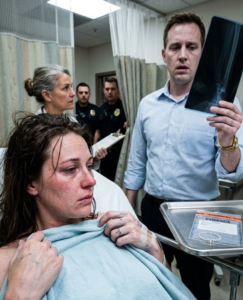
The officer’s radio cracked once, sharp and dry, and the sound made Daniel flinch harder than any shout would have.
Dr. Morris did not move from the foot of my bed. Her white coat was buttoned wrong at the bottom, like she had dressed too quickly for a shift that had already asked too much from her. The X-ray lightbox hummed against the wall. The room smelled like disinfectant, latex gloves, and the bitter coffee someone had abandoned on the counter outside.
Daniel’s fingers tightened around the film until the edge bent.
“Sir,” the taller officer said, “put that down.”
Daniel laughed once. Not because anything was funny. Because his face had run out of expressions.
“This is a family matter,” he said.
Dr. Morris looked at the officer.
“No,” she said. “It is not.”
Before Daniel became the man standing in that ER bay with police at his back, he was the man who brought me orange juice in bed after our first miscarriage.
That was the part people never understood from the outside. Cruelty did not arrive wearing its real face. It came folded inside flowers, apologies, and soft promises at 2 a.m.
We met when I was twenty-four at a charity car wash behind a church in Mesa. He had a white Ford F-150 and sunglasses tucked into his collar. I had twenty-seven dollars in my checking account and a nursing assistant certificate I was trying to turn into something more.
He called me steady.
He said he liked women who did not need attention.
At first, that sounded like praise.
When Madison was born, he held her for almost eleven minutes. I remember the wall clock because I watched the second hand move while I waited for him to smile. Patricia, his mother, stood beside the hospital bassinet and said, “Well, girls are sweet too.”
Too.
The word landed softly, but it stayed.
By the time Chloe came three years later, Daniel did not stay overnight at the hospital. He said work was busy. Patricia came with a blue baby blanket she had bought before the ultrasound and folded it back into her purse when the nurse announced another girl.
At home, Daniel stopped saying my name when he was angry.
He said “your mother” to the girls when breakfast was late.
He said “your wife” to his friends when he wanted a joke.
He said “that body” once, standing in our bathroom doorway while I brushed my hair after Chloe’s birth.
The first time he hit me, it was not a punch. It was a shove into the pantry door because I had served meatloaf instead of steak when his boss came over. The cans rattled around my feet. He apologized before the bruising even started.
I believed him because I wanted my daughters to have a house that stayed whole.
Then the rules multiplied.
No talking about family problems. No visiting my sister without permission. No bank card unless he handed it to me. No contradicting Patricia when she said I had failed the family.
The patio became his chosen place because the block wall hid most of it, and the neighbors had learned the rhythm of our mornings.
A sprinkler hiss.
A door sliding open.
His voice, low and tidy.
A window closing next door.
What Daniel did not know was that I had stopped hoping someone would save me the month before.
I had started documenting.
Not perfectly. Not bravely. Quietly.
I wrote dates in the back of Chloe’s coloring book because Daniel never opened anything with princess stickers on it. I photographed the broken cabinet handle after he slammed me into it. I kept screenshots of his messages in a hidden email folder under the name Costco Receipts.
And three days before the hospital, Madison had asked me why Daddy got mad when Grandma said the word boy.
That question changed the shape of my fear.
It was no longer something I carried inside my own ribs. It had reached my child’s mouth.
So I made one call.
Not to police. Not yet.
To my old supervisor at Banner University Medical Center, the woman who had once told me, “If you ever need a witness, don’t wait until you’re almost gone.”
Her name was Carla Bennett. She was an ER charge nurse, and she knew how stories sounded when they had been rehearsed by the person who caused the injuries.
That morning, when Daniel threw me over his shoulder and rushed me into the hospital pretending panic, he thought he was controlling the room.
He did not know Carla had seen my name on intake.
He did not know she had already pulled Dr. Morris aside.
He did not know the neighbor he called “nosy Mrs. Reed” had installed a driveway camera after someone stole packages off her porch, and the angle caught the edge of our patio gate.
The taller officer stepped closer.
“Mr. Carter, place the film on the counter.”
Daniel did it slowly.
His hand hovered too long, like letting go of that X-ray meant letting go of the last version of himself he could still explain.
“My wife is confused,” he said.
The smaller officer, a woman with a tight bun and tired eyes, looked at me.
“Ma’am, can you tell me your name?”
My throat scraped when I swallowed.
“Emily Carter.”
Daniel turned fast.
“Don’t start.”
The officer’s hand moved to her belt. Not dramatic. Just ready.
Dr. Morris stepped between him and my bed.
“She has multiple injuries at different healing stages,” she said. “She is pregnant. She lost consciousness. His explanation is medically inconsistent.”
Daniel’s face sharpened.
“You don’t know our marriage.”
“No,” Dr. Morris said. “I know bones.”
The words flattened him.
For years, Daniel had survived by making every room emotional. If I cried, I was unstable. If I stayed quiet, I was cold. If I explained, I was dramatic. If I apologized, I was guilty.
But an X-ray did not cry.
A scan did not exaggerate.
Old fractures did not care about his voice.
Carla appeared in the doorway then, holding a clear folder. She looked older than I remembered, with deeper lines around her mouth and the same hard kindness in her eyes.
“Emily,” she said, “your sister is with the girls.”
My fingers curled into the blanket.
For the first time all morning, air moved all the way into my lungs.
Daniel heard it too.
The shift.
The small, invisible sound of his control leaving the room.
“What girls?” he snapped.
Carla did not answer him. She handed the folder to the female officer.
“Neighbor footage. Intake photos. Patient’s prior clinic visits. She also has written dates.”
Daniel looked at me like I had stolen something from him.
“You planned this?”
My mouth was dry. My cheek throbbed. The baby I had not known about sat like a secret flame beneath all that pain.
I turned my head just enough to see him clearly.
“I survived it,” I said.
That was the only sentence I gave him.
The female officer read the first page in the folder. Her jaw tightened once. Then she looked at Daniel.
“Turn around.”
His voice changed immediately.
Not louder. Smaller.
“Emily,” he said. “Listen to me. Think about the girls.”
I did.
I thought of Madison teaching Chloe how to hide under the comforter without crying out loud.
I thought of two cereal bowls left in the sink because I had not made breakfast.
I thought of Patricia behind the blinds, choosing prayer beads over a door handle.
The officer cuffed Daniel with a soft metallic click.
That sound did not fix anything.
It did not erase the patio.
It did not hand my daughters back their mornings.
But it made the room honest.
Daniel kept talking as they walked him out.
“She’s pregnant,” he said. “She needs me. She can’t do this alone.”
Carla watched him disappear past the curtain.
Then she turned back and adjusted the blanket over my feet.
“You are not alone,” she said.
Later that afternoon, Patricia arrived in a cream cardigan with a gold cross at her throat. She did not ask how I was. She asked where Daniel had been taken.
Carla stopped her at the curtain.
“Only approved visitors,” she said.
Patricia looked past her at me.
“You’re destroying this family over a misunderstanding.”
The room smelled like hand sanitizer and warmed plastic from the blanket machine. My IV pump clicked. Somewhere outside, a child laughed, high and sudden, and the sound made Patricia’s mouth pinch.
I reached for the evidence bag on my tray.
Madison’s bracelet lay inside, bent but not broken.
“I’m protecting my family,” I said.
Patricia stared at the bracelet.
For one second, something like fear passed over her face. Not guilt. Fear of being named.
The next morning, a detective came in with a tablet. He showed me still images from the neighbor’s camera, each one stamped with time and date. The patio gate. Daniel’s arm. My body dropping out of frame. Patricia visible through the kitchen window.
The detective did not make me describe every second.
He simply asked, “Is this accurate?”
I nodded.
By noon, a temporary protective order was filed. My sister Megan brought the girls through a side entrance with hospital security beside them. Madison carried Chloe’s stuffed rabbit. Chloe carried a drawing folded into a square.
They climbed onto the bed carefully, one on each side, their small bodies warm against mine.
Madison touched the tape on my hand.
“Mommy, did the doctor fix you?”
I looked at Dr. Morris standing by the door, pretending to review the chart so my daughters would not see her eyes water.
“She helped,” I said.
Chloe unfolded the drawing.
It showed a house with three girls and one tiny blue bundle in the window. No man on the patio. No grandmother behind the blinds. Just a yellow sun above a square roof and four stick-figure hands touching in the middle.
Weeks later, after Daniel’s first hearing, after Patricia tried and failed to claim she had seen nothing, after the court ordered him out of the house and the locks were changed at 9:06 on a Friday morning, I went back to that patio.
The sprinkler line had been repaired. The grill cover snapped softly in the breeze. Mrs. Reed’s camera blinked from next door, a small red eye watching the place that everyone else had pretended not to see.
I found Madison’s missing silver bead near the wall.
I picked it up, washed the dust from it, and placed it in a small glass jar on the kitchen windowsill.
At sunset, the girls sat at the table eating macaroni and cheese from blue bowls. The house smelled like butter, soap, and clean laundry. My phone stayed face down beside the sink, silent for the first time in years.
Outside, the patio light clicked on by itself.
No footsteps followed it.
Caption:
Every morning, my husband would beat me and drag me out because I couldn’t give him a son… Until one day, I collapsed in the middle of the yard from the unbearable pain. He took me to the hospital and pretended I had fallen down the stairs. But what he never imagined was that, when the doctor handed him the results, the X-ray left him petrified.
My husband dragged me across the patio that morning.
The concrete scraped my knee through my thin pajama pants. At 6:18 a.m., the Phoenix air already smelled like dust, old coffee, and the wet sprinkler line hissing near the fence.
Daniel stood over me in his pressed work shirt, his wedding ring flashing when he lifted his hand.
“I married you, and you’re useless because you can’t give me a son.”
He said it quietly.
That was always worse.
Inside the kitchen window, my mother-in-law Patricia turned one bead on her rosary. She never opened the door. The blinds only moved an inch, then stilled again.
Our two daughters were upstairs. Madison was six. Chloe was four. I had taught them to keep the bedroom TV loud in the mornings, even when they were scared.
The patio smelled of chlorine from the pool and cold metal from the grill. A mourning dove cooed from the block wall. My cheek pressed against grit, and my mouth tasted like pennies.
Daniel’s shoe stopped beside my ribs.
“Look at you,” he said. “Even your own body refuses to respect me.”
I pulled my arms under myself. Not to fight. Just to stand.
He crouched, grabbed my chin, and turned my face toward the upstairs window.
“Those girls are your failure,” he whispered.
At 6:42 a.m., the ringing started in my ears.
The patio tilted. The blue sky split into pieces. My fingers opened against the concrete, and the small silver bracelet Madison made me slid off my wrist.
Then everything went white.
I woke on a gurney under fluorescent lights.
The air burned with antiseptic. A monitor beeped somewhere behind a curtain. My tongue felt swollen. My left hand had an IV taped into it, and Daniel stood beside me with one palm on my shoulder like a husband from a church brochure.
“My wife fell down the stairs,” he told the ER doctor.
His voice shook in all the right places.
I closed my eyes.
The doctor, a woman with gray at her temples and a badge that read Dr. Helen Morris, looked from his clean shirt to my bare feet. Then to the purple marks he had not covered.
“How many stairs?” she asked.
Daniel blinked.
“Seven,” he said.
“There are no carpet fibers on her clothing.”
His hand left my shoulder.
They took me to X-ray at 7:31 a.m. The table was hard and cold through the hospital gown. When I turned my head, I saw my bracelet sealed in a plastic evidence bag beside my chart.
That was when I understood.
The doctor had not believed him.
Almost an hour later, she asked Daniel to step into the hallway.
I heard the film envelope crackle.
“Sir,” Dr. Morris said, “I need you to look carefully.”
Silence.
Then one sharp breath.
The door opened.
Daniel came back in pale enough that even his lips looked gray. The X-ray trembled in his hand. His expensive watch tapped against the film again and again.
Behind him, Dr. Morris held my chart against her chest.
She looked at me first. Not at him.
Then she spoke slowly.
“Your wife is carrying your third child,” she said. “And based on the scan, the baby is a boy.”
Daniel’s knees softened.
But Dr. Morris was not finished.
She lifted the second film.
“These older fractures did not happen on stairs.”
The curtain moved.
Two police officers stepped into view.
Daniel’s mouth opened, but no words came out.
Dr. Morris placed my daughter’s bracelet on the tray beside me.
“This was found under her hand,” she said. “And your neighbor’s security camera has already been sent to Phoenix PD.”
Daniel looked at the bracelet.
Then at me.
Then at the officers.
His whole body locked around that X-ray as the taller officer reached for his radio.
Should a doctor be allowed to break silence when the evidence is right in front of her?
Continued in the first comment: the scan that made him turn white.