The brass winding stem on the silver pocket watch slipped twice before the spring caught, leaving a tiny scratch on the polished metal. On the wide mahogany desk, three separate loan extension denials sat in plain view, each stamped with the red ink of the bank’s restructuring division. If the syndicate did not approve the bridge loan by the end of the month, the manufacturing plants in Ohio would cease operations entirely.
Marcus walked into the office without knocking
Marcus walked into the office without knocking, carrying a single white envelope that had no return address. He closed the heavy oak door behind him, his boots silent on the Persian rug.
“This was delivered by hand to the lobby, Mr. Whitmore,” Marcus said, his voice a low, quiet murmur. He stopped by the edge of the desk and removed his silver-rimmed spectacles, wiping them slowly with the end of his blue silk necktie.
Daniel took the envelope, his fingers brushing the heavy cream paper. The sweeping, precise script of his name on the front was unmistakable, unchanged after nine years of absolute silence. It was the exact same script that had once signed the original articles of incorporation for Whitmore Industries.
“Is there a courier waiting?” Daniel asked, his thumb tracing the curve of the ink.
“No,” Marcus said, putting his glasses back on and adjusting them behind his ears. “The young man left as soon as he handed it to security. He said it was urgent, but he did not leave a name.”
Daniel slid his silver pocket watch into his vest pocket, his thumb lingering on the crown to stop his hand from shaking. He had spent forty years building this company into an empire, but the familiar ink on the paper made the high-rise office feel thin and fragile.
He slid a silver letter opener through the fold
He slid a silver letter opener through the fold and pulled out a single sheet of plain lined paper. There was no greeting, no explanation, and no signature, only a physical address written in the center of the page.
1420 Hollow Creek Road, Oakhaven, Kentucky.
Daniel stared at the words
Daniel stared at the words, his mind racing through the dozens of questions he had buried since the divorce. He wondered if this was her way of asking for help, or if she simply wanted him to see what had become of her life after he had used every legal resource to cut her out. The silence between them had lasted nearly a decade, a gap he had justified as necessary for the survival of the business.
“Do you recognize the handwriting, Marcus?” Daniel asked, keeping his face turned down toward the paper.
“I do, sir,” Marcus said, his voice remaining flat and neutral. “It is the same hand that used to draft the weekly operational summaries.”
Before Daniel could respond, the office door swung open with a sharp click.
George walked in with a thick legal notepad tucked under his arm, his heavy gold pen already tapping against the yellow paper in a rapid, impatient rhythm. He did not look at Marcus, who stepped back into the shadows near the tall window.
“We have a liquidity threshold issue with the third-quarter projections, Daniel,” George said, his voice loud and fast, filling the room with the sharp cadence of a man who spent his life in boardrooms. “The analysts are looking for the updated debt-to-equity ratios before the afternoon bell. We need to demonstrate solvency to the major shareholders before they start looking at outside restructuring proposals.”
Daniel slipped the letter under his large leather blotter
Daniel slipped the letter under his large leather blotter, smoothing the leather down with his palm. He looked up, his expression clearing into the mask of absolute confidence he had worn for decades.
“The reports are being finalized, George,” Daniel said, keeping his voice even and measured. “We are simply adjusting the depreciation schedules for the heavy equipment assets to reflect our current operational capacity.”
If we do not show a clear path to debt amortization
“The board is not going to buy standard depreciation adjustments,” George said, his gold pen tapping louder against the pad. “The rumor mill is already grinding. If we do not show a clear path to debt amortization, some of the senior members are going to start pushing for an acquisition partner.”
“The timeline remains unchanged,” Daniel said. He reached into his pocket and touched the cold metal of his watch, using the physical sensation to ground his voice. “I will have the audited statements on your desk by Monday morning.”
“Monday is too late if the credit rating agencies downgrade us on Friday,” George said, leaning over the desk. “We are walking a very narrow ledger here, Daniel. If we lose our investment-grade rating, the buyout offers will start looking very attractive to the minority shareholders.”
“I am aware of the parameters, George,” Daniel said. “The numbers will be solid.”
George stared at him for a second, his eyes scanning the empty desk before he turned on his heel and walked out, slamming the door behind him.
Daniel waited until the sound of George’s
Daniel waited until the sound of George’s footsteps faded down the marble hallway before he pulled the letter back out from under the blotter. The paper felt heavy in his hands, a sudden anchor in the middle of a storm he could no longer control.
He looked at Marcus, who was still standing by the window, his face unreadable.
“I need to make this trip alone, Marcus, without the office tracking my phone,” Daniel said, his voice dropping to a whisper.
Marcus did not ask where or why, but his gaze fell to the white paper in Daniel’s hand. He reached into his pocket and pulled out a set of keys attached to a simple brass ring.
“The rental van is parked on level three of the garage,” Marcus said, his voice lower than usual. “It is registered under the holding company name, and there is no global positioning system active on the dashboard. I took the liberty of filling the tank.”
“Thank you,” Daniel said, taking the keys. “Keep the office running as if I am in meetings for the next forty-eight hours.”
If you get lost
“It is a long drive to the southern border, sir,” Marcus said, his eyes meeting Daniel’s with a quiet, lingering concern. “The weather is turning, and the roads through the hills are not well lit. If you get lost, there is very little cellular reception in those valleys.”
“I can still drive, Marcus,” Daniel said, standing up and buttoning his suit jacket. “And I know how to find a highway.”
He did not take his briefcase, nor did he pack the folders of financial statements that detailed the quiet collapse of his father’s company. He left his smartphone face down on the desk, the screen dark and silent, and walked out to the private elevator.
Three hours later, the Manhattan skyline was a gray smudge in his rearview mirror as the heavy rental van bounced over the joints of the highway.
By the time Daniel crossed the Ohio border, the evening sky had turned the color of bruised iron, and a steady, cold drizzle began to smear the windshield. The rhythmic sweep of the wipers was the only sound inside the cab, a persistent reminder of the miles growing between him and his office.
He pulled into a concrete rest stop off the interstate
He pulled into a concrete rest stop off the interstate, the smell of cheap gasoline and damp asphalt thick in the air. The fluorescent lights of the convenience store hummed in the darkness, casting long, pale reflections across the wet asphalt.
He walked into the store, his leather-soled shoes sliding slightly on the wet linoleum floor. An elderly cashier with a faded blue apron sat behind the counter, reading a local newspaper.
Daniel walked down the narrow aisles, searching for something familiar. He realized with a sudden, sharp pang of displacement that he had not navigated a highway system without an assistant or a digital screen in over twenty years. He was a man who measured his life in corporate flights and town car arrivals, completely untethered from the simple mechanics of the road.
He found a rack of paper road maps near the restrooms, their paper covers dusty and yellowed at the edges. He selected a detailed road atlas of the southern states and carried it to the counter.
“Just the map?” the cashier asked, not looking up from her paper.
“And a cup of black coffee, please,” Daniel said, his voice sounding overly formal in the quiet store.
The cashier pointed a yellowed fingernail toward a stainless steel pot sitting on a burner in the corner. “Two dollars for the cup. You pour it yourself.”
Daniel filled the paper cup, the lukewarm liquid smelling faintly of burnt chicory. He handed the woman a ten-dollar bill and waited while she slowly counted out the change, his fingers twitching in his pocket where his pocket watch sat.
“Are the roads clear heading into Oakhaven?” Daniel asked, pocketing the singles.
The cashier finally looked up, her eyes narrowing slightly as she took in his expensive wool coat and tailored trousers. “The state route is fine, but the creek roads wash out when it rains like this. If you are going up the hollow, you had better watch the shoulders. The mud gets deep real quick.”
“I will be careful,” Daniel said.
“Most folks from up north don’t realize how dark it gets down there,” she added, sliding his receipt across the counter. “There aren’t any streetlights once you leave the highway.”
“Thank you,” Daniel said.
He walked back out to the parking lot, the cold rain dripping down his neck as he climbed into the driver’s seat of the van. The interior of the vehicle smelled of stale vinyl and commercial cleaning fluid.
He turned on the overhead dome light and spread the paper map across the steering wheel, his eyes searching the thin blue lines that marked the rural counties of Kentucky.
He found the tiny dot labeled Oakhaven, nestled deep in a valley where the highways turned into narrow, winding county roads. It was a place that did not appear on any of the corporate travel itineraries he had approved during his forty years of success, a world entirely removed from the high-rise boardrooms of New York.
Daniel took a sip of the lukewarm coffee and set the cup in the plastic holder. He stared at the map in the dim light of the van, the silence of the highway stretching out before him like a question he was no longer sure he could answer.
The highway narrowed into a two
The highway narrowed into a two-lane state route where the asphalt was cracked and patched with tar.
Daniel kept his speed low, the rental van bouncing over the uneven seams of the road while the autumn sun struggled to break through the morning haze.
A hand-painted sign for cider and honey stood near a gravel turnout where an old man sat on a folding chair behind a wooden crate.
Daniel pulled the van onto the gravel, the tires crunching loudly as he came to a stop near the makeshift stand.
A metal bucket on the ground held three small bundles of yellow and purple wildflowers, their stems wrapped in wet newspaper.
“How much for the flowers?” Daniel asked, stepping out of the van.
“Five dollars,” the man said, not rising from his chair.
Daniel pulled a crisp twenty-dollar bill from his leather wallet and handed it over, waiting as the man searched his pockets for change.
The vendor handed back three five-dollar bills, his fingers calloused and gray with dirt.
Daniel took the smallest bunch of flowers
Daniel took the smallest bunch of flowers, immediately noticing how the petals drooped and the leaves were already turning brown at the edges.
They looked cheap, like something pulled from a highway ditch rather than a proper shop, but there were no other stores for miles.
He placed the bundle on the passenger seat next to his leather briefcase and drove back onto the empty road.
The hills grew steeper, crowded with dense pines and skeletal oaks that blocked the morning light.
He checked the handwritten address on the envelope again, his thumb brushing the sharp slant of Emily’s handwriting.
A green road sign announced the town limit of Oakhaven, a community that seemed to consist entirely of weathered metal buildings and small, sagging houses.
He turned onto a narrow gravel road where the dust rose behind the van in a thick cloud.
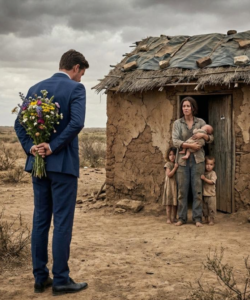
The house at the end of the lane was a single-story structure built of darkened wood, its roof line dipping significantly on the left side.
An old green pickup truck was parked across the road
An old green pickup truck was parked across the road, and a man stood beside it, leaning heavily on a hand-carved oak walking cane.
Daniel parked the van near the edge of the yard, the engine turning off with a soft click.
He stepped out into the damp air, carrying the cheap bouquet in his left hand while the man with the cane watched his every move.
The man did not call out or wave, but his gaze remained fixed on Daniel’s polished leather loafers as they sank into the loose gravel.
Daniel adjusted his silver pocket watch in his vest pocket, the metal cool against his fingers.
He walked toward the leaning house, his heart measuring the distance to the front door.
The yard was mostly bare dirt and wild weeds, with a rusted iron radiator sitting near the corner of the porch.
He stepped onto the wooden planks of the porch, which groaned under his weight but did not squeak.
The door was painted a fading blue, the surface peeling away to reveal gray wood underneath.
He knocked three times on the screen door frame
He knocked three times on the screen door frame, the sound hollow in the quiet afternoon.
The inner door opened slowly, stopping when the chain reached its limit.
Emily stood in the narrow opening, looking through the rusted metal mesh of the screen.
Her silver-streaked hair was pulled back in a loose knot, and her face was lined with deep creases around her eyes and mouth.
She wore a faded flannel shirt that was much too large for her thin frame.
Her hands, which Daniel remembered as smooth and elegant from their years in New York, were red and rough, the knuckles swollen.
“Daniel,” she said, her voice flat and without surprise.
“Emily,” he said, holding the wilting flowers toward the screen.
She unlatched the chain and pushed the screen door open just enough to let him step inside the small entryway.
She did not reach for the flowers, so he set them down on a small wooden table near the door next to a ceramic bowl.
The entryway smelled of damp wood and old paper, with a draft coming from the window beside the door.
” she asked, her hands resting against her thighs
“Why are you here, Daniel?” she asked, her hands resting against her thighs.
She rubbed her hands together as if warming them, her eyes scanning his expensive wool coat.
“I received your letter,” he said, looking at the bare wooden floorboards beneath their feet.
“I only sent the address,” she said.
“That was enough,” he said, looking at her worn collar.
“You look different, Emily, more than nine years should account for,” he said, the words slipping out before he could stop them.
“A lot of things change in nine years, Daniel,” she said, her voice direct and even.
The silence between them grew heavy, filled only by the distant sound of a crow calling from the pines outside.
Through the small window, Daniel could see the man with the cane still standing by the green pickup truck across the road.
“Who is that out there?” Daniel asked, nodding toward the window.
“That is Raymond,” she said, not turning to look.
“He watches out for me,” she added.
Daniel shifted his weight, his leather shoes sticking slightly to the worn linoleum of the entryway floor.
He had expected a small
He had expected a small, quiet cottage where she could read and garden, not this neglected structure that seemed to be holding itself up by sheer habit.
“Is there somewhere we can sit?” he asked, pointing toward the interior of the house.
Emily did not move from her position near the door, her body blocking the path to the kitchen.
“I didn’t invite you in for tea, Daniel,” she said.
“The letter was not an invitation to visit,” she added, her voice dropping a fraction.
“Then why did you send it?” he asked, his hand drifting back toward his pocket watch.
She looked at his hand, then back to his face with a cold, steady gaze.
“I wanted you to know where to find me when the time came,” she said.
“The time for what?” he asked.
“For whatever it is you are running from,” she said.
Daniel felt a chill that had nothing to do with the draft in the room.
He had spent forty years building Whitmore Industries into an empire, believing every hard decision he made was justified by the balance sheet.
Now, standing in this cramped entry hall, the
Now, standing in this cramped entry hall, the physical reality of her life made his corporate victories feel distant and hollow.
“The company is facing some difficulties,” he admitted, keeping his voice formal.
“I am aware,” she said.
“How could you be?” he asked, knowing the financial reports had not yet been made public.
“I still read the papers, Daniel, even the ones delivered two days late,” she said.
She crossed her arms, her rough fingers tucking into the sleeves of her oversized flannel shirt.
“You always did have an eye for the vulnerabilities in a structure,” he said, attempting a small, familiar smile.
She did not smile back.
“I see the mold before the roof falls in,” she said.
“Is that why you wrote?” he asked.
“I wrote because I knew you would exhaust every other option before you remembered I existed,” she said.
The directness of her words left him without an immediate reply, his mind racing to find a professional defense.
Outside, a truck engine roared to life, the sound vibrating through the thin walls of the house.