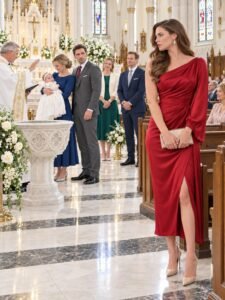
My husband kissed his mistress beneath an arch of white roses while holding her three-month-old son, then deliberately looked across the ballroom to watch my reaction.
Two hundred guests applauded beneath the crystal chandeliers of the Oceanside Ballroom at the Marston Hotel on Sea Island, Georgia. Beyond the towering windows, afternoon sunlight shimmered across the Atlantic, illuminating polished marble floors, champagne glasses, and enough inherited wealth to purchase several surrounding towns.
Preston Whitaker slowly pressed his lips against Sloane Mercer’s temple while photographers recorded what everyone assumed was a tender family portrait. Sloane leaned against him in an ivory silk dress that looked suspiciously bridal for an infant’s baptism reception, while baby Owen slept peacefully against Preston’s tailored jacket.
Preston wanted me to break beneath the spectacle, although he was careful enough to hide that desire behind a gracious public smile.
Instead, I smiled back.
The camera flashes captured everything, including the precise moment Preston unknowingly created the photograph that would define his professional downfall.
My name was Clara Monroe Whitaker, and at twenty-eight, I had already learned that public humiliation depended less upon what happened than upon how eagerly spectators awaited your collapse. Several guests watched me from behind champagne flutes, hoping for tears, shouting, or some dramatic gesture that would justify dismissing me as an unstable wife.
They received nothing except composure.
Vivian Whitaker, Preston’s sixty-one-year-old mother, approached me with the rigid posture of a woman whose family name had appeared on hospitals and university buildings for several generations.
“I hope we can depend upon you to behave appropriately this afternoon.”
I turned from the rose-covered stage. “What would inappropriate behavior look like under these circumstances?”
Vivian tightened her fingers around her champagne glass. “Whatever anger you are feeling, creating a public scene will help nobody.”
Her concern was beautifully rehearsed, but it was not intended for me. She wanted to protect Preston, Sloane, the baptism photographs, and the comforting fiction that the Whitaker family still controlled Whitaker Aeronautics.
“You do not need to worry about a scene, Vivian.”
Something in my voice disturbed her, although she recovered quickly and returned to the other guests.
Inside my evening bag rested a sealed envelope, my telephone, and a certified record showing who actually owned Whitaker Aeronautics. At eleven seventeen that morning, Meredith Shaw, the attorney representing my family trust, had sent three brief messages confirming that the emergency board vote had concluded unanimously.
Preston had not received the result because the company’s general counsel was waiting for my authorization.
The speeches began after lunch. Sloane stepped onto the stage while a gold monogram displaying Owen’s initials gleamed among thousands of white flowers. Preston joined her with the baby resting against his shoulder.
“Thank you for welcoming our wonderful little boy into this family and into our faith,” Sloane began, directing a triumphant glance toward me.
A restrained murmur moved through the ballroom because every guest knew Preston remained legally married.
“Owen carries the Whitaker name, and someday he will continue its extraordinary aviation legacy.”
Vivian rose first, applauding enthusiastically before declaring, “He represents the future of Whitaker Aeronautics.”
The remaining guests followed her example, and Preston kissed Sloane beneath the roses while staring directly at me.
He expected devastation, but my quiet smile unsettled him.
Everyone believed Whitaker Aeronautics belonged to Preston because his grandfather founded the original company, his father once served as chief executive, and Preston held the prestigious title of chairman. Financial magazines routinely described him as the third-generation heir to an American aerospace empire.
That description contained more mythology than truth.
Seventeen years earlier, Preston’s father had nearly destroyed the business through reckless expansion, enormous debt, and endangered defense contracts. My father, Henry Monroe, intervened through the Monroe Family Investment Trust.
He did not merely provide emergency financing. He purchased the patents, facilities, trademarks, contracts, and every voting share. He kept the Whitaker name because an established brand could remain valuable even after the founding family lost ownership.
After my father passed away, I became the trust’s sole controlling trustee.
Preston possessed an impressive title, a generous salary, corporate aircraft access, a private driver, and an extravagant executive allowance. Because I loved him, I allowed the world to believe that our marriage represented an equal union between two business dynasties.
He responded by beginning an affair with Sloane eighteen months after our wedding.
I discovered the affair almost a year later, but betrayal alone had not triggered the forensic investigation. Corporate spending did.
Auditors uncovered a Manhattan penthouse, private flights to European resorts, diamonds, designer furniture, medical expenses, a security detail, and the entire baptism celebration, all improperly charged to Whitaker Aeronautics. More than two million dollars had been diverted or intentionally misclassified.
Then they discovered a proposed inheritance amendment granting future ownership rights to Preston’s direct biological descendants. The document required my approval as controlling trustee, and someone had placed my signature beneath it.
The signature was mine only in appearance. Preston had copied the abbreviated name I used on holiday cards, forgetting that every legal document I signed included my middle initial.
The man who shared my bed knew my face, wardrobe, and family fortune, yet he had never bothered to learn my legal signature.
After the speeches, Preston approached my table alone.
“You are accepting this more calmly than I expected.”
“What exactly did you expect me to do?”
He glanced toward Sloane and Owen. “Cry, leave early, or throw champagne into somebody’s face.”
“I considered the champagne, but wasting it seemed unnecessarily theatrical.”
For one fleeting moment, he almost smiled like the man I had once loved.
“We cannot continue pretending our marriage still exists,” he said.
“On that point, we finally agree.”
His shoulders relaxed. “I planned to file for divorce next week.”
“That will be unnecessary because you are being served this afternoon.”
The relief vanished from his face.
“You filed without discussing it with me?”
I stared at him until the hypocrisy registered.
“You have publicly presented your mistress as your partner for six months, Preston.”
Before he could answer, a photographer summoned everyone for what he called the official legacy portrait. Sloane reserved a position for me at the outer edge, almost beyond the camera frame, while Preston quietly instructed me to behave with dignity.
The ballroom doors opened before the photograph could be taken.
Meredith Shaw entered wearing a charcoal suit and carrying a slim leather case. Two additional attorneys followed her, accompanied by Anthony Kim, the male general counsel of Whitaker Aeronautics, and two hotel security officers.
Meredith crossed the ballroom and stopped beside me.
“Mrs. Whitaker, everything is prepared whenever you are ready.”
Behind me, Preston called my name, although it no longer sounded like a warning.
For the first time that afternoon, he sounded frightened.
Part 2: The Empire Beneath the Name
Preston stepped away from the portrait arrangement and confronted the legal team.
“What is this supposed to be?”
Meredith looked toward me before answering him, and that small act immediately revealed where the authority rested.
“I requested a forensic audit of the assets controlled by the Monroe Family Trust,” I explained.
Preston’s face briefly lost its color.
Vivian hurried forward and demanded an explanation, while Sloane tightened her protective hold around Owen. I asked a nanny to take the infant into a quieter room because whatever his parents had done, a three-month-old child should never become a shield or a public exhibit.
Preston turned toward Anthony Kim.
“Clear this ballroom and schedule whatever meeting they want for Monday.”
Anthony remained perfectly still. “I no longer have the authority to accept instructions from you.”
“I am chairman of this company.”
Anthony’s expression stayed professional. “The board met this morning and unanimously removed you as chairman, effective immediately, pending the final audit findings.”
The silence following that announcement seemed to contract around Preston.
“The board cannot remove a Whitaker from Whitaker Aeronautics.”
Meredith opened her case. “Your surname does not carry voting rights, Mr. Whitaker.”
She handed Anthony three formal notices. The first confirmed Preston’s removal from every executive position. The second suspended his corporate accounts, aircraft privileges, driver, expense cards, and access to company properties.
The final document demanded repayment of $2,186,412 in unauthorized expenditures, subject to further adjustment as additional transactions were reviewed.
“Clara approved those expenses,” Preston insisted.
“Knowing about your affair did not authorize you to charge diamonds and vacations to the company,” I replied.
“They were executive hospitality expenses.”
“Was Sloane a corporate client, or was the infant nursery a satellite office?”
Several guests turned away to hide their reactions.
Meredith produced the proposed inheritance amendment and explained that it attempted to create future equity for Preston’s biological descendants without the controlling trustee’s legitimate approval.
Sloane looked at Preston with sudden hope. “You arranged ownership for Owen?”
Preston remained silent.
“The amendment never became effective,” Meredith clarified. “The person controlling the trust neither signed nor approved it.”
Vivian frowned. “Which controlling trust are you discussing?”
I removed the certified ownership record from my bag.
“The Monroe Family Trust owns Whitaker Aeronautics.”
Vivian shook her head immediately. “Your family owns an investment position, but Preston’s family retains control.”
A calm, elderly voice answered from behind her.
“No, Vivian, Henry Monroe purchased everything.”
Ruth Whitaker, Preston’s ninety-year-old grandmother, stood beside her cane with enough authority to silence the entire family.
“My son nearly destroyed the company,” Ruth continued. “Selling it preserved the factories, contracts, and thousands of jobs.”
Vivian stared at her. “Why was I never told the complete truth?”
“Because pride had already cost this family enough without printing additional receipts.”
Preston turned toward me.
“How much does your trust control?”
“Every voting share.”
His expression hardened as understanding replaced disbelief.
“You allowed me to believe that I owned my family’s company throughout our marriage.”
“I allowed you to lead it because I believed we were partners.”
“You deliberately humiliated me.”
The accusation almost left me speechless. His mistress stood beneath a bridal arrangement while his lawful wife remained at the edge of a staged family portrait, yet he still believed humiliation belonged exclusively to him.
“You forged my signature, Preston.”
Meredith displayed the amendment while explaining that I had been in Zurich on the date I supposedly signed it in Georgia. She also identified the missing middle initial.
“You copied the signature from our holiday cards,” I said. “You did not know how I signed legal documents.”
His gaze dropped for less than a second, but everyone witnessed the involuntary admission.
Vivian asked him to deny the accusation.
He could not.
Sloane slowly stepped away from him.
“You told me Owen’s ownership had already been secured.”
“It should have been secured.”
“You said the paperwork was complete.”
Meredith closed the folder. “The matter has been referred for additional legal review.”
We prepared to continue the discussion privately, but my telephone vibrated with a message from the forensic accounting team.
They had discovered another unauthorized approval.
When I raised my eyes, Preston was watching my expression, and his fear confirmed that he knew precisely what the auditors had found.
Part 3: The Price of Cooperation
We moved upstairs into a private conference room so Owen could remain separated from the confrontation. Meredith sat beside me, Anthony opened his legal file across the table, and Preston refused to sit until Sloane entered against his wishes.
Vivian and Ruth followed, while Preston’s closest friend, Julian Cross, remained near the doorway. Julian had attended boarding school with Preston, served as best man at our wedding, and recently became Owen’s godfather.
His uneasy expression had troubled me throughout the baptism.
Meredith reviewed the newly discovered transaction.
“Three hundred fifty thousand dollars left the discretionary development fund and entered Cross Strategic Advisory.”
Everyone turned toward Julian.
Preston responded too quickly. “That payment was legitimate consulting compensation.”
“What service did Julian provide?” I asked.
Julian rubbed one hand across his mouth. “Preston asked me to assist with the inheritance amendment.”
Sloane stared at Owen’s godfather. “You knew about the proposed ownership?”
“I knew Preston wanted to create it.”
“Did you know Clara had not approved the document?”
Julian looked directly at me. “I discovered that when Preston asked me to witness her signature.”
A sick heaviness settled beneath my ribs.
“Did you witness it?”
“I refused, but the signature had already been placed on the document.”
Preston struck the tabletop with his palm. “This conversation has gone far enough.”
Julian stepped away from the wall. “It has not gone nearly far enough.”
He admitted that Preston had described the payment as an advance consulting fee after asking him to confirm that I had signed the amendment in their presence. Julian refused to provide the false witness statement, but he accepted the money and remained silent.
“I returned most of it,” he added.
“Most of it does not erase your cooperation,” Meredith replied.
Julian’s face reddened with shame. “I understand that now, and I will provide every record your investigators require.”
Preston laughed bitterly. “You accepted the payment, so stop pretending you are morally different from me.”
“I am not pretending,” Julian answered. “I am admitting that fear and loyalty made me participate in something dishonest.”
I remembered Julian raising a glass at our wedding and promising that Preston would always protect my happiness. The memory hurt because betrayal did not erase every genuine moment that preceded it. Honest affection could exist beside unforgivable choices, and that contradiction created a more complicated grief than simple hatred.
“Why did you forge the amendment?” I asked Preston.
His expression became defensive. “You could never understand what it means to possess everything.”
“You had wealth, authority, access, and more professional freedom than most executives receive.”
“I had permission,” he said. “You had ownership.”
The bitterness in his voice rearranged years of memories. His anger whenever journalists mentioned my father’s rescue of Whitaker Aeronautics, his obsession with expanding the company, and his insistence upon preserving a Whitaker bloodline were suddenly connected.
Preston had inherited shame and converted it into entitlement.
“Every time somebody called me the Whitaker heir, I knew your family’s money stood behind the description,” he continued. “People believed I married you to reclaim the company.”
“I never believed that.”
“I did, and Owen was supposed to restore what my father lost.”
Sloane wiped tears from her face. “You told me the company already belonged to you.”
“It should have belonged to me.”
“Your father sold it because my father prevented its collapse,” I said. “The company survived because thousands of employees deserved protection from one family’s pride.”
Preston leaned forward. “Do you believe paying the debts gave your family a moral right to everything?”
“Morally, the company belongs to the people responsible for protecting its future. Legally, every voting share belongs to the trust.”
He accused me of enjoying his downfall.
“I loved you enough to let the world believe we controlled the company equally,” I answered. “You lost your position because you converted that trust into permission to steal.”
Sloane interrupted with a trembling question.
“Did you ever genuinely intend to divorce Clara?”
Preston closed his eyes. “This is not the proper time.”
“You told me the divorce settlement had already been negotiated.”
“That was never true,” I said.
Sloane looked as though another floor had disappeared beneath her. She had knowingly participated in an affair and deliberately humiliated me, but Preston had also constructed a separate reality for her.
She removed her diamond earrings, bracelet, and necklace before placing them on the table.
“Which of these were purchased with corporate money?”
“The auditors are preparing an itemized record,” Meredith replied.
“Then everything connected to company funds will be returned.”
Before leaving, Sloane stopped beside me.
“I hated you because Preston claimed you used the company to imprison him.”
“You still chose to stand beside him on that stage.”
Her gaze lowered. “I understand that now.”
It was neither forgiveness nor friendship, but it was finally truthful.
After everyone else left, Preston asked what would happen to our marriage.
“The corporate attorneys will address the financial misconduct, while our divorce attorneys handle everything remaining between us.”
“Do you truly hate me this much?”
“I wish hatred were all I felt, because hatred would be simpler than grieving someone I once trusted.”
I walked toward the elevators before Sloane telephoned and asked to meet privately.
Her voice trembled when she revealed that Preston might not be Owen’s biological father.
Part 4: The Child Behind the Legacy
Sloane waited inside a small oceanfront sitting room while Owen slept nearby in a portable bassinet. Without the stage lighting and triumphant smile, she looked frightened and exhausted.
“There was another relationship immediately before Preston,” she admitted. “The dates overlap enough that I was never completely certain.”
“Who was the other man?”
She hesitated before answering. “Julian.”
The uneasiness in Julian’s expression, his unexpected role as godfather, and his shame suddenly carried another possible meaning.
“Has Owen received a DNA test?”
“Preston refused because he called the suggestion insulting.”
His refusal could have reflected confidence, denial, or fear. More importantly, his forged amendment had granted inheritance only to direct biological descendants, not merely to children he legally recognized.
“Was Preston responsible for that precise wording?”
“He repeatedly insisted that the language remain biologically specific.”
The hypocrisy was extraordinary. Preston publicly presented Owen as the guaranteed Whitaker heir while privately drafting language that protected him if the child proved unrelated.
“Speak with an independent family attorney before making any decision,” I told her. “Do not allow this child to become another piece of corporate evidence.”
“What should I tell Preston?”
“Whatever you decide belongs between you and him, but Owen’s welfare must come before everyone’s pride.”
Sloane apologized before I left.
“Which part are you apologizing for?”
She looked toward her sleeping son. “Every part in which I knowingly helped Preston hurt you.”
By Monday morning, Whitaker Aeronautics publicly confirmed Preston’s removal following an internal financial audit. The statement mentioned neither Sloane nor Owen because the company existed to protect employees and contracts, not to punish my husband’s mistress.
Preston called repeatedly, but I refused every attempt until he arrived at our coastal estate while staff members packed his belongings.
“You changed the security code to my house,” he said.
“The Monroe Trust owns this property, and your attorneys received formal notice.”
He laughed without humor. “Naturally, your family owns this as well.”
The corporate apartment in Boston had also been reclaimed, along with his vehicle and aircraft privileges. For the first time, Preston recognized how much of his lifestyle had been borrowed from an organization he never owned.
“You possess enough personal assets to establish a comfortable home,” I reminded him.
“Not the life I had before.”
“That life depended upon responsibilities you deliberately violated.”
He claimed that one terrible mistake should not destroy everything, but I described the document preparation, copied signature, attempted false witnessing, secret payment, and repeated concealment.
“Those were coordinated decisions, Preston, not one moment of panic.”
He sat heavily in the library chair.
“Sloane wants a DNA test.”
“She informed me that uncertainty existed.”
“You knew and chose not to use it against me.”
“Owen has never harmed me, and I will not convert a three-month-old child into ammunition.”
Preston stared at the carpet.
“If he is not mine, the inheritance amendment becomes meaningless.”
His response extinguished the brief compassion I had felt.
“You are still evaluating a child according to the property he might deliver.”
“Everything is collapsing simultaneously.”
“Everything is revealing who you became.”
Before leaving, Preston offered the first apology that contained neither justification nor blame.
“I am sorry, Clara.”
Part of me remembered the husband who once burned pancakes in my father’s kitchen and trembled while placing a wedding ring upon my hand. Those memories remained real, but reality did not require reconciliation.
“I am sorry that I gave so much of myself to someone who eventually treated love as permission.”
Three weeks later, Whitaker Aeronautics continued operating without disruption. Factories opened, engineers designed new systems, contracts remained active, and aircraft continued flying.
I accepted the position of interim chairwoman while refusing an operational executive role. Preston had converted corporate leadership into a monument to his identity, and I would not repeat that mistake.
Sloane telephoned on a Thursday afternoon with the DNA result.
“Julian is Owen’s biological father.”
She explained that Julian had accepted the truth and offered to assume responsibility, although she remained uncertain whether forgiveness or a relationship would ever become possible.
Preston had left immediately after learning the result, blaming Sloane for destroying his future.
“I believed Preston loved me,” she whispered.
“He loved the future you represented, especially the possibility of rebuilding a bloodline around the company.”
“Did he ever love you?”
The question hurt because the honest answer was complicated.
“Yes, I believe he once loved me, and that is precisely why the ending remains tragic.”
Part 5: What the Company Inherited
Corporate reimbursement negotiations continued for several months. Assets purchased with company funds were returned or sold, while additional amounts were recovered through Preston’s compensation, benefits, and personal holdings.
The divorce required six months because Preston initially disputed valuations and classifications, searching for leverage rather than reconciliation. Eventually, financial reality accomplished what emotional arguments could not.
We signed the final documents in Meredith’s office.
Preston arrived without his driver, executive pin, or armor-like tailored suit. For the first time, his surname appeared to be an ordinary name rather than a crown.
He signed first and pushed the papers toward me.
I added my complete legal signature: Clara M. Monroe Whitaker.
Preston watched the pen form my middle initial.
“I should have known how you signed your name.”
“You should have known many things before attempting to become me.”
When Meredith left to prepare copies, Preston asked whether I still hated him.
“I never hated you, although I no longer fear losing you.”
He nodded slowly. “Sometimes I wish you hated me because hatred would mean I remained important.”
“You were profoundly important once, but importance does not survive every choice.”
He asked whether the company would retain the Whitaker name.
“Thousands of employees built careers beneath that brand, and they should not lose its value because our marriage ended.”
“Then the Monroe family will continue owning Whitaker.”
“It remains a company, Preston, not a family mausoleum.”
Before leaving, he asked whether Owen would eventually learn about the baptism and the disputed paternity.
“That decision belongs to Sloane and Julian.”
His voice softened. “I loved that child before receiving the test.”
“Then decide whether your love was ever larger than biology.”
That became our final private conversation.
One year after the baptism, I returned to the Marston Hotel for an education initiative funded by Whitaker Aeronautics and several universities. The reception occupied a smaller oceanfront room without rose arches, staged heirs, or speeches about bloodlines.
Ruth, now ninety-one, joined me on the terrace.
“You kept the Whitaker name on the company,” she observed.
“The brand belongs to the employees who preserved its value.”
Ruth smiled. “Preston has started working for a small aviation consulting firm.”
“I genuinely hope he builds something honest there.”
She studied me carefully. “You do not want him to suffer forever?”
“I wanted the misconduct stopped and the company protected. Justice does not require endless suffering.”
Ruth tapped her cane against the stone.
“Preston believed inheritance meant receiving something because of his name. He never understood that inheritance can also mean accepting responsibility for whatever survived before your arrival.”
After she returned inside, Meredith sent me a newspaper photograph from the previous year. Preston stood beneath the baptism roses, kissing Sloane while holding Owen and watching me. I remained visible near the background, smiling slightly with the legal documents inside my bag.
The photograph had been captioned as the moment before the leadership transformation at Whitaker Aeronautics.
The caption misunderstood everything.
That was the moment Preston made his final choice. He attempted to place me outside his imagined legacy, unaware that the company, estate, aircraft, and executive authority he displayed belonged to a trust under my control.
More importantly, he misunderstood what a legacy actually represented.
It was not a surname, bloodline, photograph, or infant positioned beneath expensive flowers. It was the responsibility to protect employees, preserve useful work, and leave an institution healthier than you found it.
Inside the ballroom, a twenty-two-year-old female engineering graduate approached me. Her father worked at one of our manufacturing facilities, and she had become one of the first recipients of the company’s new scholarship.
“Ms. Monroe, I want to design propulsion systems, although nobody in my family has attended graduate school before.”
“Come to my office on Monday and show me your current research.”
Her eyes widened. “Do you truly mean that?”
“I would not invite you otherwise.”
She hurried toward her parents, who embraced her with unconcealed pride.
The event photographer raised his camera before politely asking permission. I looked toward the young engineer, the employees, and the families gathering beneath the chandeliers.
“Yes, you may take the photograph.”
This time, there was no unfaithful husband, mistress, staged heir, or family hierarchy arranged beside me. I stood alone because I no longer required another person’s name to justify my place.
The flash illuminated the room.
I had not won because Preston lost his title, because Sloane returned the diamonds, or because Julian proved to be Owen’s biological father. I won when I stopped allowing another person’s betrayal to determine who I would become.
Preston intended the baptism portrait to begin his restored Whitaker dynasty. In an unexpected way, the photograph accomplished exactly that purpose.
His imagined legacy ended beneath those roses.
Mine began when I walked beyond them.
THE END