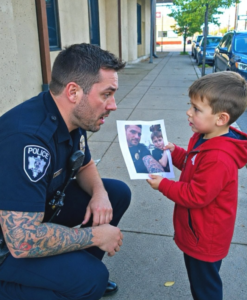
I was simply Colin Carter again, twelve years old, watching my brother dare me to jump from the old wooden dock into water we both knew was too cold.
“That’s your dad?” I finally managed.
The boy nodded.
“His name is Logan?”
Another nod.
My throat tightened.
“What’s your name?”
“Eli.”
He said it cautiously, as though he had begun to realize I wasn’t reacting the way adults usually reacted to photographs.
“Eli!”
A woman’s voice carried down the sidewalk.
The boy turned.
A woman hurried toward us from the doorway of a nearby café, holding a small paper bag in one hand. She couldn’t have been much past thirty. Her brown hair had been gathered quickly behind her head, and her expression held the unmistakable concern of a parent who had looked away for half a minute and discovered that half a minute was enough.
“There you are.”
She reached Eli, rested both hands gently on his shoulders, then looked up at me.
“I’m sorry, Officer. He was right beside the window. I was paying for breakfast and—”
“It’s all right,” I said. “He stayed right here.”
Eli held up the photograph.
“I found Uncle Colin.”
The woman went perfectly still.
I heard those two words more clearly than anything else around us.
Uncle Colin.
Her gaze dropped to my forearm.
Then she looked at my face again.
“Oh,” she said softly.
That single syllable told me she knew exactly who I was.
“You know me?”
She drew in a breath.
“My name is Rachel.”
I waited.
“Rachel Bennett.”
The name meant nothing at first.
Then somewhere in the back of my memory, a door opened.
Logan had mentioned a Rachel once.
Years ago.
Not often. My brother had never been the kind of person who talked freely about relationships until he knew they mattered. But sometime during the final year before we stopped speaking, he had mentioned a woman he had met through a friend.
Rachel.
I stared at her.
“You and Logan…”
“We’re married.”
The words landed quietly.
Maybe that was what made them so powerful.
There was no dramatic announcement, no warning, no time to prepare.
My brother was married.
My brother had a son.
My brother had built an entire life while I had been moving through mine believing he wanted nothing to do with me.
I looked at Eli again.
Suddenly the familiarity in his eyes made sense.
They were our mother’s eyes.
Gray with a narrow ring of blue around the iris.
People used to stop my mother in grocery stores and tell her how unusual they were. Logan had inherited them more strongly than I had.
Now they were looking up at me from the face of a five-year-old boy.
“How old are you, Eli?”
He held up five fingers.
“Five.”
Rachel glanced toward him.
“Why don’t you finish your muffin at the table by the window? I’ll be right there.”
Eli looked uncertain.
“Can Uncle Colin come?”
The word hit me again.
Rachel gave me a brief, apologetic look.
“If he wants to.”
I should have said something sensible.
Instead, I heard myself say, “I’d like that.”
Ten minutes later, I was sitting outside the café with a radio on my shoulder, a coffee I had forgotten to drink, and a nephew I had learned existed less than fifteen minutes earlier.
Eli sat across from me, carefully breaking a blueberry muffin into pieces and arranging them according to some system understood only by him.
Rachel sat beside him.
For a while, none of us knew where to begin.
Finally, I placed the photograph on the table.
“When was this taken?”
“Last October,” Rachel said.
I looked up sharply.
That meant Logan had looked like this less than a year ago.
It meant the photograph wasn’t some old image Eli carried because his father belonged to the past.
“He’s okay?”
Rachel understood the question immediately.
“He’s fine.”
The relief that moved through me embarrassed me with its force.
I hadn’t realized how many terrible explanations my mind had assembled in the previous few minutes.
“He works for a building restoration company,” she continued. “Mostly old houses and public buildings. He’s been with them six years.”
“Where?”
“Millhaven.”
I stared at her.
Millhaven was forty minutes away.
Forty minutes.
For years, I had imagined Logan somewhere across the country. Maybe Seattle. Maybe Denver. Maybe one of the dozen places we had talked about when we were twenty and certain adulthood meant leaving everything familiar behind.
Forty minutes away.
“How long has he lived there?”
“Almost seven years.”
I looked out toward the street.
A bus rolled past.
Someone laughed outside a bakery across the intersection.
The ordinary world continued without noticing that mine had shifted.
Rachel folded her hands around her coffee.
“I know what you’re thinking.”
“I’m not sure I know what I’m thinking.”
“That’s fair.”
“Does Logan know you’re here?”
Her pause answered before she did.
“No.”
I leaned back.
“Then why are you here?”
Eli looked up from his muffin.
Rachel lowered her voice slightly.
“We’re visiting someone.”
“Who?”
She hesitated again.
That hesitation was beginning to bother me.
“Your father.”
I stared at her.
“My father?”
“Yes.”
“My father knows you?”
Rachel’s expression changed.
Not guilt.
Something closer to regret.
“Colin, I think there are things you and Logan both believe about the last several years that aren’t entirely true.”
My hand tightened around the untouched coffee cup.
“What does that mean?”
She glanced toward Eli.
He was watching a pigeon investigate the edge of the sidewalk.
“Probably more than we should discuss while you’re working.”
“I’m listening.”
“I know.”
She offered a small, tired smile.
“And I can see that you’re very good at making people answer questions.”
Under different circumstances I might have laughed.
I didn’t.
Rachel sighed.
“Your father has seen Logan.”
“When?”
“Several times.”
The café sounds seemed to fade.
“Recently?”
“Yes.”
“How recently?”
“Three weeks ago.”
I looked down at the photograph.
Then I noticed something I hadn’t noticed before.
At the far edge of the picture, beyond the picnic tables, stood an older man in a blue jacket.
Only part of his face was visible.
But I knew that jacket.
I had given it to my father for his sixty-fifth birthday.
I brought the photograph closer.
My father was there.
Standing no more than twenty feet from Logan.
My brother.
The son he had repeatedly told me he hadn’t heard from in years.
I remembered conversations with Dad.
Not many.
Never long.
He and I were close in some ways and strangely formal in others. After Mom died, we had both become experts at discussing practical matters while stepping neatly around anything painful.
Whenever Logan’s name came up, Dad answered with some variation of the same sentence.
He seems to be doing all right.
I always assumed he heard things through old family friends.
I had never asked how.
Maybe because asking would have meant admitting I still cared.
“Why didn’t he tell me?”
Rachel looked at me for a long moment.
“I think you need to ask him that.”
I felt anger rising, but it wasn’t clean anger.
It was tangled with embarrassment.
Because there was another question underneath it.
Why hadn’t I asked?
Not once in seven years had I driven to my father’s house, sat across from him, and said: Tell me exactly what you know about my brother.
Instead, I had accepted vague answers because vague answers were easier.
Eli suddenly pushed one muffin piece toward me.
“You can have that one.”
I looked at him.
“Thanks.”
“It’s the biggest.”
“Then I’m honored.”
He smiled.
It was Logan’s smile.
Not exactly.
But close enough to bring back a memory so clear that for a moment I could smell lake water and sunscreen.
Logan and I had been eight.
Dad had taken us fishing at Mason Lake, although neither of us had possessed the patience required for fishing. Logan had dropped his sandwich into the water and spent twenty minutes insisting a trout had stolen it deliberately.
That evening Mom had asked what we caught.
“One criminal fish,” Logan said.
I hadn’t thought about that day in years.
Now, sitting across from Logan’s son, the memory returned intact.
Rachel watched me.
“He talks about you.”
I looked up.
“Logan?”
She nodded.
“What does he say?”
“Usually stories.”
I almost laughed from disbelief.
“What kind of stories?”
“The lake. Your first car. The treehouse you built that apparently leaned so badly your mother wouldn’t let either of you sleep in it.”
“It was structurally questionable.”
“Eli’s heard about the time you two tried to make pancakes for your mother’s birthday.”
“We ruined a pan.”
“Three pans, according to Logan.”
“He exaggerates.”
Rachel smiled.
“There. That.”
“What?”
“That sounded exactly like him.”
Something in my chest shifted.
Not healed.
Not even close.
But loosened.
I looked toward Eli.
“If Logan talks about me, why hasn’t he called?”
Rachel didn’t answer immediately.
“Probably for the same reason you haven’t called him.”
That answer irritated me because it was probably true.
“He left.”
“Yes.”
“He changed his number.”
“Yes.”
“He never sent me an address.”
Rachel folded the edge of her napkin.
“And he believes you told your father you never wanted to hear from him again.”
I stared at her.
“I never said that.”
“I was hoping you hadn’t.”
“When did he tell you that?”
“Years ago.”
“Who told him?”
“Your father.”
The anger returned.
Then Rachel quickly added, “But Colin, I don’t think it’s as simple as it sounds.”
I pushed the chair back slightly.
“My father told my brother I never wanted to speak to him.”
“I don’t know exactly what your father said. I only know what Logan remembers hearing.”
“That’s not much better.”
“No. But memory gets complicated when people are hurt.”
I knew that professionally.
I had taken witness statements after minor collisions where four people standing on the same corner remembered four different traffic lights.
But this wasn’t an intersection.
This was my family.
My radio crackled.
Dispatch.
Reality returning.
I checked the time and realized I had already remained there longer than I should have.
Rachel saw it too.
“You need to go.”
“Yes.”
She reached into her purse and pulled out a small card.
There was a phone number written on the back.
“That’s mine.”
I took it.
“Does Logan know you planned to find me?”
“I didn’t.”
I frowned.
“We came downtown because your father had an appointment nearby. Eli and I went for breakfast while he was there.”
Eli smiled proudly.
“I saw the tattoo.”
Rachel looked at him.
“You certainly did.”
“So this really was an accident?”
“Completely.”
I looked down at the photograph again.
“Can I keep this?”
Eli immediately shook his head.
Rachel laughed softly.
“That’s his favorite.”
“Fair enough.”
I handed it back.
“But you can take a picture of it,” Eli offered.
So I did.
My hand trembled slightly as I held my phone above the photograph.
Before I stood, Rachel said, “Colin?”
I looked at her.
“Whatever happened between you two, I don’t think Logan stopped caring.”
I wanted to believe her.
That was the problem.
Hope could be more frightening than certainty.
For seven years, I had built a version of the past that allowed me to live with it.
Logan left.
Logan chose distance.
Logan didn’t call.
Therefore Logan didn’t care.
It was painful, but it was simple.
Rachel had taken less than half an hour to make it complicated.
I spent the rest of my shift moving through familiar streets that no longer looked quite the same.
Every ordinary thing seemed connected to memory.
A man loading lumber into a truck reminded me of the summer Logan and I worked construction after high school.
A bicycle leaning outside a shop reminded me of the one we shared when we were nine.
Even the smell of coffee from a corner stand pulled me backward because Logan had once worked mornings at a diner and claimed he could identify six different coffee brands by smell.
He couldn’t.
I had tested him.
He got one right.
At eleven thirty, my partner from the afternoon rotation found me filling out a routine report at the station.
Officer Maya Chen had known me for four years, which meant she had developed the irritating ability to notice when something was wrong even when I was trying very hard to look ordinary.
She leaned against the edge of the desk.
“You’ve read that sentence six times.”
“I’m being thorough.”
“You’re holding the report upside down.”
I looked at it.
It wasn’t upside down.
Maya smiled.
“Made you check.”
I gave her a look.
“What’s going on?”
“Nothing.”
“Colin.”
I sighed.
“I met my nephew today.”
She blinked.
“I didn’t know you had a nephew.”
“Neither did I.”
That erased the humor from her face.
She pulled over a chair.
I told her the shortened version.
Tattoo.
Photograph.
Rachel.
Eli.
Logan.
When I finished, Maya sat quietly for a moment.
“You’re going to call him?”
“I don’t have his number.”
“You have his wife’s number.”
“That’s not the same thing.”
“True.”
She waited.
I knew what she was doing.
“You don’t have to give me the patient silence.”
“I’m not.”
“You’re doing it right now.”
“I’m sitting.”
“Very meaningfully.”
She smiled.
Then she became serious.
“What do you actually want?”
It should have been an easy question.
I had spent years telling myself I wanted closure.
But closure was one of those words people used when they wanted an ending to something that hadn’t truly ended.
“I want to know why.”
“Why he left?”
“Why he stayed away.”
Maya nodded.
“And after you know?”
I didn’t answer.
Because the truth frightened me.
After I knew, I might have to decide whether seven years of silence mattered more than everything before it.
My shift ended at four.
At four fifteen, I was sitting in my car with Rachel’s number open on my phone.
I didn’t call.
Instead, I drove to my father’s house.
Dad lived on the western edge of town in the same small brick house where Logan and I had grown up.
He had talked about selling it after Mom died.
He never did.
The maple tree we had climbed as children still leaned over the driveway, larger now, its roots raising one section of pavement.
Dad’s sedan was parked outside.
I sat behind the wheel for nearly two minutes before getting out.
He answered the door wearing old jeans and a green sweater.
“Colin.”
“Hey, Dad.”
He looked surprised.
“You didn’t call.”
“I know.”
“Everything all right?”
I studied his face.
For the first time in years, I wondered how much of it I had failed to see.
“I met Eli.”
Dad’s expression changed.
Slowly.
First confusion.
Then recognition.
Then something that looked almost like relief.
“So you know.”
“Apparently everyone knows except me.”
“Colin—”
“Is Logan in Millhaven?”
Dad nodded.
“He’s been there almost seven years?”
Another nod.
“You’ve seen him?”
“Yes.”
“How many times?”
Dad stepped backward.
“Come inside.”
“I’d rather you answer.”
“More than once.”
“How many?”
He looked tired.
“I don’t know. Fifteen times, maybe twenty. Over the years.”
Twenty.
The number felt enormous.
“You’ve sat with him twenty times and never once told me?”
Dad looked toward the street.
“Come inside, son.”
This time I followed.
The house smelled the same as it always had.
Wood polish.
Coffee.
The faint cedar scent from the old hall closet.
Family photographs still covered the wall beside the stairs.
There were pictures of Logan and me everywhere.
Graduation.
Little League.
Christmas.
The lake.
Dad had never taken them down.
We sat at the kitchen table.
For a while, he said nothing.
I remembered being fourteen at that same table while Mom tried to explain algebra to Logan and Dad secretly passed me cookies beneath the newspaper.
“Did you tell Logan I never wanted to see him again?”
Dad’s eyebrows lifted.
“No.”
“Rachel says he thinks you did.”
“I told him what you told me.”
“I never said that.”
“You said you were finished.”
I stared at him.
Dad continued quietly.
“It was the week after he left. You were angry. You said if Logan wanted a life without us, he could have one.”
I remembered saying something like that.
Maybe exactly that.
But I also remembered what I had meant.
I had meant: I’m hurt.
I had meant: I want him to come back and prove me wrong.
I had meant everything except the literal words.
“I was twenty-eight.”
“I know.”
“I was furious.”
“I know that too.”
“Then why would you repeat it?”
Dad’s shoulders lowered.
“Because a month later, Logan asked me whether you wanted him to call. I told him what you’d said.”
“And you didn’t tell him I was angry?”
“I thought he understood.”
“He didn’t.”
“No.”
Dad’s voice carried no defensiveness.
That made it harder to stay angry.
“What did Logan say?”
“He said he would give you time.”
“Seven years?”
“It wasn’t supposed to become seven years.”
The kitchen clock ticked.
Dad looked older than he had when I entered the house.
“Why didn’t you fix it?”
“I tried.”
“How?”
“I told each of you more than once that the other asked about you.”
I searched my memory.
He had.
Casually.
Logan seems to be doing well.
Your brother asked whether you’re still downtown.
He mentioned your promotion.
I had heard information without recognizing the invitation underneath it.
Dad rubbed one hand across his forehead.
“You both made it very clear you didn’t want me interfering.”
I looked away.
Because that was true too.
After the first year, Dad once suggested I call Logan.
I had answered, If he wants to talk, he knows where I am.
I had forgotten the conversation.
Dad hadn’t.
“Why didn’t you tell me about Rachel?”
“He asked me not to.”
“Why?”
“He said he’d tell you himself when the time was right.”
“Apparently the time was never right.”
“No.”
“Or Eli?”
Dad’s expression softened.
“That was harder.”
I stood and walked toward the window.
Five years.
Five birthdays.
Five Christmas mornings.
First words.
First steps.
A whole beginning of a life I had never known existed.
“He asked you not to tell me about his son?”
“Yes.”
I turned.
“Why?”
Dad stared at the table.
“Because by then the silence had gotten too big.”
That answer made more sense than I wanted it to.
Every year without contact created another thing to explain.
Another birthday missed.
Another holiday.
Another reason the first phone call became harder.
Dad stood.
“There’s something you should see.”
He walked toward the hallway.
I followed him into the small room that had once been Mom’s sewing room and was now crowded with boxes.
Dad opened the closet.
From the top shelf, he brought down a blue plastic storage container.
“Your mother kept almost everything.”
“Mom’s been gone nine years.”
“I know.”
He placed the container on a table.
“After she died, I sorted her papers. Some I gave you. Some I gave Logan. Some I couldn’t deal with.”
He opened the lid.
Inside were photographs, cards, receipts, school programs, and folded papers held together with old elastic bands.
Dad removed a photograph.
Logan and me at seventeen.
Standing beside Dad’s old pickup.
Both of us sunburned.
Both laughing.
“Why are you showing me this?”
“Because Logan came here three weeks ago looking for something.”
“What?”
Dad reached deeper into the box.
“The original drawing.”
My eyes moved automatically to my tattoo.
I had nearly forgotten.
The design had started on a piece of paper.
Mom drew it.
Not professionally.
Just absentmindedly.
She used to doodle when talking on the phone. One evening, when Logan and I were twenty-one, she had drawn two winding lines that crossed and separated before meeting again.
Logan saw it and said it looked like us.
Mom laughed.
“Then hopefully you meet again more than you separate.”
Years later, Logan and I took that scrap of paper to a tattoo artist and asked him to turn it into something permanent.
Dad placed the old sheet on the table.
There it was.
Faded blue ink.
Two lines.
Crossing.
Separating.
Returning.
I touched the edge.
“Logan wanted this?”
“He asked whether I still had it.”
“Why?”
Dad looked at me.
“He wouldn’t say.”
I studied the drawing.
In the lower corner was something I had never noticed before.
Mom’s handwriting.
Tiny.
Almost hidden under the edge where the paper had once been folded.
C + L.
Then beneath that:
You don’t have to walk the same road to belong to the same family.
I swallowed.
“Did Logan see this?”
Dad nodded.
“He sat where you’re standing for almost ten minutes.”
“What did he say?”
“Nothing.”
I imagined my brother in this room three weeks earlier.
Holding the same page.
Thinking whatever I was thinking now.
“Then why did Rachel come here today?”
“She wasn’t supposed to.”
I looked at Dad.
“What?”
“Logan doesn’t know.”
“She told me that.”
Dad sat slowly on the old desk chair.
“She called me yesterday.”
“Why?”
“Because they’re moving.”
That caught me off guard.
“Where?”
“Maybe.”
“Maybe?”
“Logan’s been offered a job supervising restoration projects in Vermont. It’s a good position. Rachel thinks he’s going to accept.”
My first reaction surprised me.
No.
Not because Vermont was far.
Because I had just learned my brother was forty minutes away.
I wasn’t ready for him to become hundreds of miles away again before I had decided what to do.
“When?”
“Six weeks.”
I stared at the tattoo design.
“Does he want to go?”
“Professionally, yes.”
“And personally?”
Dad gave a faint shrug.
“I think that’s why he came looking for this.”
For the first time, I understood Rachel’s visit differently.
She hadn’t brought Eli into town to force a reunion.
She had come because something was about to change.
Maybe she believed two stubborn brothers were running out of convenient tomorrows.
“Do you have Logan’s number?”
Dad nodded.
“Give it to me.”
He reached for his phone.
Then I stopped him.
“No.”
Dad looked up.
I wasn’t sure why I had changed my mind.
Maybe because a number felt too easy.
Maybe because after seven years, I didn’t want our first conversation reduced to hearing him say hello while I searched for words.
“Do you know where he works tomorrow?”
“I think so.”
I looked at the old drawing.
“Tell me.”
Dad hesitated.
“Colin, don’t go there angry.”
“I’m not angry.”
That wasn’t completely true.
But it wasn’t completely false either.
I was angry at Logan.
At Dad.
At myself.
Mostly at seven years that could never be returned.
“I just want to see him.”
Dad wrote an address.
An old library in Millhaven.
Logan’s company was restoring the building’s original windows and exterior trim.
I folded the paper into my pocket.
Before leaving, I took a photograph of Mom’s drawing.
Then Dad said something that stopped me at the doorway.
“There’s one more thing.”
I turned.
He was holding an envelope.
Cream colored.
My name was written across the front.
COLIN.
I recognized the handwriting immediately.
Logan’s.
The envelope had been opened.
Not by Dad.
The flap was torn neatly along the top.
“When did he give you that?”
“He didn’t.”
Dad held it out.
“He wrote it here three weeks ago.”
I took it.
“Why do you have it?”
“He changed his mind before he left.”
Inside was a single page.
I unfolded it.
The message was short.
Colin,
I keep thinking there has to be a perfect first sentence after this much time, but I don’t think there is one.
I don’t know what Dad told you about me, or what you decided for yourself. I only know I kept waiting until I had a good enough explanation for waiting.
Then another year passed.
I have a wife named Rachel. I have a son named Eli. He’s five and asks questions faster than anyone can answer them. You’d like him.
We’re probably moving soon.
Before we do, I wanted you to know I never forgot the promise behind the tattoo.
I just got embarrassed that I had waited so long to remember what it meant.
Logan
I read it twice.
Then a third time.
“Why didn’t he send it?”
Dad’s answer came quietly.
“Because after he wrote it, he asked me one question.”
“What?”
“He asked whether you ever talked about him.”
I looked up.
“What did you say?”
Dad’s face tightened with regret.
“I said not anymore.”
I closed my eyes.
It was true.
I hadn’t talked about Logan in years.
But silence, I was beginning to understand, could mean almost anything.
Dad had answered a factual question.
Logan had apparently heard something else.
“He folded the letter,” Dad said. “Then he told me to throw it away.”
“But you didn’t.”
“No.”
“Why?”
Dad looked at Mom’s drawing on the table.
“Because I’m getting old enough to know that people often ask you to throw away the exact thing they’re hoping you’ll save.”
I placed the letter carefully back in its envelope.
This time, I took it with me.
The next morning, I drove to Millhaven.
I wasn’t on duty.
I wore jeans, a dark jacket, and the old watch Mom had given me after the police academy.
Millhaven’s library sat beside a narrow park lined with sycamore trees.
Scaffolding covered part of the building.
A white restoration company truck was parked near the curb.
My heartbeat accelerated as soon as I saw it.
There were three men working near the entrance.
None was Logan.
I walked around the side.
Someone called instructions from above.
I looked up.
A man stood on the first level of scaffolding, inspecting the frame around a tall window.
Even before he turned, I knew.
Twins don’t remain identical forever.
Life changes faces differently.
Logan was leaner than I was.
His beard had a little gray in it.
The years had put lines around his mouth that I didn’t have.
But when he glanced down and saw me, every difference disappeared.
He stopped moving.
Neither of us spoke.
One of the workers beside him said something.
Logan didn’t answer.
He climbed down slowly.
I had imagined this moment in a dozen ways overnight.
Anger.
Questions.
Some perfect speech.
None survived the reality of him standing ten feet away.
He removed his gloves.
“Colin?”
“Yeah.”
He gave one short breath that might have been a laugh.
“You still hate mornings?”
It was such a Logan thing to say that I almost became angry simply because it made me want to smile.
“Not as much as you hate paperwork.”
“Still true.”
Silence returned.
He looked at my arm.
My tattoo was visible below my jacket sleeve.
His gaze stayed there.
Then he pushed his own sleeve up.
The same design.
Older.
Faded slightly.
But identical.
“Met Eli yesterday,” I said.
Logan closed his eyes for a second.
“Rachel.”
“Actually, Eli.”
That made him smile despite himself.
“Of course.”
“He recognized the tattoo.”
“He’s observant.”
“He called me Uncle Colin.”
The smile vanished.
Logan looked toward the ground.
“I didn’t teach him to do that.”
“I know.”
Another silence.
Then I took the envelope from my jacket.
Logan saw his own handwriting.
His face changed.
“Dad was supposed to throw that away.”
“He didn’t.”
“I can see that.”
“I read it.”
“I figured.”
A worker called Logan’s name.
He turned.
“I need twenty minutes,” Logan called.
Then he looked at me.
“There’s a diner around the corner.”
I nodded.
We walked there side by side.
Not close.
Not far apart.
Exactly as two men might walk after spending their entire childhood together and seven years pretending they had become strangers.
At the diner, we took a booth near the back.
A waitress brought coffee.
Logan ordered his black.
I stared at him.
“What?”
“You still drink that terrible stuff black?”
“You still ruin coffee with sugar?”
“Two packets.”
“That’s dessert.”
And again, absurdly, something almost normal flickered between us.
Then Logan wrapped both hands around his cup.
“You probably have questions.”
“About a thousand.”
“I deserve most of them.”
“So do I.”
That made him look at me.
I hadn’t planned to say it.
But once it was out, I knew it was true.
“I thought you didn’t want me in your life,” Logan said.
“I thought the same thing.”
“Dad told me you were finished.”
“I was angry.”
“I know that now.”
“Why didn’t you ask me?”
Logan’s mouth tightened.
“Why didn’t you ask me?”
There it was.
The entire seven years, compressed into two identical questions.
I leaned back.
“Because I was stubborn.”
“Same.”
“Because you left.”
“Because I thought you’d chosen Dad over me.”
“I wasn’t choosing anybody.”
“I know that now too.”
There were pieces missing.
I could feel them.
“Why did you leave so suddenly?”
Logan looked out the window.
“You really don’t know?”
“No.”
He turned back.
“Then we’ve been angry about different things all this time.”
I frowned.
“What does that mean?”
Logan took a slow breath.
“Do you remember Mom’s savings account?”
“Of course.”
Our mother had left a modest amount of money divided between us.
Mine had helped pay the final costs of police academy training and my first apartment.
Logan had planned to use his share toward buying into a small construction partnership.
“What about it?”
“The partnership failed before it started.”
“I know.”
“No. You know what Dad told you.”
A strange uneasiness moved through me.
“What happened?”
“My partner backed out. I had already put most of my money into equipment.”
“Logan—”
“I panicked. I asked Dad for a loan.”
That surprised me.
Dad had never told me.
“He said no?”
“He said he couldn’t.”
I nodded.
Dad’s finances had been tighter then.
“I wasn’t angry about that,” Logan continued. “But a week later, I found out Dad helped you with the down payment on your condo.”
I stared at him.
“What?”
“He gave you twelve thousand dollars.”
“No, he didn’t.”
Logan frowned.
“Colin.”
“He loaned me three thousand for closing costs. I paid him back in six months.”
Now Logan was the one staring.
“Three?”
“Three.”
“I saw a bank transfer.”
“What bank transfer?”
“Mom’s old account. Twelve thousand moved two days before your closing.”
My pulse changed.
“That wasn’t mine.”
“Then where did it go?”
“I don’t know.”
Logan leaned back slowly.
Neither of us spoke.
We were no longer discussing hurt feelings.
We were looking at a fact neither of us understood.
“Why did you think it went to me?”
“Because Dad told me he was helping you buy the condo.”
“He helped me with three thousand.”
“The transfer was twelve.”
“Did you ask him?”
“Not directly.”
“Why not?”
Logan gave me a humorless smile.
“Because apparently direct questions aren’t a Carter family strength.”
I couldn’t argue with that.
He continued.
“I thought Dad had chosen to help you because you were the responsible son and I was the one who had made a bad investment.”
“I never knew.”
“I know.”
“Did you leave because of money?”
“No.”
“Then why?”
“Because two nights later, you and I had that argument.”
I remembered it.
Not every word.
Enough.
Logan accusing me of always siding with Dad.
Me telling him he blamed everyone else whenever his plans failed.
Logan saying he was leaving.
Me telling him to go.
It had lasted perhaps fifteen minutes.
It had cost us seven years.
“I thought you knew about the money,” Logan said.
“I didn’t.”
“I thought when you said I needed to grow up and accept my choices, you were talking about Dad helping you.”
“I was talking about the business.”
“I realize that now.”
The waitress refilled our coffee.
We both sat in silence until she left.
“Where did the twelve thousand go?” I asked.
Logan shook his head.
“I never found out.”
“Did you ask Dad later?”
“Once.”
“And?”
“He said Mom had arranged something before she died and that it wasn’t his story to explain.”
I stared at him.
“What does that mean?”
“I don’t know.”
“Why wouldn’t you tell me this?”
“Because by the time I started wondering whether I’d misunderstood everything, we weren’t speaking.”
I rubbed my forehead.
There it was again.
Silence making every mystery larger.
“Rachel knows?”
“Most of it.”
“That’s why she brought Eli?”
Logan looked confused.
“Brought him where?”
“To Dad’s yesterday.”
“Rachel was at Dad’s?”
I studied his face.
He genuinely didn’t know.
“She told me you were moving.”
His expression tightened.
“We’re considering it.”
“She thinks you’re accepting.”
“I haven’t decided.”
“Why not?”
Logan looked at me.
This time there was no defensiveness.
Only exhaustion.
“Because Eli finally has grandparents nearby. Because Rachel likes Millhaven. Because I’ve spent years telling myself leaving places is the same thing as starting over, and I’m beginning to suspect it isn’t.”
I thought of the letter.
Of Mom’s drawing.
Two lines separating and returning.
“There’s something else,” I said.
I told him about the note under the tattoo design.
He smiled faintly.
“I saw it.”
“Dad said you did.”
“Mom always had inconvenient timing.”
“She’s been gone nine years.”
“Still inconvenient.”
For a moment we both smiled.
Then I asked, “Do you want to find out about the money?”
Logan looked at me.
“I wanted to seven years ago.”
“I’m asking about now.”
He considered the question.
“Yes.”
“So do I.”
We finished our coffee.
Outside, the morning had brightened.
Logan stopped beside the library.
“Colin.”
“Yeah?”
“I’m not asking you to pretend none of it happened.”
“Good.”
“I don’t know how to do this.”
“Neither do I.”
He nodded.
Then, almost awkwardly, he extended his hand.
I looked at it.
“Seriously?”
“What?”
“We’re brothers.”
“I know.”
“You shake hands with insurance agents.”
“What do you want me to do?”
I stepped forward and hugged him.
For half a second, Logan remained rigid with surprise.
Then his arms closed around me.
It wasn’t dramatic.
Neither of us said anything.
It lasted maybe three seconds.
But seven years ended inside those three seconds.
Not disappeared.
Ended.
There was a difference.
When we stepped apart, Logan cleared his throat.
“Still terrible at normal human behavior.”
“Runs in the family.”
“I’ll call Rachel.”
“I think she’s expecting that.”
He shook his head.
“She’s going to be impossible about being right.”
“She seems nice.”
“Don’t encourage her.”
I started toward my car.
Then Logan called after me.
“Colin.”
I turned.
“I have something at home you should see.”
“What?”
“Another photograph.”
“Of what?”
He hesitated.
“Mom.”
I waited.
“Taken about two months before she died.”
“What about it?”
“She’s standing outside a place called Harbor House.”
The name meant nothing to me.
Logan continued.
“I found the picture in one of Dad’s boxes three weeks ago. There’s writing on the back.”
“What does it say?”
His expression became thoughtful.
“It says, ‘For Colin and Logan, when they’re finally ready to ask.’”
A chill moved across my arms despite the warm morning.
“Ask what?”
Logan shook his head.
“I don’t know.”
Then he added the detail that stayed with me all the way home.
“The photograph was tucked beside the record of that twelve-thousand-dollar transfer.”
-END OF PART 2 –PRESS NEX PART IN BOTTOM OF PAGE TO READ NEXT PART
I stared at his name on the screen longer than necessary.
Got off early. Rachel says you’re coming for dinner.
A second message followed.
Apparently she has already decided this.
Then:
Eli wants to show you his dinosaur collection. Prepare yourself.
I laughed.
Actually laughed.
Maya looked over from the next desk.
“Brother?”
“Yeah.”
“That was fast.”
“His wife is efficient.”
“Good. Your family needs one.”
I didn’t argue.
Logan lived in a narrow two-story house on a quiet street in Millhaven.
There were bicycles in neighboring driveways, flower pots on porches, and chalk drawings on the sidewalk.
When I pulled up, Eli was waiting safely behind the front window.
The second I stepped out of the car, he disappeared from view.
The front door opened before I reached the porch.
“Uncle Colin!”
He stopped at the threshold because Rachel caught his shoulder gently.
“Shoes first.”
Eli looked down.
He was wearing socks.
This apparently seemed like an unreasonable obstacle.
Thirty seconds later, properly equipped, he hurried onto the porch.
“You came.”
“I said I would.”
“Dad said maybe.”
Behind him, Logan appeared.
“I said adults sometimes change plans.”
“That’s Dad language for maybe,” Eli explained.
“Good to know.”
Logan gave me a look that was almost familiar.
The house felt lived in.
Not staged.
There were family photographs on the walls, crayons in a cup beside the kitchen counter, and a half-finished wooden shelf near the hallway that Logan claimed he had been meaning to install for four months.
Rachel called this statement optimistic.
Dinner was pasta, salad, and garlic bread.
Nothing important happened.
That was what made it important.
Eli told me about kindergarten.
Rachel described the small graphic-design business she operated from home.
Logan complained about a contractor who believed every old building could be fixed with modern replacement windows.
I listened.
Asked questions.
Told stories.
At one point, Eli asked whether Logan and I had been best friends when we were little.
Logan and I looked at each other.
“Usually,” I said.
“Except when he stole my bike,” Logan added.
“It was our bike.”
“It was my birthday present.”
“Mom said we had to share.”
“Mom said you could borrow it.”
“Same concept.”
Eli laughed so hard he dropped a piece of garlic bread onto his plate.
Rachel looked between us.
“I suddenly understand several things about my husband.”
“Don’t believe anything Colin says.”
“I haven’t even started.”
For an hour, the seven missing years sat quietly outside the room.
Not forgotten.
Simply unnecessary.
Later, after Eli went upstairs to choose which dinosaurs I was required to inspect, Rachel brought coffee into the living room.
Logan disappeared down the hall.
He returned carrying an old photograph.
Mom.
My breath caught.
She stood beneath a painted wooden sign that read HARBOR HOUSE COMMUNITY CENTER.
She looked thinner than I remembered from that period, but she was smiling.
Beside her stood a woman I didn’t recognize.
The building behind them was an old brick structure with broad windows and a blue front door.
I turned the photograph over.
Mom’s handwriting.
For Colin and Logan, when they’re finally ready to ask.
Below that was a date.
Nine years earlier.
Two months before she died.
“What is Harbor House?” I asked.
Rachel opened her laptop.
“We looked it up.”
She turned the screen toward me.
Harbor House still existed.
It was a nonprofit community center in our hometown, though it had moved to a larger building several years earlier.
Its programs included employment counseling, temporary assistance for families facing financial setbacks, after-school tutoring, and small grants for vocational training.
I looked at Logan.
“Did Mom volunteer there?”
“Apparently.”
“How did we not know?”
“We weren’t exactly home much by then.”
That was true.
At twenty-seven, Logan and I had already built adult routines that included our parents mainly through Sunday dinners and hurried phone calls.
Mom had always been involved in something.
Food drives.
Library events.
Neighborhood committees.
Harbor House would not have seemed unusual.
“What’s the connection to twelve thousand dollars?”
“That’s what we need to ask.”
“Who?”
Logan picked up another piece of paper.
“The woman in the photo is named Marianne Cole.”
I stared.
“You found her?”
“She’s still on the Harbor House board.”
“Have you contacted her?”
“No.”
“Why?”
“I figured we’d do it together.”
The sentence was simple.
But I understood what it represented.
Years ago, Logan would have chased an answer alone.
So would I.
Now he was waiting.
I nodded.
“Together.”
The next morning, we met at Harbor House.
The new building occupied a renovated school near the southern end of town.
Logan arrived first.
He had brought the photograph in a protective envelope.
I had brought Mom’s tattoo drawing.
Neither of us explained why.
Perhaps we both wanted evidence that this wasn’t another misunderstanding we had invented.
Marianne Cole was seventy-two, silver-haired, energetic, and immediately recognizable as the woman in the photograph.
When the receptionist told her our names, she came into the lobby herself.
“Carter?”
She looked from me to Logan.
Then her expression softened.
“Of course.”
“You knew our mother?” I asked.
Marianne smiled.
“I knew Evelyn very well.”
She led us into a small office.
There were photographs covering one wall, many from Harbor House’s early years.
Mom appeared in three.
Serving food at a fundraiser.
Painting a room.
Standing beside Marianne.
I felt the strange discomfort of discovering a part of a parent that had existed completely outside my understanding.
Children often imagine that their parents’ lives happen mainly in relation to them.
Even adult children.
Seeing Mom here reminded me that she had been an entire person before, during, and beyond motherhood.
Marianne sat across from us.
“What finally brought you here?”
Logan and I exchanged a glance.
“Finally?” I asked.
She laughed softly.
“Evelyn told me you might come someday.”
“She left this.”
Logan handed her the photograph.
Marianne turned it over.
Her expression changed at the note.
“I haven’t seen her handwriting in years.”
I placed a copy of the bank record on the desk.
“We’re trying to understand a transfer.”
Marianne looked at the amount.
Twelve thousand dollars.
Recognition appeared immediately.
“You don’t know?”
“No,” Logan said.
Marianne leaned back.
“Then I think your father tried very hard to keep a promise.”
Neither of us spoke.
She folded her hands.
“Your mother helped establish a small emergency fund here. Nothing enormous. Mostly personal donations she collected from local businesses.”
I nodded.
“Where did the twelve thousand come in?”
“It didn’t come to Harbor House.”
“Then where?”
Marianne looked at Logan.
“To you.”
His forehead tightened.
“No.”
“Yes.”
“I never received twelve thousand dollars.”
“Not directly.”
She stood and opened a filing cabinet.
From a folder she removed several copied documents.
“I kept these because Evelyn asked me to.”
She placed them in front of us.
The first was an invoice from a construction equipment supplier.
The second was a payment confirmation.
The amount was twelve thousand dollars.
Purchaser:
Carter Family Trust.
Recipient:
Brighton Equipment Company.
Account reference:
Logan Carter.
Logan stopped breathing for a moment.
I understood before he did.
“Your equipment,” I said.
He stared at the page.
“When the partnership failed.”
Marianne nodded.
“Your mother knew you’d invested nearly everything you had.”
“But she was sick by then.”
“She knew she was sick.”
Logan looked up.
“She never told me.”
“No.”
“Why?”
Marianne’s smile carried sadness, but no tragedy.
“Because your mother knew you.”
I almost smiled.
That sounded like Mom.
“She believed you’d refuse help if you thought it came from her.”
Logan rubbed one hand over his face.
“The equipment company told me part of my balance had been resolved because the partnership insurance covered it.”
Marianne shook her head.
“Your mother arranged the payment through the family account.”
“Why twelve thousand?”
“Because that was the amount remaining.”
I looked at the bank record.
“Then why did Logan think Dad gave the money to me?”
Marianne couldn’t answer that.
But suddenly I could.
“Dad mentioned helping me with the condo at the same time.”
Logan stared at the papers.
“Same week.”
A coincidence.
A devastatingly ordinary coincidence.
No conspiracy.
No favoritism.
No hidden betrayal.
Just incomplete information arriving beside another incomplete piece of information.
I almost laughed at how simple it was.
Seven years.
Built partly on twelve thousand dollars that had never gone where either of us thought.
“Why did Mom leave the photograph?” I asked.
Marianne’s expression became thoughtful.
“Because the money wasn’t actually the thing she wanted you to discover.”
“What was?”
She walked toward the wall of photographs.
“Evelyn worried about you two.”
Logan smiled faintly.
“That wasn’t unusual.”
“No. But not because you fought.”
Marianne turned.
“She worried because you were so alike.”
Logan and I looked at each other.
Everyone had always emphasized our differences.
I became a police officer.
He went into construction.
I planned.
He improvised.
I stayed.
He left.
“She told me both of you had the same habit,” Marianne continued. “When you felt rejected, you became quiet.”
Neither of us responded.
“She said quiet people often believe they’re avoiding conflict when they’re really leaving other people to guess.”
That sentence landed harder than anything else.
Because it described us perfectly.
Marianne opened another folder.
“Your mother wrote two letters.”
Logan looked at me.
“To us?”
“Yes.”
“Why didn’t Dad have them?”
“She asked me to keep them.”
“Why?”
“Because she didn’t want you receiving advice simply because she died.”
Marianne smiled.
“She was very particular about that.”
That sounded like Mom too.
“What did she want?” I asked.
“She said if either of you ever came here together, I could give them to you.”
“Together?”
“Together.”
My throat tightened.
Marianne placed two envelopes on the desk.
COLIN.
LOGAN.
We stared at them.
For once, neither of us rushed.
“You first,” Logan said.
“Why me?”
“You’re older.”
“By eleven minutes.”
“Still counts.”
It was the same argument we had been having since childhood.
I opened mine.
Colin,
If you’re reading this with your brother nearby, then either I worried for nothing or I knew both of you better than you knew yourselves.
You have always believed being dependable means carrying things alone.
It doesn’t.
Sometimes dependable people become so good at standing on their own that no one knows when they’d like someone beside them.
Ask more questions.
Especially when you think you already know the answer.
And don’t make Logan guess what you feel. He’s terrible at it.
Love,
Mom
I laughed through the sudden tightness in my throat.
Logan looked up from his letter.
“What?”
“She insulted you in mine.”
“She insulted you in mine.”
“What did she say?”
He turned the page toward me.
Logan,
If you’re reading this with Colin, I’m glad.
You have always believed leaving gives everyone time to calm down.
Sometimes it does.
Sometimes it only teaches people how to live without asking you to come back.
Don’t confuse being wanted with being chased.
And don’t make Colin guess what you feel. He’s terrible at it.
Love,
Mom
For several seconds, we simply looked at each other.
Then Logan laughed.
“She couldn’t resist.”
“Apparently we’re both terrible at emotions.”
“Documented evidence.”
Marianne smiled from across the desk.
“Your mother had a sense of humor.”
“Usually at our expense,” I said.
We thanked Marianne and carried the letters outside.
There was a bench near the entrance beneath an old elm tree.
We sat.
Cars moved along the street.
Someone walked a dog across the road.
Nothing about the day looked important.
Maybe most important days didn’t.
Logan held Mom’s letter between both hands.
“I spent years thinking Dad chose you.”
“He didn’t.”
“I know.”
“I spent years thinking you left because you didn’t care enough to stay.”
“I did care.”
“I know.”
The words came more easily now.
Not easily.
More easily.
“I should’ve called,” I said.
“So should I.”
“I said things I didn’t mean.”
“Same.”
“I probably meant some of them for about fifteen minutes.”
Logan nodded.
“That’s generous. I meant mine for at least an hour.”
I smiled.
Then he became serious.
“Colin, I really did think you were better off without me for a while.”
“Why?”
“Because everything you were doing seemed to work.”
I shook my head.
“You saw the version people see.”
“Police academy. Career. Condo. Dad bragging about you.”
“And you thought that meant I didn’t need a brother?”
“No.”
He looked toward the road.
“I thought it meant you had become the person everyone expected you to be, and I was still figuring things out.”
“So you were embarrassed.”
“Yeah.”
I thought about his unsent letter.
I just got embarrassed that I had waited so long.
The longer we waited to repair something, the more embarrassing repair became.
Maybe that was one reason families could lose years without a single unforgivable event.
No villain.
No disaster.
Just pride, uncertainty, and time.
“What about Vermont?” I asked.
Logan smiled slightly.
“Rachel told you everything.”
“Rachel thinks talking is useful.”
“Suspicious philosophy.”
“Are you going?”
He considered it.
“I don’t know.”
“Don’t make the decision because of me.”
“I won’t.”
“I mean it.”
“I know.”
He looked at Mom’s letter.
“But I also won’t make it because leaving is easier than deciding whether I belong here.”
That sounded different from the Logan I remembered.
Older.
Not less adventurous.
More aware of why he moved.
“What does Rachel want?”
“She says she can be happy either place.”
“And Eli?”
“He wants a yard big enough for a treehouse.”
“Do not build him ours.”
“It had character.”
“It leaned eleven degrees.”
“Architectural expression.”
“It was dangerous.”
“We survived.”
“Because Mom banned us from it.”
Logan laughed.
For the first time, the years between us felt less like a wall and more like a long road we had finally turned around to look at.
That evening we drove to Dad’s house.
Rachel and Eli came too.
Dad opened the door and looked suspicious when he saw all four of us.
“What happened?”
“Nothing,” Logan said.
Dad looked at me.
“Why does he sound like you did when you broke the garage window?”
“I didn’t break it.”
“You threw the ball.”
“Logan missed it.”
“I was seven.”
“You had one job.”
Eli looked delighted.
Dad stared between us.
Then something changed in his face.
He realized we were joking.
Together.
His eyes became bright.
He stepped aside.
“Come in.”
Rachel carried dessert into the kitchen.
Eli immediately discovered the old photographs on the stairs.
Dad showed him a picture of Logan and me wearing matching cowboy hats at age six.
This was apparently the funniest thing Eli had ever seen.
“Why did you wear those?”
“Your grandfather made us.”
Dad objected.
“You begged for those hats.”
“Historical revision,” Logan said.
For a while, the house filled with conversation.
Ordinary conversation.
Then after Eli became occupied building a puzzle at the dining table with Rachel, Logan placed the Harbor House documents in front of Dad.
Dad read them.
His shoulders lowered.
“So you know.”
“You knew what the twelve thousand was for,” Logan said.
Dad nodded.
“Why didn’t you tell him?” I asked.
“Your mother made me promise.”
“Even after we stopped speaking?”
Dad looked toward Mom’s photograph on the wall.
“I almost broke that promise a hundred times.”
“Why didn’t you?”
“Because every time I thought about it, I wondered whether telling you would actually solve anything.”
Logan frowned.
“It would’ve solved the money misunderstanding.”
“Yes.”
“But not the rest,” I said.
Dad looked at me gratefully.
“No.”
The money had become an explanation because Logan needed one.
The argument had become an explanation because I needed one.
Neither was the whole truth.
Dad folded his hands.
“I made mistakes too.”
Neither of us interrupted.
“I should have asked what you meant instead of repeating your words to each other. I kept thinking I was respecting your boundaries.”
He sighed.
“Maybe sometimes family needs respectful boundaries. Maybe sometimes family needs someone to say, ‘You’re both being ridiculous.’”
“Mom would’ve,” Logan said.
Dad smiled.
“Immediately.”
“Probably before breakfast.”
“Definitely before coffee.”
We laughed.
Then Dad looked at Logan.
“Are you moving?”
“I haven’t decided.”
Dad nodded.
No pressure.
No speech about family.
That mattered.
Logan had spent years believing decisions were judgments about belonging.
Maybe all of us had.
Rachel entered from the dining room.
“Eli wants to know whether Uncle Colin is staying for dessert.”
Four people looked at me.
I realized how quickly the title had become natural.
Uncle Colin.
“Of course.”
Eli shouted approval from the other room.
Later, I helped Dad carry plates to the kitchen.
He stood beside me at the sink.
“You okay?”
I thought about the question.
“Yeah.”
He nodded.
“Good.”
Then I looked at him.
“Actually, no.”
Dad paused.
“I’m angry about the years.”
“That’s fair.”
“I’m angry at Logan.”
“Also fair.”
“I’m angry at you.”
He nodded.
“And mostly I’m angry at myself.”
Dad dried one plate carefully.
“You don’t have to solve all of that tonight.”
“No.”
“I spent a long time thinking forgiveness meant deciding nobody did anything wrong.”
He set the plate down.
“I don’t think that anymore.”
“What do you think it means?”
He considered.
“Maybe deciding the relationship is worth more than keeping perfect records.”
I looked toward the dining room.
Logan was helping Eli fit a puzzle piece into the wrong place.
Rachel was laughing.
There would still be difficult conversations.
Questions.
Regrets.
Moments when one of us remembered a missed birthday or an unanswered call.
Reconciliation didn’t erase history.
It simply gave history somewhere new to go.
Three weeks later, Logan called while I was leaving work.
“We decided.”
“Vermont?”
“No.”
I stopped beside my car.
“You’re staying?”
“Mostly.”
“What does mostly mean?”
“The company offered me the same supervisory position here. Less travel. Slightly less money.”
“And?”
“And I accepted.”
I smiled.
“Congratulations.”
“Thanks.”
“Did Rachel make the decision?”
“Absolutely not.”
In the background, Rachel shouted, “Absolutely yes.”
I laughed.
“Tell her congratulations.”
“Traitor.”
Then Logan said, “There’s something else.”
“What?”
“We looked at a house.”
“Already?”
“It has a big yard.”
I knew immediately.
“Treehouse.”
“Treehouse.”
“Build it straight.”
“No promises.”
“Logan.”
“I’m a professional.”
“That’s what worries me.”
Six months passed.
Not magically.
Real life rarely moves that cleanly.
Logan and I didn’t suddenly speak every day.
Sometimes a week passed.
Sometimes one of us forgot to return a message.
Once we disagreed badly about Dad’s decision to stop driving at night.
The old habits appeared quickly.
Logan stopped answering.
I became formal.
Then, two days later, he texted:
Mom says we’re terrible at guessing.
I stared at the message and laughed.
Called him.
We solved the problem in eleven minutes.
That became our private shorthand.
Mom says we’re terrible at guessing.
It meant:
Say what you mean.
Ask the question.
Don’t let silence answer for you.
Dad started having Sunday dinner again.
Not every Sunday.
Nobody wanted obligation disguised as family closeness.
Once or twice a month.
Rachel usually brought dessert.
Eli insisted I sit beside him.
He learned that police radios were less exciting than he imagined and decided my true value was knowing how to make paper airplanes.
On his sixth birthday, I gave him a wooden toolbox with his name burned into the lid.
Logan inspected it.
“You made this?”
“Yes.”
“It’s crooked.”
“It has character.”
He stared at me.
I stared back.
Rachel laughed before either of us did.
The following spring, Logan invited me to help build the treehouse.
I arrived at eight Saturday morning.
He handed me coffee.
Black.
“You forgot sugar.”
“I didn’t forget.”
I poured some out and added sugar from the kitchen.
Eli supervised from the lawn wearing a plastic construction helmet.
Rachel sat on the porch with a laptop and occasionally reminded us that the structure was intended for a child, not as an opportunity to settle thirty-year-old architectural arguments.
By noon, the floor was level.
I checked twice.
Logan checked behind me.
“Trust issues?” I asked.
“Professional standards.”
We installed the railing.
Then Logan brought out a small carved wooden plaque.
I read it.
Two Roads.
I looked at him.
He pushed up his sleeve.
The tattoo showed in the sunlight.
Two lines.
Separating.
Crossing.
Returning.
“Too sentimental?” he asked.
“Extremely.”
“I can throw it away.”
I took the plaque from him.
“No.”
We attached it above the entrance.
Eli climbed the ladder only after Rachel inspected everything and approved.
He stood inside the little structure and looked down at us.
“Uncle Colin!”
“Yeah?”
“Did you and Dad have a treehouse?”
Logan answered before I could.
“Best treehouse ever built.”
“It leaned.”
“It was artistic.”
“Grandma wouldn’t let you sleep in it,” I reminded him.
Eli considered this.
Then he looked at the new treehouse.
“Grandma would let me sleep in this one.”
Logan looked at me.
Neither of us spoke for a moment.
“Yeah,” he said softly. “I think she would.”
Later that afternoon, while Rachel and Eli went to pick up pizza, Logan and I sat beneath the tree.
The wooden structure above us cast shifting shadows across the grass.
“Do you ever think about the years?” he asked.
“All the time.”
“Me too.”
“Regret them?”
“Yeah.”
I nodded.
“Same.”
He turned his coffee cup slowly between his hands.
“But I’m trying not to turn regret into another reason to waste time.”
I understood.
Regret could become its own kind of silence.
You could spend so long wishing yesterday had been different that you stopped doing anything with today.
“I kept your letter,” I said.
“The one Dad saved?”
“Yeah.”
“Why?”
“I don’t know.”
“Very emotional answer.”
“Runs in the family.”
He smiled.
Then I added, “Maybe because it reminds me how close we came to waiting longer.”
Logan looked toward the treehouse.
“Eli would’ve found you eventually.”
“You think?”
“He spotted that tattoo from half a block away.”
“Good eyesight.”
“Mom’s eyes.”
“Yeah.”
We sat quietly.
That first morning replayed in my mind sometimes.
The little hand tugging my uniform.
The photograph.
The impossible familiar face.
At first, I had believed the tattoo was the mystery.
It wasn’t.
The tattoo was simply the clue.
The real mystery had been how two people who loved each other could spend seven years believing they were unwanted.
The answer turned out not to be dramatic.
No one had destroyed our relationship.
No one had engineered the separation.
There had been mistakes.
Pride.
Bad timing.
Half-heard sentences.
Money misunderstood.
A father trying too hard not to interfere.
Two brothers waiting for the other to move first.
And time, doing what time always does when nobody interrupts it.
It kept going.
A year after Eli stopped me downtown, I walked that same patrol route on a cool October morning.
The café was still there.
The same tables stood outside.
I slowed when I passed.
Maya, walking beside me, noticed.
“This where it happened?”
“Yeah.”
She smiled.
“Five-year-old solved your family crisis.”
“Basically.”
“Efficient.”
“He takes after Rachel.”
My phone buzzed.
A picture from Logan.
Eli inside the treehouse holding a handwritten sign.
UNCLE COLIN IS LATE FOR DINNER.
Underneath, Logan had typed:
He’s becoming judgmental.
I sent back:
Seven minutes away.
Then added:
Mom says we’re terrible at guessing.
Three dots appeared immediately.
Logan replied:
Point taken. Drive safe.
I slipped the phone back into my pocket.
My sleeve shifted upward.
The tattoo appeared.
For years, I had treated it as a reminder of something lost.
Now I understood Mom’s design better than I had when we chose it.
The lines weren’t meaningful because they stayed together.
They didn’t.
They wandered apart.
Took different directions.
Crossed distance.
Then somewhere farther along, they found each other again.
That evening, I reached Logan’s house seven minutes late.
Eli opened the door.
“You came!”
“I said I would.”
He grinned.
Behind him, Logan was setting plates on the table.
Rachel waved from the kitchen.
Dad sat near the window telling a story nobody appeared to believe.
I stepped inside.
Logan looked at the clock.
“Seven minutes.”
“Traffic.”
“Excuses.”
“You once disappeared for seven years.”
He pointed a serving spoon at me.
“Are we going to keep using that?”
“At least until dessert.”
Dad laughed.
Rachel shook her head.
Eli looked between us, trying to understand the joke.
Then Logan smiled.
The same uneven smile from the photograph.
The same smile from the lake.
The same smile I had once believed belonged only to memory.
I pushed up my sleeve as I reached for a plate.
Across the table, Logan’s matching tattoo was visible too.
Two brothers.
Two roads.
One family.
Not unchanged.
Not perfect.
But present.
And after everything we had mistaken for endings, being present turned out to be enough.