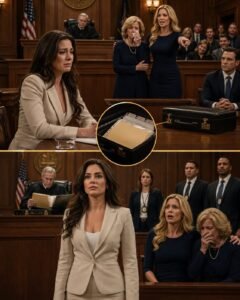
My sister tried to take my freedom, my inheritance, and my credibility in one courtroom. She didn’t know I had already given the truth to people she couldn’t intimidate.
THE WOMAN THEY SAID WAS CRAZY
The courtroom smelled like old wood, burnt coffee, and the kind of fear people pretend is justice.
My sister Natalie sat across from me in a navy dress, one hand resting gently on our mother’s shoulder as if she were the only stable person left in our family.
Mom kept dabbing her eyes with a tissue.
Not constantly.
Just often enough for Judge Holloway to notice.
Natalie had always understood timing.
When to smile.
When to cry.
When to lower her voice so people leaned closer.
And when to destroy someone while sounding concerned about their well-being.
Her attorney rose slowly from the table.
“Your Honor, Claire Mercer is mentally unfit to manage her own affairs.”
He said it with the calm certainty of a doctor announcing a diagnosis.
My fingers tightened beneath the table.
He continued.
“Her delusions have escalated dramatically over the last several months. She believes she is connected to federal investigators. She believes she is under surveillance. She believes bank records associated with her family’s finances have been altered.”
A pause.
Then the sentence they had built the entire case around.
“Ms. Mercer currently controls assets totaling approximately three point two million dollars.”
There it was.
Not my safety.
Not my mental health.
Not my supposed paranoia.
Three point two million dollars.
I looked at Natalie.
She did not look back.
Beside her, our mother pressed the tissue against her mouth.
My attorney, Daniel Cross, leaned slightly toward me.
“Don’t react,” he whispered.
“I’m not.”
“You’re crushing the pen.”
I looked down.
He was right.
I loosened my hand.
The plastic pen had bent between my fingers.
I sat alone at the defense table except for Daniel.
No husband.
No children.
No relatives willing to stand beside me.
No dramatic group of friends filling the benches behind us.
Just me, my attorney, and a locked black briefcase beneath his chair.
Natalie had thirteen people on her side of the courtroom.
Our mother.
Two cousins.
Three employees from the family company.
A family friend who had known us since childhood.
Several people I barely recognized.
They weren’t witnesses.
They were scenery.
Natalie understood that too.
A woman surrounded by concerned relatives looked loved.
A woman sitting alone looked unstable.
Her attorney walked toward the witness stand.
“Natalie, when did you first become concerned about your sister?”
Natalie inhaled carefully.
“After our father died.”
My chest tightened.
That part, at least, was true.
Dad had been dead for eleven months.
Some days I could say that sentence without feeling anything.
Other days it felt like someone had pushed a fist through my ribs.
Natalie continued.
“Claire changed. She became secretive. Suspicious. She stopped trusting us.”
Her attorney nodded sympathetically.
“What kinds of things did she say?”
Natalie finally looked at me.
Her expression was soft.
Almost apologetic.
“She said people were following her.”
A murmur moved through the benches.
“She said financial records were being manipulated. She accused people at Mercer Development of hiding money. She became convinced strangers were watching Mom’s house.”
Mom started crying harder.
Natalie reached over and squeezed her hand.
“We tried to help her,” she said. “We really did.”
I almost laughed.
Daniel’s hand settled over my wrist before I could move.
Natalie saw it.
She looked wounded.
That was another talent of hers.
Turning your resistance into evidence against you.
Her attorney asked, “Did Claire make any unusual claims about her work?”
Natalie hesitated.
Beautifully.
As if she hated having to say it.
“She started implying she was working with the FBI.”
One of my cousins lowered his head.
Someone behind Natalie whispered something.
The judge glanced toward the gallery.
Natalie continued.
“She would say things like, ‘I can’t discuss that,’ or ‘There are people watching the accounts.’ She told us certain conversations couldn’t happen over the phone.”
Her attorney turned toward Judge Holloway.
“Your Honor, we will be submitting communications supporting these statements.”
I stared at Natalie.
She had rehearsed this.
Every word.
Every pause.
Every concerned look.
I knew exactly where she had learned it.
Our father.
Dad used to say Natalie could sell a burning house by describing the warmth.
When we were young, he meant it as praise.
Later, I realized it had been a warning.
Natalie looked back at me.
“Claire thinks people are following her. She thinks bank records are being altered. She believes strangers are watching our mother’s house.”
Her voice cracked.
“We’re only trying to protect her.”
Mom broke down completely.
Judge Holloway looked at me.
She was in her early sixties, silver-haired, sharp-eyed, with the exhausted expression of someone who had heard thousands of people swear they were telling the truth.
“Ms. Mercer.”
“Yes, Your Honor?”
“Do you understand what your sister is requesting?”
I looked at Natalie.
Then at our mother.
“Yes.”
“Please explain your understanding.”
I took a breath.
“She wants the court to appoint her as guardian over my person and conservator over my property.”
Natalie shifted.
I continued.
“She wants control over my medical decisions, my home, my financial accounts, and every asset my father left me.”
Natalie shook her head immediately.
“That is not fair.”
Her attorney touched her arm.
She ignored him.
“This is about safety, Claire.”
I turned toward her fully.
“For whom?”
“Ms. Mercer,” Judge Holloway warned.
I faced forward again.
Natalie’s attorney rose.
“Your Honor, may I present the communications?”
The judge nodded.
He placed several printed screenshots on the evidence display.
My messages.
Messages I had sent Mom months earlier.
The first appeared on the courtroom monitor.
MOM, DO NOT DISCUSS MY ACCOUNTS OVER THE PHONE WITH ANYONE.
The next.
IF YOU GET AN EMAIL ASKING YOU TO CONFIRM BANKING INFORMATION, DO NOT OPEN IT. FORWARD IT TO ME.
The next.
PLEASE DO NOT LET NATALIE INTO MY OFFICE AGAIN.
The final message was shorter.
I KNOW SOMEONE HAS BEEN INSIDE.
Natalie’s attorney let the silence sit for several seconds.
Then he said, “These are not the communications of a person responding rationally to ordinary family circumstances.”
I nearly admired him.
Nearly.
He made instructions written under federal guidance sound like the diary of a frightened woman losing her mind.
He clicked to another message.
DO NOT DELETE ANYTHING. I NEED THE ORIGINAL RECORDS.
“Ms. Mercer,” he said, turning toward me, “did you send these messages?”
Daniel stood.
“Objection. My client is represented.”
“I’m asking whether she authored them.”
“She can answer,” Judge Holloway said.
“Yes,” I said.
The attorney nodded.
“You told your mother someone had entered your office?”
“Yes.”
“Did you see that person?”
“No.”
“So you have no proof anyone entered?”
I glanced at Daniel.
He gave the smallest shake of his head.
Not yet.
“No proof I can discuss here.”
Natalie’s attorney stopped.
The courtroom became very quiet.
He looked at the judge.
Then back at me.
“Ms. Mercer, do you believe this court is somehow part of the conspiracy against you?”
“No.”
“Do you believe the FBI is monitoring your family?”
Daniel rose.
“Objection.”
“Withdrawn.”
The attorney smiled faintly.
He already had what he wanted.
Another strange answer.
Another moment of hesitation.
Another brick in the wall Natalie had built around me.
Judge Holloway removed her glasses.
“Ms. Mercer, I’m going to ask you directly. Are you currently employed by the Federal Bureau of Investigation?”
There were some questions I was authorized to answer.
That was not one of them.
Not in that form.
Not in an open courtroom.
I could feel Natalie watching me.
Waiting.
Daniel said quietly, “Your Honor, my client’s employment status involves confidentiality restrictions.”
Natalie’s attorney almost smiled.
Judge Holloway’s eyes narrowed.
“That is an unusual answer.”
“I understand,” Daniel said.
“Then perhaps you can give me a less unusual one.”
Daniel glanced beneath his chair.
At the briefcase.
My heart beat once, hard.
We had been instructed not to open it unless the court received confirmation from the United States Attorney’s Office.
If the filing arrived.
That was the problem.
If.
Natalie’s petition had moved faster than anyone expected.
The hearing had been scheduled after her attorney claimed I was preparing to move assets outside the state.
A lie.
But an effective one.
The federal prosecutors had promised to intervene if necessary.
Necessary had come at nine sixteen that morning.
It was now eleven forty-three.
And nothing had arrived.
Judge Holloway looked at me again.
“Ms. Mercer?”
I swallowed.
“I am not able to answer that question fully in open court.”
Natalie closed her eyes.
Mom began to cry again.
And for the first time that morning, I understood exactly how this looked.
Maybe that was Natalie’s real advantage.
She didn’t need to prove I was delusional.
She only needed to make the truth sound impossible.
What she didn’t know was that eight months earlier, I had already learned that impossible truths had a habit of leaving paper trails.
And Natalie had left thousands.
Eight months before that courtroom, I found the first one in our father’s desk.
A bank statement that should not have existed.
And a signature that belonged to me.
Except I had never signed it.
PART 2: THE SIGNATURE THAT WASN’T MINE
Our father died on a Thursday morning.
A heart attack.
Sudden.
Clean.
Cruel.
There had been no long illness to prepare us.
No hospital room where we could say everything that should have been said.
One day Dad was arguing with Natalie about a construction loan.
The next morning he was dead on the kitchen floor.
I arrived at Mom’s house forty minutes after the ambulance.
Natalie was already there.
She stood barefoot in the foyer wearing one of Dad’s old college sweatshirts.
When I walked in, she crossed the room and hugged me so hard I couldn’t breathe.
For six weeks after his funeral, we almost became sisters again.
Almost.
We handled paperwork together.
We canceled appointments.
We sorted clothes.
We argued over photographs.
We sat on the floor of his office drinking wine and reading the ridiculous notes he had written in the margins of business reports.
Dad had built Mercer Development from a two-room construction office into a regional property company.
Apartment complexes.
Office buildings.
Warehouses.
Retail centers.
He loved numbers, but he loved deals more.
Natalie inherited that part of him.
She joined Mercer Development straight out of business school and eventually became chief operating officer.
I chose another path.
Accounting.
Then forensic accounting.
Fraud analysis.
Asset tracing.
The kind of work that made most people’s eyes glaze over until somebody’s money disappeared.
Dad used to joke that Natalie built companies and I searched their pockets.
I never worked for Mercer Development.
That mattered later.
At the time, I thought it protected me.
Dad’s estate plan was straightforward.
Natalie received his remaining voting interest in Mercer Development.
Mom retained the family home and a substantial retirement portfolio.
I received liquid investments, Dad’s minority holdings outside the company, and proceeds from a separate recovery account created after an old real-estate fraud case.
Combined value: approximately three point two million dollars.
Natalie joked that I got the boring money.
“You always liked spreadsheets more than buildings anyway,” she told me.
I laughed.
There was no reason not to.
The first problem appeared seven weeks later.
I was sorting tax records in Dad’s office when I found a folder labeled M-17.
Inside were bank statements from an account I didn’t recognize.
The account belonged to Mercer Development.
That wasn’t unusual.
What was unusual was a transfer.
$280,000.
Destination:
A trust account associated with Dad’s estate.
I checked the date.
Three months before he died.
Then I checked the ledger.
No corresponding entry.
I assumed it was an accounting mistake.
Those happen.
Then I found another transfer.
$410,000.
Different bank.
Same destination family of accounts.
No ledger entry.
Then a third.
That one went the other direction.
Money from an estate-related account into Mercer Development.
Authorized by:
Claire Mercer.
I stared at my name for a long time.
The signature was close.
Very close.
Whoever had made it knew how I signed formal documents.
The long downward stroke on the C.
The compressed M.
The slight right lean.
But I knew my own hand.
It wasn’t mine.
I photographed the page.
Then I searched the rest of the folder.
By midnight, I had nine questionable transfers.
By two in the morning, I had thirteen.
At two seventeen, Natalie appeared in the doorway.
I nearly jumped.
“What are you doing?”
She was wearing gray pajama pants and carrying a glass of water.
Mom had gone to bed hours earlier.
I turned the papers facedown.
“Reviewing Dad’s accounts.”
“At two in the morning?”
“I lost track of time.”
She smiled.
“Of course you did.”
She entered the room.
Her eyes dropped toward the desk.
“What are those?”
“Old statements.”
“Company?”
“Some.”
Her face changed.
Barely.
Most people would have missed it.
Forensic accountants are paid not to.
Her shoulders tightened.
Her gaze moved to my phone.
Then the papers.
Then back to me.
“Claire, the estate lawyers are handling this.”
“I know.”
“So why are you digging through company statements?”
“Because they’re in Dad’s personal office.”
She laughed.
“Dad brought work home constantly.”
“I know.”
“Then what’s the issue?”
I looked at her.
“I didn’t say there was one.”
That was when she stopped smiling.
Only for a second.
But I saw it.
“Don’t create problems because you’re bored,” she said.
Then she turned and left.
I stayed in Dad’s office another twenty minutes.
Not working.
Listening.
At two forty-two, I heard Natalie speaking quietly in the kitchen.
I couldn’t hear the words.
Only the tone.
Urgent.
At two fifty-one, the back door closed.
The next morning, the M-17 folder was gone.
I said nothing.
That afternoon, I pulled the same records electronically.
Or tried to.
Several entries had changed.
The $280,000 transfer now appeared as a legitimate vendor payment.
The $410,000 transfer had disappeared entirely.
And the document carrying my forged signature no longer existed in the archive.
That was the moment grief became something else.
Not certainty.
Not yet.
Suspicion.
I called Natalie.
“Did you remove a folder from Dad’s office?”
“No.”
“M-17.”
A pause.
“I don’t know what you’re talking about.”
“It was there last night.”
“Maybe Mom moved it.”
“Did she?”
“Ask her.”
I did.
Mom sounded confused.
“No, sweetheart.”
“Did Natalie take any boxes this morning?”
“I don’t think so.”
“You don’t think so?”
“Claire, please. I can’t keep track of every piece of paper in this house.”
I closed my eyes.
“Okay.”
She was silent for a moment.
Then she said, “Your sister is worried about you.”
That surprised me.
“Why?”
“You’ve been spending too much time with your father’s files.”
“He’s been dead seven weeks.”
“I know.”
“Those records matter.”
“Not more than your health.”
I almost laughed.
“My health is fine.”
“Then come have dinner Sunday and don’t bring spreadsheets.”
I did.
Natalie was warm.
Mom made Dad’s favorite roast.
We drank wine.
Nobody mentioned M-17.
For three hours, I almost convinced myself I had overreacted.
Then Natalie asked a question while cutting dessert.
“When do you expect the final estate distribution?”
My fork stopped.
“I don’t know.”
“Ballpark.”
“Why?”
She shrugged.
“Curious.”
“You inherited a company.”
“And you inherited cash.”
“Investments.”
“Same difference.”
“No, it isn’t.”
Mom sighed.
“Please don’t start.”
Natalie smiled.
“I’m not starting anything.”
Then she leaned back in her chair.
“How liquid is it?”
I looked at her.
“What?”
“Your inheritance.”
The room changed.
Not visibly.
But I felt it.
“How liquid is three point two?” she asked.
Mom stopped cutting her cake.
I had never told Natalie the exact number.
Neither had the estate attorney.
Not in my presence.
I put down my fork.
“Where did you get three point two?”
Natalie blinked.
“Dad mentioned it.”
“No, he didn’t.”
Her smile thinned.
“How do you know what Dad told me?”
“Because the final valuation wasn’t completed until after he died.”
Silence.
Mom looked between us.
Natalie took a sip of wine.
“You’re interrogating me now?”
“I asked a question.”
“So did I.”
I stood.
Mom said, “Claire.”
“I’m tired.”
“Sit down.”
“I have work tomorrow.”
Natalie laughed once.
Not kindly.
“That mysterious work you can never talk about?”
I looked at her.
She smiled.
“Good night, Claire.”
I drove home with my stomach knotted.
At eleven eighteen, I emailed copies of the photographs I had taken from M-17 to an encrypted account.
At eleven twenty-six, I sent a second set to a secure work server.
At eleven thirty-one, I wrote a note to myself.
Natalie knew the exact value of my inheritance before she should have.
Three days later, someone tried to reset the password on one of my brokerage accounts.
PART 3: THE THINGS PARANOID PEOPLE NOTICE
The first password-reset request came at 6:14 a.m.
The second at 6:17.
The third at 6:19.
By seven, I was sitting at my kitchen table with my laptop open and coffee going cold beside me.
The requests originated through recovery options that should not have been accessible to anyone except me.
One included a security challenge tied to an old family phone number.
I changed everything.
Passwords.
Recovery email.
Security questions.
Authorization codes.
Then I called the bank’s fraud department.
By noon, I knew the attempt had not been random.
Someone had enough personal information to get close.
Very close.
That afternoon, I called Mom.
“Do not discuss my accounts with anyone.”
“Why would I?”
“If somebody calls asking you to confirm information about me, hang up.”
“Claire, what is going on?”
“I’m handling it.”
“What does that mean?”
“It means don’t answer questions.”
She went quiet.
“You’re frightening me.”
“I’m trying to keep you from being used.”
“Used by whom?”
I looked through my apartment window.
A black sedan had been parked across the street for forty minutes.
Maybe it belonged to a neighbor.
Maybe it didn’t.
At that stage, I didn’t know.
So I said, “I don’t know yet.”
That message became Exhibit Four at my guardianship hearing.
MOM, DO NOT DISCUSS MY ACCOUNTS OVER THE PHONE WITH ANYONE.
Paranoid, Natalie’s attorney called it.
He never mentioned that two days after I sent it, somebody called Mom pretending to be from the estate administrator’s office.
The caller asked her to confirm my date of birth.
My address.
And whether I still used the same bank.
Mom answered two of the questions before remembering my warning.
She told me afterward.
Natalie later claimed the call had never happened.
That was when I stopped treating the situation like a family disagreement.
I contacted a supervisor from the financial-crimes task force I had been consulting for through my work.
Most people misunderstood what I did.
I wasn’t a gun-carrying FBI special agent.
I was a forensic accountant who had spent years tracing money through shell companies, false invoices, manipulated ledgers, and fraudulent transfers. For the previous year, I had been retained on federal financial investigations involving bank fraud and wire fraud.
I worked with investigators.
I worked inside federal cases.
And because those cases were sensitive, I rarely discussed them with anyone.
Natalie knew that I did “government accounting.”
She never cared about the details.
Until it became useful to call those details imaginary.
I gave the task-force supervisor the documents from Dad’s office.
I expected him to tell me it was a private estate matter.
He didn’t.
He spent forty minutes reviewing the photographs.
Then he asked, “Do you have access to the original system?”
“Some of it.”
“Legally?”
“Yes. Estate records and archived materials Dad retained.”
“What about Mercer Development?”
“I’m not an employee.”
“Then don’t access anything you aren’t authorized to access.”
“I know.”
He looked at the forged signature.
“Who benefits if this is real?”
I thought of Natalie.
Then Mom.
Then the company.
“I don’t know yet.”
He tapped the paper.
“Find out what you can legally establish. Nothing more.”
Two weeks later, the federal involvement became formal.
The transfers were not isolated.
Mercer Development had been struggling for more than a year.
Not visibly.
Publicly, Natalie still attended charity dinners and development conferences.
The company still announced projects.
Executives still drove expensive cars.
But beneath the appearance, debt was swallowing everything.
Loan covenants had been breached.
Revenue projections had been inflated.
Certain liabilities had been moved between affiliated entities.
Money had circulated through accounts in ways that created the appearance of cash Mercer Development did not actually have.
The company wasn’t merely struggling.
It was functionally bankrupt.
And somebody had been using family-controlled assets to keep lenders from seeing it.
Including accounts connected to Dad’s estate.
Including mine.
When the federal team explained the pattern to me, I felt physically sick.
Not because I didn’t understand it.
Because I did.
Perfectly.
This wasn’t a bookkeeping accident.
It was a drowning person pulling everyone nearby under the water.
I asked the question I had avoided.
“Is Natalie doing this?”
The investigator across from me said, “We’re not answering that yet.”
“You know.”
“We know enough to keep looking.”
“What about my mother?”
He didn’t answer.
That answer frightened me more.
I drove to Mom’s house the next day.
There were two unfamiliar cars parked down the block.
One drove away shortly after I arrived.
The other remained.
I noticed the same vehicle three days later outside my office.
A week later, another man photographed me leaving a bank.
I reported everything.
The federal team documented it.
At first they didn’t know whether the surveillance was connected to the financial case.
Eventually they did.
Someone associated with Mercer Development had retained an outside investigator to monitor my movements.
The stated purpose was “asset-risk assessment.”
I stared at that phrase when I saw it later in a protected summary.
Asset-risk assessment.
I was the asset.
The risk was that I knew too much.
After that, my instructions became strict.
Do not discuss protected accounts over unsecured phone calls.
Do not open unknown emails.
Do not leave sensitive documents at Mom’s house.
Do not allow anyone access to my home office.
Preserve original communications.
Report unexpected contact.
Everything Natalie later used to make me sound mentally unstable had originated as sound security practice.
I followed those instructions.
Then someone entered my office.
There was no broken lock.
Nothing obvious missing.
But the bottom drawer of my filing cabinet was open by half an inch.
I never left it open.
A framed photograph on my desk had been shifted.
And a sealed envelope containing copied estate documents was no longer beneath the tax folder where I had placed it.
That night I texted Mom.
PLEASE DO NOT LET NATALIE INTO MY OFFICE AGAIN.
Mom responded immediately.
SHE HASN’T BEEN THERE.
I typed:
I KNOW SOMEONE HAS BEEN INSIDE.
Three dots appeared.
Disappeared.
Returned.
Finally:
CLAIRE, THIS ISN’T HEALTHY.
I stared at the message.
Then another arrived.
YOU NEED TO SLEEP.
I called her.
“Mom, did you give Natalie my spare key?”
“No.”
“Did Dad?”
“I don’t know.”
“You had the spare.”
“I said I don’t know.”
“You just said no.”
“Stop interrogating me.”
“I’m not interrogating you.”
“You sound like one of those people from your work.”
“What people?”
“The federal people.”
I went still.
I had never told her federal investigators were involved.
“Who told you that?”
Silence.
“Mom?”
“You said you worked with them.”
“I said I consult on financial cases.”
“Same thing.”
“No. Who told you I was speaking to federal investigators about the estate?”
“I have to go.”
She hung up.
I sat in my dark office holding the phone.
That was the first moment I understood my mother might not simply be caught between her daughters.
She might be standing on Natalie’s side.
Two days later, Natalie came to my apartment.
I didn’t let her inside.
She stood in the hallway holding a paper bag from my favorite bakery.
“I brought peace.”
“No, you brought croissants.”
“Same thing in this family.”
I didn’t smile.
She looked at me for a long moment.
“You look tired.”
“I am.”
“Mom says you’re barely sleeping.”
“Mom talks to you a lot.”
“She’s our mother.”
“What do you want?”
Natalie exhaled.
“Can we not do this?”
“Do what?”
“Act like I’m your enemy.”
I said nothing.
She lowered her voice.
“The company is under pressure.”
There.
Finally.
“How much pressure?”
“Temporary pressure.”
“That isn’t a number.”
“You always were impossible.”
“And you always avoided numbers when they were bad.”
Her jaw tightened.
Then she smiled again.
“We have projects tied up. Credit is tight. Dad’s death complicated things.”
“How?”
“You know how.”
“No. Explain it.”
“He guaranteed certain facilities personally.”
I stared at her.
“That doesn’t give you access to his estate.”
“I didn’t say it did.”
“You knew the exact value of my inheritance.”
“Claire—”
“You knew before I told you.”
“Because I had access to Dad’s planning documents.”
“Which documents?”
She looked away.
That was answer enough.
I stepped closer.
“Did you authorize transfers from accounts connected to Dad’s estate?”
Her face hardened.
“No.”
“Did Mom?”
“No.”
“Did you use my name?”
“No.”
“Did you forge my signature?”
Her eyes flashed.
Then she laughed.
It was the wrong reaction.
Not outrage.
Not shock.
Laughter.
“Listen to yourself.”
“I am.”
“You’re accusing your family of financial crimes.”
“I asked whether you signed my name.”
“And I said no.”
“Then why are you scared?”
That erased the smile.
For several seconds we simply stared at each other.
Then Natalie moved closer.
“I’m scared for you.”
“No, you aren’t.”
“You’ve convinced yourself everyone is lying.”
“Not everyone.”
“Mom says you’ve been talking about surveillance.”
I felt cold.
“Mom told you that?”
“She tells me everything.”
That was deliberate.
A warning disguised as intimacy.
Natalie held out the bakery bag.
“Take these.”
“No.”
Her arm dropped.
“Fine.”
She turned toward the elevator.
Before leaving, she said, “Dad trusted me with the company for a reason.”
I answered before I could stop myself.
“Maybe he trusted me with the money for one.”
The elevator doors closed between us.
Three weeks later, Natalie filed for emergency guardianship.
Her petition described me as paranoid.
Delusional.
Secretive.
Obsessed with financial conspiracies.
It included my messages.
Statements from Mom.
Descriptions of my alleged belief that people were following me.
And one claim that made my attorney stare at the page for almost a full minute.
Claire believes she has been secretly recruited into federal law enforcement operations.
Daniel looked at me across his desk.
“Is there anything you haven’t told me?”
“Yes.”
“How much?”
“Enough that I can’t answer that petition normally.”
He rubbed his forehead.
“That is not a comforting sentence.”
“I know.”
“Can you prove you’re not delusional?”
“Yes.”
“Can you prove it before the hearing?”
I thought about the sealed investigation.
The protected witness designation.
The restrictions.
The ongoing warrants.
“I don’t know.”
Daniel leaned back.
“Then your sister has created a very dangerous problem.”
I looked down at the petition.
Natalie wasn’t only trying to get control of my money.
If the court declared me incapacitated, everything I had discovered could be poisoned.
Every allegation could be reinterpreted as a symptom.
Every warning could become paranoia.
Every record I had preserved could be challenged as something I had misunderstood.
And if Natalie became conservator over my property, she could gain legal authority to request access to accounts and documents she had spent months trying to reach.
I finally understood the scale of what she was doing.
This wasn’t desperation.
It was strategy.
I called the federal case attorney that evening.
“They filed for guardianship.”
Silence.
Then, “Send me everything.”
“They’re using my protected instructions as evidence of mental illness.”
Another silence.
Longer this time.
“We’ll handle it.”
“How?”
“I can’t tell you yet.”
“That answer is becoming incredibly irritating.”
“I know.”
“What am I supposed to do?”
“Tell the truth where you’re legally allowed.”
“And where I’m not?”
“Say you can’t answer.”
“That’s going to make me look insane.”
“I know.”
For the first time, I heard anger in his voice.
Not at me.
At them.
Then he said, “Claire, whatever happens in that courtroom, do not disclose the investigation before you’re authorized.”
I closed my eyes.
“When will I be authorized?”
“When the judge has what she needs.”
That was how I entered court carrying the truth and legally unable to explain it.
And that was how Natalie nearly won.
PART 4: THE HEARING
By noon, I had begun to wonder whether the federal filing was coming at all.
Natalie’s attorney called Mom to testify.
Watching my mother take the oath hurt more than anything Natalie had said.
Mom sat in the witness chair looking smaller than I remembered.
Her hair had gone almost completely gray since Dad died.
She clutched the tissue in both hands.
“Mrs. Mercer,” the attorney said gently, “do you love your daughter Claire?”
Mom looked at me.
For one second, I saw my mother.
The woman who used to sit beside my bed when I had fevers.
The woman who cried at my college graduation.
The woman who mailed me soup recipes even though I lived twenty minutes away.
“Yes,” she whispered.
“Is that why you’re here?”
Another pause.
“Yes.”
“What concerns you?”
Her mouth trembled.
“Claire has changed.”
I stared at her.
“She doesn’t trust us anymore. She thinks people are taking things from her. She thinks someone broke into her office. She talks about bank records. People watching houses. Secret investigations.”
“Has she accused you personally of wrongdoing?”
Mom looked down.
“Yes.”
That was technically true.
I had asked if she signed anything.
Natalie’s attorney let the answer breathe.
“How did that make you feel?”
Mom began crying.
“Terrible.”
I wanted to stand.
I wanted to ask her how terrible it felt to know someone had forged my signature.
How terrible it felt to let Natalie access Dad’s records.
How terrible it felt to watch one daughter try to legally erase the other.
Instead, I sat still.
Daniel wrote something on his legal pad.
WAIT.
I hated that word.
Natalie’s attorney placed another exhibit on the screen.
One of my emails to Mom.
DO NOT DELETE ANYTHING. I NEED THE ORIGINAL RECORDS.
“Mrs. Mercer, what did you understand Claire to mean?”
“That she thought there was some kind of fraud.”
“Was there?”
Daniel stood.
“Objection.”
“Sustained.”
The attorney changed direction.
“Did you ever see evidence supporting your daughter’s claims?”
Mom’s eyes flicked toward Natalie.
Only for a second.
“No.”
Something inside me went quiet.
Not broke.
Quiet.
That was worse.
Because Mom had seen evidence.
She had seen the password-reset notice.
She had received the false phone call.
She had admitted Natalie knew details about my estate.
And she had seen the missing folders from Dad’s office.
She was lying.
Not confused.
Not manipulated.
Lying.
When Daniel cross-examined her, he kept his questions narrow.
“Mrs. Mercer, did you receive a phone call from someone asking about Claire’s banking information?”
“I receive many calls.”
“That wasn’t my question.”
Natalie’s attorney stood.
“Argumentative.”
“Overruled.”
Mom swallowed.
“Yes.”
“Did Claire warn you before that call not to give out information?”
“Yes.”
“So at least one concern reflected in these messages was followed by an actual attempt to obtain her financial information?”
Mom hesitated.
“I suppose.”
Natalie stared straight ahead.
Daniel continued.
“Did Claire ever threaten you?”
“No.”
“Did she harm herself?”
“No.”
“Did she fail to pay her bills?”
“Not that I know of.”
“Has she lost her employment?”
“I don’t know.”
“Has she been evicted?”
“No.”
“Has she been unable to buy food, maintain hygiene, or manage daily life?”
“No.”
“Then your principal concern is that she believes financial misconduct occurred?”
Mom’s eyes filled again.
“She believes terrible things about her family.”
Daniel nodded.
“That wasn’t my question either.”
For the first time, Judge Holloway looked irritated with Mom.
That mattered.
But not enough.
Natalie testified next.
She was better.
Much better.
She didn’t overplay anything.
She described me as accomplished.
Independent.
Intelligent.
That was the clever part.
“She’s brilliant,” Natalie said. “That’s why this is so hard. Mental illness doesn’t erase intelligence.”
Her attorney asked whether she wanted my money.
Natalie looked almost offended.
“Absolutely not.”
“What would happen to Claire’s assets if the court appointed you?”
“They would remain hers.”
“Would you personally benefit?”
“No.”
The lie was smooth enough to polish glass.
“What do you want?”
“My sister back.”
Mom cried.
Someone in the gallery sniffed.
I looked at Daniel.
He wrote:
SHE’S VERY GOOD.
I wrote beneath it:
I KNOW.
Then Natalie’s attorney asked the question she had been building toward.
“Natalie, what is the most concerning thing Claire has told you?”
Natalie looked directly at me.
“She believes she is involved in a federal case against our family.”
My heartbeat slowed.
Her attorney turned toward the judge.
“Has she identified this supposed case?”
“No.”
“Agents?”
“No.”
“Case number?”
“No.”
“Subpoena?”
“No.”
“Any official documentation?”
“No.”
He faced me.
“Nothing.”
Daniel rose.
“Counsel knows my client is restricted from answering certain questions.”
Natalie’s attorney spread his hands.
“Restricted by whom?”
Daniel did not answer.
“Exactly,” the attorney said.
Judge Holloway frowned.
“Mr. Cross, I have allowed considerable latitude because you represented that confidentiality issues were involved. We are now several hours into a competency proceeding in which the central alleged delusion concerns a secret federal investigation that your client claims she cannot discuss.”
Daniel stood very still.
“I understand, Your Honor.”
“Then give me something.”
He glanced at the clock.
12:07.
Nothing.
My stomach turned.
Judge Holloway continued.
“Is there any documentation supporting your representation?”
Daniel looked beneath the table.
The black briefcase sat under his chair.
“Yes.”
Natalie’s attorney immediately stood.
“Then produce it.”
“I cannot without authorization.”
A faint sound came from the gallery.
Almost a laugh.
Judge Holloway leaned back.
“You understand the difficulty you are creating for your own client.”
“I do.”
I looked at Daniel.
Then at Natalie.
She was watching me now.
And she knew.
Not the truth.
But she knew whatever we had expected had failed to arrive.
Her shoulders relaxed.
Barely.
A victory measured in millimeters.
Her attorney stood.
“Your Honor, with respect, this is precisely the pattern we have described. Every contradiction is answered with a secret explanation. Every request for proof is answered by saying the proof cannot be shown.”
He pointed toward me.
“Ms. Mercer is an intelligent woman. No one disputes that. But intelligence can make a delusional system more elaborate, not less.”
I felt heat rise into my face.
He continued.
“She has accused her sister. Her mother. Company employees. Unknown strangers. Financial institutions. She claims records were altered. She claims people entered her office. She claims she is connected to federal law enforcement, yet no verifiable evidence has been presented.”
Natalie lowered her eyes.
Mom pressed the tissue to her mouth.
The attorney’s voice softened.
“This family is asking the court to intervene before Ms. Mercer’s condition results in the loss of millions of dollars or harm to herself.”
Daniel leaned toward me.
“Claire.”
I didn’t look at him.
“What?”
“If the judge asks whether you consent to temporary restrictions, say no.”
“I was already planning to.”
“She may order them anyway.”
“I know.”
Judge Holloway looked at the documents before her.
Then at me.
“Ms. Mercer, I am considering whether temporary financial protections may be appropriate pending an independent evaluation.”
Natalie closed her eyes.
Relief.
She thought she had won.
Something cold settled inside my chest.
“Your Honor,” I said.
Daniel touched my arm.
I continued anyway.
“I understand how this looks.”
Judge Holloway studied me.
“I imagine you do.”
“I also understand why the court has to take these allegations seriously.”
Natalie glanced at her attorney.
“But I do not consent to giving my sister access to my assets.”
“No one has ordered that yet.”
“She will ask.”
Natalie said softly, “Claire.”
I ignored her.
I looked only at the judge.
“If you restrict my accounts, please do not appoint Natalie Mercer or my mother as fiduciary over any of them.”
Natalie’s attorney stood.
“Your Honor—”
Judge Holloway lifted a hand.
“Why?”
I took a breath.
Because they were under federal investigation.
Because the company was bankrupt.
Because my signature had been forged.
Because someone had tried to access my accounts.
Because Natalie had used my father’s death as cover for a financial crime.
Because my mother was lying under oath.
I could say none of it.
So I said the only thing I was allowed to say.
“Because there is a conflict of interest.”
Natalie laughed quietly.
The judge heard it.
“So noted,” Judge Holloway said.
Then the courtroom doors opened.
The sound was small.
Just wood moving over carpet.
But every person in that room turned.
A federal marshal entered.
Dark suit.
Badge visible at his belt.
Sealed brown folder in his hand.
He walked directly past the gallery.
Past Natalie.
Past me.
He handed the folder to Judge Holloway’s clerk.
Natalie sat straighter.
Mom stopped crying.
The clerk examined the seal.
Then leaned toward the judge and whispered.
I watched Judge Holloway’s face change.
Not dramatically.
She simply became still.
Then she looked at Daniel.
He exhaled for what felt like the first time all morning.
Natalie’s attorney stood.
“Your Honor?”
The judge held up one finger.
The clerk passed her the folder.
Judge Holloway examined the front.
Then she broke the seal.
For the next three minutes, nobody spoke.
I heard paper turning.
The air conditioner.
Someone coughing in the hallway.
My own heartbeat.
Natalie’s attorney leaned toward her and whispered something.
She didn’t answer.
Mom’s hands began shaking.
Judge Holloway reached the second page.
Her eyebrows rose.
She turned another.
Then another.
Finally she set the documents down.
When she looked across the courtroom, she was no longer looking at me.
She was looking at Natalie.
“This court has just received a protected federal filing from the United States Attorney’s Office.”
Natalie’s attorney went pale.
Judge Holloway continued.
“It directly concerns the allegations made here today.”
He stood quickly.
“Your Honor, may we approach?”
“No.”
The word landed like a door slamming.
Judge Holloway turned one page.
Then she said the sentence my sister had spent months making impossible.
“Ms. Claire Mercer is not delusional.”
No one moved.
Not Natalie.
Not Mom.
Not me.
The judge continued.
And one by one, every lie they had brought into that courtroom began collapsing.
PART 5: THE TRUTH HAD BEEN THERE ALL ALONG
Judge Holloway adjusted her glasses.
“According to the filing, Ms. Mercer is a federally protected financial witness and a consulting forensic accountant involved in an active fraud investigation.”
Someone behind Natalie gasped.
The judge continued reading.
“The investigation involves suspected bank fraud, wire fraud, fraudulent financial statements, unauthorized transfers, and interference with protected financial records.”
Natalie whispered, “No.”
Her attorney turned sharply toward her.
Judge Holloway kept reading.
“The surveillance described by Ms. Mercer was documented by federal investigators.”
Mom’s tissue slipped from her hand.
“The altered banking records were real.”
Natalie’s attorney sat down.
“The attempts to obtain account information associated with Ms. Mercer were reported and corroborated.”
My throat tightened.
For months, those facts had lived inside me like stones.
Things I knew.
Things I could not say.
Things my own family had turned into symptoms.
Now a judge was reading them aloud.
Judge Holloway looked toward the evidence screen, where one of my supposedly paranoid messages was still displayed.
DO NOT DELETE ANYTHING. I NEED THE ORIGINAL RECORDS.
She looked back at the filing.
“The communications introduced by petitioners as evidence of paranoia appear consistent with security instructions issued in connection with the federal investigation.”
Natalie was no longer composed.
Her face had gone gray.
“Your Honor,” her attorney said carefully, “my client was not aware—”
Judge Holloway looked at him.
“I suggest you wait until I finish.”
He sat.
The room felt different now.
Twenty minutes earlier, I had been the dangerous one.
The unstable one.
The woman who needed supervision.
Now every person sitting behind Natalie seemed to be reconsidering where they had chosen to sit.
Judge Holloway turned another page.
“The filing further states that Mercer Development Group is the subject of an ongoing financial investigation and appears to have been insolvent for a substantial period preceding this petition.”
Natalie stood.
“No.”
Her attorney grabbed her wrist.
“Natalie.”
“That’s false.”
Judge Holloway’s eyes sharpened.
“Sit down.”
“You don’t understand.”
“Ms. Mercer.”
“We had liquidity problems. That is not the same thing.”
Her attorney whispered, “Sit down.”
Natalie pulled her arm away.
“You can’t say we’re bankrupt based on—”
“Sit down.”
This time the judge’s voice cracked through the courtroom.
Natalie sat.
I watched her hands.
They were trembling.
Not because the company was bankrupt.
She had known that.
She was trembling because now everyone else knew.
Judge Holloway continued.
“Federal investigators have identified substantial discrepancies between Mercer Development’s internal liabilities and representations made to lenders.”
She paused.
“Several questioned transactions involve accounts connected to the estate of the late Robert Mercer.”
Dad.
Hearing his name almost broke my composure.
Judge Holloway looked at me briefly.
Then back to Natalie.
“Some transactions also involve attempted access to funds currently controlled by Claire Mercer.”
Natalie shook her head.
“No.”
The judge ignored her.
“The United States Attorney’s Office states that the timing of this guardianship petition appears to coincide with efforts to obtain access to protected restitution and estate-related funds and to interfere with financial evidence relevant to the investigation.”
Silence.
Not courtroom silence.
Something heavier.
The silence after an explosion, before people understand what has fallen.
Mom whispered, “Natalie.”
My sister turned toward her.
For the first time all day, the performance disappeared.
“What?”
Mom stared at her.
“You said they didn’t know.”
Natalie froze.
So did her attorney.
Judge Holloway looked up.
“What did you just say, Mrs. Mercer?”
Mom’s mouth opened.
Natalie said quickly, “She’s confused.”
I almost laughed.
Of all the things Natalie could have said.
She chose that.
The same weapon.
Turn uncertainty into incapacity.
Turn inconvenient truth into confusion.
Mom looked at her daughter as if seeing the method clearly for the first time.
“I’m not confused.”
“Mom.”
“You said the investigation was nothing.”
Natalie’s attorney stood.
“I strongly advise my clients not to make further statements.”
Judge Holloway looked at him.
“That is the first piece of sound advice I’ve heard from petitioners’ table today.”
A ripple moved through the room.
He sat.
Mom started crying again.
But the sound was different.
There was no timing to it now.
No performance.
She looked at me.
“Claire.”
I said nothing.
“Claire, I didn’t know—”
“Yes, you did.”
Her face collapsed.
I had imagined this moment dozens of times.
I thought I would shout.
I thought I would demand explanations.
I thought anger would be the loudest thing inside me.
It wasn’t.
Grief was.
“You knew enough,” I said.
She shook her head.
“I knew the company needed money.”
“You knew Natalie tried to access my accounts.”
“She said it was temporary.”
“You knew she had Dad’s estate records.”
“I thought—”
“You signed statements saying I imagined the phone call.”
Mom covered her mouth.
“You told the court you never saw evidence.”
“I was trying to protect the family.”
There it was.
The sentence people use when they mean:
I chose the version of the family that did not include you.
Natalie turned toward me.
“Don’t do this.”
I stared at her.
“Do what?”
“Make Mom responsible for something she doesn’t understand.”
Mom flinched.
I looked at Natalie.
“You filed a petition to declare me mentally incompetent.”
“You were threatening everything Dad built.”
“No. I discovered what you did to it.”
“You don’t understand the company.”
“I understand insolvency.”
“You understand paper.”
“Yes.”
My voice remained quiet.
“That was your problem.”
Her face tightened.
I continued.
“You thought numbers would do whatever you told them to do because people usually did.”
Natalie stood again.
This time her attorney didn’t stop her.
“You think you’re better than me because you sat behind a desk and waited for Dad to die so you could collect money?”
The words hit harder than I expected.
I felt the entire courtroom watching me.
But I didn’t look away.
“You know that isn’t true.”
“Dad left me the company.”
“Yes.”
“He expected me to protect it.”
“By forging my signature?”
Her mouth stopped.
The judge’s head lifted.
Daniel touched my arm.
But it was too late.
Natalie said nothing.
I could see her calculating.
Then she made the mistake she had accused me of making.
She answered too much.
“I never forged anything.”
I said, “I didn’t say which document.”
Silence.
Her eyes widened.
Daniel closed his eyes briefly.
Judge Holloway looked toward the federal marshal.
Then at Natalie’s attorney.
“I believe counsel should speak with his client privately before she makes any additional statements.”
Natalie sat slowly.
That was when I knew it was over.
Not the investigation.
Not the criminal case.
Those things would continue.
But the guardianship.
The story Natalie had built about me.
The version in which she was the loving sister and I was the irrational threat.
That story was dead.
Judge Holloway reviewed the filing for several more minutes.
Then she addressed the court.
“The petition for emergency guardianship and conservatorship is denied.”
I exhaled.
I hadn’t realized I was holding my breath.
“Further, the court will not authorize Natalie Mercer, Evelyn Mercer, or any agent associated with Mercer Development Group to obtain information regarding Claire Mercer’s protected accounts.”
Mom closed her eyes.
Natalie stared at the table.
“The court is also preserving today’s record, including sworn testimony and submitted exhibits, for appropriate review by federal authorities.”
Natalie’s attorney stood.
“Your Honor, we object to any implication that—”
“I am not making an implication.”
That silenced him.
Judge Holloway looked toward me.
“Ms. Mercer.”
I stood.
“Yes, Your Honor?”
“I regret that the nature of the protected investigation prevented certain facts from being presented earlier.”
I shook my head.
“The court acted on what it had.”
She studied me.
“You understand that?”
“Better than most.”
Something almost like sympathy passed over her face.
Then she looked at Natalie.
“This court takes allegations of incapacity very seriously. Guardianship exists to protect vulnerable individuals. It is not a tool for resolving financial disputes or gaining leverage over assets.”
Natalie’s face reddened.
Judge Holloway continued.
“If federal authorities determine that this petition was knowingly used to interfere with an investigation or obtain protected funds, that matter will be addressed elsewhere.”
She struck the gavel.
“Hearing concluded.”
The room erupted.
Not loudly at first.
Chairs moving.
Whispers.
People turning toward one another.
My cousins suddenly found the floor fascinating.
Employees from Mercer Development avoided Natalie’s eyes.
Daniel bent beneath the table and retrieved the black briefcase.
“You okay?”
“No.”
He nodded.
“Good answer.”
I almost smiled.
Across the aisle, Mom stood.
“Claire.”
I gathered my papers.
She approached slowly.
Natalie remained seated with her attorney.
“Please,” Mom said.
I looked at her.
Without the witness chair, without the tissue held at exactly the right height, she seemed older.
Smaller.
“I was scared,” she whispered.
“So was I.”
“The company was everything your father built.”
“No.”
She frowned.
“What?”
“The company was something Dad built.”
I looked toward Natalie.
“It wasn’t everything.”
Mom started crying again.
This time I believed her.
That didn’t mean I forgave her.
She reached for my hand.
I stepped back.
The pain on her face was immediate.
“Claire.”
“You testified that I was mentally unstable.”
“I thought Natalie could fix things if she had time.”
“So you gave her mine.”
“What?”
“My life. My freedom. My credibility. You gave her those to buy time.”
Mom shook her head.
“That isn’t what I meant.”
“It’s what you did.”
She covered her face.
For a moment I wanted to hug her.
The instinct was so old it hurt.
But love and trust are not the same thing.
You can lose one while the other survives.
Daniel touched my shoulder.
“Claire.”
I turned.
Two federal investigators stood near the courtroom doors.
I recognized both.
One gave me a slight nod.
Then the marshal walked toward Natalie.
Her attorney immediately stood.
“What is this?”
The marshal spoke quietly.
I couldn’t hear every word.
I heard only enough.
Federal process.
Financial records.
Surrender of devices.
Natalie stood.
Her eyes found mine across the courtroom.
For the first time in my life, my sister looked at me without performance.
No pity.
No superiority.
No carefully measured concern.
Only fear.
“Claire.”
I waited.
“What did you do?”
That question almost made me angry.
Almost.
Because even now she thought I had caused this.
Not the false statements.
Not the transfers.
Not the hidden liabilities.
Not the forged authorizations.
Not the surveillance.
Not the attempt to take legal control of my assets.
Me.
I had done something to her.
I walked across the aisle.
The room seemed to disappear around us.
Natalie looked exhausted.
“You could have come to me,” she whispered.
“I did.”
“When?”
“The night I found M-17.”
Her face changed.
I continued.
“I asked about the transfers.”
“That wasn’t coming to me.”
“I asked whether you took the folder.”
“You were already accusing me.”
“No. I was giving you a chance to tell me the truth.”
She looked away.
“You don’t know what it was like.”
“What?”
“After Dad died.”
My anger sharpened.
“He was my father too.”
“You got money. I got a collapsing company.”
There it was.
The closest thing to truth Natalie had given me all day.
She laughed bitterly.
“You want motive? Fine. Everyone thought I inherited Dad’s empire. Do you know what I actually inherited?”
I didn’t answer.
“Debt. Guarantees. Projects bleeding cash. Lenders calling before the funeral flowers were dead.”
Her eyes filled.
“I spent every day trying to keep four hundred people employed.”
“And that justified taking money that wasn’t yours?”
“I was trying to keep the company alive.”
“With forged transfers?”
“With temporary liquidity.”
“Don’t.”
She flinched.
“Don’t turn theft into vocabulary.”
Her jaw tightened.
“You always hated the company.”
“No. I hated what it made you willing to become.”
“You think Dad would have let it fail?”
I felt something break open inside me.
Not rage.
Clarity.
“Dad did let it fail.”
Natalie stared at me.
“What?”
“He knew.”
Her face went still.
I continued carefully.
“He had started separating personal assets months before he died.”
That information had been in the estate records from the beginning.
Nothing secret.
Nothing dramatic.
We simply hadn’t understood why.
“He stopped signing additional guarantees. He moved the restitution proceeds out of company reach. He changed the estate structure.”
Natalie shook her head.
“No.”
“He knew the company was in trouble.”
“No.”
“And he chose not to sacrifice everything else to save it.”
“You don’t know that.”
“I know what he signed.”
Her eyes filled.
For the first time, Natalie looked less like an enemy than a daughter who had spent eleven months fighting a dead father’s decision.
It did not absolve her.
But it explained something.
She had not been protecting Dad’s legacy.
She had been trying to prove she could save what he had already decided to stop feeding.
And when legitimate money ran out, she found other money.
First inside the company.
Then inside the estate.
Then mine.
“You should have told me,” she whispered.
“I tried.”
“No. About the investigation.”
“I legally couldn’t.”
“You let me walk into that courtroom.”
I stared at her.
“You filed the petition.”
Her eyes hardened again.
“You could have stopped me.”
“I asked you for the truth eight months ago.”
She looked away.
“That was when you could have stopped.”
The marshal stepped closer.
“Ms. Mercer.”
Natalie glanced at him.
Then back at me.
For one impossible second I remembered us at twelve and fourteen, fighting over the bathroom mirror before school.
I remembered her teaching me to drive in an empty parking lot.
I remembered her holding me at Dad’s funeral.
I remembered the croissants outside my apartment.
I remembered the forged signature.
People like simple villains.
They make pain easier.
Natalie was not simple.
She loved our father.
She loved the company.
Somewhere beneath all the damage, I believed she loved me too.
But love without boundaries can become possession.
Love without honesty can become control.
And fear can turn people into criminals long before they are willing to call themselves that.
Natalie took one step toward the marshal.
Then stopped.
“Claire.”
I looked at her.
She swallowed.
“Are they arresting Mom too?”
Behind us, Mom had gone completely still.
“I don’t know.”
That was true.
The investigation had identified her signatures on several documents. What she knew when she signed them would matter. What Natalie told her would matter. What she had said under oath that morning would matter.
For once, I did not try to predict the outcome.
I did not try to protect anyone from consequences.
“I don’t know what happens next,” I said.
Natalie gave a broken little laugh.
“That must be hard for you.”
“It is.”
She nodded.
Then she was escorted from the courtroom to speak with federal authorities.
I watched until the doors closed behind her.
Mom stood near the witness stand.
Daniel waited beside me.
The courtroom emptied slowly.
When we finally stepped into the hallway, I saw sunlight through the tall courthouse windows.
I had entered that building before nine that morning afraid a judge might give my sister legal authority over my life.
Now I walked out still owning my home.
My accounts.
My work.
My name.
But freedom did not feel like triumph.
Not exactly.
Justice is cleaner in stories people tell afterward.
In reality, it can feel like standing in the ruins of something you once called family and realizing the building needed to come down because it had been burning for years.
Three months later, Mercer Development entered formal bankruptcy proceedings.
The numbers confirmed what the federal filing had revealed.
The company had been insolvent long before Natalie filed against me.
Several financial representations were referred for prosecution.
The questioned transfers became part of the federal case.
So did the false attempts to access my accounts.
So did the surveillance.
So did the guardianship petition.
My mother eventually admitted she had signed documents Natalie put in front of her because she believed losing the company would destroy everything Dad had built.
She insisted she never understood the full scope of what Natalie was doing.
Maybe that was true.
Maybe it wasn’t.
I stopped trying to decide which version hurt less.
Natalie’s lawyers did what lawyers do.
They argued intent.
Pressure.
Lack of personal enrichment.
The chaos following Dad’s death.
They described a desperate executive trying to rescue a family company.
Federal prosecutors described false statements, unauthorized transactions, and obstruction.
Both descriptions contained pieces of the same woman.
I testified when I was required to.
Nothing more.
Nothing less.
The first time I walked into federal court as a witness, I remembered Natalie telling the probate judge that I had invented all of it.
The agents.
The surveillance.
The altered records.
The investigation.
There was a strange comfort in seeing those same facts entered into evidence under case numbers and exhibit labels.
Truth does not always arrive dramatically.
Most of the time, it arrives as paperwork.
A timestamp.
A signature.
A transaction number.
A login attempt.
A phone record.
One small fact placed beside another until a lie no longer has anywhere to stand.
I kept the original screenshot from the first altered bank statement.
Not because I enjoyed looking at it.
Because I needed to remember how little the truth had looked at the beginning.
One transaction.
One missing folder.
One signature that almost looked like mine.
That was all.
Sometimes people ask why I didn’t confront Natalie sooner.
I did.
They ask why I didn’t warn my mother more clearly.
I did.
They ask how my own family could convince so many people that I was unstable.
That answer is harder.
Natalie did not invent a completely fictional Claire.
She used pieces of the real one.
I was secretive.
Because I had to be.
I was suspicious.
Because someone was accessing my information.
I did believe I was being watched.
Because I was.
I did think records had been altered.
Because they had.
I did refuse to explain everything.
Because federal instructions required me not to.
The most effective lie Natalie ever told was built almost entirely from true facts.
She only changed what those facts meant.
That was what nearly destroyed me.
Months after the guardianship hearing, Daniel sent me a transcript.
I almost deleted it.
Then I opened the file and found the page.
Natalie’s attorney:
“Ms. Mercer is an intelligent woman. But intelligence can make a delusional system more elaborate, not less.”
A few pages later:
Judge Holloway:
“Ms. Claire Mercer is not delusional.”
I printed those two pages.
Then I put them in Dad’s old M-17 folder.
The original folder had never been recovered.
So I made a new one.
Inside it I placed copies of the federal filing, the guardianship dismissal, the first forged authorization, and the photograph I had taken the night everything began.
Not as a trophy.
As a reminder.
People will sometimes call you difficult when you refuse to give them access.
They will call you selfish when you protect what belongs to you.
They will call you suspicious when you notice contradictions they hoped you would ignore.
And if they are frightened enough of what you know, they may even try to convince the world that your memory, your judgment, and your perception cannot be trusted.
That is why evidence matters.
That is why patience matters.
And that is why I survived my sister’s plan.
Not because I screamed louder.
Not because I humiliated her first.
Not because some stranger arrived at the last second and magically saved me.
The marshal carried the file into the courtroom.
But I had built what was inside it.
Every preserved message.
Every copied statement.
Every reported call.
Every document I refused to delete.
Every moment I chose not to look away simply because the truth was painful.
Natalie thought she could take control of my life by making my truth sound insane.
She thought if she called me unstable loudly enough, people would stop asking why she needed my money.
For several terrifying hours, she was almost right.
But when Judge Holloway opened that sealed federal folder, the entire courtroom finally saw what I had been seeing for months.
The surveillance was real.
The records had been altered.
The company was bankrupt.
The investigation existed.
And the woman they had called dangerous had been protecting the evidence all along.
Natalie asked me one question before the marshal took her away.
“Claire, what did you do?”
I know my answer sounded cold.
Maybe part of me wanted it to.
But it was also the simplest truth I had spoken all morning.
I looked at my sister, then at my mother, and finally at the courtroom where they had nearly convinced a judge to hand them my freedom.
And I said:
“I told the truth before you could steal it.”