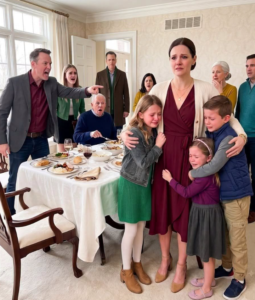
The dining room had been arranged for celebration.
Crystal glasses stood beside polished silverware.
A roast beef dinner covered the center of the table.
Walter Mercer had spent years imagining his retirement dinner as the kind of family evening people remembered for the right reasons.
Instead, his son had turned it into a public humiliation.
“You’re embarrassing this family,” Daniel Mercer said loudly enough for all twelve people at the table to hear.
Rachel heard every word.
She also heard the small shift that followed.
Forks slowed.
Conversations stopped.
People who had been smiling moments earlier suddenly found reasons to look down at their plates.
Daniel knew exactly what he was doing.
He had done it before.
He had learned that Rachel hated scenes, and he had started using that against her.
Whenever resentment built between them, he did not always confront her privately.
Sometimes he turned it into entertainment.
That night, he had an audience.
His sixteen-year-old daughter, Brooke, rolled her eyes.
“Dad’s right,” she said.
Then she looked directly at Rachel.
“You don’t even have a real job. You’re basically a deadbeat.”
The word landed harder than Daniel’s insult.
Rachel felt heat climb into her face.
But she didn’t answer.
She had learned something about silence that Daniel had not.
Silence did not always mean surrender.
Sometimes it meant refusing to give another person control over your reaction.
Daniel leaned back.
He looked satisfied.
For years, he had told his family that Rachel merely “helped out with community stuff.”
He described himself as the person carrying the household.
He let everyone believe that while he worked and contributed, Rachel somehow floated around the edges of their life without doing anything that counted.
The truth was more complicated.
Rachel paid half the mortgage from an account Daniel had never bothered to ask about.
She disappeared every Tuesday and Thursday afternoon for a reason.
And people around town sometimes stopped her in grocery stores simply to shake her hand.
Daniel knew none of that.
Or, more accurately, he had never cared enough to ask.
His mother, Elaine, gave Rachel a tight smile.
“Brooke could have phrased that better,” she said, “but perhaps this is a good time to think seriously about your future, Rachel.”
Daniel leaned farther back.
He seemed to believe the room had agreed with him.
Then the front door opened.
Walter frowned.
“I’m not expecting anyone else.”
A man stepped into the dining room wearing a dark navy coat.
Snow was melting on his shoulders.
The conversation changed instantly.
Everyone recognized him.
Thomas Whitaker.
He owned Whitaker Construction.
He chaired the county hospital board.
He was the donor behind the new library wing.
People around town sometimes joked that he was the mayor, even though he had never run for office.
But Thomas wasn’t alone.
Three children followed him.
Lily was eleven.
Mason was nine.
Ava was seven.
Walter stood so quickly that his chair scraped the floor.
“Tom? What are you doing here?”
Thomas barely looked at him.
The children had already seen Rachel.
And the next thing that happened changed the entire dinner.
“Rachel!”
All three children ran straight past Daniel.
They ran past Walter.
They ran past the stunned relatives at the table.
Then they reached Rachel.
Ava wrapped both arms around her waist and buried her face against her.
Mason grinned.
“We knew you’d be here!”
Lily hugged Rachel even harder.
“Dad said we could finally tell people.”
Walter dropped his fork.
Daniel’s face lost all its color.
For several seconds, Rachel could barely process what was happening.
These were Thomas Whitaker’s children.
And they were holding onto her as though seeing her was the most natural thing in the world.
Thomas slowly removed his gloves.
He looked around the dining room.
Then his attention settled on Daniel.
“I hope I’m not interrupting,” he said.
His voice was calm.
That made it worse.
He looked toward Rachel.
Then toward the three children.
Then back at Daniel.
“But if I heard correctly, someone here just called the woman who saved my family a deadbeat.”
Daniel opened his mouth.
No answer came.
Brooke’s confidence began to disappear.
She looked at Lily.
Then Mason.
Then Ava.
The children were not looking at Brooke.
They were still holding Rachel.
Thomas took a step into the room.
Nobody needed an explanation yet.
The children were already providing one.
Lily finally pulled back.
She looked up at Rachel.
“You’re the reason Dad could keep working after Mom left,” she said.
The table went quiet again.
Rachel’s throat tightened.
Lily continued.
“You’re the one who picked us up.”
Mason nodded.
“You helped with homework.”
Ava stayed close to Rachel.
“You stayed with me when I was sick.”
Then Lily said the part that made Rachel look toward Daniel.
“You told us we didn’t have to be scared.”
Daniel stared at the children.
Rachel remembered those afternoons.
The Tuesday afternoons.
The Thursday afternoons.
The times she had left home and never explained herself in enough detail because she had assumed her husband would eventually ask.
He never did.
Mason spoke again.
“And you never missed Thursday.”
Daniel’s expression changed.
He was finally connecting pieces he had deliberately left separate.
Those afternoons had always been there.
So had Rachel’s explanations.
So had the people in town who knew her.
So had the money in the account paying half the mortgage.
The information had never been hidden as carefully as Daniel now wanted to believe.
He simply hadn’t looked.
Thomas reached into his coat.
He pulled out a worn photograph.
He placed it on the table.
The photograph showed Rachel with Lily, Mason, and Ava at a school event.
It was an ordinary picture.
No grand occasion.
No expensive setting.
Just Rachel standing beside three children who clearly trusted her.
Thomas turned it over.
Written on the back in childish handwriting were three names and a sentence.
Rachel was there.
Daniel stared at those words.
The sentence was simple.
That was why it mattered.
It wasn’t a business record.
It wasn’t a public award.
It wasn’t a speech praising Rachel.
It was a child’s memory.
Someone had been there.
Rachel had been there.
Thomas looked at Daniel.
“You want to talk about who contributes to a family?”
Daniel didn’t answer.
Elaine shifted in her chair.
Walter looked toward his son.
Brooke looked embarrassed now.
Not because someone had yelled at her.
Because the insult she had repeated suddenly looked painfully different.
“Deadbeat.”
The word no longer fit the person standing in front of them.
Daniel finally spoke.
“Rachel, you never told me all that.”
Rachel looked at him.
“I tried.”
It was only two words.
But they carried years of conversations that had gone nowhere.
She had tried to explain where she was going.
She had tried to explain why certain people knew her.
She had tried to explain what she was doing.
Daniel had already decided that none of it was important.
He had preferred the simpler story.
He worked.
She didn’t.
He carried the household.
She was the burden.
That story had allowed him to feel justified every time he criticized her.
Now three children were standing beside Rachel, and that story was collapsing in front of everyone.
Thomas didn’t let Daniel retreat behind the misunderstanding.
“She didn’t tell you because she wasn’t doing it for praise,” he said.
Daniel looked at him.
Thomas continued.
“She was helping my kids because they needed somebody.”
Rachel lowered her eyes for a moment.
She wasn’t looking for applause.
That had never been the point.
The point was that the people she had helped knew what she had done.
The point was that three children had crossed an entire dining room without hesitation because they trusted her.
Elaine finally spoke.
“Rachel, why didn’t you ever explain this to us?”
Rachel looked around the table.
She could have defended herself.
She could have listed every Tuesday.
Every Thursday.
Every payment.
Every favor.
Every afternoon spent helping children who weren’t hers by blood but had become part of her life anyway.
Instead, she said something much simpler.
“Because I didn’t think I should have to prove that helping people counts.”
Nobody immediately answered.
Thomas looked toward her.
The children stayed close.
Daniel’s hand tightened around the edge of the table.
He had entered the evening believing he controlled the story.
He had chosen the accusation.
He had chosen the audience.
He had chosen the word “embarrassing.”
He had even watched Brooke join him.
But now the audience had changed.
They weren’t watching Rachel anymore.
They were watching him.
Daniel looked at his father.
Then at Brooke.
Then back at Thomas.
“You’re saying she was doing all of this while I was telling everyone she didn’t contribute?”
Thomas nodded.
“No.”
He paused.
“I’m saying she was doing it while you chose not to know.”
That distinction hit harder than any insult.
Daniel had a chance to claim ignorance.
But ignorance only worked if he had genuinely tried to understand.
Rachel had not been invisible.
She had simply been undervalued by the person who should have known her best.
Walter pushed his chair back.
His expression had changed.
Until then, he had been the host trying to understand what had happened at his retirement dinner.
Now he was a father addressing his son.
“Daniel,” Walter said, “you owe your wife an explanation.”
Daniel looked at Rachel.
She didn’t look away.
For once, she wasn’t trying to make the moment easier for him.
She wasn’t apologizing.
She wasn’t smoothing over his discomfort.
She was simply standing there with three children who already knew exactly who she was.
And Daniel finally understood what he had done.
He had called her a deadbeat in front of his family.
He had called her an embarrassment.
He had allowed Brooke to repeat it.
He had assumed everyone would accept his version because he had told it often enough.
But Thomas had walked through the door with the one thing Daniel couldn’t control.
The truth other people had experienced.
The children were proof of something more important than a job title.
Rachel had shown up.
She had been there when they needed someone.
She had helped them.
She had stayed.
And when Thomas told them they could finally tell people, they hadn’t hesitated.
They ran to her.
That was what Daniel could not explain away.
He looked at the photograph again.
Rachel was still in the picture.
The three children were smiling.
And on the back were those simple words.
Rachel was there.
Daniel had spent three years telling people that Rachel didn’t contribute.
The children had spent their own time remembering the opposite.
Thomas finally picked up the photograph.
“I didn’t come here tonight to embarrass you,” he said.
Daniel looked at him.
Thomas continued.
“I came because your wife has spent three years letting you take credit for sacrifices you didn’t even know she was making.”
Rachel’s eyes moved toward Daniel.
For a moment, neither of them spoke.
Then Daniel said her name.
“Rachel.”
She waited.
He seemed ready to explain.
But there was no explanation left that could make the insult disappear.
He had already said it.
Everyone had heard it.
Brooke had repeated it.
Elaine had reinforced it.
And now everyone knew the part Daniel had never bothered to learn.
Rachel had not been doing nothing.
She had been doing something Daniel considered too unimportant to ask about.
The family dinner was still sitting on the table.
The crystal glasses were still there.
The roast beef was still warm.
Walter’s retirement celebration was still supposed to be the reason everyone had gathered.
But the meaning of the evening had changed.
The people around that table had watched Rachel absorb humiliation without turning it into another fight.
They had watched three children run to her.
They had heard Thomas explain why.
And they had heard Rachel say that she shouldn’t have to prove that helping people counts.
Daniel had wanted Rachel to feel small.
Instead, the room had finally gotten large enough for everyone to see what he had refused to see.
Rachel looked down at the children.
Ava still had one hand wrapped around hers.
Rachel squeezed it gently.
That small gesture said more than another argument could have.
She had spent years showing up for people who needed her.
Now the people she had helped were showing up for her.
And Daniel was left facing the question he had tried hardest to avoid.
Not whether Rachel had a “real job.”
Not whether she had contributed enough.
But why the person closest to him had been the person he knew the least.