The Girl Behind the Gray Door: How One Suburban Secret Shattered a Town’s Silence
“Please! Somebody help me!”
Evelyn Harper stopped so fast her knees almost buckled beneath her. The warm morning breeze suddenly felt like ice.
Just a heartbeat earlier, she had been strolling down Maple Hollow Drive, a woven tote bag tucked under her arm, mentally running through her grocery list—sandwich bread, laundry detergent, maybe some of those fresh peaches from the corner stand. It was a Tuesday. It was supposed to be ordinary.
The next second, a scream ripped across the quiet street, tearing straight through her chest and anchoring her to the pavement. It wasn’t a television left on too loud. It wasn’t children playing a game.
It came from the gray house with the pristine white porch swing.
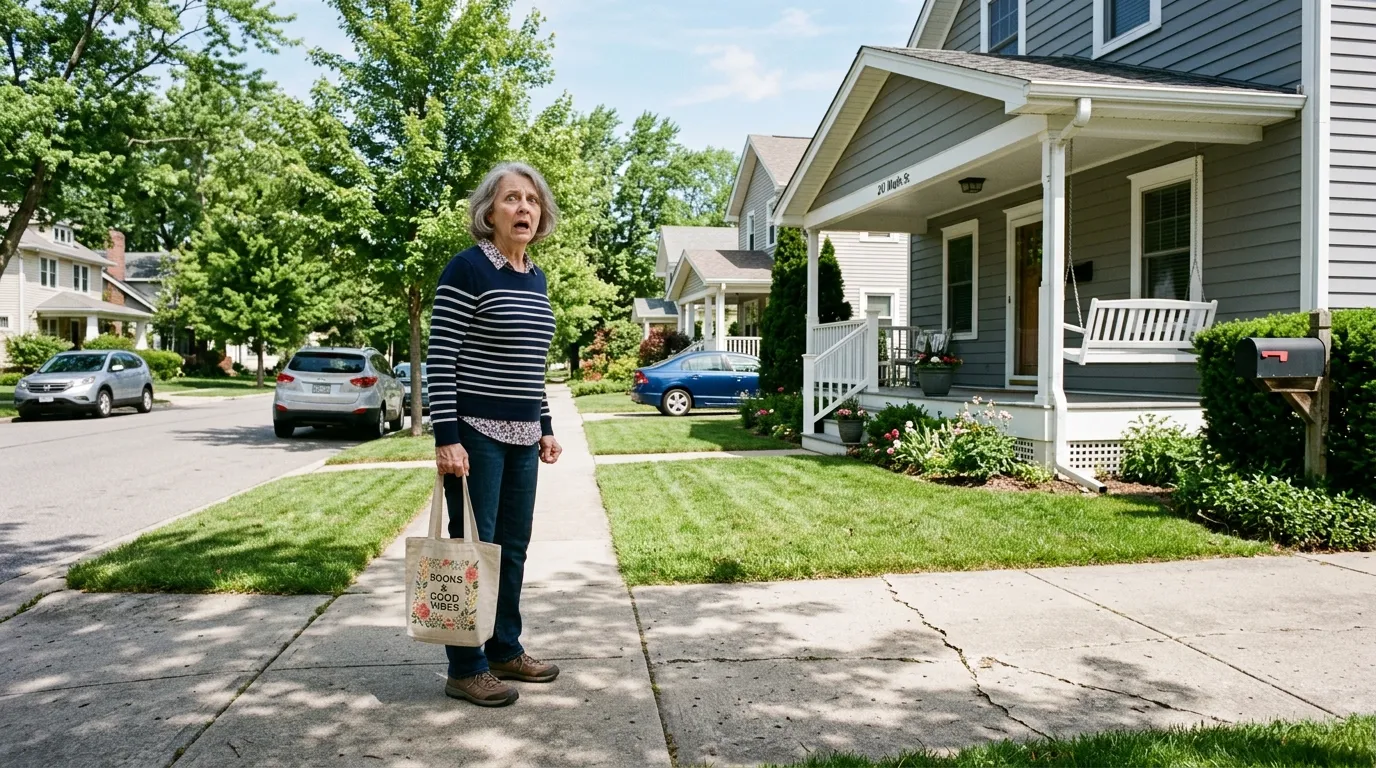 It was the kind of house that demanded absolute trust without a second thought. The flowerbeds were packed with fresh, dark mulch. The windows were streak-free. A little decorative flag fluttered gently by the front steps. It was the epitome of suburban safety.
“Help me!”
This time, the voice was louder. It was panicked. It was unmistakably female. And it was entirely real.
Evelyn’s hand flew to the pocket of her cardigan, her trembling fingers fighting to grip her phone. But before she could even swipe the screen to unlock it, the heavy front door of the gray house swung wide open.
The Uniforms That Brought No Comfort
Two police officers walked out onto the porch.
They weren’t running. They weren’t shouting into their shoulder radios for backup. They weren’t moving like men who had just burst into a house to execute a desperate rescue. They moved leisurely, rolling their shoulders, acting as if everything in the world was perfectly under control.
She was sixty-two years old. She had lived on Maple Hollow Drive for three decades. She had survived enough of life’s sharp edges to know deep in her bones when something felt terribly, fundamentally wrong.
The taller officer, a man with a square jaw and dark, flat eyes, spotted her immediately. His gaze locked onto hers with the intensity of a predator, and he lifted one hand.
It was not a friendly neighborhood wave. It was a warning.
“Ma’am,” he called out, his voice as calm and steady as a church usher, “there is no emergency here.”
Evelyn swallowed hard, her throat feeling like sandpaper. “I heard someone screaming,” she called back, surprised she found her voice at all.
The two men descended the steps and came closer. They didn’t rush. They weren’t aggressively storming toward her. The measured, deliberate pacing of their footsteps almost made it worse.
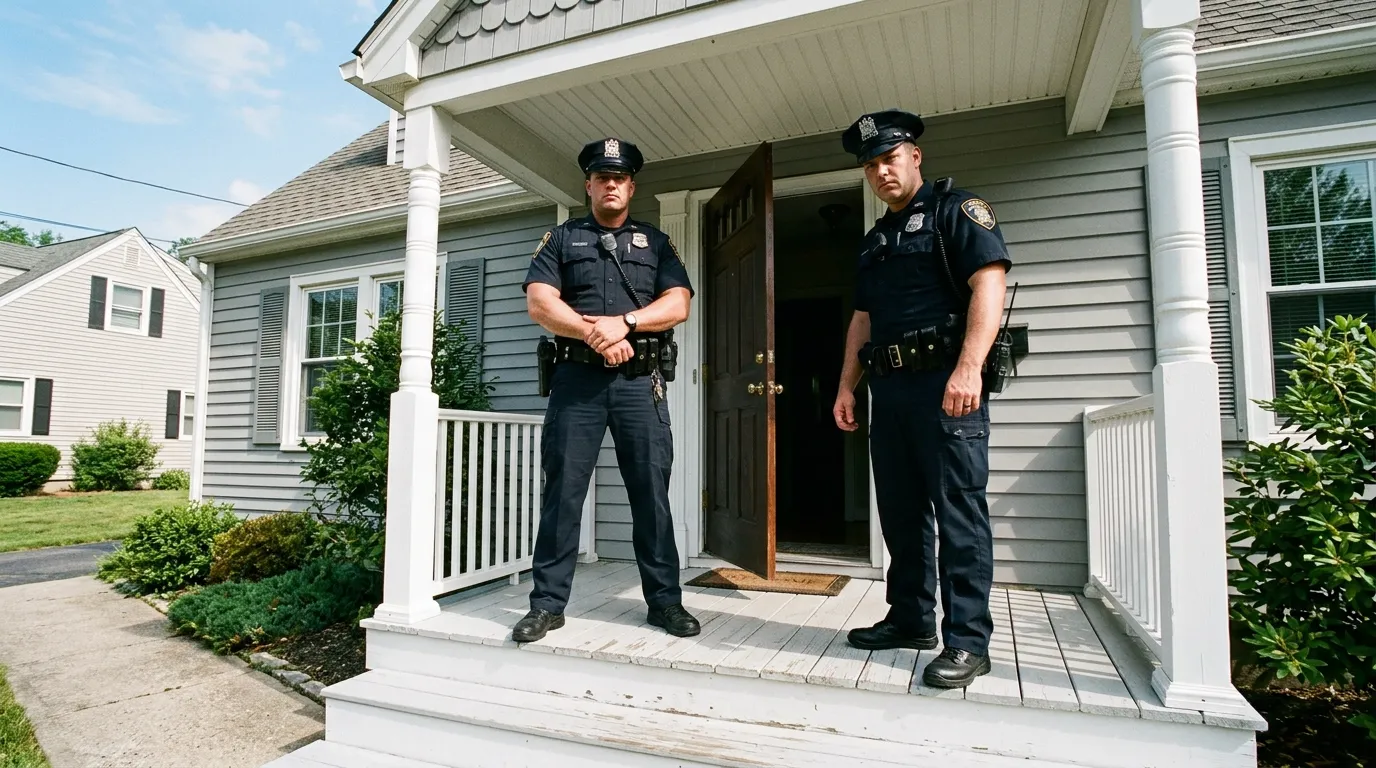
They wore the uniforms of protectors, but their eyes promised only danger.
Up close, she noticed all the terrifying details her subconscious had already processed. There was zero urgency. No genuine concern. No crackle of radio chatter breaking the morning silence. No stress lines around their eyes. No one was rushing back inside to tend to a victim.
It was just two broad-shouldered men standing like a barricade between her and that dark, open doorway.
The shorter officer offered her a thin, practiced little smile. It was the kind of smile people wear when they want to appear polite without actually possessing a single ounce of kindness. “Everything’s fine,” he said smoothly. “You just misunderstood what you heard.”
Evelyn didn’t look at him. She looked past his shoulder, deep into the house. The hallway inside was pitched in shadows. It was far too dark for ten o’clock in the morning.
“I don’t think I misunderstood,” she replied. She hated how shaky, how incredibly frail her voice sounded in the open air.
The taller officer took one more deliberate step toward her, invading her personal space just enough to establish dominance. Now he was close enough that she could see the hard, unyielding set of his jaw and smell the sharp scent of his aftershave.
Evelyn’s fingers tightened around the leather straps of her tote bag until her knuckles ached.
“You are safe right now,” he said softly. It didn’t sound like reassurance; it sounded like a condition. “You’ll stay safe if you just keep walking and mind your own business.”
The words landed against her skin like a physical slap.
The shorter officer leaned in just a fraction of an inch. “Don’t call the neighbors. Don’t make reports down at the precinct. Don’t come back here.” He paused, tilting his head. “That would be smartest.”
Evelyn stared at them, paralyzed.
She had spent the entirety of her life believing that uniforms meant absolute protection. She believed that if something was wrong in the world, you called a number, and help would come. She believed that decent people only had to speak up to make the bad things stop.
But standing there on her own familiar street, listening to the porch boards creaking under their boots, looking at the half-open door behind them, she felt a foundational piece of her worldview shatter.
And then she heard it.
A sound drifting out from the dark hallway inside.
Small. Broken. A sob.
It wasn’t loud. It wasn’t dramatic or theatrical. It was just devastatingly real.
Evelyn turned around on her heel before they could see the sheer, unadulterated horror washing over her face.
Then she walked. Then she hurried. Then she flat-out ran, leaving her dignity on the sidewalk.
The Weight of Silence
She didn’t stop running until she reached the little neighborhood market near the corner gas station, three full blocks away. By the time she pushed through the glass doors, her lungs were burning, screaming for oxygen. She bent over, resting both hands on her knees, trying desperately not to fall apart right there between a rack of discount potato chips and a humming cooler full of bottled iced tea.
The bell over the market door kept jingling every time a customer wandered in. It was such a normal sound. A friendly, everyday sound. It made her want to weep.
You should have done something.
The thought hit her like a physical blow. Then it hit her again. And again. She bought nothing. She practically sprinted the rest of the way home, locked her front door, turned the deadbolt, and then checked it twice with violently shaking hands. After that, she moved through her house like a ghost, pulling every curtain shut.
Around three o’clock that afternoon, a patrol car rolled slowly past her front living room window. Not once. Twice.
Maybe it meant nothing. Maybe it meant everything.
That night, Evelyn lay awake on her mattress, staring blankly at the shadows spinning from her ceiling fan. The woman’s voice looped in her mind, an inescapable echo. Please. Somebody help me.
- There was no yellow police tape blocking the yard.
- There was no crowd of concerned neighbors.
- There were no flashing red and blue lights.
- There was absolutely no sign that a nightmare had unfolded just 24 hours prior.
Evelyn stood hidden behind her sheer lace curtains, a mug of coffee growing cold between her palms.
By lunchtime, a large moving truck pulled up to the curb. She watched, bewildered, as two men casually carried furniture inside. A floral couch. Cardboard boxes. Brass lamps. Wooden kitchen chairs. Shortly after, a young, smiling couple arrived in a silver SUV.
By supper time, the porch light was flicked on, casting a warm glow over a brand-new welcome mat someone had laid by the door. It looked lived in. It looked profoundly ordinary.
It looked like a massive, suffocating lie.
Evelyn told herself to just forget it. She tried. She really, truly did. She scrubbed her kitchen drawers until her fingers wrinkled. She called her sister out in Tennessee and talked for an hour about old family recipes, her aching knees, and the ridiculous price of gas. she folded laundry with manic precision. She watered the ferns on the back porch.
But every quiet moment she found brought her right back to that visceral, tearing scream.
The Crack in the Facade
Days bled into weeks. The neighborhood hummed along, blind to the darkness.
Then one Thursday evening, Evelyn was half-asleep in her worn recliner, the television muttering in the background, when the local news caught her attention.
An anchor with a serious face was talking about a missing teenage girl. She was last seen heading out to meet a friend. The screen flashed a standard high school portrait. Dark hair. A soft, slightly awkward smile. Metal braces just visible when she grinned. She was only seventeen years old.
Evelyn sat up so incredibly fast that her knitted throw blanket slid onto the floor in a heap.
Then, the text appeared at the bottom of the screen. The last known address associated with her disappearance.
Maple Hollow Drive.
Evelyn’s entire body went completely numb. She reached for the remote with a heavy hand and shut the television off. The living room instantly dropped into a deafening silence. She sat there in the dark, listening to the frantic, rabbit-like pounding of her own heart.
Then, her cell phone buzzed against the wooden end table.
One new message. An unknown number.
You were warned.
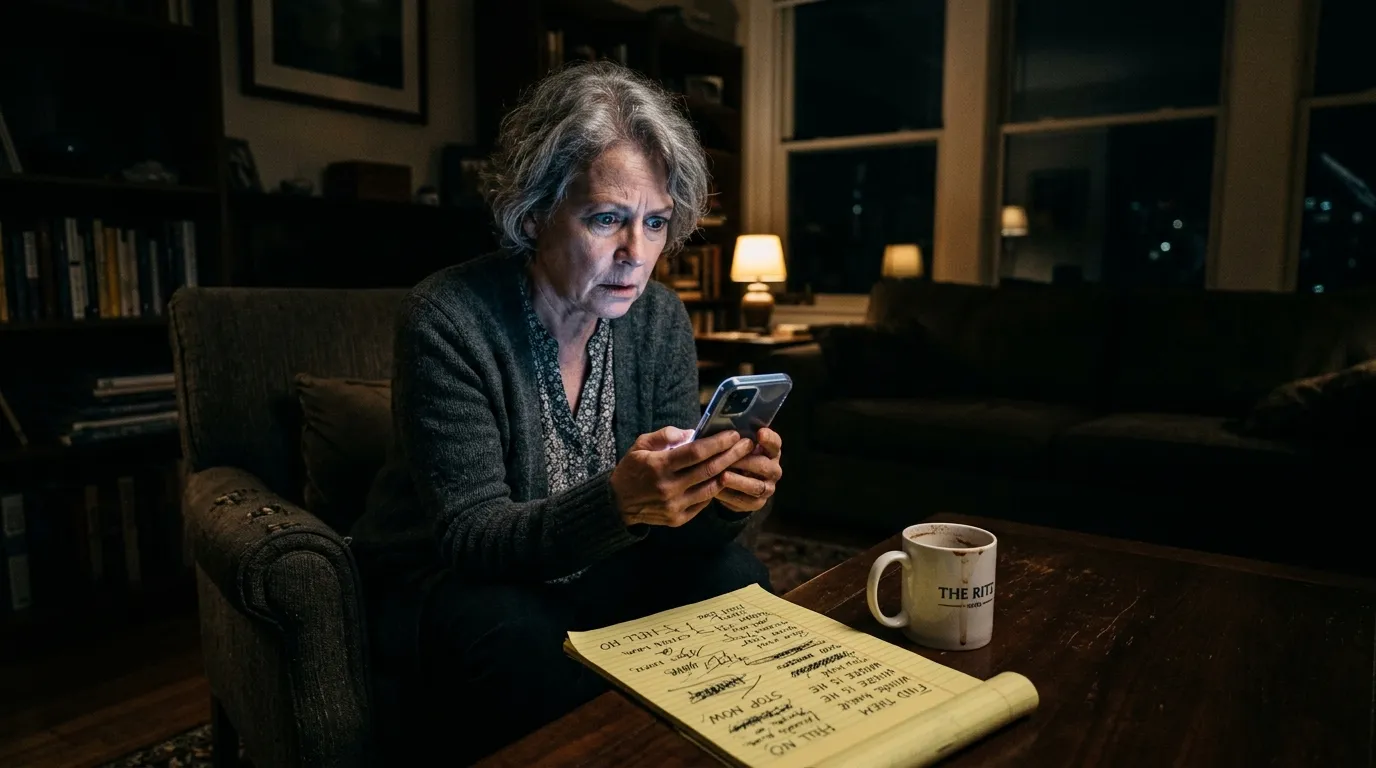
When the threats come to your sanctuary, nowhere feels safe.
Evelyn dropped the phone so hard it hit the hardwood floor and skidded under the coffee table. For a long, agonizing time, she couldn’t move a muscle. She just sat there, pressing both hands tightly over her mouth, breathing in ragged gasps through her fingers as if she was trying desperately not to scream, too.
The next morning, however, the fear crystallized into something else. She did something she knew she should have done the very day it happened.
She pulled a fresh yellow legal pad from her desk drawer, clicked her favorite pen, and wrote down absolutely everything.
- The exact time she heard the first scream piercing the air.
- The precise, chilling words the two officers had spoken to her.
- The neat, undisturbed way the gray house looked on the outside.
- The relaxed, arrogant way the men had stood on the porch.
- The way the shorter officer smiled with entirely dead eyes.
- The muffled, heartbreaking sob from inside the dark hallway.
- The slow, deliberate patrol car rolling past her house later that afternoon.
- The timestamp and exact wording of the text message.
She wrote until her hand cramped so badly her knuckles ached. Then, she pushed through the pain and copied it all out twice more. She slipped the pages into three separate envelopes.
When the Walls Come Down
After she dropped the letters in the blue mailbox outside the post office, she waited.
Waiting turned out to be its own unique kind of psychological punishment. Every car engine rumbling outside made her flinch. Every unexpected knock at the door made her heart slam against her ribs. She stopped sleeping through the night, jumping at the creak of the house settling. She stopped sitting on her porch entirely. She started checking the locks three times before eating breakfast.
Then, about ten days later, the first public crack appeared.
It was a short article published online. It raised pointed questions about missing dispatch records. It highlighted conflicting timelines. It outlined a missing person case tied to a “neighborhood welfare check” that inexplicably had no official report filed in the system.
Then more articles came. The dam was breaking.
The investigative reporter called her. Evelyn stared at the ringing phone and nearly didn’t answer it. But she forced herself to pick it up. Her voice shook violently through the entire hour-long conversation. Still, she told the truth. Every single, horrifying piece of it.
After that, the machinery of justice moved incredibly fast. There were internal affairs reviews. There were loud public demands for body camera footage. There were televised statements from high-ranking officials who looked stiff, pale, and deeply nervous sweating behind podium microphones.
Then came the bold headline that made Evelyn grip her kitchen countertop until her knuckles turned snow-white:
Two Officers Placed on Leave Pending Investigation.
A few days later, a second, even larger headline dropped. Arrested.
She stood in the middle of her kitchen, reading that single word three times over just to make sure her eyes weren’t playing tricks on her. Arrested.
The neat gray house down the street was finally searched. Fleet upon fleet of unmarked vehicles lined the suburban curb. Men wearing dark windbreakers carried endless brown evidence boxes through the front door. Reporters swarmed like locusts at the end of the block, talking into cameras in hushed, dramatic voices, as if speaking too loudly might wake the dead.
The full, gruesome details never fully made it onto the evening news. Not all of them. Some things stayed legally sealed. Some things got heavily redacted, reduced to careful legal language, solemn faces, and sterile phrases like ongoing active investigation.
But Evelyn knew enough.
She knew enough to understand that what she had heard that sunny Tuesday morning had been completely, terribly real. She knew enough to understand that her own fear had nearly buried the truth alive.
The missing seventeen-year-old girl was finally found. She was not unharmed. She was certainly not unchanged. But she was alive.
When Evelyn heard that news on the radio, she sat down heavily at her small kitchen table and cried until her chest physically hurt. She didn’t cry because it fixed anything. It didn’t. Nothing in this world could ever give that young girl back the innocence and the person she had been before she walked into that gray house.
And nothing could return Evelyn to the woman she had been before that morning, either. She could never go back to being the woman who still believed that danger always looked outwardly dangerous. The woman who naively thought that evil always announced itself with a certain menacing face, a certain aggressive tone, or a certain kind of dilapidated door.
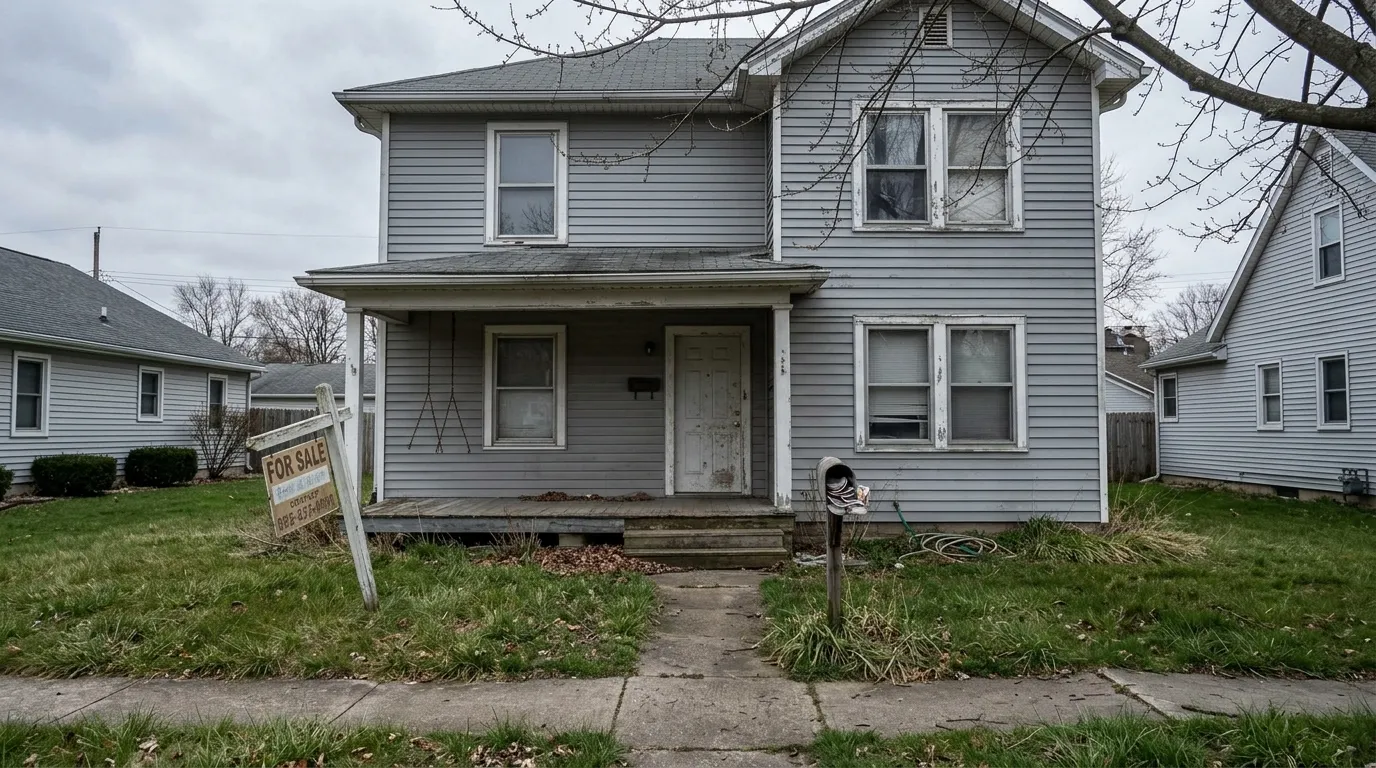
The monsters aren’t always hiding in the shadows; sometimes, they stand in the broad daylight.
Months later, long after the reporters had packed up their vans, the television cameras had disappeared, and the street had stubbornly started pretending everything was normal again, Evelyn walked down Maple Hollow Drive one more time.
She walked slowly. Carefully.
The neat gray house stood entirely empty now. The white porch swing was gone. A crooked “For Sale” sign leaned heavily in the patchy, dying yard, looking as though even the wood was tired of holding on.
Somewhere farther down the block, she could hear children laughing in a sprinkler. A bicycle tire hissed rhythmically over the warm pavement. A neighbor’s dog barked cheerfully behind a wooden fence.
They were normal neighborhood sounds. The exact kind of sounds that lull people into thinking everything around them is safe.
Evelyn stopped directly in front of the empty house and stared at it for a long, quiet moment.
Then, she adjusted her tote bag and kept walking. Because now she carried a heavy knowledge that she wished she had never had to learn.
A quiet street can hide terrible, unspeakable things. A neat porch with fresh mulch can hold a waking nightmare. And silence is not, and never will be, the same thing as peace.
Sometimes, silence is a threat. Sometimes, silence is guilt. And sometimes, silence is exactly what lets evil stay alive.
Note:This work is inspired by real events and people, but it has been fictionalized for creative purposes. Names, characters, and details have been changed to protect privacy and enhance the narrative. Any resemblance to actual persons, living or dead, or actual events is purely coincidental and not intended by the author.
All images used in this article are AI-generated and intended for illustrative purposes only.