
Comedy is an art form that thrives on timing, unpredictability, and surprise. But what happens when you take those elements and slow them down, stretching the moment to its breaking point? What if the greatest joke isn’t the one that makes you laugh immediately but the one that makes you wait, building tension until the payoff becomes an eruption of pure, uncontrollable laughter? This was the genius of Tim Conway. His comedy wasn’t about speed, but about suspense—and it was in this very skill that he became the most dangerous man in live television comedy.
THE COMEDY LEGEND: TIM CONWAY AND THE ART OF SUSPENSE
Tim Conway is often hailed as one of the greatest comedic talents to ever grace the stage, but what set him apart from his peers wasn’t just his impeccable timing or his wide-ranging talent—it was his ability to weaponize the simplest of movements, turning every second into a masterstroke of comedic brilliance. While other comedians relied on fast-paced gags and outrageous antics, Conway’s genius lay in his ability to make audiences wait. He knew that sometimes, the most effective comedy wasn’t in the punchline, but in the anticipation.
Conway’s style was unique in that it defied conventional comedic pacing. He didn’t rush to deliver his humor. Instead, he let it unfold slowly, methodically, dragging out every moment until the audience couldn’t take it any longer. It was like watching a bomb tick down, each second stretching into infinity, until finally, the explosion of laughter came at the perfect moment. It wasn’t just about making people laugh—it was about making them earn the laughter.
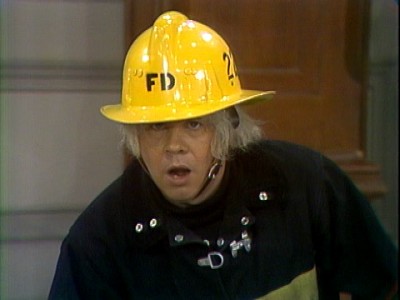
The fire truck sketch, where Conway took center stage, became the perfect demonstration of this comedic style. What began as a typical fast-paced sketch, involving firemen rushing to save the day, turned into a breathtaking exploration of how far you could stretch a comedic moment without breaking it.
The sketch began like any other in the world of live television. The stage was set in a frenzy, with fire trucks, alarms blaring, and actors scrambling to respond to the emergency situation. The speed of the scene was designed to create a sense of urgency, a palpable pressure that would have naturally demanded quick reactions. The fire truck was the symbol of that urgency—everyone was running toward it, prepared to make a dramatic, quick-paced entrance.
But then there was Tim Conway.
While the rest of the cast scurried around in their fireman outfits, Conway stood still. Dead still. Instead of running toward the truck, he paused. Every other actor seemed to be in a state of action, but Conway’s inaction became the focus.
And this was where the magic happened.
For what felt like an eternity, Conway simply waited. A moment that should have been filled with urgency was now suffused with deliberate and painful slowness. For 30 seconds, Conway lifted one foot off the ground and then froze. And for those 30 seconds, every single second stretched out, drawing every eye to him as if he were the only person in the world. It was almost as though the tension in the room was building, and Conway was the conductor of this tension, pulling the strings of the audience’s patience.

THE SUSPENSE: TIM CONWAY’S COMEDY GENIUS IN ACTION
What made this sketch so iconic wasn’t the fire truck or the blaring alarms. It was the excruciating slowness with which Conway moved. As Conway finally lifted his foot and slowly moved toward the fire truck, the air became thick with suspense. It wasn’t just that Conway was moving slowly—it was that every movement he made was deliberate, as though each inch he gained toward the fire truck was carefully calculated. It wasn’t fast-paced chaos that filled the room—it was slow, suspenseful stillness.
The audience, expecting the usual fast-paced humor of live comedy, didn’t know how to react at first. They waited for Conway to do something—anything—but instead, he just kept going slower. Every move he made seemed agonizingly deliberate, and yet the tension only grew with each passing second. The clock was ticking, and yet, Conway continued, freezing mid-air, wobbled slightly, then pausing again.
It was brilliant. And then it became dangerous.
The audience didn’t just become passive observers; they became participants in the tension Conway had built. They too had to wait. They too had to endure the slow unraveling of the scene. Conway knew that comedy wasn’t just about filling space with jokes or movement; it was about manipulating the audience’s emotions, making them uncomfortable, building anticipation until it was almost unbearable.
THE BREAKDOWN: HARVEY KORMAN’S MELTDOWN
As the scene played out, the comedy genius wasn’t just evident in Conway’s performance—it was in how his partner, Harvey Korman, reacted. The dynamic between Conway and Korman had always been one of mutual respect, but in this sketch, it was clear that Conway was the master, and Korman was the foil who had to endure the chaos that Conway was deliberately orchestrating.
For Korman, this was more than just a comedy sketch—it was an exercise in self-control. As Conway took his time, as every second seemed to stretch longer than the last, Korman’s struggle to maintain his composure became just as much a part of the sketch as the actions themselves.
You could see Korman’s face slowly turning red. His eyes darted between Conway and the fire truck, the tension in his face becoming more and more pronounced. The longer Conway took, the harder it became for Korman to remain professional. And that’s when the cracks started to show.
Korman began to shake, visibly trying to fight back his laughter. He covered his mouth to prevent himself from breaking character, but it was no use. The more Conway paused, the harder Korman’s restraint became. His shoulders tensed, his body folded in half as he tried to contain himself. He even turned away from the camera, trying to shield himself from the camera’s gaze while he desperately fought to stop laughing.
But no matter how hard he tried, Korman could not escape Conway’s genius. Conway’s slowness, his deliberate pauses, had broken him. And as Korman finally succumbed, his laughter became just as integral to the sketch as the slow-motion actions Conway had created.
TIM CONWAY’S LEGACY: THE MOST DANGEROUS MAN IN LIVE COMEDY
Tim Conway’s comedy was dangerous not because it was loud, but because it was subtle. It was dangerous because it took the simplest moments—like moving toward a fire truck—and turned them into a battlefield of timing. In doing so, Conway created a space for comedy that was unlike anything anyone had seen before. He showed the world that comedy didn’t need to be fast to be funny. Sometimes, the funniest moments came from the pause—from dragging things out to a point where the tension was so thick that the audience could hardly take it.
What made Conway the most dangerous man in comedy wasn’t just his ability to make people laugh; it was his ability to control the moment, to hold the audience in suspense until the laughter came as a release. While most comedians relied on energy, gags, and quick movements, Conway worked in stillness—letting silence become just as powerful as words.
The slow-motion brilliance of the fire truck sketch became a defining moment in Conway’s career. It proved that the most dangerous thing in comedy wasn’t fast-paced chaos, but a controlled, carefully crafted moment of slowness.
Tim Conway’s fire truck sketch was more than just a funny moment—it was a work of art. It was a moment that rewrote the rules of live comedy, teaching us all a valuable lesson: that sometimes, the funniest moments come from making the audience wait. And while the scene itself was filled with fire trucks, sirens, and urgency, the real magic came from the stillness, the tension, and the exquisite timing that Tim Conway infused into every movement.
In this sketch, Conway didn’t just break the rules of comedy. He created new ones.
He became the most dangerous man in live comedy because he understood that true comedic brilliance comes not from rushing, but from stretching the moment until the entire room could feel the pressure build—until, finally, the explosion of laughter came as the greatest release.