For years, the people of a small Kentucky mountain town avoided one particular road after sunset.
Not because of ghosts.
Not because of legends.
But because of a house.
A simple white farmhouse sitting on a quiet hillside, surrounded by trees and old fields. From the outside, it looked like thousands of other rural homes scattered throughout Appalachia. It had a porch, a barn, and a chimney that sent smoke into the cold morning air.
But behind those walls was a story that the town tried desperately to forget.
A story about three brothers who disappeared from public memory while still living only a few miles away.
Their names were Thomas, William, and Robert Buckner.
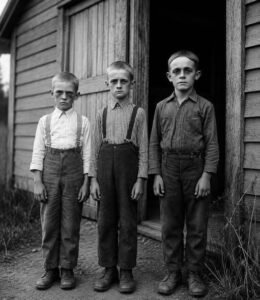
In 1953, a photograph was taken of the three boys standing beside an old wooden barn. At first glance, it appeared ordinary. Three brothers. One family. One moment frozen in time.
But years later, people who studied the photograph noticed something unsettling.
The boys were not smiling.
Their expressions were serious.
The oldest brother stood behind the younger two, his hand resting on the shoulder of the youngest.
It looked protective.
But there was something else in the image.
A sense that the boys were not simply standing together.
They were holding onto each other because they had nowhere else to go.
Seven years after that photograph was taken, the Buckner brothers would walk into a sheriff’s office in rural Kentucky and reveal a story that would leave their community struggling with one painful question:
How could an entire town fail to notice three children disappearing right in front of them?
The Family That Looked Perfect From The Outside
The Buckner family arrived in Harlan County shortly after World War II.
Thomas Buckner Sr. returned from military service carrying medals, memories, and a personality that had changed during his years away.
Like many veterans of that generation, he rarely spoke about what he had experienced.
To neighbors, he appeared disciplined and hardworking.
He purchased a small farmhouse on several acres of land outside town. It was private enough that visitors rarely stopped by, but not so isolated that anyone considered it unusual.
His wife, Margaret, managed the home.
Their three sons—Thomas Jr., William, and Robert—were young boys trying to grow up in a world that was rebuilding itself after war.
At church, the family appeared respectable.
At the local store, Thomas Sr. was polite.
People saw what was visible.
They did not see what happened when the front door closed.
That was the danger of the Buckner home.
It did not look like a place where something was wrong.
It looked normal.
And sometimes the most difficult truths are hidden behind the most ordinary walls.

The Warning Signs Nobody Wanted To See
Years later, when old records were examined, small details began to stand out.
The boys had attended school briefly, but they never remained enrolled for long.
Each time, there was another explanation.
Family responsibilities.
Health concerns.
A need to help at home.
Teachers noticed the boys were quiet.
They rarely spoke about their family.
They rarely invited friends over.
They seemed older than children their age.
A neighbor once mentioned hearing arguments coming from the Buckner property late at night.
Another remembered that the boys often appeared nervous whenever their father entered the room.
But in the 1950s, especially in rural communities, people often followed an unspoken rule:
Do not interfere in another family’s business.
A man’s home was considered private.
Parents were trusted.
Authority was respected.
And sometimes that respect allowed suffering to remain hidden.
The House On The Hill
The Buckner farmhouse stood above the road where everyone could see it.
That almost made it easier to ignore.
It was not hidden deep in the woods.
It was not abandoned.
Smoke rose from the chimney.
Lights appeared in the windows.
The family existed.
But slowly, the boys disappeared from community life.
They stopped attending school.
They stopped appearing at church.
They stopped being seen around town.
Nobody filed a missing person report.
Nobody organized a search.
Because officially, they had not vanished.
They were still listed as members of the Buckner household.
But a person can disappear without ever leaving a place.
Sometimes disappearance happens when the world simply stops looking.
The Death Of Margaret Buckner
The first major change came when Margaret Buckner died.
Her death was described as illness-related.
The funeral was small.
The boys were not seen among the mourners.
Afterward, the house became even quieter.
Thomas Sr. continued living there.
Neighbors occasionally saw him in town.
He purchased supplies.
He maintained his appearance.
From the outside, life continued.
But inside the farmhouse, the three brothers remained separated from the world.
Years later, when investigators reconstructed their story, they discovered that the boys had lived under strict control for a long period of time.
Their contact with outsiders had almost completely disappeared.
They had grown up without friendships beyond the family.
Without normal schooling.
Without the experiences most children consider ordinary.
Their world had become the size of one house and one person’s rules.
The Day The Brothers Finally Spoke
In 1960, everything changed.
The brothers finally reached a point where silence was no longer possible.
They went to authorities.
They did not arrive as confident young men seeking justice.
They arrived as people who had spent years learning to survive.
Their story shocked everyone who heard it.
They described years of isolation.
Years of fear.
Years of being taught that the outside world could not be trusted.
The sheriff and investigators realized they were not dealing with a simple family disagreement.
They were dealing with years of control that had shaped every part of the brothers’ lives.
The investigation that followed forced the community to confront something uncomfortable.
The signs had been there.
People had heard things.
People had noticed changes.
But noticing and acting are two very different things.
The Hidden Effects Of Isolation
Experts who later studied similar cases explained that extreme isolation can have devastating effects on children.
Children learn about the world through relationships.
Through teachers.
Through friends.
Through neighbors.
Through experiences outside their homes.
When those connections are removed, children may begin to accept abnormal situations as normal.
They adapt because adaptation is how humans survive.
The Buckner brothers’ story became a reminder that silence can be powerful.
Not because it hides the truth forever.
But because it delays the moment when someone finally decides to ask questions.
A Community Forced To Remember
After the investigation, many people in the town struggled with guilt.
Some wondered whether they should have spoken sooner.
Some wondered whether they had ignored signs because accepting the truth would have been uncomfortable.
The Buckner house became a symbol of something larger than one family.
It represented the dangers of looking away.
The danger of assuming someone else will help.
The danger of believing that what happens behind closed doors is always private.
Because children do not always have the power to save themselves.
Sometimes they depend on someone outside the family noticing that something is wrong.
The Brothers After The Truth Came Out
The years after their escape were not simple.
Surviving an experience does not mean forgetting it.
The brothers had to learn things many people take for granted.
How to trust others.
How to build relationships.
How to understand a world they had been separated from.
But they also showed something remarkable.
Resilience.
Despite everything they experienced, they continued moving forward.
Their story was not only about what happened to them.
It was about what they survived.
The Photograph That Remained
The old photograph of the three boys remained the most powerful reminder of their story.
Three children standing together.
Three brothers who had once hoped someone would notice.
Looking at the image decades later, people often ask the same question:
How many other stories like this remained hidden because nobody looked closely enough?
The answer may never be known.
But the lesson remains.
Families can hide secrets.
Communities can ignore warning signs.
Time can bury painful memories.
But eventually, the truth has a way of finding the light.
The Buckner brothers were not remembered because of the tragedy that surrounded their childhood.
They were remembered because, after years of silence, they finally found the courage to speak.
And sometimes, one voice is enough to break a silence that has lasted a lifetime.