
No one thought they would ever see him like that again.
Not under the lights.
Not at center stage.
Not with thousands of people holding their breath.
The room was full — but it didn’t feel loud. It felt suspended. Like the air itself had paused out of respect.
There was no swelling orchestra.
No dramatic entrance.
No voice booming through the speakers to welcome him back.
Just movement.
Slow. Careful. Intentional.
Randy Travis was gently rolled forward in his wheelchair, stopping directly beneath a soft circle of light. No microphone in his hands. No instrument resting across his lap. No expectation that he would sing.
Only presence.
And somehow… that was enough.
The Silence That Felt Heavier Than Any Song
For a few seconds — maybe five, maybe ten — nothing happened.
But those seconds carried the weight of an entire era.
The kind of weight that only comes when a man who once defined a genre returns to the place where his voice used to echo like thunder.
Everyone in that arena knew the story.
They knew about the stroke in 2013.
They knew about the long hospitalization.
They knew about the uncertainty.
The months when doctors weren’t sure he would survive.
The years of speech therapy.
The painstaking rehabilitation.
The loss of the instrument that had once made him a giant in country music.
And yet, there he was.
Not restored to who he was before.
Not magically healed.
But undeniably present.
The silence wasn’t awkward. It wasn’t uncomfortable.
It was sacred.
A Voice That Once Carried a Generation
There was a time when Randy Travis didn’t need lights or introductions. His voice alone could command a room.
When “Forever and Ever, Amen” poured from speakers across America, it didn’t just top charts — it settled into homes, weddings, and memories. When “Three Wooden Crosses” played, people didn’t just listen. They reflected.
He didn’t chase trends. He didn’t bend to the moment.
He brought country music back to its roots — honest storytelling, steady baritone, songs that felt lived-in rather than manufactured.
In the 1980s and 1990s, Randy Travis wasn’t just successful. He was foundational.
And then, in a single medical crisis, everything changed.

The Stroke That Stole More Than Sound
In July 2013, Randy Travis suffered a massive stroke following complications from viral cardiomyopathy. Doctors performed emergency surgery to relieve pressure on his brain. His survival was uncertain.
When he awoke, he had lost much of his ability to speak. The voice that once filled arenas had been reduced to fragments.
For an artist, losing a voice is not just physical.
It’s identity.
It’s livelihood.
It’s connection.
But what the public didn’t always see was the fight that followed.
The daily therapy.
The effort behind every word.
The courage required simply to show up at events when speech came slowly and unpredictably.
He could have disappeared.
Many would have.
Instead, he chose to remain visible.
That Night Wasn’t About a Comeback
As he sat at center stage, there was no sense of performance.
He wasn’t there to prove he could still hit a note.
He wasn’t there to reclaim a chart position.
He wasn’t there to stage a triumphant “return.”
He was there to exist in the space that once belonged to his voice.
And that distinction mattered.
Because sometimes the bravest thing a person can do is show up — not restored, not polished, not fixed — but present.
The Nod That Broke the Room
After those heavy seconds of silence, Randy lifted his head slightly.
A small nod.
Barely noticeable.
But intentional.
Then came a quiet smile — steady, unforced, calm.
It was not the smile of a man asking for sympathy.
It was the smile of someone who had survived something most people never see and was choosing to stand — even if seated — in front of it.
That’s when it happened.
The crowd rose.
Not in a sudden explosion — but like a wave building from the back of the arena to the front.
One section stood.
Then another.
Then another.
Within seconds, thousands of people were on their feet.
But they weren’t cheering wildly.
They weren’t screaming.
They were honoring.

A Standing Ovation for Survival
There’s a difference between applause for talent and applause for resilience.
That night was the second kind.
People weren’t clapping because he sang.
They were clapping because he lived.
Because he fought.
Because he endured the kind of silence that could swallow a lesser spirit.
And in that moment, no one dared to whisper the question that had haunted headlines for years:
“Does he still have it?”
Because “it” had never been just a voice.
“It” was integrity.
“It” was steadiness.
“It” was the quiet gravity that made his songs feel like scripture to so many.
And that was still there.
Clear as ever.
When Country Music Stopped Being Loud
Country concerts are usually noisy affairs — boots stomping, guitars ringing, choruses shouted back from the crowd.
But this was different.
This was country music remembering its soul.
Remembering that it was built on stories of hardship. On faith through adversity. On men and women who endured storms and still showed up to work the next morning.
Randy Travis embodied that narrative long before his stroke.
After it, he became it.
The Power of Being Seen
For fans in that room, the moment carried layers.
Some had grown up on his music.
Some had danced to it at weddings.
Some had buried loved ones to it.
Some were facing their own health battles.
And to see him — not erased by tragedy, not hidden away — but centered, visible, acknowledged — meant something.
It whispered a message louder than any lyric:
“You are not finished just because something was taken from you.”

The Courage of Remaining
We celebrate comebacks.
We love dramatic returns.
But what about the quieter kind?
The kind where someone doesn’t return to their former strength — but instead returns simply as themselves?
Randy Travis didn’t walk out triumphantly.
He didn’t belt out a high note to prove critics wrong.
He sat.
And that took courage.
Because sitting under lights without the voice that built your career requires a level of vulnerability few artists ever show.
The Audience That Understood
As the ovation continued, something shifted.
The applause grew warmer.
Not louder — warmer.
People wiped tears.
Some pressed hands to their chests.
Some simply stared, absorbing the gravity of it.
In that shared silence before and after the applause, something rare happened:
An arena became intimate.
Twenty thousand people felt like they were in a living room.
More Than Music
Country music has always prided itself on authenticity.
Randy Travis helped define what that meant.
And authenticity doesn’t vanish when ability changes.
If anything, it becomes clearer.
That night wasn’t about perfection.
It was about humanity.
And humanity, when stripped of spectacle, is powerful.

A Legacy That Doesn’t Depend on Volume
Legends are often measured by what they can do.
By sales.
By awards.
By vocal range.
By chart positions.
But sometimes, legacy is measured by what remains when all of that is removed.
Strip away the microphone.
Strip away the ability to perform.
Strip away the roar of a stadium.
What’s left?
Character.
Presence.
Dignity.
Randy Travis had all three.
The Moment That Didn’t Need Words
Eventually, someone placed a microphone nearby.
He didn’t reach for it.
He didn’t need to.
Because the message had already landed.
Sometimes, silence communicates more than lyrics ever could.
And in that silence, there was no pity.
There was respect.
The Fear to Breathe
At one point, the arena truly felt afraid to breathe.
As if any sound might break something fragile and holy.
That kind of stillness is rare.
It only happens when people sense they are witnessing something that cannot be recreated.
This wasn’t nostalgia.
This wasn’t a reunion.
This was presence in its purest form.

Why It Mattered So Much
In a world addicted to spectacle, this moment was radical.
No fireworks.
No surprise guest.
No elaborate production.
Just a man and the acknowledgment that he had endured.
And maybe that’s why it felt so powerful.
Because resilience is quieter than we expect.
It doesn’t announce itself with fanfare.
It shows up, nods slightly, and lets others respond.
He Didn’t Need to Prove Anything
There’s a cruelty in the entertainment industry that often demands proof.
“Can you still do it?”
“Are you still relevant?”
“Is the magic still there?”
That night answered those questions without a single note sung.
Relevance isn’t about performance.
Magic isn’t about perfection.
Sometimes, the most powerful thing a legend can do is simply exist in front of the people who love them.
Still Here
The phrase echoed through conversations afterward.
“He’s still here.”
Not “He’s back.”
Not “He’s restored.”
Still here.
And sometimes, that’s the greatest victory of all.
The Man Beyond the Music
When the lights eventually dimmed, and he was gently rolled offstage, the applause followed him.
Not because the show was ending.
But because something had been affirmed.
Randy Travis was never just a voice.
He was faith.
He was steadiness.
He was the kind of country music that didn’t need polish to be powerful.
And even without the baritone that once defined a generation, he remains a cornerstone of the genre.
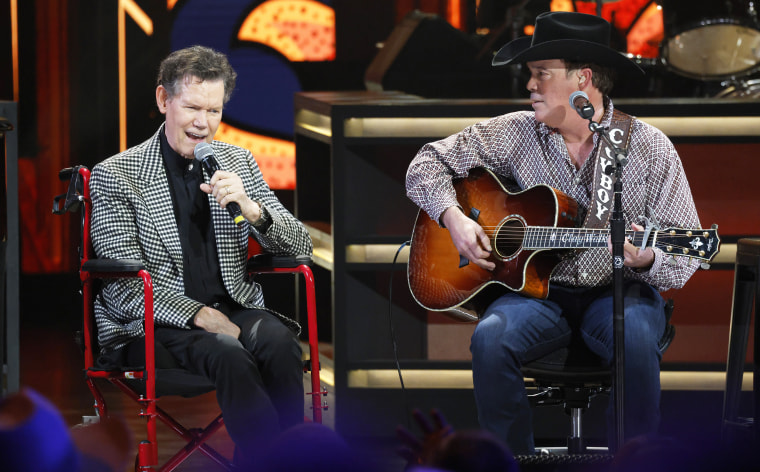
The Night That Redefined Strength
Strength doesn’t always look like volume.
Sometimes it looks like sitting still in front of thousands and allowing yourself to be seen as you are.
No filters.
No disguise.
No pretenses.
Just truth.
That night, Randy Travis reminded everyone that strength is not about reclaiming what was lost.
It’s about honoring what remains.
And That Was Enough
No encore.
No dramatic final note.
Just a quiet exit.
But as people filed out of the arena, there was a shared understanding:
They hadn’t just witnessed a moment in music history.
They had witnessed grace under unimaginable change.
They had witnessed a man who lost his voice — but not his identity.
And in that stillness, in that nod, in that smile —
Country music felt whole again.
Because sometimes, the most powerful sound in the world…
is silence filled with respect.