In April 1945, as Allied forces pressed deeper into the collapsing heart of Nazi Germany, American soldiers approached a place most of them had never heard of: Mittelbau-Dora concentration camp. They had seen combat. They had crossed rivers under fire. They had watched friends fall. But nothing in their training—nothing in the long march from Normandy—prepared them for what they would find there.
The gates did not look like the end of the world.
But inside, it was.
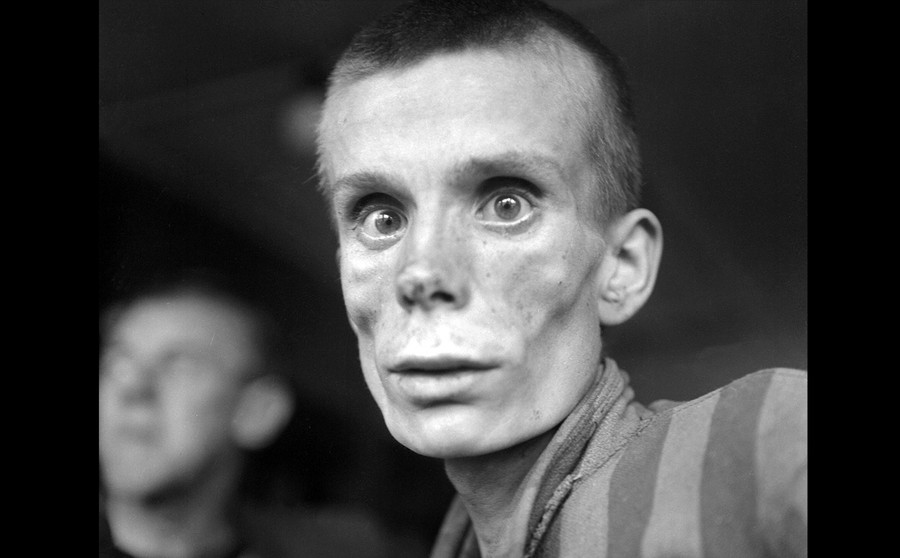
Among the skeletal figures who stumbled forward to greet the soldiers was one man whose presence would remain etched in memory long after the war ended. He was so thin that it seemed impossible he was still alive. His shadow, cast faintly on the dirt beneath him, looked heavier than the body that created it.
He tried to stand when he saw the Americans.
That small act—born of instinct, dignity, and something deeper than pride—broke the hearts of men who believed they had already seen everything war could show them.
This is his story.
And it is also the story of those who witnessed him.
The Camp Beneath the Mountain
To understand that moment in April 1945, we must understand the place.
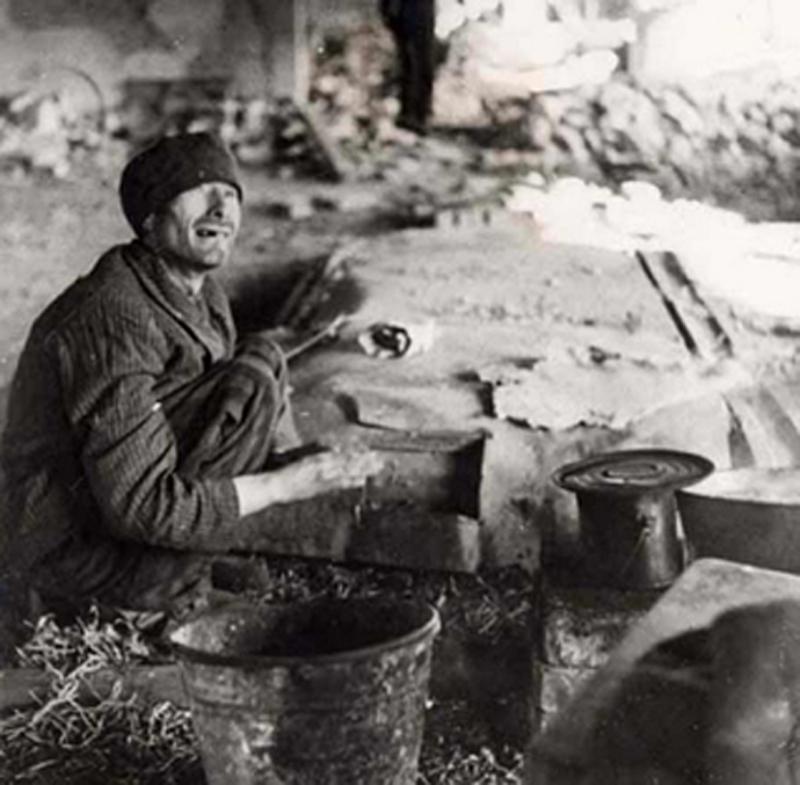
Mittelbau-Dora was not just another camp in the sprawling Nazi system. It was a forced labor complex carved into the Kohnstein mountain near Nordhausen. Prisoners—many transferred from Buchenwald concentration camp—were driven underground into tunnels where they assembled V-2 rockets for the German war effort.
These were not factories in the traditional sense. They were cavernous chambers blasted into rock, suffocating with dust and fumes. There was no sunlight. No fresh air. No relief.
The rockets built there were intended to terrorize cities like London and Antwerp.
The human cost was hidden in the dark.
Prisoners worked 12 to 14 hours a day, often more. They were starved, beaten, and denied medical care. Dysentery and tuberculosis spread unchecked. The tunnels became both workplace and tomb.
More than 20,000 people are believed to have died in the Mittelbau-Dora system.
But numbers do not tell the whole story.
A single human face does.
April 11, 1945: The Americans Arrive
As the war neared its end, U.S. forces advanced toward central Germany. Units of the U.S. Army entered the Nordhausen area in early April. What they found shocked even hardened combat veterans.
Corpses lay in heaps.
Barracks were filled with men who looked less like living people and more like shadows draped over bone.
One soldier later wrote that the smell reached them before the sight did. Another described the silence—no cheering, no rush forward. Just a quiet, stunned stillness.
And then there was the man.
He was seated on the ground when they first saw him.
When the Americans stepped closer, he looked up. Recognition flickered in his eyes—not triumph, not joy. Something quieter.
Relief, perhaps. Or disbelief.
And then, with slow determination, he tried to stand.
A Body That Could No Longer Remember
His legs were thin as broom handles. His ribs were etched sharply beneath parchment skin. His knees trembled before they even bore weight.
But he tried.
Because in another life—before the tunnels, before the starvation—he had been a man who stood to greet guests. A man who understood dignity.
The effort lasted seconds.
His knees buckled.
Two American soldiers rushed forward to catch him, but he was almost weightless in their arms. They would later say that lifting him felt like lifting a child.
Yet the weight they carried was not physical.
It was moral.
It was historical.
It was unbearable.
“I’m Sorry to Be a Burden”
When the medics arrived, they knelt beside him.
He whispered something.
They leaned closer to hear.
He apologized.
“I’m sorry,” he murmured, voice thin as thread. “I don’t want to be a burden.”
He apologized for breathing too slowly.
For taking time.
For existing.
The soldiers—young men from farms in Iowa, from factories in Detroit, from neighborhoods in Brooklyn—had crossed an ocean to fight tyranny. But in that moment, they felt something deeper than anger.
They felt shame.
Shame that a human being had been made to believe survival itself was an inconvenience.
A nurse—her hands trembling—knelt beside him. She reassured him that he was not a burden. That his survival was a miracle.
That the world had tried to erase him.
And failed.
The Science of Starvation, The Reality of Cruelty
Medical teams documented what they saw at Mittelbau-Dora and other camps. Bodies reduced to skeletal frames. Muscles consumed. Organs failing.
Starvation at that level is not merely hunger.
It is the slow dismantling of a human being.
The body begins to metabolize itself. The heart weakens. The brain struggles. Skin stretches over bone until even touch becomes painful.
Yet the human spirit often lingers.
That is what the soldiers encountered.
A spirit refusing to vanish.
Witnesses Who Could Never Forget
Years later, veterans would struggle to describe what they saw at camps like Mittelbau-Dora. Many did not speak of it for decades.
One said that combat was different. In combat, there is motion. Noise. Adrenaline.
In the camps, there was stillness.
A stillness filled with accusation.
The man who apologized stayed in their memories. Not because he was the most dramatic case. Not because he survived longest.
But because of his gentleness.
Because after everything done to him, he did not curse.
He did not rage.
He tried to stand.
And when he could not, he worried about inconveniencing his rescuers.
A Few Weeks of Freedom
The medics did everything they could.
They fed him carefully, aware that refeeding too quickly could cause fatal complications. They cleaned wounds. They provided blankets and sunlight.
He experienced freedom again.
For a few weeks.
He saw open sky. Felt fresh air.
Perhaps he remembered who he had been before the camp.
But his body had endured too much.
He died not long after liberation.
He died a free man.
And that distinction mattered.
The Weight of Memory
In the United States, Holocaust memory has been shaped by testimony, education, and institutions dedicated to remembrance. The United States Holocaust Memorial Museum stands as one of the nation’s central places of reflection.
Visitors walk through exhibits filled with shoes, photographs, and recorded voices.
But it is often one personal story—one fragile human moment—that stays with them.
The man who apologized represents millions whose names we do not know.
He reminds us that genocide is not only about mass death.
It is about the stripping away of identity, dignity, and self-worth.
It is about convincing a human being that he is a burden.
Why This Story Still Matters
In America, Holocaust remembrance is not only a Jewish issue. It is not only European history.
It is a warning.
The soldiers who liberated camps became witnesses for the world. They testified in trials. They spoke in schools. They showed photographs to skeptics.
Because even in 1945, there were those who doubted.
The man’s shadow—lighter than air—carries a heavy message.
Dehumanization begins with language.
It grows through indifference.
It thrives in silence.
The Promise of “Never Again”
“Never again” is not a slogan. It is a responsibility.
It demands vigilance against hatred in all forms—antisemitism, racism, xenophobia.
It asks us to see individuals, not numbers.
To protect the dignity of those who are vulnerable.
The man at Mittelbau-Dora did not live to see postwar trials. He did not witness the rebuilding of Europe. He did not see memorials rise.
But his memory survives in the soldiers who held him.
And in the stories we tell.
An American Reckoning
For many U.S. soldiers, liberation was both a victory and a reckoning. They had fought fascism abroad.
They returned home to a nation still grappling with segregation and injustice.
The images from camps forced Americans to confront questions about humanity, prejudice, and responsibility.
The Holocaust was not an abstract tragedy.
It was witnessed by American eyes.
Carried home in American hearts.
The Shadow That Speaks
When we remember Mittelbau-Dora, we remember tunnels and rockets.
But we also remember a man who tried to stand.
Whose knees failed.
Whose voice trembled in apology.
His shadow still speaks.
It asks us:
Will you remember me as more than a number?
Will you see my dignity?
Will you defend it when others are threatened?
