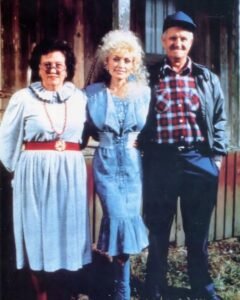
There was a time when the man who loved Dolly Parton more than anyone in the world looked at the woman she had become and quietly worried that the world would misunderstand her. He watched the rhinestones. He saw the towering blonde hair. He noticed the bright makeup, the sparkling dresses, and the unmistakable image that would eventually become one of the most recognizable symbols in American entertainment. But instead of seeing the dream behind it, he saw something else. He worried that people would judge his daughter. He worried that the world would call her names. And most of all, he worried that the little girl he had carried through poverty in the mountains of Tennessee had transformed herself into someone people would not respect.
His name was Robert Lee Parton. He was a man shaped by hard work, silence, and survival. He was not a man who expressed love with words. He never learned how to read. He never wrote a letter telling his daughter how proud he was. He never sat her down and said the simple sentence many children spend their entire lives waiting to hear: “I love you.”
But love was there. It was hidden in every early morning he spent working. It was in every piece of food he brought home. It was in every sacrifice he made so his children could have something he never had.
Robert Parton was the kind of father who believed actions spoke louder than words because actions were the only language he knew.
And decades before Dolly Parton became a global superstar, before millions of people knew her name, before the world celebrated her generosity, her music, and her unforgettable personality, she was simply a little girl growing up in a tiny cabin on Locust Ridge, surrounded by poverty, faith, and a family trying to survive.
The world knows Dolly Parton as the woman covered in glitter.
But her father knew her as the little barefoot girl who sang songs on a porch.
And that difference between those two images tells one of the most touching stories about family, identity, and unconditional love.
The Little Girl Born in a Cabin With Twelve Children and One Dream
On January 19, 1946, in the mountains of East Tennessee, Dolly Rebecca Parton entered a world that had almost nothing.
She was born in a small cabin in Locust Ridge, near Sevierville, Tennessee, the fourth of twelve children born to Robert Lee Parton and Avie Lee Owens Parton. The family lived without many of the things modern families consider essential. There was no comfortable home filled with conveniences. There was no financial security. There was no guarantee that tomorrow would be easier than today.
The cabin had a dirt floor. The roof was made of tin. Water had to be carried. Money was scarce.
The story of Dolly’s birth became one of the most famous examples of her family’s poverty. The doctor who delivered her, Dr. Robert F. Thomas, arrived on horseback. When it was time to pay him, Robert Parton did not have money. Instead, he gave the doctor a small sack of cornmeal.
A bag of cornmeal.
That was the value of a doctor’s visit in a world where survival mattered more than comfort.
Years later, Dolly would tell that story with humor, but behind the laughter was something deeper. It represented the reality her parents lived every day. They were not rich in possessions. They were rich in resilience.
Her father, Robert, worked whatever jobs he could find. He farmed tobacco. He worked construction. He used his hands to build things, repair things, and provide for a family that depended on him.
He was a man who understood the physical weight of responsibility.
But there was one burden he carried that few people knew about.
Robert Parton could not read or write.
Not because he lacked intelligence.
In fact, Dolly would later say the opposite.
She often described her father as one of the smartest men she had ever known. He could calculate numbers in his head faster than many educated people. He understood land, materials, farming, and construction with an instinct that could not be taught in a classroom.
He could look at a pile of wood and imagine a house.
He could look at a difficult problem and find a practical solution.
But put a piece of paper in front of him with words he could not understand, and suddenly the man who could build almost anything became powerless.
That contradiction stayed with Dolly throughout her entire life.
Because her father’s greatest limitation became one of the reasons she worked so hard to succeed.
She wanted to honor him.
She wanted to prove that a person’s worth was never measured by what they lacked.
The Two People Who Created Dolly Parton
If Robert Parton gave Dolly her determination, her mother gave her music.
Avie Lee Owens Parton was the storyteller of the family.
She sang old mountain ballads. She sang church hymns. She filled the small cabin with melodies that transformed poverty into something almost beautiful.
The Parton children did not have many luxuries, but they had music.
They had voices.
They had stories.
They had faith.
Dolly later said that many of her earliest songs came from listening to her mother. Avie Lee had twelve children before she was thirty-five years old, and life was incredibly difficult. She was often sick, exhausted, and overwhelmed, but she continued singing because music gave the family something poverty could not take away.
Hope.
Their home may have been small, but imagination made it larger.
Their family may have been poor, but their dreams were enormous.
However, Dolly grew up surrounded by another powerful influence: religion.
Her grandfather, Reverend Jake Owens, was a Pentecostal preacher. Faith was central to the family’s identity. The church shaped their beliefs, their values, and their understanding of right and wrong.
For many people in that community, modesty was not just a personal choice.
It was a moral expectation.
Women were encouraged to avoid anything considered attention-seeking. Makeup, jewelry, flashy clothing, and dramatic appearances were often viewed with suspicion.
Beauty was supposed to be quiet.
Femininity was supposed to be humble.
A woman who attracted too much attention risked being judged.
And this created a conflict inside young Dolly.
Because from the very beginning, she felt something different inside herself.
She wanted color.
She wanted creativity.
She wanted to stand out.
She did not want to disappear.
The Woman Everyone Criticized — And The Little Girl Who Saw Something Beautiful
Long before Dolly Parton became famous, there was another woman in Sevierville who caught her attention.
The woman had blonde hair.
She wore bright red lipstick.
She dressed differently from everyone else.
People in town did not admire her.
They criticized her.
They used words that Dolly remembered for the rest of her life.
They called her cheap.
They called her inappropriate.
They looked down on her.
But little Dolly saw something completely different.
She saw confidence.
She saw freedom.
She saw a woman who refused to blend into the background.
To everyone else, this woman represented everything a respectable woman was not supposed to be.
To Dolly, she represented possibility.
She looked at that woman and thought:
“That is what I want to be.”
Not because Dolly wanted to be judged.
Not because she wanted attention.
But because, as a child growing up in a world where everyone around her struggled, she saw someone who seemed impossible to ignore.
Every woman Dolly knew worked hard.
Every woman sacrificed.
Every woman carried burdens.
But this woman walked into a room and people noticed.
For a little girl living in a tiny mountain cabin, that was powerful.
She did not see the criticism.
She saw the confidence.
She did not see the shame others placed on that woman.
She saw beauty.
And that moment became one of the earliest clues to understanding Dolly Parton.
Her famous appearance was never just about appearance.
The hair.
The makeup.
The clothes.
The rhinestones.
They were never simply decoration.
They were a declaration.
A declaration that a poor little girl from the mountains had the right to dream.
A declaration that being different was not something to hide.
A declaration that she could create herself exactly the way she wanted the world to see her.
But for her father, Robert Parton, that transformation was difficult to understand.
Because he remembered the little girl before the fame.
And he worried that the world would judge the woman she became.
The Statue That Did Not Look Like Dolly Parton — And The Father Who Finally Understood Her
In the heart of Sevierville, Tennessee, where the Smoky Mountains rise behind the town and generations of families have carried stories from one generation to the next, there stands a statue that tells a very unusual story.
It is a statue of Dolly Parton.
But at first glance, many people would not recognize her.
There is no enormous blonde hairstyle. No sparkling dress. No dramatic makeup. No rhinestones catching the sunlight. No image of the woman who would become one of the most famous entertainers in the world.
Instead, the statue shows a young girl sitting barefoot on a rock, holding a guitar.
A simple mountain girl.
A dreamer.
A child before the fame.
When sculptor Jim Gray created the bronze statue that was placed in front of the Sevier County Courthouse in 1987, the town made an interesting choice. They did not choose the Dolly Parton the world knew from television stages and award ceremonies.
They chose the Dolly Parton who came before all of that.
The little girl from the mountains.
The child who sang before she was famous.
The girl who grew up in a tiny cabin and believed that music could carry her somewhere beyond the hills of Tennessee.
Dolly herself admitted that she felt embarrassed by the statue at first.
She once said she did not feel like she had earned such an honor yet.
That reaction revealed something important about her personality. Despite becoming a worldwide icon, despite selling millions of records and becoming a successful businesswoman, Dolly never forgot the person she was before anyone knew her name.
She still saw herself as that little girl from Locust Ridge.
But there was another person who looked at that statue differently.
Her father.
Robert Lee Parton.
And the way he reacted to it revealed something about a father who spent years struggling to understand the woman his daughter had become.

A Father Who Feared The World Would Misunderstand His Daughter
Robert Parton came from a generation where people did not talk about feelings.
Men of his time were expected to work, provide, and endure.
You did not explain your emotions.
You showed them through responsibility.
You showed them by waking up before sunrise.
You showed them by coming home tired but still carrying food for your family.
You showed them by fixing what was broken.
Robert Parton was not the kind of father who would sit down and write Dolly a long emotional letter.
He could not.
He never learned how to read or write.
But every day of his life was a letter written through action.
Dolly understood that.
She knew her father loved her.
But she also knew there were things about her success that made him uncomfortable.
The world saw Dolly Parton’s transformation as confidence.
Her father sometimes saw it as danger.
Because Robert Parton came from a world where reputation mattered.
A person’s appearance could determine how others judged them.
A family’s name could be damaged by gossip.
A woman who looked too different could become the subject of criticism.
And suddenly, his daughter — the little girl he once watched sing barefoot outside a mountain cabin — was appearing on national television wearing glamorous outfits, bright colors, and a style that could not be ignored.
To millions of fans, Dolly’s look represented joy.
To some people in her hometown, it represented something they did not understand.
And Robert worried.
Not because he was ashamed of his daughter.
Because he was afraid other people would be cruel to her.
He knew how harsh the world could be.
He had lived through poverty.
He had experienced being judged because he had no education.
He understood what it felt like when people looked at someone and decided their value before knowing their heart.
That fear followed him.
He did not want Dolly’s appearance to become the reason people ignored her intelligence, her talent, or her kindness.
He knew the woman behind the image.
But he worried the world would only see the image.
The Conversation Behind The Famous Look
One of the most misunderstood parts of Dolly Parton’s life is the meaning behind her appearance.
Many people have looked at her blonde hair, her makeup, and her glamorous clothing and assumed it was simply about wanting attention.
But Dolly has always explained that there was a deeper reason.
She created the image of herself that she had dreamed about as a child.
She did not wake up one day and accidentally become Dolly Parton.
She built her character piece by piece.
The hair was part of the dream.
The clothes were part of the dream.
The humor was part of the dream.
The confidence was part of the dream.
She once described herself as a “country girl’s idea of glamour.”
And that sentence explains everything.
Dolly was not trying to escape where she came from.
She was celebrating it.
The world often assumes that success means leaving your past behind.
But Dolly did the opposite.
She carried her past with her.
Every rhinestone represented the little girl who once dreamed of something bigger.
Every song carried the voice of her mother.
Every business decision honored the lessons she learned from her father.
She did not become famous because she wanted to forget the poor child she had been.
She became famous because she wanted that child to believe anything was possible.
The Father Who Could Not Read But Could Understand People
There was a beautiful contradiction in Robert Parton’s life.
He could not read a newspaper.
He could not sign his own name the way many people could.
But he understood people.
He understood hard work.
He understood loyalty.
He understood kindness.
And eventually, he understood his daughter.
Dolly often said her father was one of the smartest people she knew.
That statement confused people because they measured intelligence differently.
They measured intelligence through degrees, education, and accomplishments written on paper.
Robert Parton had none of those things.
But he had something else.
Wisdom.
He knew when someone was genuine.
He knew when someone was pretending.
He knew that success could change people.
And perhaps that was his greatest fear.
He was afraid fame would take Dolly away from the values that raised her.
But fame did not change Dolly.
If anything, it gave her the ability to prove who she always was.
The woman who became one of the wealthiest entertainers in the world was still the same person who remembered growing up with almost nothing.
She still helped families in need.
She still invested in education.
She still honored her hometown.
She still talked about her parents with love.
She still told stories about the tiny cabin where everything began.
The Night The Meaning Changed
Over time, Robert Parton’s feelings about Dolly’s image changed.
He began to see what many people eventually understood.
The hair was not vanity.
The makeup was not insecurity.
The clothes were not an attempt to become someone else.
They were a celebration of imagination.
His daughter had not forgotten the little girl from the mountains.
She had carried her all the way to the world stage.
The same man who once worried that people would misunderstand Dolly eventually became one of her greatest supporters.
He watched as millions of people loved the very things he once feared would cause judgment.
The world did not reject her.
The world embraced her.
And perhaps the greatest lesson Robert Parton learned was that his daughter was never trying to become someone else.
She was becoming exactly who she was always meant to be.

A Daughter Who Turned Her Father’s Silence Into A Legacy
Robert Parton passed away in 2000, but his influence remains everywhere in Dolly’s life.
The world remembers Dolly Parton as the singer with the unforgettable voice.
The businesswoman who built an empire.
The philanthropist who helped millions of children through literacy programs.
The entertainer who could make audiences laugh and cry within the same conversation.
But behind all of those achievements is a little girl who came from a poor cabin and a father who taught her the value of work.
He never gave her fame.
He never gave her money.
He never gave her a perfect childhood.
What he gave her was something much more important.
Strength.
Determination.
A belief that a person’s circumstances do not define their future.
And perhaps the most touching part of their story is that Robert Parton eventually discovered something many parents struggle to understand:
Children do not always grow into the person we imagine.
Sometimes they become something greater.
Dolly Parton did not become successful despite where she came from.
She became successful because of it.
The little girl with the guitar on the statue was not a different Dolly.
She was the beginning of everything.
Before the fame.
Before the fortune.
Before the world knew her name.
She was simply a daughter who wanted to dream.
And she was loved by a father who spent his entire life learning how to say the words he never spoke.
“I love you.”
He just said them differently.
Through every sacrifice.
Through every long day of work.
Through every quiet moment when he stood behind the daughter who became a legend.
And in the end, that was the truth Robert Parton finally understood:
The woman covered in rhinestones was still the little girl from the cabin.
She had never left home.
She had simply taken the love her father gave her and shared it with the entire world.