His Children Fought Over His $900,000 House Before He Was Dead—So Their Father Invited Them to One Final Sunday Dinner
“Dad won’t need all this furniture.”
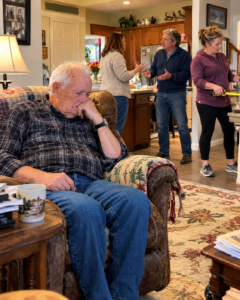
Frank Holloway heard his daughter say it from the kitchen while he sat ten feet away in his favorite chair.
He didn’t move.
He didn’t turn down the television.
He just stared at the family photograph on the mantel and listened to his children divide up a life he was still living.
Frank was 79.
Two weeks earlier, a doctor had given him news serious enough to change the way he looked at calendars.
Nothing was certain, but suddenly every Sunday mattered.
Every morning cup of coffee mattered.
Even the old oak tree outside his California home seemed more important than it had the month before.
Frank had lived in that house for 43 years.
He had bought it when the neighborhood still smelled like fresh lumber and orange blossoms.
His wife, Margaret, had painted the kitchen cabinets twice, raised three children there, hosted Christmas mornings there, and sat beside Frank on the back patio every evening until she died six years earlier.
The house was worth close to $900,000 now.
Frank had never thought much about that.
To him, it was simply home.
But after his diagnosis, his three adult children suddenly started visiting.
His eldest son, Daniel, came twice in one week after barely making it over once every few months.
His daughter, Melissa, started bringing casseroles.
His youngest son, Brian, called every evening.
At first, Frank was deeply touched.
Maybe illness had reminded them that time was short.
Maybe families really did come together when it mattered.
Then one Thursday afternoon, everything changed.
Frank had closed his eyes in the living room while Melissa and Daniel made coffee in the kitchen.
They thought he was asleep.
“The market around here is ridiculous,” Daniel whispered. “If we list it properly, we could probably get more than nine hundred.”
Melissa lowered her voice.
“I’m not selling my share cheap. And I want Mom’s dining set.”
“What about Brian?”
“He already got Dad’s old tools.”
“That was twenty years ago.”
“So?”
Frank kept his eyes closed.
His hands rested on the same worn armrests where Margaret had once placed hers over his during bad news.
Then Melissa said something Frank would remember for the rest of his life.
“I measured the living room yesterday. My sectional would fit perfectly if we took out that old bookshelf.”
Frank opened his eyes after they left.
He looked at the bookshelf.
Margaret had bought it at a yard sale in 1989 for twenty-five dollars.
The bottom shelf still had scratches from toy trucks Daniel used to race across it.
Frank sat there for a long time.
Not angry.
Just strangely empty.
A few days later, Brian came by.
Frank was in the garage when Brian stepped outside to take a phone call.
The window was cracked.
“Yes,” Brian said quietly. “It’s a 1972 pickup. Original body. Dad barely drives it anymore.”
Frank looked toward the truck.
That truck had hauled Christmas trees, Little League equipment, lumber, broken bicycles, camping gear, and once an entire washing machine tied down with rope because Frank refused to pay a delivery fee.
Brian was already finding out what it was worth.
The final blow came the following Tuesday.
Frank walked past the kitchen and saw an email open on Daniel’s laptop.
A realtor.
Daniel had already asked for an estimate on the house.
Frank quietly walked back down the hallway.
That night, he sat alone at the kitchen table.
There were three empty chairs around him.
He remembered Daniel at age nine crying because his bicycle chain had broken.
Melissa at sixteen waiting up for him after her first school dance.
Brian asleep against his shoulder during a fishing trip.
Frank didn’t hate his children.
That almost made it worse.
He loved them.
But somewhere between childhood and middle age, they had begun seeing their father’s life as a collection of assets waiting to become available.
Frank poured himself another cup of coffee.
Then he made a phone call.
Two weeks later, he invited all three children to Sunday dinner.
“Come at five,” he told them.
“I’ve settled everything.”
They all arrived early.
Daniel brought an expensive bottle of wine.
Melissa brought a pie from Frank’s favorite bakery.
Brian polished the old truck before coming inside.
Frank noticed how cheerful everyone seemed.
He had cooked pot roast, mashed potatoes, green beans, and Margaret’s old recipe for biscuits.
For two hours, they almost felt like the family they used to be.
They laughed about childhood vacations.
Melissa remembered the year Frank accidentally burned the Thanksgiving turkey.
Brian told the story about Daniel backing the truck into the mailbox at seventeen.
For a moment, Frank wondered whether he should forget everything he had heard.
Then Melissa glanced around the room and said, almost casually, “You know, with lighter paint, this place would look ten years newer.”
The moment passed.
After dessert, Frank cleared the table.
Then he returned carrying four envelopes.
He placed them in a row.
The room became completely silent.
“I told you I settled everything,” Frank said.
Daniel straightened in his chair.
Melissa folded her hands.
Brian looked at the envelopes.
Frank handed one letter to each child.
“The fourth envelope,” he said, “contains the deed to the house.”
Nobody spoke.
Daniel opened his letter first.
Frank had written only one page.
He reminded Daniel of the years they had spent fixing bicycles and building pinewood derby cars in the garage.
Then he wrote:
*I hope someday you understand that the saddest thing I heard wasn’t that you wanted my house.*
*It was that you were asking a realtor what it was worth while I was still sitting inside it.*
Melissa’s eyes filled as she read hers.
Frank reminded her of the nights Margaret had rocked her in the living room during thunderstorms.
Then:
*You measured the room for new furniture before anyone measured how much time I might have left.*
*I’m not writing this to punish you. I’m writing it because I still have time to tell you something I should have taught you years ago.*
Brian stopped halfway through his letter.
His face changed.
Frank had written about the old truck.
About teaching Brian to drive.
About the fishing trips.
About the afternoon Brian fell asleep in the passenger seat holding a bluegill he refused to throw back.
Then:
*Son, the truck mattered to me because of what happened inside it.*
*Not because of what someone might pay for it.*
Nobody touched the fourth envelope.
Finally Daniel asked, “Who gets the house?”
Frank picked it up.
“The person who was here before there was anything to inherit.”
Melissa looked confused.
Frank opened the envelope.
The name on the paperwork was **Evelyn Carter**.
For several seconds, nobody said anything.
Evelyn was 68.
She lived three houses down.
A retired school cafeteria worker with silver hair, bad knees, and a laugh that could be heard from the sidewalk.
She had been Margaret’s closest friend.
After Margaret died, Evelyn never treated Frank like a lonely old man who needed rescuing.
She simply kept showing up.
Sunday coffee.
Tuesday groceries.
Tomatoes from her garden.
A ride when Frank’s truck wouldn’t start.
A chair beside him in the hospital waiting room.
She had sat with him after his diagnosis while he cried for the first time in years.
And she had never once asked what the house was worth.
“She didn’t want it,” Frank said.
“She argued with me for three days.”
Daniel pushed his chair back.
“Dad, you’re giving a nine-hundred-thousand-dollar house to the neighbor?”
Frank looked at him.
“No.”
His voice was gentle.
“I’m giving my home to a friend.”
Melissa wiped her cheek.
“But we’re your children.”
“I know.”
Frank paused.
“And I love you. That’s why I’m telling you this while I’m still alive instead of leaving you something to fight about after I’m gone.”
Nobody moved.
Frank explained that he had made other arrangements for what he owned.
Nothing extravagant.
Nothing designed to make anyone rich.
His grandchildren would receive help for their futures.
His children would receive personal belongings that carried memories, not price tags.
Daniel would get Frank’s watch.
Melissa would get Margaret’s dining set.
Brian would get the truck.
“But only if,” Frank said, looking at Brian, “you promise to take your own kids fishing in it before you ever think about selling it.”
Brian covered his face.
Then something happened Frank hadn’t expected.
His youngest son began to cry.
Not quietly.
Not politely.
He cried the way little boys cry when they finally understand something too late.
“I’m sorry, Dad.”
Melissa reached across the table for Frank’s hand.
Daniel stared down at his letter for a long time.
Then he whispered, “I don’t know when we became like this.”
Frank squeezed Melissa’s hand.
“I do.”
They looked at him.
“When life got busy, we started measuring everything in dollars, minutes, miles, and inconvenience.”
He looked around the kitchen Margaret had loved.
“And we forgot some things can’t be measured that way.”
They stayed until almost midnight.
Nobody discussed property values again.
Before leaving, Daniel walked through the living room and stopped beside the old bookshelf.
He ran his fingers across the scratches he had made with toy trucks nearly fifty years earlier.
“I remember doing that,” he said.
Frank smiled.
“I remember telling your mother we’d sand it out.”
“You never did.”
“No.”
Frank looked at the scratches.
“Some damage becomes part of the furniture.”
Months later, that Sunday dinner was still what Frank remembered most.
Not because he had taught his children a lesson.
But because, after the envelopes were opened, they finally began acting like his children again.
They visited without checking their watches.
Brian took him fishing in the old truck.
Melissa sat with him on the patio where Margaret used to sit.
Daniel stopped talking about real estate and started asking questions about his father’s childhood.
And Evelyn?
She still came over every Sunday.
She brought coffee.
She complained about Frank’s terrible television choices.
And she never once called the house hers while Frank was living in it.
One afternoon, Frank looked around at the people gathered on his porch and realized something.
He couldn’t control how much time he had left.
But he could decide what his life meant while he was still here.
A home wasn’t four walls and a market price.
An inheritance wasn’t the reward for waiting long enough.
And love wasn’t proven by who arrived when the doctor delivered bad news.
It was proven by who had been showing up all along.
Sometimes the greatest thing a parent leaves behind isn’t property—it’s one last chance to remember what should never have had a price.