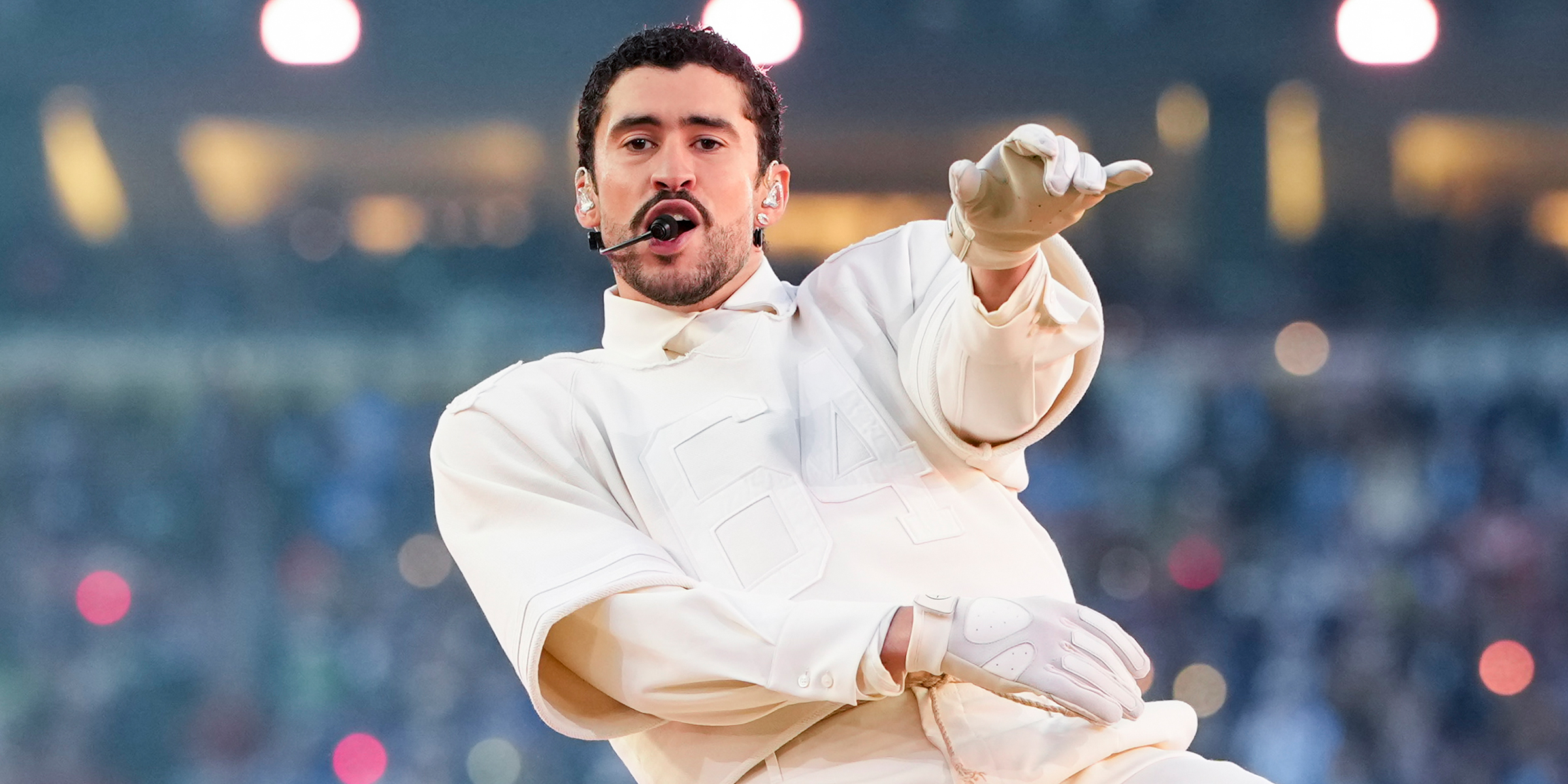
Something felt different the second the lights dimmed, and it wasn’t just the stage’s scale or the crowd’s roar. The clues were subtle, almost hidden in plain sight, daring viewers to keep watching.
By the time the performance ended, fans weren’t just talking about the music. They were dissecting every glance, prop, and gesture from Bad Bunny’s halftime show, one of the most talked-about in recent memory. Bad Bunny is a Puerto Rican rapper and singer.

Bad Bunny performs onstage during the Apple Music Super Bowl LX Halftime Show at Levi’s Stadium in Santa Clara, California on February 8, 2026. | Source: Getty Images
The NFL uploaded the full performance of the Apple Music Super Bowl LX Halftime Show at Levi’s Stadium in Santa Clara, California, on February 8, 2026, to YouTube on February 9, 2026.
The clip quickly surged past 6,977,501 views, with numbers still climbing on their page. From the opening beat, Benito Antonio Martínez Ocasio, professionally known as Bad Bunny, controlled the spectacle with precision, weaving high-energy choreography with cinematic transitions.
The set felt immersive, almost theatrical, hinting that this wasn’t just a concert.

Bad Bunny performs during the Apple Music Super Bowl LX Halftime Show at Levi’s Stadium in Santa Clara, California on February 8, 2026. | Source: Getty Images
Who Everyone Noticed
Early in the show, cameras lingered on a sharply dressed couple woven into the choreography. At first, it looked like a stylized narrative device, the kind halftime shows love to tease.
As the performance progressed, that couple kept reappearing, and the crowd’s curiosity grew. Was this part of the story, or something more real?
When the Stage Became Something Else Entirely
Midway through the set, the answer arrived in the most unexpected way. According to ESPN, the couple was legally married during halftime, surrounded by dancers and lights, with millions of viewers worldwide watching.
The reveal hit harder knowing the backstory. The couple had initially invited Bad Bunny to their wedding, but he flipped the script and gave them the ultimate gift: inviting them to marry during his halftime show.
The Crowd Thought They Had Seen It All
The surprises didn’t stop there. Lady Gaga and Ricky Martin appeared for blink-and-you’ ll-miss-it moments. At the same time, famous guests including Pedro Pascal, Jessica Alba, and influencer Alix Earle gathered inside Bad Bunny’s playful “La Casita” set.

Bad Bunny and Lady Gaga perform onstage during the Apple Music Super Bowl LX Halftime Show in California on February 8, 2026. | Source: Getty Images
Then came a scene that felt almost casual, yet instantly iconic. In the middle of the performance, legendary New York performer Toñita stepped in to serve Bad Bunny a drink onstage.
Spanish journalist Sarah Yáñez-Richards shared the moment on X, writing that this was when the iconic Toñita served a drink to Bad Bunny in the middle of the #Halftime of the #SuperBowlLX.”
A Gesture Sparked a Firestorm
As the show moved toward its finale, another moment quietly sparked intense online speculation. Bad Bunny handed his Grammy Award to a young boy onstage, a gesture many viewers immediately interpreted as symbolic.
Some fans believed the child was Liam Ramos, a 5-year-old who ICE had recently detained in Minneapolis. One viral post questioned whether the emotional exchange carried a deeper meaning.
Symbol or Something More?
Others amplified the claim, suggesting the moment was intentional and deeply political, while additional accounts pushed back. Another post insisted it was not Liam Ramos, but rather a representation of young Benito, meant to convey a “dream big/dreams come true” message.
Raphousetv (RHTV) added to the conversation by reporting that Bad Bunny handed his Grammy to a child resembling his younger self, reinforcing the idea of symbolism over literal identity.
ESPN later clarified, citing a source, that the child was an actor, not Liam Ramos, though the ambiguity had already sparked a wave of emotional reactions across social media.
The Final Message
The show closed with a powerful visual: a billboard reading, “The only thing more powerful than hate is love.” In hindsight, it tied everything together: the wedding, the child, the quiet moments amid the chaos.

The message displayed while Bad Bunny performs during the Super Bowl LX Halftime Show in California on February 8, 2026. | Source: Getty Images
By the final note, Bad Bunny hadn’t just delivered a halftime show. He offered a layered spectacle that invited interpretation, sparked debate, and reminded millions why the world keeps watching until the very last second.
Even before the final notes echoed through the stadium, Bad Bunny’s halftime show had already sparked political reaction, with President Donald Trump weighing in and setting the stage for a wider controversy.
Donald Trump weighed in after Bad Bunny took the Super Bowl halftime stage, unleashing a blistering critique that echoed and escalated his earlier remarks. The president used social media to outline his objections, touching on the performance, the NFL, and media coverage.

President Donald Trump. | Source: Getty Images
Trump Shares Post-Game Criticism
Shortly after the halftime show aired, Trump published a statement on Truth Social describing his reaction to the performance.
“The Super Bowl Halftime Show is absolutely terrible, one of the worst, EVER!” Trump wrote. “It makes no sense, is an affront to the Greatness of America, and doesn’t represent our standards of Success, Creativity, or Excellence.”

President Donald Trump is seen before departing from the White House in Washington, DC, on February 6, 2026. | Source: Getty Images
He also criticized the language and choreography, adding, “Nobody understands a word this guy is saying, and the dancing is disgusting, especially for young children that are watching from throughout the U.S.A., and all over the World.” Trump described the show as “just a ‘slap in the face’ to our Country,” saying there was “nothing inspirational” about it.
Media and NFL Also Targeted
In the same post, Trump predicted that coverage of the performance would still be positive. He claimed it would “get great reviews from the Fake News Media,” adding that they “haven’t got a clue of what is going on in the REAL WORLD.”
He also included criticism unrelated to the halftime show, writing that the NFL should “immediately replace its ridiculous new Kickoff Rule.” The post ended with “MAKE AMERICA GREAT AGAIN!” followed by his signature.
Trump Had Addressed the Halftime Show Earlier
Trump’s comments followed remarks he made weeks earlier about the Super Bowl and its performers. In a January 24, 2026, interview with the New York Post, he said he planned to skip the game entirely.
During the Oval Office interview, Trump specifically criticized the selection of Bad Bunny and Green Day, noting that both acts have been outspoken critics of him. “I’m anti-them. I think it’s a terrible choice. All it does is sow hatred. Terrible,” Trump said, according to the New York Post.
Trump’s post-Super Bowl comments closely aligned with his earlier statements, expanding on concerns he had already raised before the event.
His reaction added to the ongoing discussion surrounding the halftime show, placing his views alongside broader public debate about the performance and the NFL’s entertainment choices.

Performers wave flags from across the Americas during the finale of Bad Bunny’s Super Bowl LX halftime show in Santa Clara, California on February 8, 2026. | Source: Getty Images
In the end, Bad Bunny’s halftime show proved impossible to contain within the stadium or the broadcast window. What began as a musical spectacle evolved into a cultural flashpoint, touching art, symbolism, politics, and identity in ways few Super Bowl performances ever do.
Love it or loathe it, the show did exactly what great pop moments are meant to do, it demanded attention, sparked conversation, and refused to be forgotten.