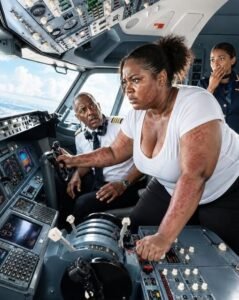
The cockpit smelled like hot electronics and fear.
Captain Thomas Reed had both hands wrapped around the control column so tightly his knuckles were white.
First Officer Jennifer Parker was firing through emergency procedures, one after another, her voice clipped and fast.
Nothing was giving them what they needed.
Outside the windshield, the horizon was tilted so far to the right it looked impossible.
Warning tones overlapped.
Passengers screamed behind me.
And somewhere underneath all of it, I heard something I had not heard in thirty-two years.
My old voice.
Calm.
Cold.
Useful.
I stepped between the seats and said seven words.
“Stop fighting her. Fly her with thrust.”
Reed turned his head.
For a second, he just stared at me.
“What?”
“Differential thrust. Stop chasing dead controls.”
Jennifer looked at me like I was insane.
“Who the hell are you?”
“Sarah Mitchell.”
Nothing.
Then I added:
“Edwards. Flight Test.”
Jennifer’s expression changed.
Captain Reed’s changed more.
He looked at my burned hands.
Then at my face.
“Mitchell?”
There wasn’t time to enjoy the recognition.
The aircraft banked farther.
A water bottle flew across the cockpit.
“Forty-eight degrees right!” Jennifer shouted.
I grabbed the back of Reed’s seat.
“Bring the left engine up slowly.”
“We’re already fast.”
“I know.”
“We’ll overspeed.”
“Not if you trade some of it for control.”
Reed stared at me.
“Captain,” I said, “you already told 187 people they’re going to die. You have nothing left to lose by listening.”
That did it.
His left hand moved to the throttles.
“Left coming up.”
The engine note changed.
Slowly.
Almost imperceptibly at first.
Then the right bank stopped increasing.
Jennifer looked at the attitude display.
“Bank holding forty-seven.”
“Good. Now bring the right back slightly.”
Reed made the adjustment.
The nose trembled.
The aircraft hesitated.
Then—
“Forty-five.”
Nobody celebrated.
“Keep working it.”
“Forty-three.”
Reed whispered:
“My God.”
“Don’t thank God yet.”
I leaned closer.
“Tiny changes. You don’t fly this with your hands anymore. You fly it with patience.”
For thirty-two years, I had tried to forget those words.
My instructor had said them to me before my first experimental propulsion-control test.
Later, I had said them to younger pilots.
And on the worst day of my career, I had screamed them into a radio while an aircraft came apart underneath me.
Now I was saying them again aboard a passenger jet full of people who didn’t even know my name.
Jennifer stared at the hydraulic indications.
“Nothing’s recovering.”
“Then stop expecting recovery.”
“We need a checklist.”
“You need an airplane first.”
She looked at me.
I softened my voice.
“Keep running the checklist. I’m not replacing procedure. I’m giving Reed another control input.”
That mattered.
Whatever movies teach people, nobody walks into a cockpit and magically becomes captain.
Reed was still in command.
Jennifer was still his first officer.
I was simply the only person on board who had spent part of her life asking one particular question:
How do you fly something after the airplane stops behaving like an airplane?
“Thirty-eight degrees,” Jennifer called.
Then thirty-five.
Thirty-two.
Passengers were still screaming, but the violent sideways pull was easing.
Reed looked at me.
“What’s our goal?”
“Wings close to level first. Then we find out what she still gives us.”
“Airport?”
“Later.”
“We don’t have later.”
“We don’t have an airport if you can’t point at one.”
He nodded.
No argument.
That was when I knew why Thomas Reed had survived thirty-eight years in aviation.
Pride vanished when it needed to.
Good pilots don’t need to be the smartest person in the cockpit.
They need to recognize when survival has entered the room.
Jennifer called:
“Twenty-seven degrees.”
The left engine was working harder than the right.
I watched the aircraft respond sluggishly.
Too sluggishly.
But it was responding.
That was life.
“Easy.”
Twenty-two.
Eighteen.
Twelve.
Then Reed overcorrected.
The aircraft started rolling left.
“Don’t chase it!” I snapped.
He froze his hand.
“Right engine up. Small.”
He moved it.
The roll slowed.
Six degrees left.
Four.
Two.
Then roughly level.
For the first time in several minutes, the horizon looked like a horizon again.
No one spoke.
Reed exhaled.
Jennifer closed her eyes for half a second.
Then the radio exploded with ATC.
“Southwest 2891, Portland Center, confirm status.”
Reed reached for the transmitter.
“Portland Center, Southwest 2891. We have partial directional response using differential thrust.”
There was silence on the frequency.
Then:
“Southwest 2891, say again.”
Reed looked at me.
I almost smiled.
“I know that reaction.”
He transmitted again.
“We are controlling bank with asymmetric engine thrust.”
ATC came back immediately.
“Southwest 2891, roger. Nearest suitable airports available. State intentions.”
Jennifer pulled up navigation data.
“Portland is about sixty miles northwest.”
I looked at the weather.
Not ideal.
“Anything longer?”
“Portland’s good.”
“Terrain?”
“Manageable from here.”
Reed looked at me.
“Portland?”
I stared at the instruments.
The airplane was still descending.
Not catastrophically.
But steadily.
And controlling heading was one thing.
Landing was another.
To land, we would eventually have to control speed, descent rate, alignment, and flare.
With an airplane that had already shown us it could turn into a falling piece of metal if we asked too much of it.
“Portland,” I said.
Reed keyed the radio.
“Portland Center, 2891 requests vectors Portland. Emergency equipment standing by.”
The controller answered almost instantly.
“Southwest 2891, understood. Portland is preparing all runways and emergency response.”
Then came the part I hated.
Turning.
We were not pointed directly at Portland.
To get there, we had to change heading.
Reed looked at me.
“How much left thrust?”
“Barely enough to start the turn.”
Jennifer read our altitude.
“Thirty thousand eight hundred.”
Plenty of sky.
Very little margin.
“Let’s see if she’ll listen.”
Reed reduced thrust slightly on the left.
Increased slightly on the right.
The jet began a slow left bank.
Three degrees.
Five.
Eight.
I watched the trend.
“Hold there.”
The heading crawled.
One degree.
Then another.
Then another.
It was agonizing.
Like steering a ship with two hair dryers.
But we were turning.
Behind us, the cockpit phone chimed.
Jennifer answered.
“Flight deck.”
Her expression changed while she listened.
“What?”
Reed glanced over.
She covered the receiver.
“Passenger medical emergency. Row twenty-seven. Possible heart attack.”
For one second, nobody spoke.
Of course.
Because apparently falling out of the sky wasn’t enough.
“Tell them to use any medical personnel onboard,” Reed said.
Jennifer relayed it.
Then she listened again.
Her face changed.
“There are injuries too. People hit by service carts during the bank.”
I looked toward the cockpit door.
One hundred eighty-seven people.
Every one of them had a story.
Someone was going home to a child.
Someone had just gotten engaged.
Someone was flying to a funeral.
Someone had probably spent the entire morning complaining about a middle seat.
And now every person behind that door had heard their captain apologize because he believed he was about to die.
I thought about Emily.
Seattle.
Her wedding invitation folded inside my handbag.
I had read it maybe fifty times.
Mom, if you’re willing to come, I’d like you there.
Not I forgive you.
Not I was wrong.
Not I love you.
Just:
I’d like you there.
After fifteen years, that was enough.
Now I might die sixty miles from getting another chance.
Something inside me hardened.
Not today.
“What’s our heading?”
Jennifer called it.
“Keep turning.”
Reed watched me.
“You’ve really done this before?”
“Not in a 737.”
“That doesn’t make me feel better.”
“It shouldn’t.”
Despite everything, he laughed.
One short laugh.
Then I said:
“The aircraft I flew lost primary flight controls during a propulsion-control test. We learned that engines aren’t just for speed. With enough altitude and enough patience, unequal thrust gives you some directional authority.”
Jennifer looked at my hands again.
“The scars?”
I didn’t answer.
She understood.
Then ATC came back.
“Southwest 2891, Portland emergency operations requests souls and fuel.”
Jennifer gave them the numbers.
One hundred eighty-seven souls.
That word always sounds different when you’re one of them.
We descended through twenty-seven thousand feet.
Then twenty-five.
The aircraft was still responding.
Barely.
But something bothered me.
The failure pattern.
Complete hydraulic loss doesn’t just happen because fate has a bad afternoon.
Redundancy exists for a reason.
Multiple independent failures meant either we had suffered a catastrophic common cause—
or something upstream had compromised more than one system.
Jennifer must have been thinking it too.
She whispered:
“The maintenance release was clean.”
“When?”
“Two weeks ago major hydraulic inspection. Minor line replacement yesterday.”
I turned toward her.
“Yesterday?”
“Yes.”
“Which line?”
She pulled up the electronic log.
Her face tightened.
“System B pressure return line.”
“Contractor or company maintenance?”
“Contractor at Vegas.”
Captain Reed looked at us.
“What are you thinking?”
“Nothing useful before we’re on the ground.”
That wasn’t entirely true.
But I had learned the hard way what happens when pilots start solving mysteries before they finish flying airplanes.
“Altitude twenty-two thousand.”
Portland was getting closer.
So was the ground.
The controller gave us a wide approach corridor.
Every other aircraft had been cleared away.
The sky belonged to us.
I almost laughed at the irony.
Thirty-two years ago, the Air Force had spent millions creating enormous restricted test ranges where I could break airplanes without killing civilians.
Now the most important test flight of my life was happening in an airliner carrying families, retirees, children, business travelers, and one terrified captain who had never expected a passenger in row fourteen to become part of his crew.
At fifteen thousand feet, the real problem began.
Landing configuration.
Reed said it first.
“We have to get gear down.”
Jennifer nodded.
“Alternate extension should be available.”
“Do it late,” I said.
Reed looked at me.
“Why?”
“Drag.”
He understood immediately.
The landing gear would stabilize some things.
It would also dramatically change everything we had spent the last twenty minutes learning.
More drag.
Different yaw.
Different thrust required.
No guarantee we could compensate.
“Ten thousand feet,” Jennifer announced.
Portland appeared through scattered cloud ahead.
Small.
Gray.
Beautiful.
I had seen runways thousands of times from cockpits.
None ever looked like that.
Reed came over the intercom again.
His voice wasn’t trembling anymore.
“Ladies and gentlemen, Captain Reed. We have regained limited control of the aircraft. We are attempting an emergency landing at Portland International Airport.”
Silence behind the door.
He continued:
“I need everyone seated, restrained, and following our flight attendants exactly. We are not safe yet.”
Then he paused.
“And I owe you an apology for what I said earlier.”
I looked at him.
He swallowed.
“I believed we had lost the aircraft.”
Another pause.
“We haven’t.”
I don’t know what happened in the cabin when people heard that.
Later, passengers told reporters they cried harder at those two words than when Reed told them we were going to die.
We haven’t.
At eight thousand feet, ATC cleared us toward the longest runway.
Emergency vehicles were already lining taxiways.
Fire engines.
Ambulances.
Police.
I could see flashing lights from miles away.
Jennifer called:
“Seven miles.”
“Gear.”
Reed nodded.
Jennifer initiated alternate extension.
Seconds later, we heard the mechanical sequence.
Then three green indications.
The aircraft immediately changed.
Nose movement.
Drag.
A slight right yaw.
Reed reacted.
“She’s rolling.”
“I see it. Left thrust.”
“Adding.”
“Not that much.”
“Coming back.”
“Hold.”
The bank reached eleven degrees.
Then twelve.
The runway moved right in the windshield.
Jennifer called:
“Six miles.”
“We’re losing centerline.”
Reed whispered:
“I can’t bring her back.”
“Yes, you can.”
“I don’t have enough authority.”
“Use time.”
“We don’t have time!”
I grabbed his shoulder.
“Thomas.”
He looked at me.
“You cannot bully a damaged airplane.”
His breathing slowed.
“Ask.”
That had been my rule at Edwards.
Don’t command the broken machine.
Ask it a question.
Give it an input.
Wait.
See what remains possible.
Reed made the smallest thrust change of the entire flight.
We waited.
Three seconds.
Nothing.
Four.
Then the nose began inching back.
Jennifer whispered:
“That’s it.”
The runway moved toward us.
Five miles.
Altitude 3,200 feet.
Too high.
We needed descent.
Reducing both engines would increase descent—but it would also reduce the only control authority keeping us aligned.
This was the trap.
I had faced something similar thirty-two years earlier.
And this was where people later turned my story into a miracle.
It wasn’t.
Miracles are clean.
This was ugly mathematics mixed with fear.
“Reduce both together,” I said.
Reed eased the thrust back.
Our descent steepened.
“Keep differential.”
“Trying.”
“Don’t try. Watch.”
Jennifer called speed.
Then altitude.
Then runway distance.
Four miles.
The jet wandered left.
Right engine adjustment.
Back.
Three miles.
Too fast.
We needed more drag.
But we couldn’t afford abrupt changes.
“Speed brakes?” Reed asked.
“No.”
He nodded.
He had reached the same conclusion.
Anything that disturbed what little equilibrium we’d built could finish us.
Two miles.
The runway filled the windshield.
Jennifer’s voice became mechanical.
“One thousand five hundred.”
I remembered my first solo.
My first supersonic flight.
My first flameout.
The day Emily was born.
The Wraith.
The ejection handle.
Fire.
Hospital lights.
A colonel standing over my bed telling me two people were dead.
A board of officers asking why I failed to disclose a control anomaly.
Me screaming that I had disclosed it.
Reports disappearing.
Signatures changing.
My daughter growing up believing her mother had killed two people because she was reckless.
Thirty-two years of silence.
And now—
“One thousand.”
Reed looked at me.
“How do we flare?”
That was the question.
Directional control with thrust was possible.
A normal flare was another matter.
“We don’t chase a normal landing.”
Jennifer stared.
“What?”
“We accept hard.”
Reed understood.
“Better a hard runway impact than a stall trying to make it pretty.”
“Yes.”
Five hundred feet.
The runway was slightly right.
“Right engine.”
Reed adjusted.
Four hundred.
“Hold.”
Three hundred.
We drifted left.
“Left engine.”
Two hundred.
The aircraft corrected.
Too much.
“Back.”
One hundred.
Jennifer called:
“Sink rate.”
I looked at Reed.
“Both engines. Small increase.”
He added power.
The descent softened slightly.
Fifty.
Thirty.
Twenty.
“Don’t force the nose.”
Ten.
The main landing gear slammed into the runway hard enough to throw me against the seatbacks.
A roar exploded through the cabin.
People screamed.
Something crashed behind us.
The aircraft bounced.
“POWER!” I shouted.
Reed adjusted.
We came down again.
Harder.
This time we stayed.
“Keep her straight!”
Differential thrust.
Tiny changes.
The runway raced beneath us.
Reed couldn’t use the airplane the way he’d used one for thirty-eight years.
So we kept doing what had worked in the sky.
Ask.
Wait.
Correct.
The jet drifted toward the right edge.
Left thrust.
Back.
Speed falling.
Emergency vehicles waiting.
Six thousand feet remaining.
Four thousand.
Three.
The aircraft finally slowed enough that the remaining systems and mechanical capability gave Reed more options.
He fought it.
Jennifer worked beside him.
I stood behind them gripping both seats.
Two thousand feet.
Then—
we stopped.
Not elegantly.
Not centered perfectly.
But on pavement.
Alive.
For several seconds, nobody moved.
No cheering.
No screaming.
Nothing.
The three of us listened to engines winding down.
Captain Thomas Reed stared through the windshield.
Then put his forehead against the control column.
Jennifer covered her mouth.
I looked at my hands.
They were shaking.
Badly.
The cockpit phone rang.
Nobody answered.
Then the cabin erupted.
One hundred eighty-seven people screaming.
Crying.
Cheering.
The sound came through the reinforced cockpit door like a stadium had exploded behind us.
Reed looked at me.
Tears were running down his face.
“Who the hell are you?”
I gave him the answer I should have been proud enough to give thirty-two years earlier.
“Lieutenant Colonel Sarah Mitchell.”
His face changed.
“Phoenix.”
I nodded.
He stared.
“My father was at Edwards.”
That surprised me.
“What?”
“Major Charles Reed. Flight systems.”
I knew the name.
Barely.
Then Thomas Reed said something that stopped me colder than the hydraulic failure had.
“My father always said you didn’t cause the Wraith crash.”
I couldn’t speak.
“He said the investigation was fixed.”
Jennifer slowly turned toward him.
Reed continued.
“He kept copies.”
My legs nearly gave out.
“Copies of what?”
“Engineering reports.”
I stared at him.
“My father died eleven years ago. His files are in storage.”
Thirty-two years.
Thirty-two years I had lived under a lie.
And the man whose airplane I had just helped bring home was the son of someone who might have proof.
Before I could answer, someone pounded on the cockpit door.
Airport rescue.
We evacuated.
The second I stepped out, passengers started clapping.
I hated it.
Not because I wasn’t grateful.
Because I knew how quickly survival becomes mythology.
People reached for me.
Cried.
One woman grabbed my hand and kissed it.
A teenage boy shouted:
“She saved us!”
“No,” I said.
“Your pilots did.”
Captain Reed heard me.
He shook his head.
“We all did.”
Outside, the air smelled like rubber, fuel, and rain.
Emergency crews surrounded the aircraft.
Medics rushed injured passengers toward ambulances.
Federal investigators were already arriving.
And then I saw her.
Beyond the emergency vehicles.
Standing behind a security barrier.
Emily.
My daughter.
For a second, I didn’t recognize her.
Fifteen years is a long time.
She was forty now.
Brown hair shorter than I remembered.
Wedding ring not yet on her hand.
White sweater.
Tears streaming down her face.
My bag had contained her wedding invitation.
Apparently the passenger manifest had contained my name.
And when the news reported the flight emergency, she’d driven from Seattle before anyone could stop her, later transferring with family arrangements after the diversion.
None of that mattered.
She was there.
“Mom?”
I stopped.
That word.
I had imagined hearing it again so many times that the real thing felt quieter than memory.
Emily ran toward me.
Security tried to stop her.
Someone waved them away.
Then my daughter hit my chest so hard I stumbled backward.
Her arms wrapped around me.
And I broke.
Completely.
The woman who had just stood in a failing cockpit couldn’t stand upright when her daughter hugged her.
“I thought you were dead,” Emily sobbed.
I held her face.
“So did I.”
“I watched the coverage. They said the plane had no control.”
“We got lucky.”
She shook her head.
“You always say that.”
I stared at her.
She was crying and smiling at once.
“I read everything, Mom.”
I knew what she meant.
The Wraith reports.
The ones she’d found months earlier.
“The original test memos,” she continued. “You warned them.”
My throat closed.
“I know.”
“I didn’t.”
Those two words hurt.
She grabbed my hands.
“I believed them.”
“Emily—”
“I believed what they said about you.”
“You were a kid.”
“I was twenty-five when I stopped speaking to you.”
“You were hurt.”
“I was cruel.”
“No.”
“Yes.”
I pulled her against me again.
“Not today.”
She cried into my shoulder.
“I’m sorry.”
Thirty-two years of anger.
Fifteen years of silence.
And somehow, on a wet runway in Portland beside an aircraft that should never have needed saving, I finally heard the words I had stopped expecting.
Then someone behind me said:
“Colonel Mitchell?”
I turned.
Three people were approaching.
FAA investigators.
One introduced himself.
“Ma’am, we need to speak with you about what happened onboard.”
“Captain Reed is the pilot in command.”
“We’ll speak with him too.”
His expression was strange.
Not celebratory.
Serious.
“There’s something else.”
I looked at him.
“What?”
“Maintenance personnel have started examining the aircraft.”
My stomach tightened.
“And?”
He lowered his voice.
“The hydraulic failure may not have been accidental.”
Emily stopped crying.
I stared at him.
“What did you find?”
“We’re not ready to make a determination.”
“Then why are you telling me?”
He looked toward the aircraft.
“Because preliminary evidence suggests components connected to more than one hydraulic circuit were tampered with.”
Silence.
Captain Reed had walked close enough to hear.
His face drained.
“Tampered?”
The investigator nodded carefully.
“We’re preserving the aircraft as a potential crime scene.”
Jennifer whispered:
“Sabotage?”
“No conclusions yet.”
But the word was already hanging there.
Sabotage.
I looked back at the 737.
Then something occurred to me.
“Passenger manifest.”
The investigator frowned.
“What about it?”
“Was it public before departure?”
“No.”
“Crew list?”
“Limited access.”
“Maintenance had access?”
He didn’t answer.
I looked at Emily.
Then at Reed.
Then at the airplane.
Thirty-two years earlier, engineers had concealed a known failure on the Wraith because billions of dollars were at stake.
Now, on the first flight I had taken in decades, multiple hydraulic systems had failed under suspicious circumstances.
Maybe coincidence.
I had spent enough of my life around intelligence officers and test programs to know coincidence exists.
But I also knew when coincidence deserved to be interrogated.
The investigator’s phone rang.
He walked several yards away to answer it.
Then stopped.
Turned toward me.
His expression had changed.
He came back slowly.
“Colonel Mitchell.”
“What?”
“You said your call sign was Phoenix?”
I felt Emily’s hand tighten around mine.
“Yes.”
The investigator held up an evidence photograph on his phone.
A maintenance access panel had been opened beneath the aircraft.
Inside, investigators had found a small strip of red tape attached beside one compromised component.
Someone had written one word on it with black marker.
PHOENIX.
My entire body went cold.
Captain Reed whispered:
“Sarah…”
But I wasn’t listening anymore.
Because suddenly Flight 2891 didn’t feel like an accident I happened to survive.
It felt like a message.
Someone knew I was on that plane.
Someone knew what happened to me at Edwards.
Someone knew the name I had not used in thirty-two years.
And whoever sabotaged that aircraft had expected 187 people to die just to prove one thing:
Phoenix could not bring this one home.
They were wrong.
My phone vibrated inside my pocket.
Unknown number.
One text message.
I opened it.
There was no greeting.
No signature.
Just nine words:
YOU SHOULD HAVE STAYED DEAD AFTER THE WRAITH, PHOENIX.
Emily saw my face.
“Mom?”
I couldn’t answer.
Then a second message appeared.
This one contained a photograph.
Taken less than ten minutes earlier.
Emily and me hugging on the runway.
From somewhere nearby.
Someone was watching us.
And beneath the photograph were four words:
PART 3: The FAA treats Flight 2891 as possible sabotage, Captain Reed gives me the files his father hid for three decades, and I finally learn who buried the truth about the Wraith crash. But the worst discovery comes from the passenger manifest—because someone aboard Flight 2891 booked a ticket under the name of a man who officially died 32 years ago.
Disclaimer: This story is fictional and created for entertainment purposes only. Any names, characters, places, or events are fictitious or used fictitiously. No real person or organization is intended to be portrayed.