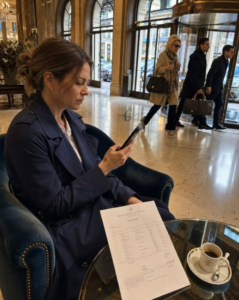
THE BILL MY MOTHER LEFT ME IN PARIS
My mother’s message appeared on my phone while I was standing beneath a chandelier in one of the most expensive hotel lobbies in Paris.
“Have fun paying the bill, Genevieve. Maybe the hotel can teach you some respect.”
A second message arrived before I had finished reading the first.
“Walk home.”
For several seconds, I simply stared at the screen.
Around me, luggage wheels whispered across polished marble. A bellman pushed a brass cart toward the revolving doors. Somewhere behind the front desk, a printer began feeding out a receipt. Outside, black cars eased through the morning traffic while tourists stopped beneath the awning to photograph the pale stone buildings across the boulevard.
My mother had canceled my ticket home.
She had left me with the hotel charges.
And she believed she had finally taught me who held the power in our family.
I slipped my phone into my coat pocket, walked to a velvet chair near the windows, and sat down.
Then I laughed.
Not loudly. Not dramatically.
Just one quiet breath of disbelief that turned into something colder and clearer.
My mother had spent ten years making sure I understood that she considered me replaceable.
The mistake she had never bothered to understand was that almost nothing supporting her lifestyle was replaceable without me.
My name is Genevieve Laurent. I was thirty-five that morning, and for nearly a decade I had been the invisible backbone of Heritage Supply Chain, the company my father had built from one rented warehouse into one of the strongest regional logistics businesses in the Midwest.
On paper, my mother was president.
Sterling, her second husband, carried the title of executive vice president.
His son, Desmond, had been given a vice president title before he could explain the difference between gross revenue and operating income.
And me?
I worked from a basement office without windows.
That was the arrangement my mother preferred.
She liked the organization chart to reflect the family hierarchy she had constructed after my father died: Sterling beside her, Desmond just below them, and me somewhere far enough down the page that nobody would mistake me for important.
The people who actually kept Heritage running knew differently.
Truck dispatchers called me when a winter storm shut down interstate routes.
Warehouse managers called me when inventory numbers stopped making sense.
Our largest vendors called me before they called anyone else because they knew I answered.
Bank representatives sent documents to me.
Insurance brokers copied me.
Accountants asked for my approval.
When contracts became complicated or a client threatened to leave, the problem eventually landed on my desk.
My mother never seemed to notice the pattern.
Or perhaps she noticed and decided acknowledging it would cost her something she valued more than money.
Control.
My father, August Laurent, had never cared much about titles.
He cared about whether something worked.
When I was ten, he started taking me to the warehouse on Saturday mornings. He would buy me a cinnamon roll from a bakery near our house, then drive us across town in his old pickup while explaining whatever problem was waiting for him.
A delayed shipment.
A supplier dispute.
A customer who wanted thirty-day terms but had a history of paying in sixty.
By thirteen, I could read a basic ledger.
By sixteen, I understood why cash flow could matter more than profit on paper.
By nineteen, I was spending college breaks negotiating carrier rates at a folding table in the back of the warehouse while Dad listened without interrupting.
“You don’t have to be the loudest person in the room,” he told me once. “You just have to understand the room better than everybody else.”
That sentence stayed with me long after almost everything else changed.
My father died when I was twenty-five.
One morning, he was drinking coffee at our kitchen island and complaining that a vendor in St. Louis had sent the wrong pallet dimensions.
By that evening, he was gone.
The suddenness divided my life cleanly into before and after.
In the weeks that followed, I discovered how quickly grief becomes administration.
There were signatures to collect, insurance forms to complete, attorneys to meet, clients to reassure, and employees who needed to know whether their paychecks would still arrive on Friday.
I assumed my mother and I would face it together.
Instead, Beatrice Laurent became someone I barely recognized.
At first, I told myself she was grieving differently.
She started buying clothes that looked more appropriate for charity galas than warehouse visits. She hired a public-relations consultant. She renovated the executive floor even though Dad had always said offices should be functional, not impressive.
Then Sterling appeared.
He was charming in a way that required an audience.
He remembered waiters’ names when other people were watching. He sent expensive flowers. He spoke in confident sentences about markets he had never worked in and industries he understood mostly from magazine articles.
My mother loved being beside him.
Within a year, they were married.
Sterling’s son, Desmond, joined Heritage three weeks after the honeymoon.
His first morning, he arrived at 10:40 wearing loafers that probably cost more than the forklift operator’s monthly rent.
By noon, my mother had announced that he would become vice president of strategic development.
I remember looking down at the printed announcement in my hand and reading the title twice.
Desmond had no logistics experience.
No finance background.
No management record.
He had spent the previous few years moving between vague consulting projects and social circles where people seemed to know more about golf resorts than payroll.
Still, my mother gave him a salary of two hundred thousand dollars a year.
My office changed the same week.
Dad’s old corner office had remained empty after his death. He had always told me that when I was ready, the room would be mine.
Instead, my mother gave it to Desmond.
My belongings were boxed while I was at a vendor meeting.
When I returned, an assistant told me my new workspace was downstairs.
The basement room had gray carpet, fluorescent lights, two filing cabinets, and no windows.
My mother stood in the doorway while I unpacked.
“Don’t be dramatic,” she said. “You always said you care more about the work than appearances.”
I looked at the framed photograph of Dad I had just placed beside my computer.
“I do.”
“Good. Then this shouldn’t bother you.”
That became the pattern.
Every insult was presented as proof of my supposed weakness if I acknowledged it.
Sterling snapped his fingers when he wanted coffee during meetings and smiled afterward as though it were a joke.
Desmond commented on my clothes.
“You dress like an accountant attending a weather emergency,” he told me once.
I was wearing navy slacks, a white blouse, and flats because I had spent the morning walking through a distribution center.
My mother laughed.
I did not.
When Desmond forgot to renew a vendor agreement, I fixed it.
When Sterling promised delivery terms our warehouses could not meet, I renegotiated them.
When my mother approved expensive corporate events without checking cash projections, I rearranged payment schedules so payroll would remain untouched.
Every time they created a problem, I quietly removed it.
I told myself I was protecting my father’s company.
For years, that explanation was enough.
The irony was that my mother’s dependence on me grew in direct proportion to the disrespect she showed me.
Four years before Paris, Heritage expanded into international sourcing.
The growth required new credit facilities, foreign vendor accounts, insurance guarantees, and banking permissions.
The documents arrived in thick folders.
My mother hated them.
One Thursday afternoon, she carried an entire stack into my basement office and dropped it onto my desk.
“I’m leaving tomorrow,” she said.
“For what?”
“The spa weekend in Scottsdale. Sterling booked it months ago.”
I looked at the folders.
“Our lender needs these finalized before Monday.”
“Exactly.”
She smiled as though we had reached the same obvious conclusion.
“You handle it.”
“There are authorization documents in here.”
“So?”
“Some of them designate who controls account access.”
She waved one manicured hand.
“Genevieve, I cannot spend three hours reading banking language. That is why you work here.”
I remember watching her sign the pages I flagged.
She barely looked down.
The documents appointed me primary financial administrator for several of Heritage’s major corporate accounts. Additional agreements placed me as the controlling guarantor on credit facilities because the lenders required an officer with continuous operational oversight.
My mother signed.
Sterling signed.
The board approved the structure because I was the only executive who could answer every operational question the banks asked.
Nobody celebrated the change.
Nobody even mentioned it afterward.
That was exactly how my family liked power when it belonged to me.
Invisible.
Over the next four years, the authority expanded.
I approved international transfer access.
I managed corporate card permissions.
I coordinated lender reporting.
I reviewed vendor payment thresholds.
If Heritage was a body, my mother controlled the smile it showed the world.
I controlled the heartbeat.
She never read enough paperwork to understand that distinction.
Paris began as one of her ideas.
Heritage had been invited to an international supply-chain conference, and there were legitimate reasons for someone from the company to attend.
My mother decided four people were necessary.
Herself.
Sterling.
Desmond.
And me.
The business conference lasted three days.
Our trip lasted seven.
I knew what the week would become the moment I received the itinerary.
Designer appointments.
Private sightseeing.
Long lunches.
A luxury hotel near the center of the city.
Sterling had arranged upgraded suites for himself and my mother. Desmond had booked another premium room. I received a standard room several floors below them, which suited me perfectly because I planned to work.
The conference itself went well.
I met two European suppliers, resolved a packaging dispute with a Dutch distributor, and negotiated preliminary terms that could save Heritage nearly eight percent on one of our most expensive import categories.
My mother attended the opening reception.
She skipped almost everything else.
By the fourth day, I was back in my hotel room answering messages from home while she and Sterling spent the afternoon shopping.
Desmond returned near midnight and left three expense receipts under my door.
One was from a restaurant.
One was from a boutique.
The third was for wine.
I placed them beside my laptop without entering them.
Something about the totals bothered me.
Not because they were large. I had seen large expenses before.
Because they fit a pattern I had been quietly documenting for six months.
Unusual reimbursements.
Vague vendor descriptions.
Personal purchases placed under corporate travel categories.
Amounts that individually seemed annoying but collectively suggested something much bigger.
That was why Mr. Harrison, Heritage’s outside corporate attorney, already knew I had concerns.
It was also why an independent accounting firm had begun reviewing several archived accounts without my family’s knowledge.
I had not launched an accusation.
I had asked a question.
Where was the money going?
The answer was still incomplete when we reached our final morning in Paris.
The hotel lobby smelled faintly of coffee and polished wood. Sunlight spilled through tall windows and turned the marble floor almost white.
I came downstairs carrying my laptop bag and one suitcase.
My mother was dressed for travel in cream trousers, a silk scarf, and oversized sunglasses.
Sterling was complaining about luggage.
Desmond had purchased enough clothing to require several additional bags.
Near the doors sat a large leather trunk he had bought two days earlier.
When he saw me, he pointed at it.
“Genevieve. Take that to the car.”
I stopped.
A hotel employee standing nearby glanced between us.
Desmond was already looking at his phone.
“I said take the trunk to the car.”
For ten years, I had answered commands like that with silence.
Not because I was weak.
Because every argument seemed smaller than the company I was trying to protect.
But something had changed during that week.
Maybe it was watching my mother toast Sterling at dinner with champagne charged to a business my father had built one invoice at a time.
Maybe it was the expense receipts under my hotel door.
Maybe it was simply exhaustion.
I looked at the trunk.
Then I looked at Desmond.
“No.”
His thumb stopped moving across his phone.
“What?”
“I said no.”
Sterling turned.
My mother lowered her sunglasses.
Desmond gave a small laugh.
“Very funny.”
“I’m not joking. Carry your own luggage.”
The hotel lobby suddenly felt quieter even though nothing around us had changed.
Sterling walked toward me.
“What exactly is your problem this morning?”
“I don’t have one.”
“You’ve had an attitude all week.”
“I’ve been working all week.”
My mother stepped between us.
“Genevieve, enough.”
I looked at her.
She lowered her voice.
“You are embarrassing me.”
That sentence nearly made me smile.
Not hurting me.
Not misunderstanding me.
Embarrassing her.
“I’m going to the airport,” I said. “I’ll see you there.”
Desmond nudged the trunk toward me with his shoe.
“Not before you take that.”
I stepped around it.
My mother reached for my arm, then stopped when she noticed two hotel guests watching.
Her expression changed immediately.
She smiled.
The smile was for them.
Her words were for me.
“You will do what you are asked.”
“No.”
The smile disappeared.
For a moment, I saw the same woman who had moved me into the basement, laughed when Desmond mocked me, and told herself that my patience was proof I would never leave.
“Fine,” she said.
The word came out soft.
Dangerously soft.
“You want independence? Have it.”
She turned toward Sterling.
“Let’s go.”
The three of them walked out.
Desmond left the trunk.
A bellman hurried after them.
Through the windows, I watched them climb into a waiting black SUV.
My mother never looked back.
I thought she was staging another punishment.
Perhaps she expected me to find a taxi and apologize at the airport.
I had seen versions of that behavior for years.
Create discomfort.
Wait for me to repair it.
Then call the repair evidence that she had been right all along.
I walked to the front desk.
“I’d like to check out, please.”
The clerk smiled professionally.
“Of course, Ms. Laurent.”
She began typing.
My phone buzzed.
The notification was from the airline.
My reservation had been changed.
I opened the message and stared.
My first-class return ticket had been canceled.
Before I could process that, another notification appeared.
My mother’s text.
“Have fun paying the bill, Genevieve. Maybe the hotel can teach you some respect.”
Then:
“Walk home.”
The clerk looked up.
“Ms. Laurent?”
“I’m sorry?”
“There is a remaining balance associated with the rooms under the company reservation.”
She turned the screen slightly.
The total was more than twenty-five thousand dollars.
Suites.
Dining charges.
Spa appointments.
Transportation.
Several items from the rooms.
I read the total twice.
My mother had not only canceled my flight.
She had deliberately left the consolidated hotel balance attached to the account she knew I administered.
Ten years earlier, that might have frightened me.
Five years earlier, I might have called her.
Even one year earlier, I probably would have fixed everything quietly, booked another flight, returned to the basement, and convinced myself the company mattered more than my dignity.
Instead, I asked the clerk one question.
“May I have fifteen minutes?”
“Certainly.”
I walked toward the velvet chairs near the windows.
A server passed carrying espresso cups.
I ordered one.
Then I opened my tablet.
The corporate banking dashboard loaded beneath my fingerprint.
Heritage’s primary card account appeared first.
My mother’s card.
Sterling’s.
Desmond’s.
Mine.
For a long moment, my finger hovered over the screen.
I thought about Dad.
Not the polished photograph on my desk.
The real man.
Sleeves rolled to his elbows.
Pencil behind one ear.
Eating vending-machine pretzels at six in the evening because a shipment had arrived late.
He had spent thirty years building something stable.
My mother had spent ten years confusing stability with permission.
I opened the account controls.
Temporary suspension.
Secondary-user access.
International spending.
Travel permissions.
I read each option carefully.
Then I began.
First, I froze the primary corporate card account pending an internal expense review.
Second, I disabled all secondary card access except my own.
Third, I reduced discretionary travel permissions to zero.
Fourth, I placed additional approval requirements on international transfers.
Nothing I did touched payroll.
Nothing interfered with warehouse operations.
No vendor payments were interrupted.
The company could function.
Their lifestyle could not.
My espresso arrived.
I took one sip.
Then I opened my mother’s text.
I typed three words.
“Check your bank.”
I set the phone face down.
The first call came less than four minutes later.
I ignored it.
Then Sterling called.
Then Desmond.
Then my mother again.
Messages started arriving.
CARD IS NOT WORKING.
CALL ME.
WHAT DID YOU DO?
GENEVIEVE ANSWER THE PHONE.
FIX THIS NOW.
I watched the screen light up and go dark.
Light up.
Go dark.
For perhaps the first time since my father died, I did not feel responsible for solving their emergency.
The feeling was so unfamiliar that I almost mistook it for guilt.
It was not guilt.
It was space.
My mother called again.
I answered.
“Hello?”
“Genevieve.”
Her voice was low and controlled.
That meant people were nearby.
“What did you do to the corporate cards?”
“I restricted them.”
“Why?”
“You left me in Paris.”
A pause.
“That has nothing to do with business.”
“You used company travel funds to punish me personally.”
“I canceled your ticket because your behavior was unacceptable.”
“And now the discretionary travel account is unavailable because your behavior requires review.”
Her voice sharpened.
“We are standing at the airline counter.”
“I assumed so.”
“Desmond has baggage charges.”
“Then Desmond can pay them.”
There was another pause.
Longer this time.
“Unlock the cards.”
“No.”
I heard Sterling in the background.
Then his voice came closer.
“Give me the phone.”
A moment later he was speaking.
“Genevieve, stop this nonsense.”
“I’m not interested in arguing.”
“You work for us.”
“I work for Heritage.”
“I am executive vice president.”
“And I am the primary financial administrator on the accounts you are trying to use.”
“That can be changed.”
“Eventually. Through the proper board process.”
Silence.
I could almost hear him remembering paperwork he had signed without reading.
“You wouldn’t dare take this further.”
I looked across the hotel lobby at the front desk.
“Sterling, six months ago I began reviewing irregular corporate expenses.”
Another silence.
This one felt different.
I continued.
“The review is not finished.”
“What are you talking about?”
“You’ll receive everything in writing.”
My mother came back onto the line.
“Genevieve, do not do something you will regret.”
I stared at the espresso cup in my hand.
For years, every boundary I tried to establish had been described as an act I would regret.
“No, Mom,” I said quietly. “I think I’m finally done doing things I regret.”
I ended the call.
Then I blocked all three numbers for the rest of the day.
The hotel balance remained.
I paid it from my personal savings.
That decision hurt, but not for the reason my mother had intended.
Twenty-five thousand dollars represented years of discipline.
I had lived below my means while Desmond bought watches.
I had invested carefully while my mother replaced cars.
I had built private savings because some part of me had always understood that depending entirely on Heritage meant depending on people who did not respect me.
As the clerk handed me the receipt, I folded it once and placed it inside my briefcase.
Another piece of paper.
Another record.
Another thing my mother had assumed would disappear because I was the person expected to clean everything up.
It would not disappear this time.
I booked myself onto a later flight through an executive aviation service that had a seat available on a shared transatlantic route.
It was expensive.
I paid personally.
By late afternoon, I was sitting near a window with my laptop open and Paris fading beneath a layer of pale cloud.
I connected to the onboard network.
Then I sent Mr. Harrison a message.
I am ready.
His reply came almost immediately.
Are you certain?
I looked at the receipt from the hotel.
Then at the screenshots I had taken of my mother’s messages.
Yes.
Five minutes later, a secure call opened.
Mr. Harrison appeared first.
He was in his home office despite the time difference, wearing a white shirt with the sleeves rolled up. He had represented Heritage for more than fifteen years and had known my father.
A second window opened.
Claire Benton, the senior partner from the independent accounting firm, joined.
“Genevieve,” Mr. Harrison said, “before we proceed, I need you to understand what happens next.”
“I do.”
“Once the board receives the preliminary findings, this stops being a family disagreement.”
“That is exactly what I want.”
Claire glanced down at a folder.
“We have enough now to request expanded access to several accounts.”
“How bad?”
“We need the full review before I answer that responsibly.”
That was Claire’s way.
No drama.
No speculation.
Just facts.
I had hired the firm for precisely that reason.
Mr. Harrison leaned toward his screen.
“There is something else. Under the company bylaws, an emergency board review can temporarily suspend discretionary executive privileges if there is credible evidence of financial misconduct.”
“My mother signed those bylaws?”
“Your father drafted the original version. Your mother approved the amended version three years ago.”
I almost laughed again.
Of course she had.
A document.
Another signature she had never read.
“What do you need from me?”
“Authorization to expand the audit.”
“You have it.”
“Authorization to preserve the account restrictions until the board meets.”
“You have it.”
“And a written statement describing what happened in Paris.”
I looked down at the hotel receipt.
“I’ll send it tonight.”
For the next several hours, the plane became the quietest office I had ever worked from.
Documents appeared in my encrypted inbox.
Account summaries.
Expense reports.
Vendor lists.
Transfer histories.
The deeper Claire’s team went, the stranger the patterns became.
Several vendors existed mostly on paper.
Some invoices repeated descriptions but changed amounts.
There were reimbursements approved by Desmond for services nobody in operations remembered receiving.
One account showed recurring transfers to a small corporation registered less than two years earlier.
I recognized the mailing address.
It matched an office building Desmond had once mentioned while complaining about a private investment that had “gone sideways.”
Another account showed withdrawals from a reserve fund established for long-term employee benefits.
The money had been categorized as a property-related corporate investment.
But Heritage owned no such property.
My stomach tightened.
“Claire.”
“I see it,” she said.
“Where did that money go?”
“We’re tracing it.”
Thirty minutes later, she sent a property record.
A mountain vacation home.
The ownership structure passed through a holding company.
The beneficial names connected to it were Sterling and Beatrice Laurent.
For several seconds, nobody spoke.
Clouds moved beneath the plane.
My father had established that employee reserve because he believed loyalty should run in both directions.
Some of the warehouse supervisors had worked for Heritage since I was a child.
My mother had used money meant to strengthen their future to help finance a second home.
That was the moment the last part of me stopped hoping there had been a misunderstanding.
“This ends,” I said.
Mr. Harrison nodded once.
“Yes.”
When I landed back in the United States, dawn was beginning to lighten the horizon.
I had slept less than an hour.
I drove directly to my apartment, showered, changed clothes, and went to Heritage before most employees arrived.
The building looked exactly the same.
Brick exterior.
Loading docks behind the warehouse.
The old Heritage sign my father had installed twenty years earlier.
Inside, the lobby lights had just come on.
Maria at reception looked surprised.
“I thought you were still in Paris.”
“So did my family.”
Her eyebrows lifted.
I almost smiled.
“Long story.”
By eight, Mr. Harrison was in the boardroom.
Claire and two members of her team had taken over an unused conference room.
At 8:20, the first board member arrived.
At 8:45, all five were present.
My mother had always treated the board as ceremonial.
Most of its members had known my father and rarely interfered because the company continued producing acceptable numbers.
What they had not understood was how much effort went into making those numbers look stable.
For three hours, Claire walked them through the preliminary findings.
Nobody interrupted.
False vendor records.
Unauthorized transfers.
Improper personal expenses.
The vacation property.
More than half a million dollars routed through questionable transactions connected to Desmond.
Additional amounts still under review.
When Claire finished, one board member, Thomas Keane, removed his glasses.
Thomas had been my father’s first major investor.
He looked older than I remembered.
“Genevieve,” he said, “how long have you known?”
“I knew there were irregularities six months ago. I did not know the scale.”
“Why didn’t you come to us sooner?”
“Because I wanted evidence, not accusations.”
He nodded slowly.
“And Paris?”
I slid the hotel receipt across the table.
Then I placed printed copies of my mother’s messages beside it.
Nobody spoke for several seconds.
Thomas read the messages.
His jaw tightened.
“That was company travel?”
“Yes.”
“And she intentionally canceled your return booking while leaving you responsible for the consolidated charges?”
“Yes.”
Another board member looked at Mr. Harrison.
“What are our options?”
Mr. Harrison opened the bylaws.
By lunchtime, the board had voted unanimously to suspend Beatrice, Sterling, and Desmond from discretionary financial authority pending a formal review.
Their building access remained active only for the scheduled board meeting.
Their corporate cards remained frozen.
Their signing authority was suspended.
Operational authority was assigned temporarily to me.
I should have felt triumphant.
Instead, I felt tired.
Deeply tired.
Ten years of exhaustion seemed to arrive all at once.
I went downstairs to my basement office and closed the door.
Dad’s photograph was still beside my monitor.
I picked it up.
“You were right,” I whispered.
Power was never about being loud.
It was about understanding the room.
My mother, Sterling, and Desmond returned two days later.
I learned some details afterward.
They had missed their preferred flight because the baggage and upgrade charges could not be placed on the corporate account.
They used personal funds for a much less comfortable route home after reorganizing luggage and canceling several extras.
By the time they reached the city, my mother had left me more than thirty messages from different numbers.
I listened to none of them.
Mr. Harrison advised me not to.
“Family arguments create noise,” he said. “We are dealing with documents now.”
That sentence became my anchor.
Documents.
Not memories.
Not guilt.
Not the fact that she was my mother.
Not Sterling’s voice.
Not Desmond’s entitlement.
Documents.
The board meeting was scheduled for nine the next morning.
I arrived at 7:15.
For the first time in ten years, I did not go downstairs.
I walked into the executive conference room.
The long mahogany table had been my father’s choice.
He hated it.
He used to joke that anyone who bought a table that large was trying to compensate for a shortage of useful ideas.
I sat at the head.
Mr. Harrison sat to my right.
Claire sat to my left with three thick binders.
Thomas and the other directors filled the remaining seats.
At exactly nine, the doors opened.
My mother entered first.
I had never seen her look so tired.
Her hair was pulled back instead of styled. Her cream travel coat was wrinkled at the sleeves. Sterling followed, red-faced and rigid.
Desmond came last.
He looked at me and immediately stopped.
Because I was sitting in Dad’s chair.
My mother noticed it too.
“Move.”
One word.
The old command.
I remained where I was.
“Sit down, Mom.”
Her face changed.
“You have no idea what you’ve done.”
“I know exactly what I’ve done.”
Sterling stepped forward.
“This meeting is finished before it starts. Genevieve has abused her financial access and caused enormous embarrassment to this company.”
Mr. Harrison opened a folder.
“No, Sterling. This meeting is about the financial activity discovered during the review that her actions triggered.”
Sterling looked at him.
“What review?”
Claire pushed the first binder across the table.
The sound was not dramatic.
Just cardboard sliding over polished wood.
But every person in that room looked at it.
Desmond’s face lost color.
That was the first moment I knew he understood what was inside.
Claire spoke.
“We examined vendor transactions, executive reimbursements, property-related transfers, and several accounts under the control of senior management.”
My mother turned toward Desmond.
Not toward me.
Toward Desmond.
That tiny movement told me something.
She did not know everything either.
Claire opened the binder.
The next forty minutes were almost painfully quiet.
There were no theatrical accusations.
No raised voices from our side of the table.
Claire simply showed them the records.
Invoice number.
Date.
Amount.
Destination account.
Approval.
Supporting document.
Next page.
Next transaction.
Next signature.
One questionable vendor had received more than one hundred and eighty thousand dollars over fourteen months.
A second had received almost two hundred thousand.
Additional funds had moved through consulting invoices connected to a company with no meaningful operating history.
Desmond shifted in his chair.
My mother stared at him.
“Explain that.”
He swallowed.
“It was a strategic project.”
Claire answered.
“We found no project.”
Desmond looked at Sterling.
Sterling did not look back.
Claire continued.
By the time she reached the half-million-dollar total linked to Desmond’s unauthorized activity, his hands were clasped so tightly his knuckles had gone pale.
“It was going to be replaced,” he said.
Nobody answered.
He tried again.
“I had an investment problem. It was temporary.”
Thomas leaned forward.
“You moved company money through false vendor invoices.”
“I was going to put it back.”
“That is not an explanation.”
Desmond looked at my mother.
“Mom.”
She recoiled slightly.
It was subtle.
But I saw it.
For years, she had protected him because he made her new family look complete.
Now the image was costing her something.
Claire opened the second binder.
“This concerns the employee reserve.”
My mother’s eyes moved toward Sterling.
This time, Sterling looked away.
The vacation property appeared on the screen at the end of the room.
A beautiful house.
Stone exterior.
Mountain view.
Large windows.
My mother had once shown me photographs of it.
She had called it “a friend’s place.”
Claire displayed the ownership structure.
Then the funding trail.
The room became absolutely still.
Thomas looked at my mother.
“Beatrice.”
She straightened.
“This was an investment.”
“For whom?”
“The company could have used the property for retreats.”
I finally spoke.
“Did the company ever use it?”
She looked at me.
“No.”
“Was it listed as a corporate facility?”
“No.”
“Did the board approve it?”
Her mouth tightened.
“No.”
“Did employees know part of their reserve had been redirected toward it?”
“Do not speak to me as though I’m being questioned by my own daughter.”
Mr. Harrison closed the binder.
“You are not being questioned by your daughter.”
He looked directly at her.
“You are being asked to account for decisions made while serving as company president.”
That was when the room changed.
My mother had spent years making everything personal when professionalism threatened her.
If I challenged a decision, I was jealous.
If I asked about spending, I was difficult.
If I wanted authority matching my responsibility, I was ungrateful.
But she could not turn Claire’s spreadsheets into a family argument.
She could not make Thomas’s questions disappear by reminding him she was my mother.
She could not laugh off bank records.
Paper has no feelings to manipulate.
Mr. Harrison placed a final document on the table.
“The board met yesterday.”
My mother stared at him.
“You met without me?”
“You were temporarily suspended under the emergency provisions you approved three years ago.”
“I approved no such thing.”
He turned the document around.
Her signature was at the bottom.
I watched her recognize it.
For the first time since she entered the room, she looked frightened.
Not dramatic fear.
Something quieter.
The fear of a person who suddenly realizes the rules she ignored still exist.
Mr. Harrison continued.
“The board voted unanimously to remove you as president effective immediately.”
My mother did not move.
Sterling pushed his chair backward.
“This is absurd.”
“Your employment is also terminated for cause.”
Sterling stared at him.
Then at me.
“You planned this.”
“No,” I said.
His expression twisted.
“You’ve been waiting for an excuse.”
“I spent ten years preventing this company from falling apart.”
“You hated us.”
“I stopped trusting you.”
“That’s the same thing.”
“No. It isn’t.”
Desmond’s voice came quietly.
“What happens to me?”
Claire closed her laptop.
“You will be required to cooperate with the company’s recovery process and return funds connected to unauthorized transactions.”
His eyes widened.
“I don’t have five hundred thousand dollars.”
“Then assets will have to be reviewed.”
“My house?”
Mr. Harrison answered.
“Everything will be handled through counsel and documented agreements.”
Desmond leaned back.
The confidence I had seen in Paris was gone.
The man who had pushed a leather trunk toward me because he could not imagine hearing no was now staring at a binder containing his own signatures.
My mother finally looked at me.
Not at the board.
Not at the attorney.
At me.
“Genevieve.”
Her voice was softer.
I knew that voice too.
It was the voice she used when command failed and sentiment became the next available tool.
“I am your mother.”
I said nothing.
“We are family.”
Still nothing.
She glanced around the table.
“Whatever mistakes were made, this does not need to destroy everything.”
Something inside me hurt then.
Not because I wanted to save her position.
Because ten years earlier, I would have given almost anything to hear her say we were family and mean me too.
I remembered Dad’s funeral.
Her hand in mine.
The way we had stood together beside the flowers.
There had been a moment when I believed grief might make us closer.
Instead, she had built a new family around Sterling and Desmond and slowly taught me that belonging had conditions.
Work harder.
Stay quiet.
Fix the problem.
Accept the joke.
Carry the luggage.
Pay the bill.
I reached into my folder.
From inside, I removed the Paris hotel receipt.
I placed it in front of her.
She stared at it.
“You left me with this.”
Her eyes moved over the total.
“That was anger.”
“No. It was a decision.”
“I was upset.”
“So was I.”
“You froze our accounts.”
“Business accounts.”
“You humiliated us.”
“I protected company funds.”
She looked at the receipt again.
Then at the printed message beside it.
Walk home.
Her own words.
Her own punctuation.
Her own decision sitting on paper between us.
I leaned back.
“You thought leaving me in Paris would remind me that I needed you.”
She did not answer.
“It reminded me that I didn’t.”
Her face changed.
The anger disappeared first.
Then the posture.
For one brief second, I saw not the president of Heritage, not the woman in designer clothes, not the mother who had controlled every room she entered.
Just Beatrice.
A woman who had spent so much energy protecting the appearance of power that she had never noticed how much actual power she had handed away.
“I made mistakes,” she whispered.
“Yes.”
“I can fix them.”
“That isn’t my decision.”
“Genevieve.”
“No.”
She closed her eyes.
The word hung between us.
The same word I had used in the Paris lobby.
No.
It had taken me ten years to understand how much a life can change when you finally mean it.
The board approved the next steps that afternoon.
There was no spectacle.
No dramatic public scene.
We handled everything through attorneys, accountants, repayment agreements, ownership transfers, and signed resignations.
The mountain property was sold.
Several luxury assets were liquidated.
Funds were restored to the employee reserve.
Desmond entered a structured restitution agreement requiring him to repay what could not be recovered immediately.
Sterling lost every company privilege he had treated as personal property.
My mother lost the presidency.
I expected her to fight longer.
She did not.
The binders had ended that possibility.
Heritage employees were told only what they needed to know.
There had been a leadership transition following an internal financial review.
Operations would continue normally.
Payroll would remain unchanged.
Vendor relationships were secure.
No family details were circulated.
That mattered to me.
I did not want revenge attached to my father’s name.
I wanted order.
On my first official Monday as interim chief executive, I arrived before sunrise.
The building was nearly empty.
I walked upstairs.
Desmond’s old corner office had already been cleared.
My father’s office.
The room looked larger without Desmond’s furniture.
For several minutes, I stood at the windows.
The parking lot lights were still on.
Beyond them, I could see the warehouse.
A truck backed slowly toward loading dock four.
A worker in a reflective vest guided it with one raised hand.
Everything that mattered was already moving.
I brought only a few things into the office.
My laptop.
Three folders.
Dad’s photograph.
And an old wooden pencil holder he had kept on his desk when I was a child.
Maria from reception stopped at the doorway.
“Looks right,” she said.
I turned.
“What does?”
“You in here.”
The compliment hit harder than I expected.
I looked back toward the window.
“Thank you.”
By the end of the first month, we had renegotiated two major vendor agreements and eliminated several unnecessary executive expenses.
By the second, cash reserves had improved.
By the third, employees began noticing something else.
Meetings started on time.
Decisions were documented.
People who actually did the work were invited into conversations about the work.
I promoted a warehouse manager named Luis who had been solving operational problems for years without recognition.
I restored two employees Sterling had pushed aside.
We created a formal expense policy requiring dual approval for executive purchases.
Nobody complained.
At least nobody whose opinion mattered.
Six months after Paris, the board removed the word interim from my title.
Chief Executive Officer.
I held the letter in my hands for almost a minute before signing it.
My father had once imagined that office for me.
I had spent years believing someone else had to give it to me.
The truth was more complicated.
Nobody had given it to me.
I had earned the ability to hold it.
Those were different things.
Seven months after Paris, Heritage posted one of its strongest quarters in company history.
The stolen and improperly used funds had largely been recovered.
Our employee reserve was restored.
Vendor confidence was higher.
Turnover dropped.
The basement office where I had spent ten years became a small operations planning room with a window added during renovation.
I insisted on the window.
Not because rooms without windows are unbearable.
Because nobody doing essential work should be deliberately hidden.
My mother and Sterling sold their large house.
I heard through their attorneys that they moved into a modest apartment while resolving the last of their financial obligations.
Desmond sold most of the expensive things he had accumulated during his years at Heritage.
He eventually found an overnight warehouse job with another company.
The irony was obvious.
I never mentioned it.
For the first time in his adult life, he had to learn what logistics looked like from the floor instead of an executive lunch table.
Perhaps it would change him.
Perhaps not.
That was no longer my responsibility.
My mother started texting me again about two months after the board meeting.
At first, the messages were angry.
Then defensive.
Then nostalgic.
She sent a photograph from one of my childhood birthdays.
She sent another of Dad standing beside the original Heritage warehouse.
One evening, she wrote:
I know you think I chose them over you.
I stared at the message for a long time.
Then another appeared.
Maybe I did.
That one hurt more.
Not because it surprised me.
Because it was the closest she had ever come to admitting the truth.
A third message followed.
I don’t know how to undo ten years.
I sat alone in Dad’s old office while the building grew quiet around me.
The reasonable part of me understood that people are complicated.
My mother had lost her husband suddenly.
She had been terrified of running a company she did not understand.
Sterling had offered confidence at a moment when confidence felt like safety.
Desmond had given her another person to nurture while our relationship became tangled in work, grief, resentment, and control.
I understood all of that.
Understanding does not require surrender.
I typed a reply.
Then deleted it.
Typed another.
Deleted that too.
Eventually, I wrote:
I hope you build a life you can be proud of. I am building mine.
I sent it.
She answered two minutes later.
Can I see you?
I looked through the office window at the warehouse lights.
Not yet, I wrote.
Maybe someday.
That was the first boundary I gave her that did not contain anger.
And strangely, it felt stronger than all the others.
A year earlier, I would have thought peace meant winning.
Now I understood it meant no longer organizing my life around whether someone else lost.
My mother’s smaller apartment did not make me successful.
Sterling’s missing title did not make me powerful.
Desmond’s repayment plan did not restore my dignity.
Those things were consequences.
My life was elsewhere.
It was in the warehouse at seven in the morning when Luis showed me a routing system that cut wasted miles from three delivery zones.
It was in Friday lunches where employees sat together without caring who had a corner office.
It was in the restored retirement statements that went out to long-term workers.
It was in the photograph of Dad on my desk.
It was in the fact that nobody snapped their fingers at me anymore.
And if anyone had tried, I knew exactly what I would say.
No.
A year after Paris, Heritage held its annual leadership meeting.
I almost canceled the dinner afterward because corporate celebrations had become so tangled in my mind with my mother’s excess.
Thomas convinced me not to.
“Your father celebrated good years,” he reminded me.
“He ordered barbecue.”
“Then order barbecue.”
So we did.
No ballroom.
No champagne tower.
No luxury suites.
We rented the outdoor pavilion behind a local restaurant Dad used to love.
Managers brought spouses.
Warehouse crews came in after shifts.
Kids ran between picnic tables while their parents talked.
Someone hung small strings of lights beneath the pavilion roof.
Near the entrance, Maria placed a framed photograph of my father.
Not an executive portrait.
A candid picture of him standing in the first warehouse, laughing with a clipboard under one arm.
At sunset, Thomas asked me to say a few words.
I stood.
For several seconds, I looked at the people in front of me.
Some had known Dad.
Some had never met him.
All of them were part of what Heritage had become.
“I spent a long time thinking my father’s legacy was a company,” I said.
The conversations quieted.
“I was wrong.”
I looked toward his photograph.
“The company was what he built. The legacy was how he built it.”
Luis nodded from one of the tables.
“With work. With accountability. With respect for people who showed up every day and did their jobs well.”
I paused.
“We lost some of that for a while.”
Nobody needed the details.
“But we have it back.”
Applause began somewhere near the warehouse team.
Then spread.
I felt my throat tighten.
I had imagined revenge many times during those first angry weeks.
None of those imagined victories felt anything like that moment.
Because this was not revenge.
It was repair.
Later that night, after almost everyone had left, I stayed behind to help fold tablecloths.
Maria laughed when she saw me carrying a stack of chairs.
“You know you’re the CEO, right?”
“I’ve heard rumors.”
“You can make somebody else do that.”
I set another chair against the wall.
“I know.”
The difference mattered.
I could ask.
I no longer needed to order.
When I finally drove home, my phone buzzed at a red light.
A message from my mother.
I almost ignored it.
Then I saw the photograph attached.
Paris.
The hotel.
Not a picture of us.
A photograph of the front entrance she must have taken during the trip.
Beneath it, she had written:
I think about that morning all the time.
The light changed.
Cars behind me began moving.
I drove another mile before pulling into a grocery-store parking lot.
Then I read the rest.
I thought I was punishing you.
I understand now that I was showing you exactly who I had become.
I rested my head against the seat.
For years, I had wanted an apology so badly that I imagined it would erase something.
It did not.
The past remained.
The basement office existed.
The insults existed.
The years of being made smaller existed.
Paris existed.
But the message did something else.
It confirmed that I had not imagined any of it.
Sometimes that is enough.
I replied:
I think about it too.
Her response appeared.
I am sorry, Genevieve.
No explanation followed.
No request for money.
No demand to be forgiven.
Just the sentence.
I sat there for a long time.
Then I wrote:
Thank you for saying that.
I did not invite her back into my life that night.
Forgiveness and access are not the same thing.
Love and trust are not the same thing.
Family and obligation are not the same thing.
Those were lessons I had learned slowly and at considerable cost.
When I reached home, I placed my phone on the kitchen counter and opened the balcony door.
The evening air was warm.
Traffic moved quietly below.
For once, there was no problem waiting for me to solve.
No urgent email.
No executive expense.
No family demand disguised as duty.
Just silence.
Good silence.
The kind I used to fear because silence meant someone was disappointed with me.
Now it meant peace.
I made tea and sat outside.
Paris came back to me then.
The chandelier.
The marble.
My suitcase beside the velvet chair.
My mother’s message glowing on the screen.
Walk home.
At the time, she intended those words to make me feel small.
Instead, they had become strangely accurate.
I had walked home.
Not across an ocean.
Back to myself.
Back to the daughter my father had trusted with spreadsheets when she was thirteen.
Back to the young woman who could negotiate freight rates before she could legally rent a car.
Back to the executive who had spent ten years believing that being useful was the same as being valued.
Back to the person I had been before other people’s contempt became the mirror I used to measure myself.
The canceled ticket did not ruin my life.
It interrupted a pattern.
The hotel bill did not bankrupt me.
It showed me the true price of continuing as I had been.
The frozen cards did not create my power.
They simply revealed where the power had already been.
Months later, during a review of old company files, I found one of my father’s notebooks.
Most of the pages contained ordinary business notes.
Fuel rates.
Warehouse dimensions.
Names of clients.
Near the back, I found my name.
Genevieve — international expansion.
Underneath, Dad had written:
She sees the whole board.
I sat alone in my office holding that notebook.
At first, I did not understand.
Then I remembered something he used to say when teaching me chess.
Most people stare at the piece that just moved.
Good players watch the whole board.
I ran my thumb over his handwriting.
Ten years after his death, my father had reached across time and reminded me of something I had almost forgotten.
He had seen me.
Before the basement.
Before Sterling.
Before Desmond.
Before Paris.
He had known exactly who I was.
I framed that page.
It hangs beside my desk now.
Not the CEO certificate.
Not the quarterly profit report.
Not the photograph from the leadership dinner.
A single piece of paper with six handwritten words.
She sees the whole board.
Every morning, I pass it when I enter my office.
Some days are still difficult.
Businesses do not become simple because the right person is in charge.
Suppliers raise prices.
Clients leave.
Trucks break down.
Employees disagree.
Markets change.
But those problems no longer frighten me.
They are honest problems.
They do not smile while pretending to love you.
They do not call exploitation loyalty.
They do not ask you to carry their luggage and then tell you your exhaustion proves you are weak.
They are simply problems.
And problems can be solved.
My relationship with my mother remains careful.
We eventually met for coffee.
Neutral place.
Sunday afternoon.
No Sterling.
No lawyers.
No company discussion.
She looked older.
So did I, probably.
For several minutes, we talked about nothing important.
Weather.
A bakery she remembered.
A cousin who had moved.
Then she placed her hands around her coffee cup.
“I kept thinking you would come back.”
“I know.”
“I thought you always would.”
“I know that too.”
She looked at me.
“Why didn’t you?”
I considered the question.
Because there were a hundred answers.
Because Paris.
Because the basement.
Because Dad.
Because every joke.
Every command.
Every time she chose comfort over truth.
But the simplest answer was the most honest.
“Because coming back required me to disappear again.”
Her eyes filled.
She looked down.
For once, I did not rush to make her feel better.
That had been another old habit.
She nodded slowly.
“I understand.”
Maybe she did.
Maybe she only understood enough.
Either way, it was not my job to complete the lesson for her.
When we left the café, she asked whether she could hug me.
Asked.
Not assumed.
Not commanded.
I said yes.
It was brief.
It did not repair ten years.
It did not need to.
Some relationships return gradually.
Some never return at all.
Some become something entirely different from what they were.
I have learned to let reality decide instead of forcing an ending because it sounds kinder.
Sterling and I do not speak.
Desmond and I do not speak either.
I wish neither of them harm.
That surprises people when they hear a simplified version of the story.
They expect anger to remain forever.
Mine did not.
Anger was useful when I needed to move.
It would be exhausting as a permanent address.
I prefer indifference.
My life is too full now to keep three chairs reserved for people who once made me feel small.
Heritage continues to grow.
We opened a new distribution facility last spring.
At the ribbon cutting, I stood beside Luis, Maria, Thomas, and employees whose names my mother had probably never learned.
A small American flag moved in the breeze beside the loading dock.
Behind us, a new Heritage sign had been mounted over the entrance.
The company name remained.
The meaning had changed.
A reporter from a local business journal asked what I considered the turning point in the company’s recovery.
I could have mentioned the audit.
The board vote.
The vendor restructuring.
Instead, I thought about a leather trunk sitting on a marble floor in Paris.
“I learned that protecting an organization doesn’t mean protecting every person inside it from the consequences of their choices,” I said.
She wrote the sentence down.
I smiled.
Dad would have liked it.
He believed accountability was a form of respect.
For employees.
For customers.
For yourself.
That evening, after the ceremony, I returned to my office alone.
The building gradually emptied.
I opened the bottom drawer of my desk and took out a folder I rarely touch.
Inside was the Paris hotel receipt.
I had kept it.
Not because I wanted proof anymore.
Not because I expected another argument.
I kept it because sometimes an ordinary object becomes a border between two lives.
Twenty-five thousand dollars.
A canceled ticket.
Three words on a screen.
Check your bank.
I laughed softly when I saw them.
The woman who wrote that reply in Paris thought she was finally fighting back.
She did not yet understand that the real victory would not be freezing a card.
It would be reaching a point where she never needed another person’s fear to prove her own strength.
I returned the receipt to the folder.
Then I looked at Dad’s framed note.
She sees the whole board.
Outside my window, the final truck of the evening pulled away from the loading dock.
Its red lights moved across the parking lot, turned toward the highway, and disappeared.
The building settled into silence.
I switched off my desk lamp.
For years, I believed my mother had abandoned me in Paris.
That was how I told the story in my head.
But time changed the sentence.
She left me there.
I stopped abandoning myself.
And that made all the difference.
If you came here from Facebook because of this story, return to the Facebook post, tap Like, and comment exactly “Amazing” to support the storyteller. That small action means more than it seems and gives the writer genuine encouragement to keep sharing more stories about family pressure, firm boundaries, and finally protecting what you worked so hard to build.