I’m Matt. I’m 28, recently turned, and for the past few years, I thought I had this whole family support thing figured out. I didn’t grow up with a silver spoon in my mouth, but I wasn’t starving either.
We were your typical middle-class family in a Midwest town where people still wave at neighbors, and everyone somehow knows if you forget to mow your lawn on Saturday.
My dad worked for the city’s water department for over 30 years. Reliable, practical, nononsense kind of guy. My mom stayed home until my little brother Brian started high school, then took up a part-time receptionist job. They raised us with the idea that family sticks together no matter what, that helping each other out is just what you do.
I bought into that hard. I believed in it, maybe too much. I bought my first home at 25. Nothing flashy.
Three bed, two bath ranch on the edge of town, just past the high school football field. It was the kind of house that had good bones but needed a bit of love. I saved for it the old-fashioned way. Long hours, skipped vacations, and enough instant ramen to make a college student wse.
I work in IT remote mostly. And after landing a decent contract with a medical software company, I had enough to scrape together a down payment and take on the mortgage solo. It felt good, like I was doing something real, something solid. When my parents hit a rough patch, dad’s pension got delayed.
Mom’s hours were slashed. I didn’t think twice. I invited them to stay with me. Rentree, I didn’t even set a deadline.
“As long as you need,” I told them. They were hesitant at first, but not for long. Within a week, they were moved in. I cleared out the master for them and took the smaller guest room for myself.
“You’re doing a good thing,” people told me. I felt like I was. The first year was fine, cozy, even. We had dinners together most nights.
My mom insisted on cooking, and I wasn’t about to argue. I actually liked having them around. Mom’s lasagna, dad’s occasional help fixing up odd things around the house. Brian visited sometimes on weekends, usually with laundry in hand, or a new story about how college is just a scam.
Anyway, he was 20 then, still bouncing between majors, still figuring things out. My folks always babyed him, but I chocked it up to being the youngest. By year two, things started to shift slowly, quietly, like a crack in the foundation. You don’t notice until it starts leaking.
My parents got comfortable, too comfortable. My fridge started looking like a community pantry. Groceries I bought would disappear without a word. I’d come back from a work trip and find new furniture I hadn’t approved.
Some decorative lamp or wall art mom thought would brighten the place. My dad commandeered the garage and turned it into his personal workshop without asking. He even started keeping the lawnmower locked in there with his key.
Still, I brushed it off. I told myself it was temporary, that they were grateful, just showing it in their own way. I didn’t want to be the guy who kept score, but I started to feel like a guest in my own home, like I needed to knock before entering the living room.
And Brian, he dropped out of school entirely and moved back in with them. Only he wasn’t living with them. Not exactly.
He was crashing on my couch half the week at first, then almost full-time. He’d stay up late, gaming in the living room, feet on my coffee table, yelling into his headset like he was in some underground bunker. I’d wake up to find empty soda cans, pizza boxes, and the unmistakable stench of weed, despite me asking him to keep it out of the house.
I brought it up gently to my parents at first. “Hey, maybe Brian could contribute a little, just until he gets back on his feet.”
My dad grunted. My mom gave me that wounded look like I just suggested abandoning a puppy.
“He’s your brother, Matt. He’s just going through a rough time. Don’t be so hard on him.”
Rough time or not, I was starting to feel squeezed. My house, the one I bought, maintained, and paid for, was becoming less of a sanctuary and more like a place I rented a room in.
Every time I tried to set a boundary, I got push back. Passive aggressive comments from mom. Silence from dad.
Brian just laughed it off, cracking jokes like, “Relax, Mr. Landlord. We’ll leave the light on for you.”
By year three, I felt like a stranger. I started spending more time at coffee shops, at the gym, even parking in random lots just to get some silence.
One night, I came home to find Brian had invited friends over, blaring music, smoke trailing out the back door. I lost it. I told him to shut it down, reminded him this was my house.
He looked me dead in the eye and said, “You’re acting like you own the place.”
I stood there stunned, the words echoing in my head.
“I do own the place,” I said low and slow.
He smirked. “Well, you sure don’t act like it.”
That night was the first time I truly realized something was broken. Not just the situation, but the dynamic, the respect, the gratitude, the unspoken contract between family members.
I lay in bed staring at the ceiling, thinking about every time I bit my tongue, every time I let something slide, because that’s just how family is. I had sacrificed my space, my peace, and my comfort for what.
But the tipping point didn’t come from Brian. It came from my mother.
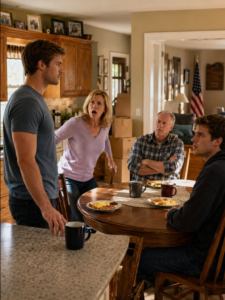
3 days later, a Saturday morning, just as I was pouring coffee, she sat me down at the kitchen table with this serene, almost rehearsed expression on her face. Dad was next to her, arms crossed, like some silent moral support statue.
She said, “Matt, your brother needs a better start. It’s been hard for him lately, and we’ve all noticed how you seem stressed. Maybe it’s time for a change.”
I blinked. “What kind of change?”
My mom sighed. “We were thinking it might be better if you took a little break. Moved out for a while. Let Brian settle in here. You’ve got a good job. You can find a nice apartment, something close by. It would only be temporary, of course, just until Brian’s back on his feet.”
The audacity hit me like a slap. My fingers tightened around the coffee mug.
I looked at my dad, searching for some kind of push back, some hint of this being a mistake. But he just looked at me and said, “It’s only fair. He’s younger. He needs a foundation.”
I didn’t answer right away. I just stared at them both. Not angry yet, just numb. Like my brain couldn’t fully process what I was hearing.
They were kicking me out of my own home. And not because I had done anything wrong. Not because I failed to pay the mortgage or brought chaos into the house.
No, they were asking me to leave so that Brian, who paid for nothing, contributed nothing, and disrespected everything, could have a better start.
I took a breath, set the mug down, and in the calmst voice I could muster, I said, “You want me to leave my house?”
My mom nodded. “Just for a little while. For Brian. You’re strong, Matt. You’ll land on your feet.”
That moment changed something in me. Something deep. A quiet rage settled in. Not loud, not explosive, just resolved.
I stood up, nodded, and said, “Okay, then I guess we all need a fresh start.”
And I meant it. I gave them two days.
But that’s not where the story ends. That’s just where it begins. Because what they didn’t realize was how long I’d been holding back.
Let me tell you what happened next.
I didn’t slam the door. I didn’t yell. I didn’t throw a single insult their way.
That’s what caught them off guard. I think a part of them expected me to explode, maybe even storm out, and leave everything behind.
But I just walked upstairs, closed the door to my room, the room I downgraded to in my own house, and sat there in silence, staring at the walls I painted, the floor I installed, the closet I built extra shelves in so I could maximize space.
Every inch of this house had my effort etched into it, and they wanted to evict me like I was a squatter.
That night, I didn’t sleep. My brain wouldn’t shut off.
It ran through every little thing I’d ignored over the past 3 years. How I stopped hosting friends because it made dad uncomfortable. How I couldn’t work in my own home office anymore because mom turned it into her craft room.
How Brian ate the leftovers I labeled “Matt’s lunch, do not touch,” like it was some sort of dare.
And now after all that, they decided I was the one who needed to go.
I waited until the next morning.
Breakfast was on the table. Scrambled eggs, toast, and the smell of coffee filled the air. Mom acted like everything was normal, like she hadn’t asked me to hand over my life the day before.
Brian sat there, half asleep, scrolling through his phone while shoveling food into his mouth like it owed him something.
I poured myself a cup of coffee, leaned against the counter, and said, “You’ve got 2 days.”
They all looked up.
“What?” Dad said, blinking.
“You wanted a fresh start,” I replied calmly. “So, I’m giving you one. You have 48 hours to pack your things and find somewhere else to live.”
Brian scoffed. “Wait, are you being serious right now?”
Mom stood up, voice already shaking with disappointment. “Matt, this isn’t what we meant. You’re being irrational. We weren’t kicking you out. We were asking you to help your brother.”
I shrugged. “And I’m choosing to help myself.”
I left the kitchen before the argument could erupt. I wasn’t in the mood for manipulation or fake tears.
I went to work, closed the door, and turned off my phone. I didn’t want to hear excuses. I didn’t want to second guessess myself.
I just needed peace. And for once, I wasn’t going to apologize for it.
The next 48 hours were awkward, to say the least.
Mom tried the guilt angle first, leaving photo albums open on the table, making accidental comments like, “I just don’t know where we’ll go, but I suppose we’ll figure it out somehow.”
Dad didn’t speak much, but his silence was heavy, like I was betraying some unspoken code.
Brian barely even tried. He sulkked around, huffed loudly, made stupid little jabs like, “Guess some people forget who raised them.”
I remembered.
I remembered everything, but I also remembered who paid for the plumbing repairs, who mowed the lawn every week, who stayed up filing taxes while they watched Netflix in the living room.
I remembered that when mom broke the dryer door by stuffing it too full, it was me who fixed it with a $38 replacement latch and 3 hours of online tutorials.
I remembered me.
When the 48 hours were up, I walked downstairs and found mom still unpacked. Dad sitting with his arms crossed and Brian lounging like it was any other day.
“I wasn’t kidding,” I said. “I need you all out today.”
Dad stood up. “You’d throw your own family onto the street?”
“I gave you 3 years of free living,” I replied. “I didn’t charge rent. I didn’t ask for help with bills. I didn’t even ask you to respect my space, but asking me to leave my own house. That was the line. You crossed it. Now it’s your turn to figure things out.”
That afternoon, they left begrudgingly, not without muttering dramatic farewells and bitter glances.
I could tell mom thought I’d cave at the last minute. She kept pausing, staring at me, waiting for some emotional breakdown.
It never came.
I held the door open, watched them leave, and then I locked it.
I thought that would be the end of it. That maybe a few weeks of space would cool everything off. That they’d come to understand why I made the choice I did.
But I should have known better.
A week later, I got a call from my aunt.
“Matt, honey, I just wanted to let you know your parents are staying with me for a bit. They said, well, they said you kicked them out to sell the house and move out of state.”
I blinked. “What? I know that’s not even close to true.”
She sighed. “I didn’t think so, but your mom’s been telling everyone you’ve changed, that you’re cold now, ungrateful that she and your dad sacrificed so much, and now you’ve abandoned them.”
It was like a punch to the gut.
I hadn’t even had time to breathe after finally getting the house to myself. And already the smear campaign had started.
I thanked my aunt for the call, then sat on the couch, the couch Brian used to hog, and just stared at the wall.
They were painting me as the villain.
But I still held out hope. Maybe it was all heat of the moment. Maybe they just needed time.
I was wrong.
The real betrayal came two weeks later.
I was scrolling through my emails trying to get ahead on some contract work when I saw one from my mortgage provider.
Subject line: mortgage transfer request.
I frowned and opened it.
Apparently, someone had attempted to transfer the mortgage deed to another name. Bryant’s.
At first, I thought it was some kind of scam, but the document was real. It listed my property, my loan number, my address, and the signature, my father’s.
He tried to sign over my mortgage without my permission.
I froze for a full minute. I couldn’t breathe. My hands trembled as I reread the email.
How is that even possible?
They didn’t own the house. They weren’t on the title.
But there it was, an official request with a forged signature attempting to switch ownership of my home.
I called the mortgage company immediately, explained that this was fraudulent, that no such transfer was authorized, and they assured me no changes had been made.
But the fact that they tried, that broke something in me.
I called my dad. Straight to voicemail.
Then I tried Mom.
She picked up.
“Matt,” she said, her voice all sweet like nothing had happened. “Are you okay?”
“Did you really try to give Brian the house?” I asked, my voice low.
Silence.
“Matt, I think you’re misunderstanding.”
“Don’t,” I said, cutting her off. “Don’t lie. I saw the paperwork. I saw Dad’s signature.”
Her voice faltered. “We just… We thought maybe it would be easier for you if Brian took over. You’re always traveling for work and you said you wanted a fresh start, so we assumed.”
“You assumed what?” I snapped. “That you could steal my house?”
“We weren’t stealing, Matt,” she said, defeensive now. “You weren’t using it properly. It was chaotic. You were angry all the time. Brian needs structure, a home base. You’re grown. You’re successful. You’ll land on your feet.”
Those words again.
You’ll land on your feet.
Like I was some cat being tossed out a window.
I hung up.
I didn’t say goodbye. I didn’t scream.
I just ended the call and sat there staring at my laptop screen while a strange numbness crept over me.
This wasn’t just about disrespect anymore. It wasn’t just about favoritism or bad boundaries.
They had tried to take my house.
They saw what I built. Every brick, every light fixture, every damn cabinet handle I installed myself and decided it should go to Brian because he was starting out.
Because he needed it more. Because I was strong and he was weak.
And somehow that meant I owed him everything.
That night, I didn’t sleep again. But I wasn’t tossing and turning like last time.
No, this time was different.
I was planning.
Something inside me had shifted.
Not rage, not revenge yet, but clarity.
Cold focus clarity.
Because if they thought they could take my house, then they hadn’t even begun to understand what I was capable of when I stopped holding back.
And believe me, I had stopped holding back.
I didn’t leave the house much in the days after the forged mortgage request. I couldn’t.
Every time I stepped outside, I worried I’d see their faces.
My parents, Brian, maybe at the gas station, maybe down at the diner mom used to go to every Thursday. Maybe on the street standing in front of my house like they still belong there.
That was the worst part.
How wrong it all felt. How inverted.
They were the ones who’d used me, lied to me, tried to steal from me. And yet I was the one hiding inside like a fugitive.
Blinds drawn, coffee going cold in my hand.
I kept telling myself I was just processing, just taking time to breathe.
But the truth, I was shattered.
Not on the outside. I still looked like me, still shaved, still worked, still made polite small talk with clients during Zoom meetings like nothing had changed.
But inside, inside, I was floating in this hollow space where all the certainty I’d once had about my family, about loyalty, about what it meant to be a good son was just gone.
And that was the real loss, I think.
Not the attempted mortgage fraud, not the betrayal.
It was the death of the story I’d told myself for 28 years.
The one where I believed family came first. That if I gave enough, loved hard enough, they’d always be in my corner. That being the responsible one meant something, that it mattered.
Turns out, it just made me the easiest target.
It didn’t take long for the rumors to start spreading.
Small town, big mouths.
My mom had always been the kind of woman who made casual comments at church that just happened to frame her as the long-suffering saint.
My dad, quiet as ever, backed her up by saying nothing, which somehow gave her more credibility.
Before I knew it, neighbors I’d known since childhood were looking at me like I’d gone cold, like I was the ungrateful one.
I’d get these half frowns at the grocery store, polite nods with no eye contact.
Even my barber, a guy I’d tipped well for 5 years, asked, “So, you really kicked your folks out over a disagreement?”
I wanted to scream or disappear or both, but I didn’t.
Instead, I shrank quietly.
I stopped going to the gym, started ordering groceries online. I worked weird hours avoiding sunlight.
At night, I’d find myself just sitting, staring at the walls, remembering, replaying conversations in my head where I stood up for myself better, clearer, earlier.
Ones where I didn’t let things slide, ones where I didn’t confuse being agreeable with being respected.
But those conversations never happened. Not in real life.
And no matter how much I rewound them in my head, they wouldn’t fix what had already broken.
It got to the point where I stopped answering calls altogether.
Even from friends, even from Dan, who I’d known since high school.
He showed up at my door one Saturday afternoon with a six-pack. And that look guys give each other when they know you’re not okay, but don’t want to say it directly.
“Still breathing in there?” He asked, raising an eyebrow.
I forced a smile. “Barely.”
He didn’t push. Just dropped onto the couch and cracked open a beer.
We didn’t talk about what happened. Not at first.
We just sat, watched a basketball game neither of us cared about, laughed at a dumb ad.
Then during a quiet stretch of the second quarter, he said, “You know, you didn’t deserve any of that, right?”
I didn’t respond right away. I just stared at the screen.
“I’m serious,” he added. “You’re one of the most solid people I know, and they treated you like a free ride. That’s not your fault, man. That’s on them.”
Something about the way he said it, the finality of it stuck.
It was the first time in weeks that I felt like someone saw what I’d been going through.
No spin, no manipulation, just the truth.
Dan didn’t stay long, just enough to check in.
But after he left, I did something I hadn’t done in months.
I stood up.
I walked into the guest room, my room now, and grabbed a cardboard box that had been sitting in the corner collecting dust.
Inside were the business cards, the notebooks, the sketches, and outlines for an idea I’d shelved years ago, my own consulting firm.
It had always been a someday plan.
I was too busy, too settled, too comfortable.
But comfort had turned to rot.
And now I had nothing left to lose.
The next few weeks weren’t glamorous.
I worked like a man possessed.
16-hour days building a website, registering an LLC, filing paperwork, creating branding, pitching myself to clients.
I reached out to every contact I had in IT consulting, even small business owners I’d helped in the past.
Most ignored me.
A few didn’t.
That was enough.
Slowly, quietly, I started rebuilding.
One contract at a time, one small project, then another, then a retainer.
I brought in more than I had during my last full quarter of corporate work.
It wasn’t flashy. I wasn’t posting about it online.
I didn’t need to because every step I took forward made the bitterness fade just a little bit more.
I reclaimed my office, painted over the pastel green mom had chosen and replaced it with deep navy blue, sharp, clean, mine.
I sold the old couch Brian had destroyed with energy drinks and grease stains and bought a sleek leather one, black, minimalist, untouchable.
I even turned the master bedroom into something out of a luxury Airbnb listing.
New bed, new lights, blackout curtains, the works.
Not for anyone else, for me.
Because for the first time in years, I wasn’t building a life for anyone else to crash into.
I was building it for me.
And bit by bit, the silence that used to haunt me became peace.
Of course, they tried to claw back in.
It started with a text from my mom.
“Hope you’re doing okay. Your dad says, ‘Hi, we’re staying with Brian’s girlfriend’s family now. It’s not ideal. Maybe we could meet for coffee sometime.’”
I didn’t reply.
Then came the email.
“Matt, your father’s birthday is coming up. We’d love to have dinner. Just the three of us. No drama. Please consider it.”
Still, I said nothing because I knew what they wanted.
It wasn’t forgiveness.
It was access.
They weren’t sorry. Not really.
They were uncomfortable, displaced, living in someone else’s guest room, likely overstaying their welcome again.
And in their minds, I was still the safe option, the responsible one, the backup plan.
But I wasn’t a backup anymore.
I was done being plan B.
The final straw came in the form of a voicemail from Brian, of all people.
“Hey, bro. So, listen. I know things got out of hand. Water under the bridge, right? Anyway, I’m looking at apartments and it’s rough out here. If you’ve got any space, just temporarily, I’d appreciate it. Could throw you some cash when I land a job. Just like old times.”
Just like old times.
That line echoed in my head for the rest of the day.
It was stunning really how someone could casually gloss over the wreckage they caused.
How they could frame their own sabotage as a rough patch.
How easily they assumed that the door would always be open.
But this time, I didn’t just ignore the message.
I saved it because it was proof.
Proof that no matter how much I gave, how much I forgave, they’d never change.
They didn’t see what they did as wrong.
They just saw it as inconvenient.
And that was the day I decided I wouldn’t just move on.
I would move forward on my terms.
Quietly, methodically, I began preparing something more than a personal rebound.
I started documenting everything.
The fraudulent mortgage attempt, the forged signature, the texts and voicemails.
I contacted a lawyer, not just for advice, but for protection.
If they ever tried to pull anything again, I’d be ready.
I also started putting feelers out for new property.
Not to move out.
No, I was keeping this house.
This house was mine.
But I was thinking bigger.
Commercial property, office space, a headquarters for my consulting firm, somewhere downtown, somewhere visible.
I’d been living small for too long, hiding behind modesty and family obligation like they were virtues instead of cages.
But not anymore.
The fall had come.
Now it was time to rise.
And soon enough, they’d see it.
Not in a loud, vengeful way.
Not yet.
But in the quiet horror of realizing the man they dismissed, used, and tried to erase was doing better without them than they’d ever imagined.
And deep down, I think they knew because when the messages stopped coming, I didn’t feel abandoned.
I felt free.
They say revenge is a dish best served cold.
But I wasn’t interested in theatrics.
I didn’t need some elaborate takedown or moview worthy finale.
What I wanted was precision, quiet consequences.
The kind that settled into people’s bones slowly day by day until they realized the weight they carried was one they’d strapped on themselves.
That’s the difference between anger and clarity.
Anger wants fire.
Clarity wants results.
And for the first time in my life, I was thinking clearly.
I didn’t tell anyone I was planning anything.
Not Dan, not my co-workers, not even my lawyer at first.
I just kept building.
Publicly, it looked like I was thriving, and I was, but privately, I was also sharpening.
The first step was reclaiming the narrative.
My parents had always been storytellers, subtle, passive aggressive ones.
They knew how to shape perception, how to twist facts just enough to make themselves seem noble while painting everyone else as volatile or selfish.
I used to let them.
I figured it was harmless, that people would see through it eventually.
But now, now their version of events was being passed around like gospel in town.
I knew they were still talking.
My aunt would send the occasional message, trying to mend the bridge, but really just acting as their mouthpiece.
And I knew they were still bitter.
So, I started planting seeds.
I reached out to a few old mutual acquaintances, people who had heard their version of the story, people who had once been close to my parents, but had since drifted, some due to similar experiences, some just out of time and distance.
I didn’t come at them with fire or bitterness.
I just talked, explained what had really happened, what I’d really done for them, and what they had tried to do to me.
It wasn’t about gossip.
It was about truth.
And once you lay it out fact by fact, receipt by receipt, people start to realize how lopsided things were.
“Oh, I didn’t know you paid the mortgage on your own all those years.”
“I didn’t realize they’d never contributed to utilities.”
“Wait, they tried to forge a mortgage transfer?”
Yeah, that part always landed hard, especially once I pulled up the actual email.
The ripple effect wasn’t immediate, but it started to show.
One mutual friend uninvited my parents from a community potluck.
A local charity they used to volunteer with quietly stopped calling them.
Not because I asked them to, but because truth, when exposed, has a way of infecting lies and hollowing them out from the inside.
But that wasn’t the revenge.
That was just cleanup.
The real plan was still taking shape.
And it started with Brian.
He was always the weak link.
The one who thought confidence and entitlement were the same thing.
The kind of guy who believed people should get handouts because the world was unfair.
As if the universe owed him something just for showing up.
Brian had never held down a job for longer than 6 months.
Always blamed management or rigged systems or lazy co-workers.
The truth was he just didn’t like being told what to do.
He thought he was too smart for the system, too clever to need structure, which is why he’d started calling himself an entrepreneur online.
The reality, he was selling knockoff sneakers from Facebook Marketplace and trying to launch a crypto YouTube channel that had six subscribers, one of them being my mom.
But still, he bragged constantly.
I’d muted him on every platform, but I still had a burner account where I kept tabs.
Not because I cared, but because I wanted to know how reckless he was willing to be.
And then he gave me the perfect opening.
He posted a video public on his channel talking about his newfound experience in property investment.
He sat in the front seat of a borrowed car wearing knockoff Ray-B bands and told his subscribers about how he had once almost inherited a property but gave it up for family reasons.
Then he smirked into the camera and said, “But the next one, that one’s going to be mine.”
I watched it three times.
I wasn’t angry.
I was amused because in that moment I realized something important.
Brian wanted the appearance of success more than actual success.
He needed to look like a winner and that made him vulnerable.
So I called my lawyer.
Her name was Lydia.
She wasn’t flashy, but she was smart.
The kind of person who saw five moves ahead.
I laid everything out for her.
What they did, the attempted fraud, the voicemail, the messages, Brian’s latest investor persona.
I told her I wasn’t looking to sue for now, but I wanted options, protections, leverage.
She reviewed everything.
After a few days, she came back with a simple but effective strategy.
We document the mortgage fraud attempt officially, follow a notorized letter with the county stating there had been an unauthorized request made on my behalf.
We weren’t accusing anyone publicly yet, but we were putting a legal wall around my property.
If anyone tried something again, they’d be flagged and it would be on record.
That was the start of the chessboard.
Next came phase two, reputation.
I created a website for my consulting business, professional, sleek, modern.
But I added a personal blog section, a side project I hadn’t told anyone about.
And on that blog, I began writing articles, not rants, not hit pieces, stories, essays about boundaries, about toxic family dynamics, about what it’s like to be the responsible one in a dysfunctional system.
I never named names.
I never even mentioned my town.
But the stories were real and they hit home for a lot of people.
The blog started gaining traction.
People shared it, commented, reached out privately to thank me.
It even got picked up by a midsized self-improvement site that syndicated three of my posts.
Suddenly, I wasn’t just Matt, the guy with a messed up family.
I was Matt, the founder, the writer, the guy who got out and built something.
And that made me dangerous because while they were stuck spinning their same tired web of manipulation and excuses, I was building a platform and a network.
One of the people who reached out after reading one of my blog posts was a real estate agent named Jordan.
She had been through a similar situation.
Her brother tried to sue her over a shared inheritance and we ended up grabbing coffee just to talk.
Turned out she knew Brian’s girlfriend’s family.
“Oh, them?” she said, smirking over the rim of her latte. “Yeah, Brian’s already wearing out his welcome. Thinks he’s some kind of genius investor. Keeps asking her dad for a loan to start a flipping business.”
I nearly laughed into my cup.
I didn’t say much, just listened.
But the more she told me, the more pieces fell into place.
Brian had told everyone he chose to walk away from the house.
My parents were still painting me as a cold, emotionally stunted son who lost his way in business and had become paranoid about money.
And yet, none of them had moved forward.
Not a single inch.
They were stagnant, floating, hoping for a miracle or for me to cave.
So, I started crafting one more plan.
The kind of plan that doesn’t make noise, but leaves an echo.
I found a small commercial building for sale.
Not flashy, just a two-story brick space on the edge of downtown.
Previously used by a law firm that had since relocated.
It had an office, a conference room, and most importantly, an upstairs apartment.
Perfect.
I bought it in cash.
Didn’t even flinch.
Then I announced my firm’s expansion.
Quietly at first.
Just an email to my growing client list, a soft launch post on LinkedIn, a few photos of the new office being renovated.
It spread faster than I expected.
Old friends reached out.
Old enemies noticed.
And then came the whispers.
“Did you hear Matt opened his own building?”
“I thought he was struggling.”
“Isn’t he the one whose parents had to leave his house?”
“Wait, he’s running a firm now?”
I didn’t answer any of it because the setup was almost complete.
But the final stroke that came when Brian messaged me again.
No apology, no accountability, just a simple line.
“Hey bro, heard you opened a new office. Pretty cool. Got room upstairs. I could help out with some side stuff. Could be fun working together.”
That was when I knew they hadn’t changed at all.
They still believed I was a fall back.
They still believed I had room.
They still believed I’d forget.
And that was going to be their biggest mistake because now, now I wasn’t just rebuilding.
I was preparing, not for reconciliation, not for forgiveness, but for the moment they’d finally see with perfect clarity what it looks like when the person you underestimated decides they’re done being your foundation and starts building something without you.
And I promise you that moment was coming.
Revenge, when done right, doesn’t need an audience.
It doesn’t need to be loud, messy, or vindictive.
It just needs to work.
And when it lands, it shouldn’t look like revenge at all.
It should look like consequence.
That was the mindset I carried into the final act.
By the time I opened the doors to my new office, the transformation was complete.
The building had been gutted and remodeled.
Sleek floors, clean walls, sharp lighting.
My firm, Matteo Consulting, had picked up three major retainer clients and a handful of small business contracts in the span of 6 months.
I had a small team working with me now, a project manager, a webdev, and a part-time assistant.
Upstairs, I lived like a king in a minimalist loft I designed myself.
Simple, efficient, quiet.
It was the kind of piece I hadn’t known in years.
I didn’t make a big show of anything.
No ribbon cutting, no launch party, just progress, just momentum.
And they noticed.
I heard from my aunt that my mother had started asking around about me again.
Not directly.
She’d never risk looking too curious, but through little concerned questions at church and community events.
“Is Matt doing okay? We haven’t heard from him in so long. Poor thing. He’s just so isolated now.”
But she knew.
They knew.
The whispers were getting louder.
People in town weren’t buying their story anymore, especially after the feature.
A local business magazine had been doing a spotlight on new entrepreneurs revitalizing the downtown area.
And Jordan, remember the real estate agent I met? Put my name forward.
I hadn’t asked her to.
She just thought I had a good story.
The writer came by, took some photos, interviewed me about my career path, the firm, the renovation, even my philosophy on leadership and boundaries.
It went live on a Wednesday.
By Thursday morning, it was the top story on their homepage.
The title, Reclaiming More Than a Building: How One Consultant Turned Betrayal into a Business.
It didn’t name my parents.
It didn’t have to.
The opening paragraph made it clear.
After a devastating breach of trust within his own family, 29-year-old Matt Greer took the pieces of what was nearly stolen and built something stronger, not just for himself, but for others seeking to break toxic cycles.
It was elegant, subtle, but powerful.
People noticed.
That same day, I got a text from an unknown number.
Mom.
“Saw the article. Beautiful photos. We’re happy for you.”
No apology, no admission, just another shallow attempt to keep a toe in the door.
I ignored it.
But the real revenge that came in two parts.
Part one, Brian’s big opportunity.
About a month after the article dropped, Brian posted on social media that he was finally launching his first investment, a flip, a singlestory house on the edge of town.
He framed it like it was some massive real estate deal, like he was entering the big leagues.
But I knew the truth.
Jordan had told me he’d barely qualified for a loan, had begged his girlfriend’s dad for a co-sign, and was relying on free labor from friends to get it renovated.
Worse, he had no plan, no timeline.
He thought watching a few Tik Toks about house flipping made him an expert.
So, I made a call, not to sabotage.
I didn’t need to.
I just called the city.
I asked for a copy of the renovation permits Brian had filed.
Turns out, he hadn’t filed any.
No electrician, no plumbing, no structural inspections, nothing.
And the part he really didn’t see coming, that house had a busted water mane under the lawn.
An issue flagged two owners ago, but never fixed because the house sat vacant.
The city had flagged it as pending remediation, meaning any sale or major renovation required a full utility inspection and environmental clearance.
But Brian didn’t check any of that.
He just jumped in.
So, when he posted that he was almost done with the renovations, I sent an anonymous tip to the city planning office, just a screenshot of his post, location tagged, showing clear structural work without permits.
They shut him down 2 days later.
A city inspector arrived on site, documented multiple violations, and posted a bright red SDOP WRK order on the front door.
It derailed the entire project.
His flip was now a money pit and with no inspections, no approvals, and no legal renovations, it couldn’t be sold without major remediation.
Brian went quiet on social media for weeks.
Then one day, Jordan texted me.
“He tried to list the house off market. No takers. Heard he’s trying to offload it back to the bank.”
I didn’t reply.
I just smiled.
Part two.
The house they forgot was mine.
After the Brian fiasco, I decided it was time to deal with the original crime, the attempted mortgage transfer.
Lydia, my lawyer, had been quietly building a file over the past year.
She documented the forged request, the digital signature, the emails, and the messages from my parents and Brian.
It was rock solid.
But I wasn’t suing.
Not yet.
Instead, I called in a favor.
One of my clients ran a local financial literacy nonprofit.
They did workshops for young adults, struggling families, and former offenders trying to reenter the workforce.
I offered to sponsor their next three events, and redesign their website on the condition that I get to host one of the events in my office space.
They agreed, so we planned it, marketed it.
Rebuilding after financial betrayal, a free event for anyone who’d experienced manipulation, theft, or toxic money dynamics in families.
I expected 20 people.
We got 60.
The place was packed.
I opened the event with a short talk, just 15 minutes.
But I told my story, not with names, but with details.
How I bought my first house young, how I let family move in.
How it started with love and ended with them trying to sign the deed over without my knowledge.
How I rebuilt, how I learned, and how I came out stronger.
There were tears in the crowd.
Afterward, people came up to shake my hand, share their own stories, ask for help, book consultations.
That was the final blow because my parents showed up, not to the event.
They wouldn’t dare.
But later that week, my mother messaged me.
“I heard about your little workshop. Was that really necessary?”
And that was when I knew they were watching.
They were losing control.
The narrative was no longer theirs.
They couldn’t spin it.
Couldn’t twist it.
The town wasn’t buying it.
Their golden child had outgrown them and they had nothing left to take.
I replied with just one sentence.
“I told the truth. That’s something you never taught me how to do.”
The fallout.
In the months that followed, my parents faded from public life.
They stopped attending community events.
Word got around that Brian had defaulted on his house and was living back with them again, only this time in a cramped duplex rental outside of town.
Their silence was deafening.
No more messages, no more voicemails.
They were ghosts now.
But I wasn’t haunted.
I was free.
My firm grew.
I brought on more clients, hired two interns, expanded into the space next door.
Jordan and I, well, we started seeing each other more often.
She was sharp, grounded, and funny in that dry I’ve seen some stuff kind of way.
She never asked me to shrink.
She knew I’d already spent too long doing that.
One night we sat on the rooftop of my building watching the street lights below and she asked, “Do you ever miss them?”
I thought about it, really thought.
And I said, “No, I miss who I thought they were.”
She nodded.
“That’s fair.”
And we sat there in silence, not because there was nothing left to say, but because I didn’t need to say anything else.
That chapter was closed.
If you came here from Facebook because of this story, go back to the Facebook post, tap Like, and comment exactly “Worth reading” to support the storyteller. That small action means a lot, and it gives the writer real encouragement to keep creating and sharing more stories like this for readers who want to keep following them.