Long before sunrise, it moved like a living thing, brown and swollen from the torrential rains that had fallen far upstream during the night. By 7:18 a.m., the river was already higher than Isabel Perez had predicted.
She had spent eight years photographing wildlife in the Maasai Mara reserve, and she had learned to read the water like others read weather reports. Color mattered. Sound mattered. The small wisps of foam swirling near submerged roots mattered most of all. They told her the current wasn’t just fast. It was confused. Confused water kills animals quickly because it pulls in several directions at once.
Isabel was 34, cautious by nature, and respected by the local conservation teams because she didn’t act like a tourist with a camera. She recorded coordinates. She noted the times. She submitted photographs when injured animals needed to be identified. She knew which crossings were dangerous and which herds tolerated vehicles getting too close. Above all, she knew the rule that governed every serious wildlife photographer working with predators: observe, record, do not interfere.
That morning, her equipment was laid out on a strip of red earth above the riverbank. A telephoto lens lay next to a folded gray cloth. Her field notebook was tucked into the open bag. Her waterproof action camera, mounted high on her shoulder strap, flashed red because she planned to film the river after the nighttime high water. It was to be background footage.
Mud slid in patches beneath her boots as she adjusted the tripod legs. A scent of wet grass and animal musk wafted through the acacia trees. Further downstream, a flock of birds suddenly rose from the reeds. Then Isabel heard the little one.
At first, she didn’t understand what the sound was. It was too faint to be a roar and too desperate to be an ordinary call. She turned just as the bank collapsed beneath a small body at the water’s edge. The lion cub couldn’t have been more than four months old. One moment it stood on soft, sodden ground near the river, and the next, the ground gave way beneath its paws. It slid abruptly into the brown water. The current swept it away instantly.
An impossible decision
For a suspended second, Isabel did nothing. It wasn’t cruelty. It was her training. Eight years of training separated her from the river, teaching her that nature wasn’t a stage set for human rescue. Animals die. Floods sweep away the weak. Predators lose their young. The photographer’s duty was to bear witness without rewriting the outcome.
Then the lion cub’s head disappeared beneath the water. When it resurfaced, it was coughing, clawing at the air, swept toward the deeper bend. The cry that escaped it no longer sounded like the noise of a wild animal. It sounded like panic.
Isabel released the tripod’s shutter release so quickly it slammed against the metal leg. Her camera bag remained open behind her. Her lens rolled against a clump of wet grass. She didn’t take off her boots. She didn’t calculate the angle. She walked into the river.
The cold hit her chest and stole her first breath. Then the current struck her. It pushed her violently sideways, so hard that she almost immediately lost her footing. The river was full of things she couldn’t see: branches, stones, roots torn up by the rain. Something hard struck her shin, and the pain shot up her leg. She pushed through.
The lion cub was only a few meters away, but the river made those few meters impossible. Every time Isabel lunged forward, the current pulled the animal further from her hand. The water filled her mouth with the taste of silt, leaves, and rot. Her action camera continued recording from the strap near her shoulder. The footage would later show little besides the brown water, flashes of sky, and the blurry shape of Isabel’s arm slicing through the current. It would also show the moment a submerged log struck her left shoulder.
The impact nearly ended the rescue. A white light exploded behind her eyes. Her arm went half-numb. For two seconds, her body forgot what it was trying to do. She heard the river. She heard her own stifled breath. She heard the lion cub crying somewhere ahead. That sound brought her back.
She kicked vigorously with both legs and thrust her right arm forward. Her fingers met wet fur. The lion cub writhed in terror, and for a dreadful moment, Isabel thought it was going to bite her. Instead, it gripped her shoulder and neck with surprising strength. Its claws pierced her shirt and dug into her skin. Its body trembled violently against her chest. It spat river water down the back of her throat.
Isabel wrapped her good arm around him and turned toward the shore. It was then that she realized the hardest part was only just beginning. Getting out had been instinctive. Getting back required survival.
The current had carried them further downstream than she had anticipated. The bank ahead was steeper there, slippery with mud and broken grass. A deeper pool awaited them beyond the bend, one she knew from previous seasons because crocodiles often lay motionless in the brown stillness after heavy rains. She didn’t look back. She knew that looking would waste her strength.
The cub’s heart pounded against her ribs. It wasn’t struggling anymore. This frightened Isabel more than the claws had. An exhausted wild animal falls silent when its body begins to give out. She tightened her grip and kicked again. Her injured shoulder burned as if a white-hot wire were piercing the joint. Her jaw clenched. Her boots found the bottom for half a second, then lost it again. She pulled the cub higher against her collarbone and forced herself into the shallows.
Later, when investigators asked her why she hadn’t given up after the log struck her, Isabel gave the only answer that seemed honest to her. « I couldn’t just stand there and watch him drown, » she said. It sounded simple when said in a dry room. It hadn’t been simple in the river.
The confrontation with the troop
When Isabel reached water shallow enough to stand in, her legs were shaking so violently she almost fell. She staggered, standing with the water up to her chest, coughing until her throat burned. Mud smeared one side of her face. Blood from a small cut near her hair mingled with the rainwater and river gravel. Her left shoulder had begun to swell beneath the soaked fabric of her field jacket. The lion cub collapsed against her, alive but exhausted.
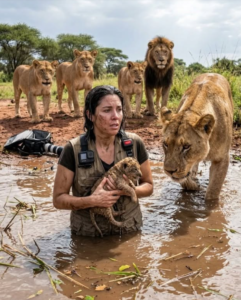
Then Isabel looked up. The riverbank was full of lions. At first, her mind refused to count them. It registered the color, the eyes, the bodies, the teeth. Then the shapes organized themselves into meaning. Five adult lionesses stood along the water’s edge in a loose semicircle. Behind them stood a huge male lion with a dark mane heavy with the humid air. They weren’t running. They weren’t roaring. They were still. This stillness was more terrifying than movement.
Isabel knew enough about lions to understand what she was seeing. The pride had followed the sound of the cub’s cries of distress. They had tracked the whimpers to the river. They arrived just in time to see a human emerge from the water holding one of their cubs. There was no angle from which it seemed safe.
Her equipment was behind the lions. The upper bank was behind the lions. Her vehicle was farther away, beyond the acacia trees. The river pressed against her from behind. Six adult lions blocked the only way out.
Isabel didn’t move. The troop didn’t move. Only the river continued to flow. Foam slid around her waist. Water dripped from the cub’s paws. Somewhere beyond the semicircle, a bird called once and fell silent. The action camera on Isabel’s shoulder strap blinked red against the ripped edge of her jacket. That small mechanical light would later become one of the strangest pieces of evidence in the incident file. There would be the timestamp. There would be the audio of the crying cub. There would be the blurry footage of the rescue. And there would be the long, impossible silence after Isabel looked up and saw the troop waiting for her.
The matriarch moved first. Isabel knew it was the matriarch before anyone told her. Some animals carry authority in ways the body understands before the mind can explain. This lioness had a broad chest and a scar above one eye. Her tail was low but not curled. Her ears were forward. Her gaze never left the cub. She stepped into the water. A circle of ripples widened beneath her paw. Then another. Behind her, the other lionesses remained where they were, their bodies inclined toward Isabel with controlled tension. The male lion stood farther away, silent and immense, his mane moving slightly in the damp breeze.
Isabel’s fingers tightened in the lion cub’s wet fur. Her first instinct was to back away. Her second was to run. Both would have been fatal. A predator doesn’t need to understand your fear to respond to it. Fear has a posture. Fear has a speed. Fear has those small, sudden movements that turn a confrontation into an attack.
Isabel forced herself to breathe slowly. The matriarch approached. Three feet separated them. Isabel could see the droplets clinging to the lioness’s whiskers. She could see the scar tissue tightening near her left eye. She could see the small muscles shifting beneath the tawny fur. The cub moved against Isabel’s chest and let out a soft meow. The sound changed the entire scene.
The lioness stopped. Her eyes softened in a way Isabel would later struggle to describe without sounding foolish. It wasn’t human gentleness. It wasn’t sentimental gratitude like people like to project onto animals. But it wasn’t aggression either. It was recognition. The cub was alive. The stranger was holding it. The stranger hadn’t run away. The stranger was bleeding, trembling, and still keeping the cub out of the water.
Then the matriarch lowered her head. The movement was slow, deliberate. Not a crouching position. Not a preparation to pounce. A bow. That was the only word Isabel could find later, though the scientists who examined the images preferred more cautious language. They called it a gesture of non-aggressive bowing. They called it a posture of social appraisal. They called it an unprecedented response of tolerance under extreme conditions. Isabel called it what she felt in the river: permission.
She looked down at the cub. Its eyes were half-open, its fur darkened by water and mud. A paw twitched against her jacket. Around that paw, caught in the wet fur, was a narrow strip of blue tracking tape from a monitoring effort in the reserve after the recent floods. It wasn’t a collar, and it wasn’t a tag meant to stay. It was simply enough to show that this cub had already been noted by conservation staff during emergency checks. That detail would matter later. In the moment, it barely registered. All Isabel understood was that she had to hand the cub over. Slowly. Carefully. Without looking like she was throwing it or refusing to let it go.
« Gently, » she murmured. Her voice was hoarse from the river water. « I saved him. That’s all. »
The lioness didn’t understand the words. But the tone seemed to matter. Isabel bent her knees slightly, ignoring the pain in her shoulder, and lowered the cub toward a small ridge of damp mud that jutted out above the water’s surface. Her hand trembled. The cub slipped once, and every lioness in the semicircle seemed to tense at the same time. Isabel froze. No one moved.
The cub made another small noise. The matriarch responded with a low call that vibrated through the water. It wasn’t loud. It was deeper than sound alone. Isabel felt it in her ribs. The cub moved weakly away from her chest. This time, she let it. She laid it on the muddy ridge and withdrew her hands inch by inch.
The matriarch stepped forward immediately, but not toward Isabel. She touched the cub’s flank with her muzzle. The cub shivered, coughed once, and pressed awkwardly against her front paw. Behind the matriarch, one of the younger lionesses made a soft sniffing noise. The male remained motionless, but his head lowered slightly.
Isabel remained in the water, her palms open. Her left arm throbbed. Her knees trembled. She didn’t know if she would be allowed to leave. The matriarch nudged the lion cub once with her muzzle, then looked back at Isabel. For several seconds, the animal and the woman faced each other in the muddy light of the swollen river.
This was the part of the footage that would first circulate in conservation circles. Not because it proved that the lions felt gratitude in the human sense. Serious biologists rejected that conclusion, and so did Isabel. The footage mattered because it showed restraint where instinct might have predicted violence. It showed assessment. It showed a pride responding to a human not as prey, not as a rival, but as a temporary part of an emergency that all had survived.
The matriarch turned away first. She gently grasped the cub by the loose skin at the back of its neck and lifted it from the mud. The cub collapsed in the usual way of young animals being carried. The lioness emerged from the shallow water and walked toward the grass. One by one, the other lionesses moved aside. They didn’t rush at Isabel. They didn’t challenge her path. They parted the semicircle just enough.
Her shoulder pain arrived in full force once the danger had passed. It came in such sharp waves that she had to press her forehead against the damp ground and breathe through her teeth. The pride stayed close for another minute. The matriarch set the cub down in the grass and began licking the river water from its head and neck. The cub’s small body wobbled, but it remained upright. Another lioness joined it. The male glanced once at Isabel, then turned and followed the others into the shadows of the acacia trees. The last thing Isabel saw was the cub stumbling between two tawny bodies, alive because a rule had been broken at that precise moment.
It was only when the pride had disappeared that Isabel reached for her radio. Her first call wasn’t dramatic. It was practical. She gave her location. She reported an injured lion cub she’d pulled from the floodwaters. She reported her own shoulder injury. She asked for a reserve team to check the bend in the river because the bank had collapsed and other animals might be in danger. The ranger who answered thought he’d misheard. « You went into the river? » he asked.
Isabel looked at the muddy paw prints where the pride had stood. “Yes,” she said. There was a pause. Then he asked, “Are the lions still here?” Isabel almost laughed, but her throat hurt too much. “No,” she said. “They let me go.” That sentence would become the one everyone repeated, though Isabel never liked how clear it sounded. Nothing about that moment had been clear. It had been wet, painful, terrifying, and uncertain from one breath to the next.
Mid-morning, two members of the reserve team reached her position with a field doctor. They found the camera bag open, the jacket torn, drag marks in the mud, and paw prints along the water’s edge. They also found Isabel sitting against an acacia trunk, her left arm propped against her body, still gazing at the grass where the troop had disappeared.
The doctor suspected a severe shoulder contusion and a possible concussion from the impact of the log. A later examination confirmed deep bruising but no fracture. The action camera footage was recovered that afternoon. The file was waterlogged, chaotic, and incomplete in places, but the timestamp matched Isabel’s field notes. The audio captured the cub’s cries. It captured Isabel coughing in the current. It captured the long silence after she reached shallow water. Most importantly, it captured the matriarch entering the water and lowering her head.
This clip sparked debate. Some viewers saw it as an expression of gratitude. Some scientists urged caution. Lion behavior is complex, and humans are notoriously prone to interpreting animal gestures as reflections of themselves. A gesture of affection may not mean the same thing to a lion as it does to a person. Recognition may not equate to gratitude. Mercy may be too human a word for a predator making a decision in a crisis.
But even the most cautious observers agreed on one point. The pride had every reason to attack Isabel if they perceived her as a threat. They didn’t. Instead, they allowed her to return the lion cub. Then they let her go. For Isabel, that was enough.
She didn’t build her career afterward by claiming a mystical connection with lions. She didn’t say the pride loved her. She didn’t say the matriarch understood sacrifice or debt or courage the way humans do. What she did say was more understated. She said the lioness saw the cub alive. She said the lioness saw its hands. She said that, for a few impossible seconds, neither species did what fear told them to do. That was the miracle. Not that a savage predator had become human. But that a human, surrounded by predators, had remained still enough to be understood.
In the weeks that followed, reserve staff reported sightings of the same pride near the eastern grasslands. The cub was seen moving with the group, weaker than the others at first but alive. The blue ribbon was gone, probably torn off during grooming or travel. No one tried to approach it. No one needed to. The images had already shown the important part of the story.
Isabel returned to photography after her shoulder healed, but she changed one habit. She always carried long lenses. She always noted timestamps in her field notebook. She still believed the golden rule existed for a reason. But on the first page of a new notebook, beneath the date of the incident, she wrote a sentence in small capital letters: » The formation looks clean from a dry shore. »
Years later, when asked if she would do it all again, Isabel never gave a quick answer. She understood the danger better than anyone watching the video from the comfort of their armchair. She knew she could have died in the river. She knew the lions could have killed her on the bank. She knew one wrong move could have turned the entire morning into a warning rather than a wonder. But she also remembered the cub’s claws digging into her jacket. She remembered its heart pounding against her chest. She remembered the matriarch bowing her head as the river flowed around them. And she remembered standing there, soaked and trembling, with six adult lions between her and safety, realizing that the wild world wasn’t gentle, but it wasn’t always easy either.
Sometimes nature is brutal. Sometimes it’s indifferent. And once in a lifetime, if someone is lucky enough and terrified enough to notice, they are something stranger than either. A raging river. A drowning lion cub. A woman who broke the rules. And a troop that chose, for reasons no one can fully explain, to let her live.
Key points to remember
- Training and rules have their place, but the instinct for compassion can sometimes override them.
- Wild animals are capable of surprising recognition and restraint.
- Courage is not about not being afraid, but about acting despite fear.
- Nature is complex and cannot be reduced to simple predator-prey patterns.
- Sometimes, the most incredible moments are born from vulnerability and mutual trust.